Jun 25, 2018 | Advocacy, Non-legal submissions
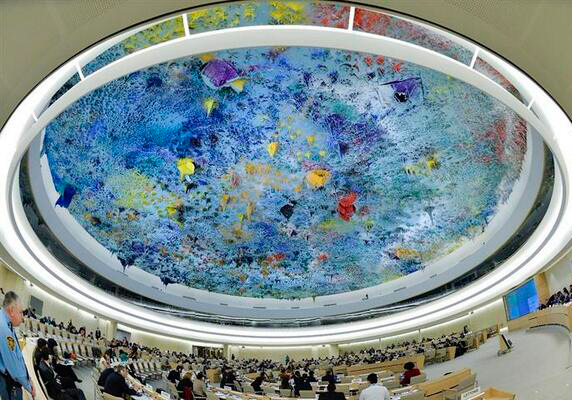
The statement on behalf of four groups was delivered in the context of the General Debate on Item 3 during the 38th Session of the UN Human Rights Council.
The groups called all States to take up the opportunity to strengthen a multilateral approach the issue of business and human rights by joining the intergovernmental process to establish a legally binding instrument in this field.
The statement is as follows:
The current intergovernmental process to establish a legally binding instrument in the field of business and human rights offers States the opportunity to work through international cooperation and multilateral engagement to effectively address the human rights impact of business activities.
We thus urge all States –including those that have been so far reluctant to engage- to actively participate in this process.
Only constructive dialogue among all States and other stakeholders, especially the affected communities, can lead to sustainable solutions to the existing normative and protection gaps.
This 38th session of the Human Rights Council marks the 10th anniversary of its adoption of the Framework Report “Protect, Respect and Remedy”.
As we celebrate the contribution of this Framework, which led to the creation of the Guiding Principles on Business and Human Rights, we must emphasize the need to increase the international community’s response.
In the past ten years, although important work has been done in some areas and by some countries, little systemic positive change has been felt on the ground, where many individuals, especially indigenous and peasant workers and communities, continue to endure the violation of their rights without recourse to real remedy avenues.
The creation of an international legally binding framework for States to maximize action and cooperation regarding rights abuses in the context of business operations remains a compelling necessity of our times.
I thank you.
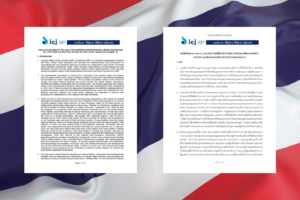
Full statement in English (PDF): Universal-HRC38-BHR-treaty-Advocacy-non-legal-submission-June-2018-ENG
Jun 22, 2018 | Events, News
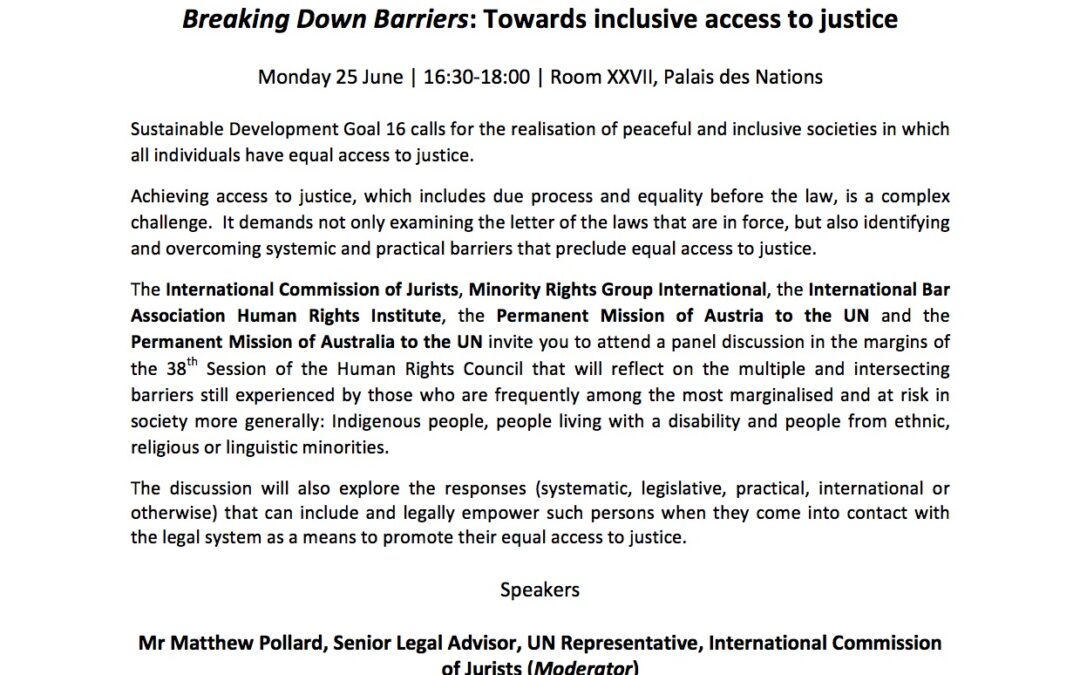
This side event to the UN Human Rights Council session addresses equal and effective access to justice for indigenous people, people living with a disability and people from ethnic, religious or linguistic minorities.
Monday 25 June | 16:30-18:00 | Room XXVII, Palais des Nations
Sustainable Development Goal 16 calls for the realisation of peaceful and inclusive societies in which all individuals have equal access to justice.
Achieving access to justice, which includes due process and equality before the law, is a complex challenge. It demands not only examining the letter of the laws that are in force, but also identifying and overcoming systemic and practical barriers that preclude equal access to justice.
The International Commission of Jurists, Minority Rights Group International, the International Bar Association Human Rights Institute, the Permanent Mission of Austria to the UN and the Permanent Mission of Australia to the UN invite you to attend a panel discussion in the margins of the 38th Session of the Human Rights Council that will reflect on the multiple and intersecting barriers still experienced by those who are frequently among the most marginalised and at risk in society more generally: Indigenous people, people living with a disability and people from ethnic, religious or linguistic minorities.
The discussion will also explore the responses (systematic, legislative, practical, international or otherwise) that can include and legally empower such persons when they come into contact with the legal system as a means to promote their equal access to justice.
Speakers:
Mr Matthew Pollard, Senior Legal Advisor, UN Representative, International Commission of Jurists (Moderator)
Dr June Oscar AO, Australia’s Aboriginal and Torres Strait Islander Social Justice Commissioner, Australian Human Rights Commission
Mr Glenn Payot, UN Representative, Minority Rights Group International
Ms Victoria Lee, Programme Manager, Human Rights and Disability Team, Office of the High Commissioner for Human Rights
For more information contact un(a)icj.org
May 30, 2018 | Advocacy, Non-legal submissions
The ICJ today made a submission for an upcoming report by the UN Secretary General on recent developments concerning human rights in the administration of justice.
In 2016, the UN General Assembly requested the Secretary General “to submit to the General Assembly at its seventy-third session a report on the latest developments, challenges and good practices in human rights in the administration of justice, including on efforts to ensure equal access to justice for all through the independent, impartial and effective administration of justice, and on the activities undertaken by the United Nations system as a whole”.
The UN is in the process of preparing the report, which will cover developments during the last two years since the previous report of the Secretary General.
The ICJ’s submission can be downloaded in PDF format here: UN-GA-AdminJustice-2018
May 28, 2018 | Advocacy, Non-legal submissions
Today, the ICJ and 22 other rights organizations submitted a paper to the 30th meeting of Chairs of the human rights treaty bodies (Chairpersons meeting) in New York (28 May-1 June).
This paper is presented to the 30th meeting of Chairs of the human rights treaty bodies (Chairpersons meeting) by non-governmental organizations that contribute to many aspects of the work of the treaty bodies, including by encouraging and supporting national partners in their use of the system.
It focuses on existing good practices in treaty body working methods and makes recommendations for further discussions.
The signing NGOs hope that this submission will provide a basis for an effort by the treaty body Chairpersons to take stock of some of the important changes to working methods that the treaty bodies have undertaken and lead to further discussion on areas where greater alignment of working methods would make a particularly meaningful contribution to NGOs’ efforts to engage with the treaty bodies and promote better implementation by States of their human rights obligations.
Universal-Amnesty-Submission-to-the-30th-meeting-of-chairs-of-the-human-rights-treaty-bodies-Advocacy-non legal submission-May-2018-ENG (Full text in PDF)
May 3, 2018 | Feature articles, News
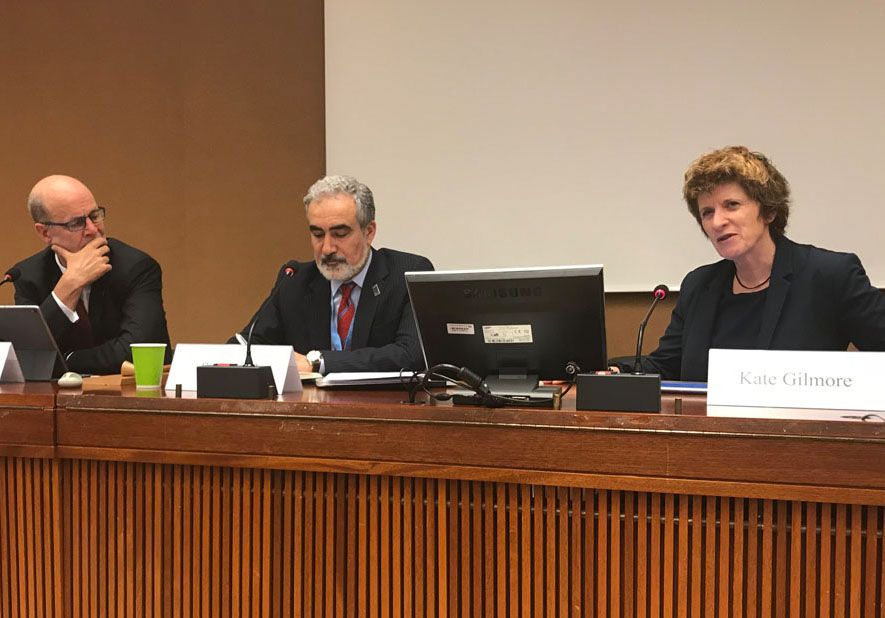
On 3 and 4 May 2018, the ICJ supported by UNAIDS and OHCHR convened an expert meeting on global principles addressing criminalization’s detrimental impact in the areas of sexuality, reproduction, drug use and HIV.
The expert meeting of leading jurists from around the globe aimed at laying the foundations for a set of principles to address the misuse and abuse of the criminal law and its detrimental impact on health, equality and human rights.
The expert group focused on the criminalization of conduct relating to four principal areas: sexuality, reproduction, personal drug use, and the overly broad criminalization of HIV exposure, transmission and non-disclosure.
In these areas, international human rights authorities, as well as domestic courts, have regularly found criminal law provisions to be contrary to international law and standards, and to have a deleterious effect on public health.
“We need to understand why the blunt instrument of the criminal law is used against and affects real people, and why the criminal law ought not to apply in our four areas of concern. Where the criminal law is misused, that is a betrayal of the rule of law. The rule of law must be our guiding compass,” said Justice Cameron, Constitutional Court of South Africa.
“The principles we hope to develop must facilitate the availability of tools which can impact key populations where they are in conflict with the law. They are often at risk of blackmail, stigma and discrimination. It falls on courts to make the difficult decisions. Judges can then consider legality, legitimate purpose and questions of necessity and proportionality in light of a broader understanding of the human rights principles at stake and the relevant scientific evidence,” said Judge Mbaru, Industrial Court of Kenya.
“The law is required to guarantee rights but at same time it can impose arbitrary restrictions. Often those restrictions in the form of the criminal law purport to be necessary in order to ‘protect’ people. That purported purpose ought to be closely scrutinised,” said Justice Ortiz, Constitutional Court of Columbia.
Sam Zarifi, Secretary General of the ICJ, stated: “The misuse of the criminal law affects the most marginalized groups of people and, in particular, the dispossessed and disenfranchised.”
“The centrality of the rule of law at a time when it is under threat globally, and our crucial obligation to stand against laws that are arbitrary, unequal and discriminatory,” he added.
Tim Martineau, Acting Deputy Executive Director of UNAIDS said: “The application of human rights principles to criminal law is key in order to address the detrimental impact of such laws in the areas of sexuality, reproduction, drug use and HIV.”
“While there was significant progress in HIV prevention, treatment and care, there was a big discrepancy in HIV prevention in relation to key populations who are more vulnerable to HIV infection in many respects because of a lack of legal protection, and the unjust criminalization of their behaviour,” he added.
Kate Gilmore, Deputy High Commissioner for Human Rights, stated that the criminal law can readily become a tool of repression or oppression. She said: “Wrongful deployment of criminal law betrays universal human rights standards. By eroding rather than protecting physical and mental integrity specifically in the contexts of sexuality, reproduction and gender identity, misuse of criminal law seeks a wrongful “regulation” of the body of women in particular, with devastating consequences for women’s and girls’ autonomy, health and well being.”
She emphasized that “the criminal law plays an essential role in the recognition, protection and enforcement of rights including by tackling impunity for violations for those rights.”
ICJ, UNAIDS and OHCHR consider that the envisaged principles will help legislators, judges and advocates in the development and review of criminal laws that have adverse consequences on health, equality and human rights particularly where they relate to key populations.