Jul 5, 2018 | Advocacy, Non-legal submissions
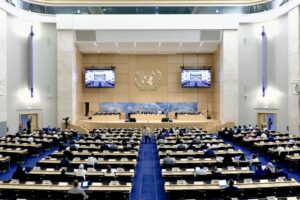
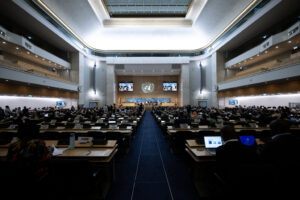
The ICJ and other NGOs today highlighted the need for the next UN High Commissioner for Human Rights to continue to maintain a strong voice and independent voice for human rights.
The statement was delivered by International Service for Human Rights (ISHR), on behalf of a number of NGOs, during a general debate at the UN Human Rights Council in Geneva. It read as follows:
“Thank you Mr. President,
We want to highlight key features for the next High Commissioner – the world’s premier human rights defender – whose mandate includes providing technical assistance and capacity building to States, as well as standing up for universal human rights and those who defend them.
The work of the next High Commissioner, and of human rights defenders more broadly, is essential to justice, fairness and dignity for all. Defenders contribute to sustainable and inclusive development. They combat corruption and the misuse of power. They promote good government, transparency and accountability. They seek to ensure that no-one gets left behind.
Despite this, around the world, defenders face mounting attacks and criminalisation for standing up to power, privilege, prejudice and profit. Their work has never been more important, nor more imperiled.
Mr President, it is in this context we say that the next UN High Commissioner needs to be a dedicated human rights defender. They need to be committed to working with and for human rights defenders; consulting and partnering with them, supporting their causes, and speaking out and protecting them when they are threatened or attacked.
The next High Commissioner needs to build strategic alliances with States, civil society, academics and business enterprises with a shared interest in human rights and the rule of law. They need to be fiercely independent, but also collaborative and capable of building influential partnerships and coalitions.
With the promotion, protection and realisation of human rights being linked to the attainment of peace, security and sustainable development, the next High Commissioner needs to be strongly supported by the UN Secretary-General and key UN agencies. Mr President, while the High Commissioner may be the UN’s premier human rights defender, it is time for the entire organisation to put human rights defenders up front.”
International Service for Human Rights
Cairo Institute for Human Rights Studies
Human Rights House Foundation
The International Lesbian, Gay, Bisexual, Trans and Intersex Association (ILGA)
CIVICUS
Peace Brigades International Switzerland
International Federation for Human Rights Leagues (FIDH)
Conectas Direitos Humanos
Asian Forum for Human Rights and Development (FORUM-ASIA)
West African Human Rights Networks
International Commission of Jurists (ICJ)
Jun 27, 2018 | Events, News
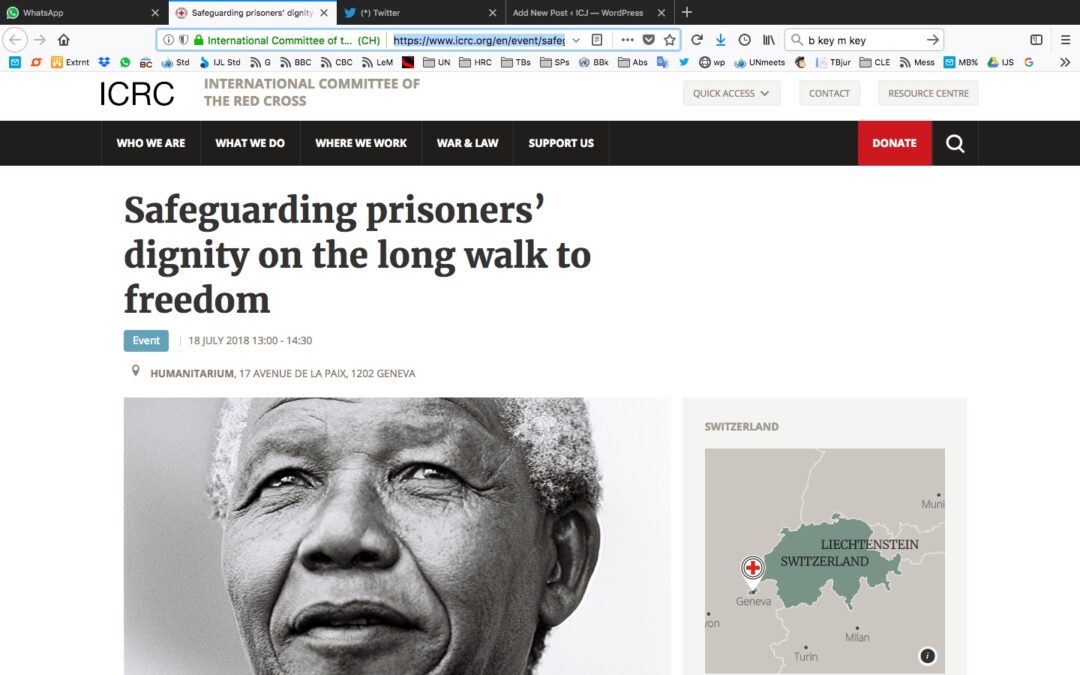
ICJ Senior Legal Adviser Matt Pollard will speak at an ICRC event on 18 July, marking Nelson Mandela International Day.The event, 18 July 2018, 13:00 – 14:30, will take place at the ICRC Humanitarium, 17 avenue de la paix, in Geneva.
On 18 July, the ICRC is marking Nelson Mandela International Day with the launch of a new edition of ‘A Human Rights Approach to Prison Management’ by the Institute for Criminal Policy Research. This Handbook, which has been translated into 19 languages, is used by the ICRC and many others around the world.
During the launch, author Professor Andrew Coyle will reflect on developments in the use of imprisonment worldwide over the last 20 years, focusing on topical issues such as the use of highly restrictive forms of detention for certain categories of prisoner, including solitary confinement. Detention experts from the ICRC and Geneva-based international organizations, the Association for the Prevention of Torture (APT) and the International Commission of Jurists (ICJ) will respond, and there will be space for questions and discussion.
In December 2015 the UN General Assembly adopted revised United Nations Standard Minimum Rules for the Treatment of Prisoners, to be known as the Nelson Mandela Rules in honour of the contribution of South Africa to the Rules’ development and of the legacy of the late President of South Africa, Nelson Rolihlahla Mandela, who spent 27 years in prison. In the accompanying resolution, the General Assembly decided to extend the scope of Nelson Mandela International Day as an opportunity to promote humane conditions of imprisonment, raise awareness about prisoners being a continuous part of society and to value the work of prison staff as a social service of particular importance.
Speakers:
- Andrew Coyle, Emeritus Professor of Prison Studies at Kings College, University of London
- Barbara Bernath, Secretary General of the Association for the Prevention of Torture
- Matt Pollard, Senior Legal Adviser to the International Commission of Jurists
- Sara Snell, Prison System Adviser to the International Committee of the Red Cross
- Valérie Belchior-Bellino Captier, Detention Nutrition Adviser to the ICRC
For more information and to register, click here.
Jun 25, 2018 | Advocacy, Non-legal submissions
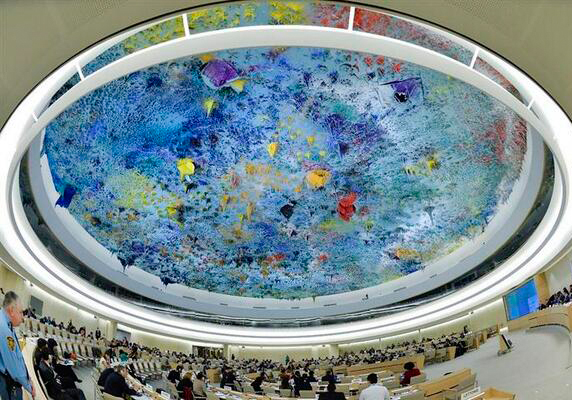
The statement on behalf of four groups was delivered in the context of the General Debate on Item 3 during the 38th Session of the UN Human Rights Council.
The groups called all States to take up the opportunity to strengthen a multilateral approach the issue of business and human rights by joining the intergovernmental process to establish a legally binding instrument in this field.
The statement is as follows:
The current intergovernmental process to establish a legally binding instrument in the field of business and human rights offers States the opportunity to work through international cooperation and multilateral engagement to effectively address the human rights impact of business activities.
We thus urge all States –including those that have been so far reluctant to engage- to actively participate in this process.
Only constructive dialogue among all States and other stakeholders, especially the affected communities, can lead to sustainable solutions to the existing normative and protection gaps.
This 38th session of the Human Rights Council marks the 10th anniversary of its adoption of the Framework Report “Protect, Respect and Remedy”.
As we celebrate the contribution of this Framework, which led to the creation of the Guiding Principles on Business and Human Rights, we must emphasize the need to increase the international community’s response.
In the past ten years, although important work has been done in some areas and by some countries, little systemic positive change has been felt on the ground, where many individuals, especially indigenous and peasant workers and communities, continue to endure the violation of their rights without recourse to real remedy avenues.
The creation of an international legally binding framework for States to maximize action and cooperation regarding rights abuses in the context of business operations remains a compelling necessity of our times.
I thank you.
Full statement in English (PDF): Universal-HRC38-BHR-treaty-Advocacy-non-legal-submission-June-2018-ENG
Jun 22, 2018 | Events, News
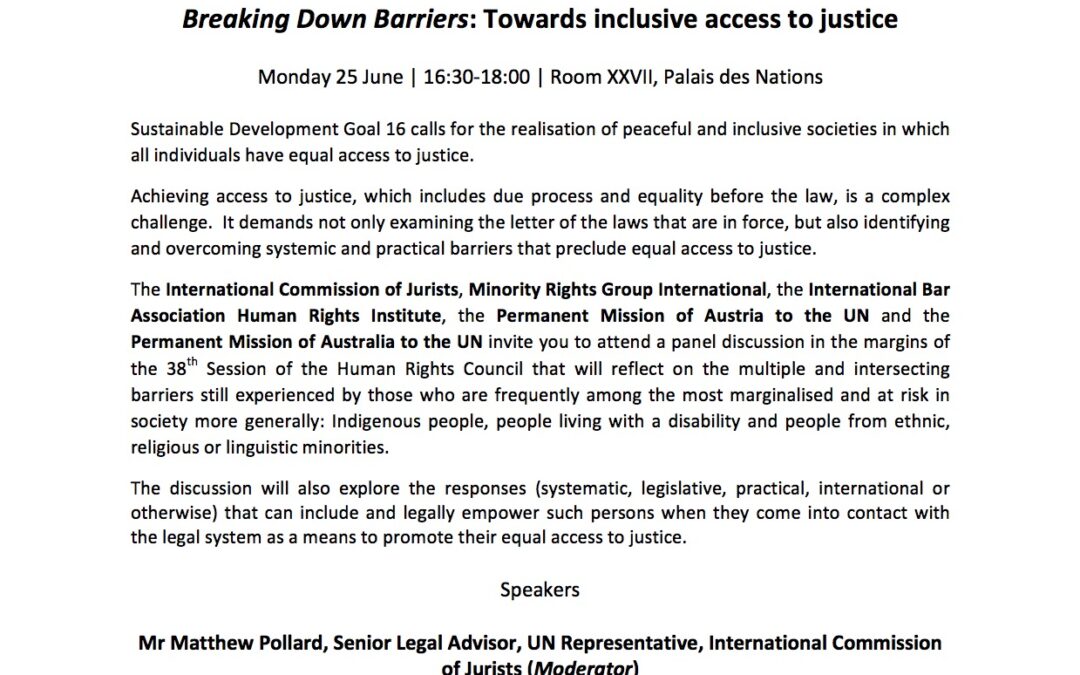
This side event to the UN Human Rights Council session addresses equal and effective access to justice for indigenous people, people living with a disability and people from ethnic, religious or linguistic minorities.
Monday 25 June | 16:30-18:00 | Room XXVII, Palais des Nations
Sustainable Development Goal 16 calls for the realisation of peaceful and inclusive societies in which all individuals have equal access to justice.
Achieving access to justice, which includes due process and equality before the law, is a complex challenge. It demands not only examining the letter of the laws that are in force, but also identifying and overcoming systemic and practical barriers that preclude equal access to justice.
The International Commission of Jurists, Minority Rights Group International, the International Bar Association Human Rights Institute, the Permanent Mission of Austria to the UN and the Permanent Mission of Australia to the UN invite you to attend a panel discussion in the margins of the 38th Session of the Human Rights Council that will reflect on the multiple and intersecting barriers still experienced by those who are frequently among the most marginalised and at risk in society more generally: Indigenous people, people living with a disability and people from ethnic, religious or linguistic minorities.
The discussion will also explore the responses (systematic, legislative, practical, international or otherwise) that can include and legally empower such persons when they come into contact with the legal system as a means to promote their equal access to justice.
Speakers:
Mr Matthew Pollard, Senior Legal Advisor, UN Representative, International Commission of Jurists (Moderator)
Dr June Oscar AO, Australia’s Aboriginal and Torres Strait Islander Social Justice Commissioner, Australian Human Rights Commission
Mr Glenn Payot, UN Representative, Minority Rights Group International
Ms Victoria Lee, Programme Manager, Human Rights and Disability Team, Office of the High Commissioner for Human Rights
For more information contact un(a)icj.org
May 30, 2018 | Advocacy, Non-legal submissions
The ICJ today made a submission for an upcoming report by the UN Secretary General on recent developments concerning human rights in the administration of justice.
In 2016, the UN General Assembly requested the Secretary General “to submit to the General Assembly at its seventy-third session a report on the latest developments, challenges and good practices in human rights in the administration of justice, including on efforts to ensure equal access to justice for all through the independent, impartial and effective administration of justice, and on the activities undertaken by the United Nations system as a whole”.
The UN is in the process of preparing the report, which will cover developments during the last two years since the previous report of the Secretary General.
The ICJ’s submission can be downloaded in PDF format here: UN-GA-AdminJustice-2018