
Report of the Special Rapporteur on the situation of human rights defenders, A/HRC/31/55, 1 February 2016
III. Conceptualizing protection practices A. Background 27. Some activists face greater and more specific risks than others (see A/HRC/16/44, A/HRC/19/55 and A/70/217, paras. 61-77). Defenders who challenge social and cultural norms, do not fit stereotypes and...Report of the Special Rapporteur on the sale of children, A/HRC/31/58, 30 December 2015
III. Tackling the demand for the sexual exploitation of children C. Demand for the sexual exploitation of children 45. Racism and discrimination play a central part in certain forms of demand for the sexual exploitation of children. Some offenders, in particular in...Report of the Special Rapporteur on adequate housing, A/HRC/31/54, 30 December 2015
V. Homelessness and marginalized groups 39. Discrimination is both a cause and a consequence of homelessness. Those who face discrimination on the grounds of race, ethnicity, place of origin, socioeconomic status, family status, gender, mental or physical disability,...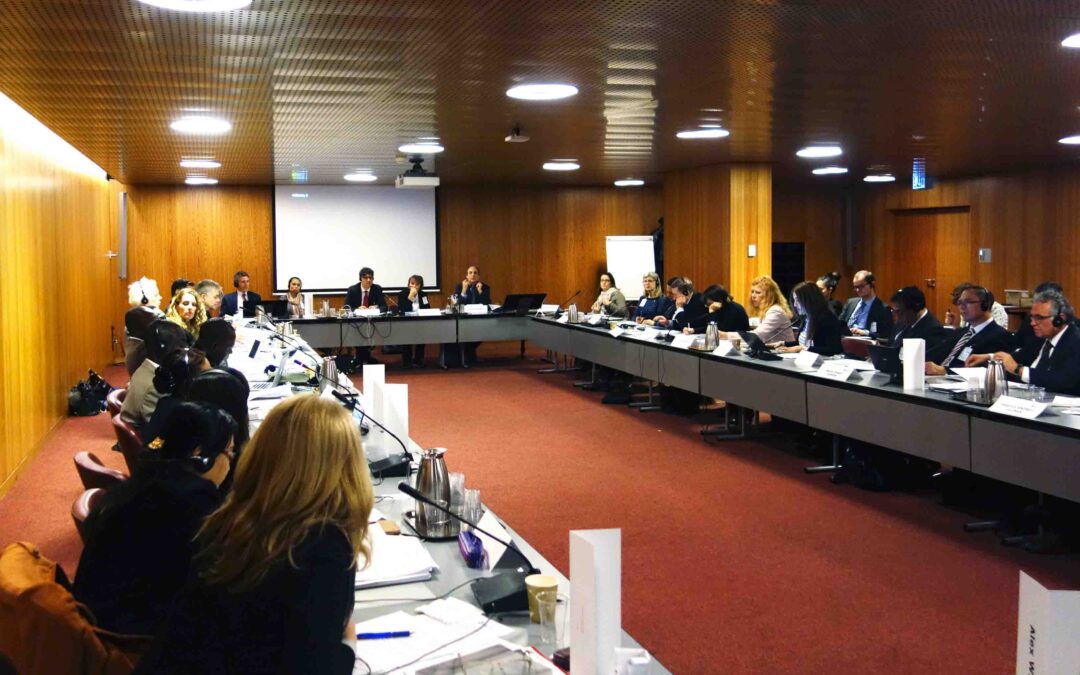
On Video: Judicial Accountability: 2015 Geneva Forum of Judges & Lawyers
More than 40 senior judges and lawyers from all parts of the world have made an important contribution to efforts to hold judges accountable for involvement in human rights violations and judicial corruption, by participating in the sixth annual ICJ Geneva Forum of Judges & Lawyers.
The Geneva Forum is organized annually by the ICJ’s Centre for Independence of Judges & Lawyers (CIJL) and brings together judges, lawyers and prosecutors from around the world, together with UN officials and representatives from international professional associations of legal professionals, as well as academics and other experts.
This year’s Geneva Forum (14-15 December) formed part of a larger CIJL project to promote judicial accountability, through sharing of knowledge about relevant international standards and international and national good practices, between the judiciary, other legal actors, and governments and civil society around the world.
The focus of the project is on judicial involvement in human rights violations such as unjust executions, prolonged arbitrary detention including imprisonment after deliberately unfair trials, judges providing impunity to perpetrators or enforced disappearance and torture, as well as judicial corruption that leads to human rights violations.
Victims of such violations have the right to remedy and reparation, including in relation to the role of judges, and society as a whole should be able to be confident that those responsible for such judicial misconduct will be held to account.
The two days of intense and detailed discussion and debate, at times practical and at times passionate, identified wide areas of agreement amongst participants, as well as areas of divergence and questions requiring further study and deliberation. Topics covered included:
- the composition and character of accountability bodies (and particularly, the importance of judge-led processes that at the same time may benefit from involvement of representation of the legal profession, legal academia, and general public – while excluding undue influence from the Executive or Legislative branches of government);
- the practicalities of bringing criminal proceedings against judges;
- the role of national, regional and international professional associations;
- possible options in situations of transition to democracy where the judiciary on the whole may have been an instrument of repression of the prior regime, or situations of pervasive corruption, or conflict or post-conflict situations;
- particular considerations in relation to judicial accountability in developing countries;
- the powers and methods for gathering of evidence of judicial misconduct;
- the rights of individual judges and of alleged victims of judicial misconduct;
- the role of publicity and transparency in judicial accountability processes;
- the inclusion of safeguards against the abuse of judicial accountability mechanisms for ulterior motives, including political interference that undermines the independence of the judiciary;
- and practical means for ensuring that mechanisms and procedures, once established, operate effectively and fairly in practice.
The Forum follows a smaller expert consultation meeting convened in Tunisia in October focussing on judicial accountability in developing countries where, it is widely recognized, the negative impacts of corruption on human rights are deepest and most widespread. A report of the Tunis consultation is available here.
The Geneva Forum and Tunisia consultation are an opportunity for direct sharing of experience and expertise between practitioners, strengthening their capacity to carry out effective judicial accountability work in their own regional and national contexts, and to further disseminate this knowledge to others.
It is also an opportunity to discuss possible global strategies for promoting more effective and fair judicial accountability mechanisms and procedures.
The exchanges between leading judges and lawyers at the Geneva Forum and Tunis consultation will also directly feed into an ICJ Practitioners Guide on Judicial Accountability, with global legal, policy and practical guidance, to be published in June 2016. (Update 7 June 2016 – the Guide has now been published and is available here.)
The Practitioners Guide will be printed, published electronically, and distributed as a foundation for subsequent work by the ICJ and others at the national and regional level, from 2016 onwards, including in development-assistance recipient countries. It will join a series of Practitioners Guides published by the ICJ (nine to date, no. 10 and 11 to be published very soon), which have proved to be leading reference guides and training materials in the field of legal protection of human rights and the rule of law.
The developing countries consultation in Tunisia, and participation of practitioners from developing countries in the global Geneva Forum, will help to ensure that the Practitioners Guide is relevant to and has impact in ODA recipient countries.
The ultimate aim of the work of the CIJL, including the 2015 Geneva Forum on judicial accountability and the eventual Practitioners Guide, is to improve access to independent and impartial justice for victims of human rights violations, corruption and similar abuses, including when the judiciary itself has been involved in the wrongdoing.
The 2015 Geneva Forum, and the earlier Tunisia consultation, have been made possible with the support of the Republic and Canton of Geneva, as well as the Ministry of Foreign Affairs of Finland. The ICJ is also grateful for the assistance of the Geneva Welcome Centre (CAGI).
The list of participants to this year’s Geneva Forum is available here: Participants list (public)
The report of the Tunis consultation is available here: Universal-Tunis Consultation-Publications-Seminar and Conference Report-2016-ENG
Information about previous years’ events and publications is available here: Geneva Forum Homepage
A 2000 CIJL Yearbook focussing on Judicial Corruption is available here: 2000 CIJL Yearbook Judicial Corruption
Voices from the Geneva Forum:
Recent News
 HRC63: ICJ Raises Concern over Torture, Executions and Impunity in Libya23 Sep 2026
 HRC63: ICJ Calls for Renewal and Strengthening of the Venezuela Fact-Finding Mission21 Sep 2026
 Joint Statement: Attacks on the Rule of Law, Judicial Independence and Access to Justice in Zambia17 Sep 2026
 HRC63: ICJ Raises Concern over Widespread and Systematic Arbitrary Detention in Egypt16 Sep 2026