Jun 12, 2013 | News
The Tshwane Principles on National Security and the Right to Information seek to protect the right to information and to ensure public access to information held by governments, without jeopardizing legitimate efforts to protect people from security threats.
Jun 12, 2013 | Agendas, Events
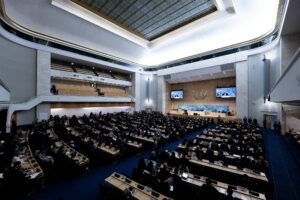
On Tuesday 11 June 2013, the ICJ convened a parallel event, organised with the Geneva Academy of International Humanitarian Law and Human Rights, during the Human Rights Council’s 23rd regular session held in Geneva.
The event, held in Room XXV of the Palais des Nations, discussed how human rights will be promoted by the Arms Trade Treaty (ATT), including ways to ensure compliance with the ATT and the relevance of the treaty for activities of the Human Rights Council and international human rights experts. The event was chaired by Alex Conte, Director of the ICJ’s International Law and Protection Programmes. Panelists were Simon Bagshaw, Senior Policy Adviser for the UN Office for the Coordination of Humanitarian Affairs; Professor Andrew Clapham, Director of the Geneva Academy of International Humanitarian Law and Human Rights; and Dr Stuart Casey-Maslen, Head of Research at the Geneva Academy of International Humanitarian Law and Human Rights.
Simon Bagshaw provided a background to the treaty from a humanitarian perspective, recognising that the ATT provides an opportunity to address some of the humanitarian impacts and costs of the arms trade. He also stressed the importance of specific elements within the treaty, such as the obligation to refrain from authorising the transfer of weapons where a substantial risk exists that this may result in serious violations of international human rights law or international humanitarian law.
Andrew Clapham and Stuart Casey-Maslen focussed on the human rights perspective. Professor Clapham promoted the use of mechanisms such as the Human Rights Council and its Universal Periodic Review to assist in implementation of the treaty. Dr Casey-Maslen discussed areas that may help ratification, implementation and monitoring of the ATT, including the role of civil society in that regard.
Several questions were raised during discussions concerning how the treaty would work in practice and its broader implications for non-State actors. Panellists confirmed that the ATT includes the facilitation of crimes as enumerated in the treaty and may also cover domestic crimes of terrorism. Since the ATT does not provide for the establishment of fact-finding missions, it was emphasised that civil society will need to act to monitor compliance with the ATT. Panellists also pointed out the important role of the treaty regarding the conduct of non-State actors. Although the treaty sets out obligations for States only, States parties will be responsible for providing licensing to arms manufacturers and private companies working within the weapons industry.
UN HRC-Arms Treaty side event flyer-event-2013 (event flyer in pdf)

May 30, 2013 | Agendas, Events
The event will be held Friday, 31 May 2013, from 16.00 to 18.00, in Geneva, Palais des Nations, Room XXVII. It marks the 5th anniversary of the HR Council adoption of the Framework “Protect, Respect and Remedy”.
It also promotes the publication of the ICJ Report on “Corporate complicity in international crimes”. It will highlight the fact that the business and human rights agenda in the Human Rights Council remains unfinished, especially in the critical areas of access to justice and accountability, as well as the need for bold Council action to provide States and other actors with the necessary tools to ensure remedy and justice to victims of serious human rights abuses committed by or with the complicity of corporations in home and host countries.
HR Council-UN SIDE EVENT Business-Event-2013 (full text in pdf)

May 29, 2013 | Agendas, Events
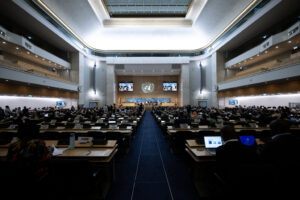
On Tuesday 28 May 2013, the ICJ co-sponsored a parallel event with TRIAL and the Missions of Botswana, Costa Rica, Estonia and Switzerland during the Human Rights Council’s 23rd regular session held in Geneva.
The event, held in Room XXV of the Palais des Nations, addressed key issues concerning accountability and human rights. The event was chaired by Professor Paola Gaeta from the Geneva Academy of International Humanitarian Law and Human Rights. Panelists were Tiina Intelmann, President of the Assembly of the States Parties to the ICC Statute; Mothusi Bruce Rabasha Palai, Ambassador of Botswana; Ian Seiderman, Director of the ICJ’s Law and Policy Office; and Gabriella Citroni, Senior Legal Adviser at TRIAL (Swiss association against impunity).
Panelists agreed that accountability is intimately linked to the enjoyment of human rights. It was stated that – under State responsibility – States are, or should be, held responsible for acts involving any violation of international law, including international human rights law and international humanitarian law. Accountability is thus not only about criminal justice, but also about ensuring reparations and guarantees of non-recurrence.
Recommendations made under the Universal Periodic Review (UPR) mechanism were seen as having been partly successful in bridging gaps, although there remains a lack of proper follow-up on the progress of implementation between UPR cycles. Panellists observed that States often fail to refer to standards enunciated by the High Commissioner for Human Rights and by the Special Procedures. Regarding the accountability of non-State actors for conduct involving human rights abuses and violations, the ‘Ruggie Principles’ were referred to as a representing good progress but still failing to be as comprehensive as they should be.
Concerning future steps by Human Rights Council mechanisms, panellists proposed that resolutions, statements and Special Procedures should more directly and frequently refer to accountability. The need for greater political pressure on the International Criminal Court was expressed, with the aim of supporting the domestic capacity of States parties to the Rome Statute. Concerning domestic capacity to strengthen accountability more generally, panellists and participants agreed on the need to improve linkages between the work of persons dealing with development and those working on accountability.
HR Council-Strengthening accountability-event-2013 (event flyer in pdf)