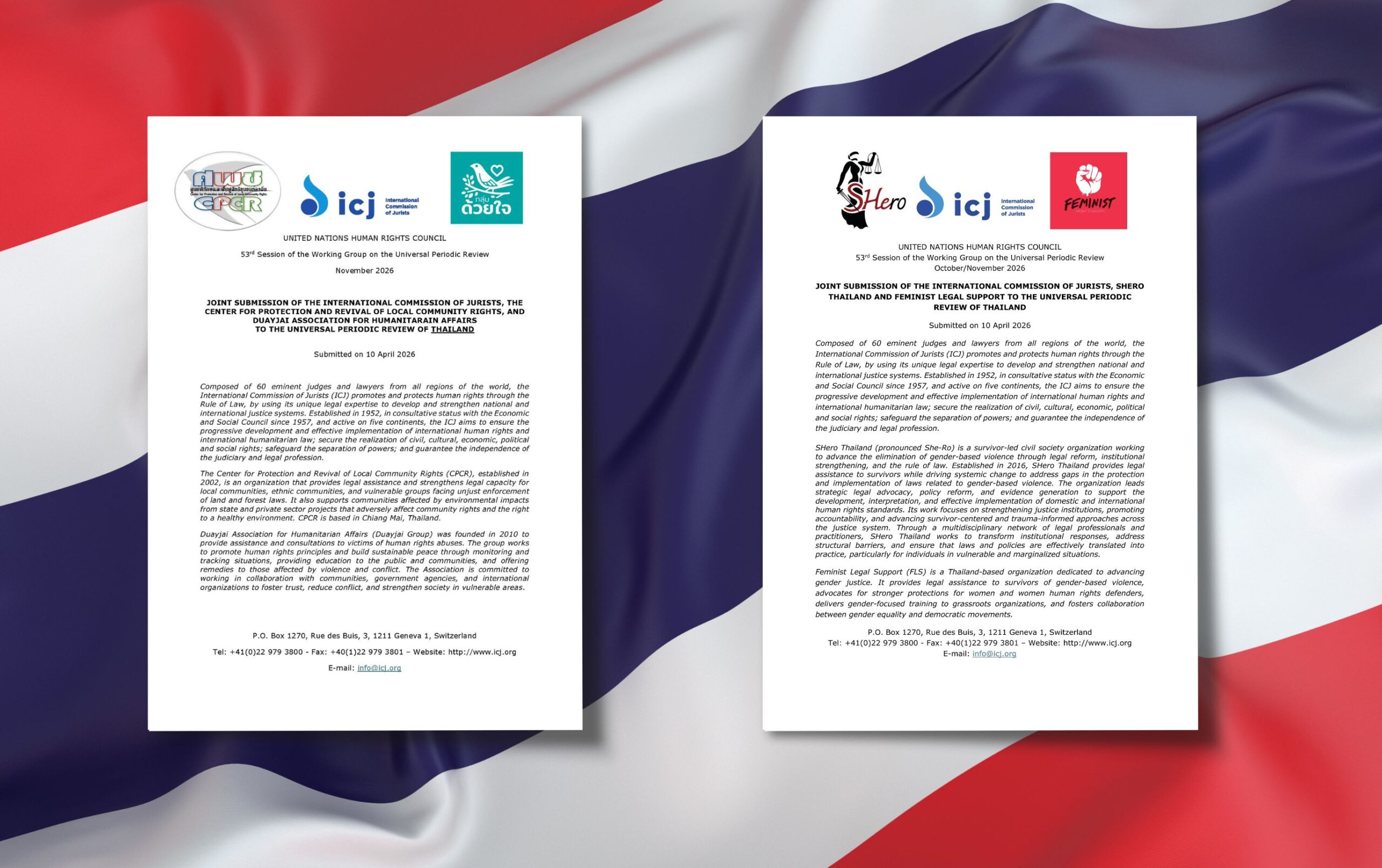
On 10 April 2026, the International Commission of Jurists (ICJ) filed two submissions with the UN Human Rights Council’s Working Group on the Universal Periodic Review (UPR) ahead of its review of Thailand’s human rights record in November 2026. For this review cycle, the ICJ made both submissions jointly with its partners.
In the first joint submission, the ICJ, the Center for Protection and Revival of Local Community Rights (CPCR), and the Duayjai Association for Humanitarian Affairs (Duayjai Group) provided information and analysis to assist the UPR Working Group in formulating recommendations regarding the protection of human rights defenders (HRDs), particularly from violence, threats, intimidation, reprisals, and harassment. The submission raised several human rights concerns relevant to HRDs, including:
- the lack of an adequate framework for the protection of HRDs;
- killings and attempted killings of HRDs;
- the lack of progress in uncovering the fate and whereabouts of HRDs who have allegedly disappeared;
- extraterritorial “abductions” of HRDs and political activists;
- the deportation of non-Thai HRDs;
- online smear campaigns and spyware attacks against HRDs;
- other forms of harassment against HRDs; and
- strategic lawsuits against public participation (SLAPPs) against HRDs.
Download
In the second joint submission, the ICJ, SHero Thailand, and Feminist Legal Support (FLS) provided information and analysis to assist the UPR Working Group in making recommendations addressing human rights concerns arising from Thailand’s failure to fully comply with its international human rights law obligations, particularly in relation to persistent gaps in addressing gender-based discrimination and gender-based violence (GBV), including:
- Domestic legislation that inadequately addresses gender-based discrimination, including the lack of recognition of sexual orientation, gender identity, and gender expression as protected characteristics;
- Shortcomings in legal provisions addressing GBV, including with respect to rape, sexual harassment and domestic violence; and
- Barriers to access to justice for GBV survivors, including obstacles such as: (i) the criminalization of abortion, sex work and of undocumented migrants and refugees who are victims/survivors of GBV; (ii) the failure to ensure gender-sensitive procedures; and (iii) the lack of adequate essential services and support for GBV survivors, including those with disabilities.
Download