May 9, 2016 | News
Bangladesh President Abdul Hamid must stay the execution of opposition political leader Motiur Rahman Nizami, said the ICJ today.
On 5 May 2016, the Supreme Court of Bangladesh dismissed a petition by Motiur Rahman Nizami to review its previous decision confirming his death sentence.
He is now at imminent risk of execution.
“Bangladesh must stay this execution, and end its continued and unlawful use of the death penalty,” said Sam Zarifi, ICJ’s Asia-Pacific Director. “The death penalty is not justice and is the ultimate form of cruel and inhuman punishment.”
Motiur Rahman Nizami, a leader of the Jamaat-e-Islami party, was found guilty of crimes committed during the 1971 war for independence in Bangladesh, including genocide, torture, and the murder of intellectuals, and sentenced to death by the International Crimes Tribunal (ICT) in October 2014.
The Supreme Court confirmed this decision and sentence on appeal earlier this year, following which Motiur Rahman Nizami filed his review petition.
Thus far, four individuals have been executed based on convictions by the Bangladesh International Crimes Tribunal: Salahuddin Quader Chowdhury and Ali Ahsan Mohammad Mujahid were executed in November 2015; Muhammad Kamaruzzaman was executed in April 2015; and Abdul Qader Mollah was executed in 2013. Several others have been sentenced to death.
“The perpetrators of the atrocities committed during the 1971 war for independence must be brought to justice and held to account for their crimes,” said Zarifi.
“However, another execution on the basis of a flawed trial that is inconsistent with international human rights standards undermines justice, and must be stopped,” he added.
Bangladesh is party to most of the principal human rights treaties, including the International Covenant on Civil and Political Rights, which obliges it to respect the right to a fair trial.
The ICJ has previously raised concerns that trials before the ICT are not in compliance with Bangladesh’s international legal obligations, and international standards for fair trials.
According to the ICJ, there are serious procedural flaws at all stages: pre-trial release has been routinely and arbitrarily denied; witnesses have been abducted and intimidated; and there have been credible allegations of collusion between the Government, prosecutors and judges.
Background information
In a statement on 8 April 2016, the UN Office of the High Commission of Human Rights reaffirmed that trials before the ICT in Bangladesh did not met international standards of fair trial and due process, and that the imposition of a death sentence in such circumstances constitutes a violation of the right to life.
The ICJ opposes capital punishment in all cases without exception. The death penalty constitutes a violation of the right to life and the right not to be subjected to cruel, inhuman or degrading punishment.
In December 2014, the UN General Assembly adopted a resolution, for the fifth time since 2007, emphasizing that that the use of the death penalty undermines human dignity and calling on those countries that maintain the death penalty to establish a moratorium on its use with a view to its abolition.
A majority of 117 UN Member States voted in favor of a worldwide moratorium on executions as a step towards abolition of the death penalty.
Apr 6, 2016 | News
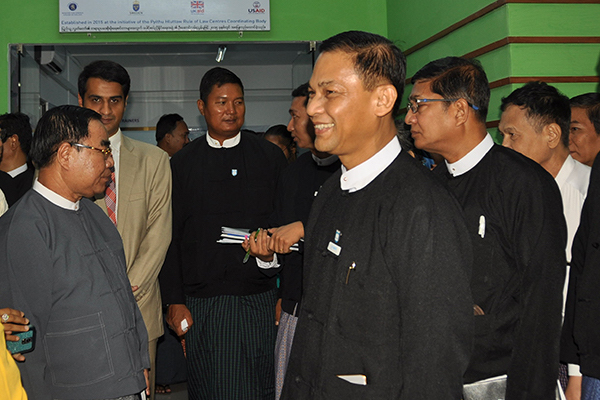
Newly appointed Myanmar Attorney General U Tun Tun Oo must commit to strengthening the rule of law and respect for human rights in the country, said the ICJ today.
U Tun Tun Oo (photo) has been one of the Deputy Attorney-Generals in the Union Attorney General’s Office since 2006.
“U Tun Tun Oo is taking over a post that is Myanmar’s most powerful legal officer. He plays a complex role, at once a member of the Executive, adviser to the President and the Hluttaw, the authority drafting and amending laws,” said Sam Zarifi, ICJ’s Asia Director. “As an immediate matter, he should review all political cases and stop the harassment of human rights defenders.”
The Attorney General represents the government in judicial proceedings and advises the cabinet on the legality of its actions.
He also leads Prosecutors in the country, and thus has the authority to select, initiate and undertake investigations into criminal and politically sensitive cases.
The Attorney General is also the president of the country’s only officially recognized Bar Association.
The Attorney General is, in effect, the minister of justice, and as such has controlled much of the work of the judiciary, too.
The Union Attorney General’s Office has historically followed the interests of the military and impeded an independent judiciary, the ICJ notes.
It has been criticized for failing to tackle major problems such as corruption and human rights abuses while continuing to prosecute human rights defenders and political opponents.
“Within the Union Attorney General’s Office, prosecutors must act with integrity in an independent, impartial and objective manner and in the protection of the public interest”, said Zarifi.
“Prosecutors must exercise sound discretion in the performance of their functions. They must seek justice, without fear of favour, not merely convict.”
“The Attorney-General’s Office must not shy away from prosecutions that will combat impunity,” he added.
The Union Attorney General’s Office launched its Strategic Plan for 2015-2019, establishing important benchmarks for measuring the institution’s development.
The Strategic Plan acknowledges the public’s low confidence in the office and commits the office to the rule of law, human rights, fair trials, prosecutorial ethics and accountability, in accordance with international standards.
“The Union Attorney General’s Office must investigate and prosecute criminal offences, including gross human rights violations and abuses, with impartiality. The Union Attorney General’s Office must be free from unwarranted interference from the legislative and the executive branches of government. Likewise, it must not interfere with judges or lawyers in an independent judiciary,” Zarifi said.
Contact:
Sam Zarifi, ICJ Regional Director for Asia and the Pacific, t: +66807819002; e: sam.zarifi@icj.org
Vani Sathisan, ICJ International Legal Adviser for Myanmar, t: +95(0)9250800301; e: vani.sathisan@icj.org
Additional information:
Under international standards, prosecutors are required to “respect and protect human dignity and uphold human rights” and “give due attention to the prosecution of crimes committed by public officials, particularly corruption, abuse of power, grave violations of human rights and other crimes recognized by international law.” These principles are set out in the United Nations Guidelines on the Role of Prosecutors.
An exposition and analysis of international law and standards are available in English and Myanmar language in the ICJ’s authoritative Practitioners’ Guide on the Independence and Accountability of Judges, Lawyers and Prosecutors.

Apr 5, 2016 | News
The Court of Appeal’s decision to lift the stay of execution of Kho Jabing is a serious blow to human rights in Singapore, the International Commission of Jurists (ICJ) said today.
The ICJ urges the Government of Singapore to grant Kho Jabing clemency and immediately impose a moratorium on executions, with a view towards abolishing the death penalty in the near future.
“The death penalty is never justifiable,” said Sam Zarifi, ICJ’s Regional Director for Asia and the Pacific. “If Singapore goes through with the execution of Kho Jabing, it will go against the growing international consensus to abolish the death penalty.”
Currently, 117 member states of the United Nations support the General Assembly resolution passed in December 2014 calling for an international moratorium on the use of death penalty, the ICJ reminds.
The Geneva-based organization opposes the death penalty in all circumstances and considers the imposition of the death penalty to constitute a denial of the right to life and a form of cruel, inhuman and degrading punishment.
The ICJ has received information that there are nine other individuals currently on death row in Singapore.
Authorities have not yet released the date of Kho Jabing’s execution.
The lawyers of Kho Jabing will be filing a petition for clemency in the next few days.
The ICJ urges the Government of Singapore to halt the imminent execution of Kho Jabing, grant the petition for clemency and commute his death sentence.
Background
Kho Jabing, a Malaysian national, was convicted of murder and sentenced to death in Singapore in 2010. After amendments were made in 2012 on the laws on the death penalty in Singapore, Kho Jabing was re-sentenced to life imprisonment and 24 strokes of the cane. The prosecution, however, appealed the re-sentencing and the case was brought to the Court of Appeal.
The court rejected his application for clemency in October 2015. On 23 November 2015, he was granted a temporary reprieve pending the outcome of a petition filed by his lawyers, which raised questions of fact and law.
The decision of the Court of Appeal this morning lifted the temporary reprieve and upheld its decision to impose the death penalty on Kho Jabing.
Contact
Emerlynne Gil, ICJ’s Senior International Legal Advisor, tel. no. +66840923575, email: emerlynne.gil(a)icj.org

Jan 14, 2016 | News
As today marks the fifth anniversary of the toppling of Ben Ali’s regime, the ICJ calls on Tunisian authorities to adopt key legal and policy reforms to combat impunity and to deliver justice to victims of past human rights violations.
Under Ben Ali’s regime, thousands of human rights violations, including torture and other ill-treatment, unlawful killings, enforced disappearances, and arbitrary arrests and detentions, were committed by law enforcement and other security officers.
Numerous similar violations were also committed during the December 2010 to January 2011 uprising and some of them continue today.
“The political and institutional reforms introduced in Tunisia over the past 5 years should not be the sole yardstick to measure the success of the transition,” said Said Benarbia, Director of the ICJ Middle East and North Africa Programme.
“Victims of human rights violations, in particular under Ben Ali’s rule, and during the uprising still await justice,” he added.
Despite several cases being brought before Tunisian courts, in particular military courts, these proceedings have yet to establish the truth about violations, ensure that all those who are responsible are held to account, and fulfill the rights of victims to effective remedies and reparation.
“Until their rights to effective remedies and reparation are realized, including by holding the perpetrators to account, the transition will remain incomplete,” Benarbia said.
Indeed, despite numerous legal and policy reforms, including the adoption of the “Transitional Justice Law”, and the establishment of the Truth and Dignity Commission (Instance Vérité et Dignité), the ICJ is concerned that justice for victims remains mostly elusive.
Obstacles that impede victims’ access to justice and effective remedies include current weaknesses in the Tunisian criminal procedures, such as the broad discretion of the public prosecutor to dismiss cases without providing specific reasons (and the lack of ability of victims effectively to challenge such decisions), the lack of effective measures for the protection of victims and witness, inadequate laws on the definition of crimes and superior responsibility, and the use of military courts to address human rights violations.
“Key reforms both in law and practice are needed for Tunisia to properly address past abuses in Tunisia, end pervasive impunity and provide victims with justice,” Benarbia said.
Contact:
Theo Boutruche, Legal Adviser of the ICJ Middle East and North Africa Programme, tel: +96 170 888 961, e-mail: theo.boutruche(a)icj.org
Tunisia-Anniversary-News Press Release-2016-ARA (Arabic version, in PDF)

Dec 22, 2015 | News
The ICJ today called on Egypt’s newly elected House of Representatives to amend or annul the web of repressive presidential decrees promulgated since the ouster of President Morsi.
“Egypt’s House of Representatives must dismantle the catalogue of repressive presidential decrees that have been used by the authorities to stifle dissent, curtail fundamental rights and freedoms and shield state officials from accountability in cases of human rights violations,” said Said Benarbia, Director of the ICJ’s Middle East and North Africa (MENA) Programme.
Article 156 of the Egyptian Constitution provides that decrees issued by the President while the House of Representatives is not in session must be discussed and approved by the new House of Representatives within 15 days of it convening.
Failure to do so results in the laws being automatically nullified with retroactive effect.
The ICJ and others have detailed how many of these presidential decrees, including the Demonstration Law (No.107 of 2013), the Counter-Terrorism Law (No.94 of 2015), the Terrorist Entity Law (No.8 of 2015), the Law on Military Courts (No.136 of 2014) and laws amending the Criminal Code (No.128 of 2014) and the Prison Law (No.106 of 2015), violate Egypt’s obligations under international law.
Key concerns relate to the right to life, the right to liberty and the right not to be subjected to arbitrary detention, fair trial rights, and the rights to freedom of expression, association and assembly.
These fundamental rights are protected by for instance the International Covenant on Civil and Political Rights, which Egypt ratified in 1982 and which today counts 168 states as parties.
Over the last two years, thousands of individuals have been prosecuted and convicted pursuant to such decrees, including the Demonstration Law, through proceedings that fell short of international fair trial standards.
Further, many of these decrees, in particular the Counter-Terrorism Law and the Demonstration Law, institutionalise the immunity of state officials from legal proceedings against any use of force committed in the course of their duties, including the use of lethal force when it is not strictly necessary to protect lives.
The decrees also fail to provide for any reparations mechanism for victims.
“Egypt’s parliament should, as a matter of urgency, ensure that those who have suffered human rights violations on the basis of these laws obtain effective remedy and reparations, remove all obstacles to justice and accountability, and address the impunity of state officials underpinned by these decrees”, Benarbia added.
Contact:
Alice Goodenough, Legal Adviser of the ICJ Middle East and North Africa Programme, t: +44 7815 570 834; e: alice.goodenough(a)icj.org
Nader Diab, Associate Legal Adviser of the ICJ Middle East and North Africa Programme, t: +41 229 793 804; e: nader.diab(a)icj.org
Egypt-New House of Representatives-News-Press releases-2015-ARA (full text in Arabic, PDF)