Dec 6, 2013 | News
The ICJ and Amnesty International expressed concern over the trial of Mohamed Belbouri before the criminal court of Oran in Algeria. The next hearing of the trial is held on Monday 9 December.
Belbouri, aged 29, stands as the sole accused in the murder of Professor Ahmed Kerroumi, an Algerian political activist. Kerroumi was killed in April 2011, shortly after meeting with the UN Special Rapporteur on freedom of expression, Frank La Rue, in Algeria.
The ICJ and Amnesty International call on the Algerian authorities to ensure the right of Kerroumi’s family members to know the truth about his killing and to criminally hold the perpetrator(s) to account in line with international fair trial standards.
The two organizations are concerned that the Belbouri trial has failed to meet these standards, including the right of the accused to be presumed innocent and to defence.
The two organizations are further concerned by allegations that acts of torture and other ill-treatment were inflicted on Belbouri during his interrogation in police facilities between 12 and 17 May 2011, apparently aiming to make him “confess” to the killing of Kerroumi.
Belbouri says he was beaten on the head, face, stomach and feet, electrocuted, made to sit on his knees for hours with a chair on his head, and threatened that his relatives would be ill-treated if he did not “confess”.
“Algerian authorities must respect and ensure the right of Belbouri to a fair hearing before an independent and impartial tribunal and in full compliance with international fair trial standards,” said Wilder Tayler, ICJ Secretary General.
“The authorities must also ensure that all reports of torture and other ill-treatment of Belbouri are thoroughly and impartially investigated, and that any statement alleged to have been obtained as a result of torture or other ill-treatment is not admitted as evidence by the court,” Tayler added.
Lawyers representing the accused and the family of Professor Kerroumi have both said that the trial was marred by irregularities.
These include the court’s refusal to allow the defence to call and cross-examine witnesses, including the forensic expert who performed the autopsy on Ahmed Kerroumi’s body, and to challenge and test evidence put forward by the prosecution.
“Justice would not be served by sentencing – possibly to death – a man who has claimed his innocence all along when they are so many doubts about the seriousness of the investigation,” said Philip Luther, Middle East and North Africa Director at Amnesty International.
Contact:
Said Benarbia, ICJ Senior Legal Adviser of the Middle East and North Africa Programme, tel: 41 22 979 38 1, e-mail: said.benarbia(a)icj.org

Oct 2, 2013 | Events
The ICJ today welcomed the launch of the OSCE/FBA Handbook for Monitoring Administrative Justice as a tool able to contribute to the open administration of justice.
Noting that trends throughout the world see administrative cases dealt with in a manner that lacks transparency and fails to comport with the open administration of justice, the ICJ expressed the hope that the tool will be used by practitioners and officials to make an impact on the ground. The ICJ pointed to several reasons why the open administration of justice, in all forms of proceedings, is important to human rights and the rule of law:
- As a starting point, it is widely recognised, including by the UN Human Rights Committee in its General Comment on the right to a fair trial, that the open and transparent administration of justice is an important safeguard for the interests of both the individual and society at large.
- The conduct of administrative and other proceeds in an open and transparent manner helps to ensure the integrity of such proceedings and protect against potential abuse.
- Publicly accessible documentation, including timely and reasoned decisions, protects individuals from being subject to arbitrary decisions.
- Transparency and openness contributes to accountability by enabling parties to determine the viability of any appeal or review, including the possibility of taking a case to regional or international mechanisms.
- In all these ways, the open administration of justice also helps guarantee the right of individuals and society to access justice, including remedies and reparation.
The Handbook is a publication arising from a joint initiative of the Folke Bernadotte Academy (FBA) Rule of Law Unit and the OSCE Office for Democratic Institutions and Human Rights. Work began on the Handbook in May 2011. The ICJ participated in expert meetings on the development of the Handbook in 2011 and 2012.
OSCE/FBA Handbook for Monitoring Administrative Justice
Sep 12, 2013 | News
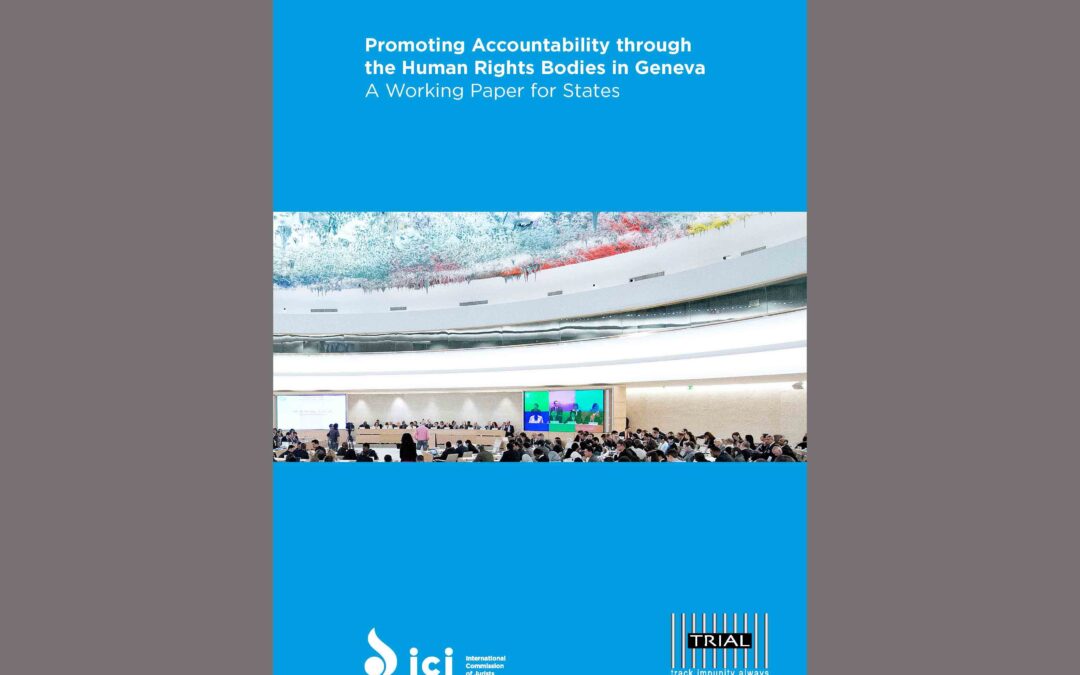
Yesterday, during the 24th session of the UN Human Rights Council, the ICJ and TRIAL (Swiss Association against Impunity) jointly held a parallel event on promoting accountability through human rights mechanisms in Geneva.
The event was co-sponsored by the Permanent Missions of Switzerland, Estonia and Costa Rica to the United Nations Office at Geneva.
A corresponding report produced by ICJ and TRIAL was also launched at this event in two versions, one aimed at civil society and another aimed at States.
Panellists at this event included Ian Seiderman of the ICJ, Gabriella Citroni of TRIAL and Theo van Boven, former Special Rapporteur on torture and other cruel, inhuman or degrading treatment or punishment and ICJ Honorary Commissioner.
Mona Rishmawi of the Office of the High Commissioner for Human Rights (OHCHR) chaired the event.
The main topic of this event was the ICJ-TRIAL report, which reviews the legal framework for promoting accountability and suggests possible action by civil society and States to engage with the human rights mechanisms in Geneva to better promote and achieve accountability for human rights violations.
The role of national mechanisms, such as national human rights institutions, working in cooperation with the UN mechanisms was also highlighted.
The report focuses specifically on the Human Rights Council and its subsidiary bodies, such as the Universal Periodic Review and the special procedures mechanisms.
OHCHR’s role was further emphasised in regards to sharing best practices as well as ensuring follow-up to issues of accountability as they come to the attention to the UN.

Sep 3, 2013 | News
The ICJ today expressed its serious concern at the continued detention of lawyer Zinaida Mukhtorova in a psychiatric facility.
In its statement, the ICJ expressed concern that this detention may amount to an act of harassment or reprisal for Zinaida Mukhtorova’s legitimate exercise of her professional functions. Furthermore, the ICJ is concerned at reports that her detention may have been extended today as a reprisal for her challenging the detention through the courts.

Sep 2, 2013 | News
The ICJ today called on the Bangladesh authorities to immediately withdraw the contempt of court notice issued against the international human rights organization Human Rights Watch.
The charges are in response to well documented concerns by Human Rights Watch that the trial of Ghulam Azam (photo), former head of the Islamist group Jamaat-e-Islami Azam’s trial was “deeply flawed” and failed to meet international fair trial standards.
“Silencing voices that highlight the shortcomings of the International Crimes Tribunal impede rather than advance the enormously important task of ensuring that those responsible for committing atrocities during Bangladesh’s war of liberation are brought to justice in a process that complies with international law and standards”, said Alex Conte, Director of the ICJ’s International Law and Protection Programmes.
On 2 September 2013, the International Crimes Tribunal (ICT) in Bangladesh issued a show cause notice asking Human Rights Watch to explain why contempt of court proceedings should not be initiated against it for its allegedly ‘biased’, ‘scandalous’ and ‘inaccurate’ statements about the ICT. Human Rights Watch has to respond within three weeks, or possibly face trial and conviction in absentia.
“Assessing the conduct of administration of justice in judicial proceedings, including where it entails criticism of judicial performance is an important means of ensuring accountability,” said Conte. “Judges and prosecutors should defend the right to freedom of expression, not use their discretionary powers to muzzle criticism”.
Contact:
Alex Conte, Director, International Law & Protection Programmes, t: +41 79 957 2733; email: alex.conte(a)icj.org
Additional information:
The Bangalore Principles on Judicial Conduct clarify that “since judicial independence does not render a judge free from public accountability, and legitimate public criticism of judicial performance is a means of ensuring accountability subject to law, a judge should generally avoid the use of the criminal law and contempt proceedings to restrict such criticism of the courts”.
The Commonwealth (Latimer House) Principles on the Accountability of and the Relationship Between the Three Branches of Government also stress that “criminal law and contempt proceedings should not be used to restrict legitimate criticism of the performance of judicial functions”.
The UN Declaration on Human Rights Defenders underscores that “everyone has the right, individually and in association with others, to promote and to strive for the protection and realization of human rights and fundamental freedoms at the national and international levels”.
The Declaration also highlights that human rights defenders have the right to “freely to publish, impart or disseminate to others views, information and knowledge on all human rights and fundamental freedoms” and to hold opinions and draw public attention to the observance of human rights.