Jun 13, 2019 | News
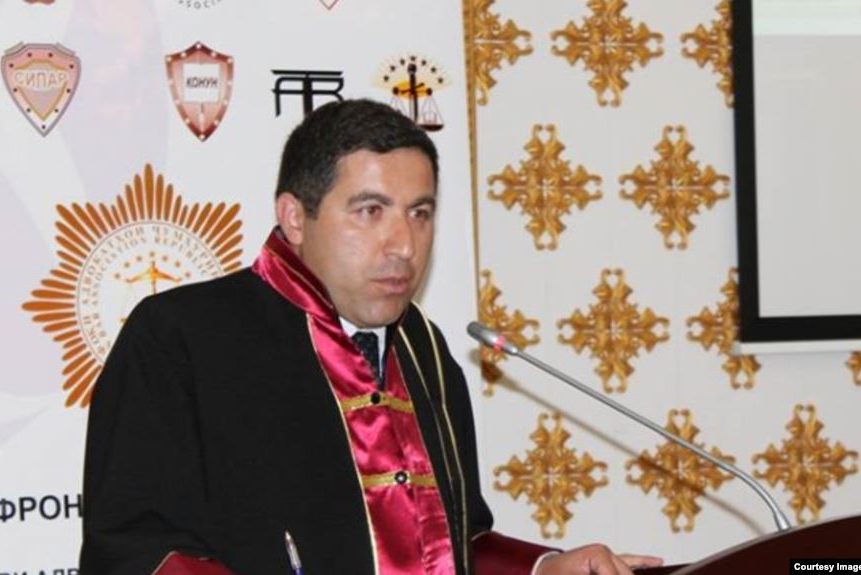
Today, the ICJ called on the authorities in Tajikistan to immediately release a prominent lawyer who is currently serving a sentence of imprisonment of 28 years on dubious charges.
The UN Working Group on Arbitrary Detention (WGAD) published a decision in Mr Yorov’s case on (date), finding that “the trials of Mr. Yorov were carried out in total disregard for the guarantees encapsulated in article 14 of the Covenant, being of such gravity as to give the deprivation of liberty of Mr Yorov an arbitrary character […].”
The Working Group recommended that the government remedy the situation of Yorov without delay and to this end “release Mr. Yorov immediately and accord him an enforceable right to compensation and other reparations, in accordance with international law”.
The ICJ has previously expressed concern that Buzurgmehr Yorov’s conviction may constitute a reprisal for his defense work in high-profile political trials in connection with his representation of thirteen leaders of the Islamic Renaissance Party of Tajikistan (IRPT).
The ICJ earlier expressed concerns at the conviction of the lawyer to a 28 year sentence in prison, which is based on clearly improper charges related to the defense of his clients.
The ICJ welcomes the decision of the WGAD and calls on the Tajikistan authorities to fully implement the decision and to take all necessary measures to protect lawyer Yorov, his family and his lawyers against any threats to their security, or any intimidation, hindrance, harassment or improper interference with their performance of their professional functions as lawyers.
In this regard, the ICJ notes recent protests by dozens of individuals who took part in a rally against Yorov in front of the representative offices of the United Nations and the European Union in Tajikistan, soon after the decision of the WGAD.
Posters of the demonstrators called on the UN High Commissioner of Human Rights to “take her hands off Tajikistan” and named organisations that had defended Mr Yorov or brought the petition on behalf of Yorov to the UN WGAD.
In this context, it is imperative that the Tajikistan government immediately publicly affirm the legitimacy of the decision of the WGAD and make clear its commitment to complying with it, the ICJ underlined.
Background
Buzurgmekhr Yorov was arrested two years ago on 28 September 2015, on charges of “fraud” and “forgery of documents.” Later, he was accused of violating three more articles of the Criminal Code, including in relation to alleged “public calls for extremist activity.”
On 6 October 2016, The Dushanbe City Court sentenced Yorov to 23 years imprisonment in a strict regime prison.
In March 2017, Yorov was sentenced to an additional two years’ deprivation of liberty for “contempt of court and insulting the representative of power.” In August 2017, he received a further three years sentence on charges of “insulting the president.”
The ICJ has, on a number of occasions, expressed its serious concerns over the arrest and conviction of Buzurgmehr Yorov and other lawyers in Tajikistan.
On 24 May 2019, the UN Working Group on Arbitrary Detention, a group of independent experts established in 1991 whose members are appointed by the UN Human Rights Council, published an Opinion finding a number of violations of human rights of Yorov protected under the International Covenant on Civil and Political Rights and recommended as a remedy his immediate release, payment of compensation or other reparation and conducting an investigation into the violation of Yorov’s rights.
The UN Basic Principles on the Role of Lawyers require that the Governments ensure that lawyers “are able to perform all of their professional functions without intimidation, hindrance, harassment or improper interference ”. Under these Principles “where the security of lawyers is threatened as a result of discharging their functions, they shall be adequately safeguarded by the authorities.” The right to “offer and provide professionally qualified legal assistance or other relevant advice and assistance in defending human rights and fundamental freedoms” is guaranteed by the Declaration on the Right and Responsibility of Individuals, Groups and Organs of Society to Promote and Protect Universally Recognized Human Rights and Fundamental Freedoms (Article 9.3(c)).
Jun 7, 2019 | News
The ICJ today condemned the impending moves to subject three prominent Saudi clerics to an inevitably unfair trial on dubious charges that might result in sentences of death and arbitrary execution.
According to credible media reports citing Saudi government sources, Salman al-Odah, Ali Al-Omari and Awad al-Qarni, three prominent Saudi clerics, will almost certainly be convicted, sentenced to death and executed soon after Ramadan.
The media reports follow last April’s mass executions of 37 people, and the crucifixion of one them, following their conviction and sentencing to death for similar “terrorism” related charges.
The ICJ calls for the clerics’ release unless they can be charged with a recognizable criminal offence consistent with the rule of law, and tried before a competent, independent, and impartial court that ensures fair trial rights.
“Saudi Arabia is abusively resorting to terrorism related charges, unfair trials, and sentences of death followed by arbitrary execution to permanently silence perceived critical voices,” said Said Benarbia, the ICJ’s MENA Programme Director.
“Instead of perpetuating egregious violations of the right to life, Saudi authorities must administer justice fairly and in accordance with international law and standards,” he added.
One of the defendants, Salman al-Odah, was charged by prosecutors in September 2018 with 37 offences, including “belonging to a terrorist group: the Muslim Brotherhood,” “stirring public discord and inciting people against the ruler,” “calling for change in government,” “supporting Arab revolutions,” “possessing banned books” and “describing the Saudi government as a tyranny.”
The ICJ fears that Salman al-Odah may be subject to these charges simply for exercising his protected right to freedom of expression.
Together with the other two clerics, Salman al-Odah faces trial before the specialized criminal court, an exceptional court that fails to ensure respect of fair trial rights and that has been used to try those suspected of committing terrorism related offences, political activists, and human rights defenders.
The ICJ is concerned that since their arrest in September 2017, the clerics have allegedly been subject to incommunicado detention and prolonged solitary confinement for months. Such treatment amounts to torture or cruel, inhuman and degrading treatment, prohibited under international law.
Carrying out executions following proceedings that fail to scrupulously observe international fair trial standards always amounts to an arbitrary deprivation of life.
The ICJ opposes the use of the death penalty in all circumstances as a violation of the right to life and a form of cruel, inhuman and degrading punishment.
The ICJ underscores that the United Nations General Assembly, by an overwhelming majority, has repeated called on States that retain the death penalty to impose an immediate moratorium on executions with a view to abolition.
The ICJ calls on the Saudi authorities to immediately move toward abolishing the death penalty and impose an immediate moratorium on executions.
Background
The clerics’ detention and ongoing trial are part of a broader crackdown on activists and dissidents since September 2017, including through politicized judicial proceedings and trumped up charges under the 2014 Royal Decree.
The Decree criminalizes as terrorism offences acts that do not involve serious violence, including acts that aim to suspend the enforcement of the Constitution or some of its articles, as well as any acts that undermine the State’s prestige and standing.
Such broad definitions have effectively been used to criminalize the legitimate and peaceful exercise of human rights, including the rights to freedom of expression, association and assembly, and the right to take part in the conduct of public affairs.
The 2014 Royal Decree also allows the Minister of Interior to order the arrest of any person suspected of committing terrorism related offences, and for those arrested to remain in pre-trial detention for up to six months and to be prohibited from communicating with their family members for up to three months. Those arrested cannot be released pending trial without the authorization of the Minister of Interior or someone authorized by him.
Such conditions contravene international standards on the rights to liberty and to a fair trial.
Saudi Arabia-Death penalty-News-2019-ARA (Arabic version, in PDF)

Jun 6, 2019 | News
The ICJ today called on the Zimbabwe government to stop using the highly criticized offence of “subverting a constitutional government” to punish human rights defenders for the exercise of fundamental freedoms protected under international and Zimbabwe Law.
George Makoni, Tatenda Mombeyarara, Gamuchirai Mukura Nyasha Mpahlo, Farirai Gumbonzvanda, Rita Nyamupinga, and Stabile Dewa, referred to by the media as the “Zimbabwe 7”, have been charged under section 22 of the Criminal Law (Codification and Reform) Act [Chapter 9:23] and will face a bail hearing, due to be heard at the High Court in Harare on 6 and 7 June 2019.
“The Zimbabwean authorities need to desist from the growing practice of abusing the offence of subverting a constitutional government as an instrument to persecute human rights defenders through abuse of the legal system,” said Arnold Tsunga, ICJ’s Africa Director.
“The oppressive and retaliatory use of law by government violates the rule of law and human rights as guaranteed in the Zimbabwean Constitution as well as in regional and global human rights treaties to which Zimbabwe is a State party,” he added.
The ICJ has previously shown that the law of subversion in Zimbabwe has been used often against HRDs who peacefully exercise their fundamental freedoms, with no single conviction to date.
The law violates the African Charter on Human and Peoples Rights and the International Covenant on Civil and Political Rights (both of which Zimbabwe is a party to), including the rights of persons to freedom of opinion and expression (Article 9 African Charter on Human and People’s Rights; article 19 ICCPR), freedom of assembly (article 11 ACHPR; 21 ICCPR) article, freedom of association (article 10 ACHPR; article 22 ICCPR), and the right to political participation (article 25 ICCPR).
The UN Declaration on Human Rights defenders, adopted by the UN General Assembly, requires that States afford particular protection to human rights defenders (HRDs) who exercise these rights.
HRDs charged with this offence can face a sentence of up to 20 years in prison and have often been denied bail for some periods, in contravention of international law, which provides that charged persons should generally not be held in pre-trial detention. Such prolonged pretrial detention effectively serves as pre-trial punishment of suspects.
“Criminal law must never be used as a means to silence opposition or persecute human rights defenders, which also necessarily has a chilling on others who perform critical human rights work. It is important that the police do not arrest to investigate but they must investigate before they arrest,” said Tsunga.
Contact
Arnold Tsunga, ICJ’s Africa Director, t: +27716405926 ; e: arnold.tsunga(a)icj.org
Background
Four human rights defenders, George Makoni, Tatenda Mombeyarara, Gamuchirai Mukura and Nyasha Mpahlo were arrested on 20th May 2019 upon arrival at Robert Mugabe International Airport, Harare from the Maldives where they had attended a workshop on human rights work. Law enforcement officials alleged in the charge sheet that,” during the workshop, the four had received training on the use of small weapons, how to mobilize citizens to turn against the government and to engage in acts of civil disobedience and or resistance to law during anticipated national protests. Law enforcement agents confiscated the HRDs’ laptops and cell phones. In similar fashion, Social Justice and Girls’ Rights advocate Farirai Gumbonzvanda was arrested upon arrival at the Harare airport on 21 May. Charged with the offence of subverting constitutional government as defined in section 22(2)(a)(iii) of the Criminal Law (Codification and Reform) Act, all five persons remain in custody as their application for bail in the High Court of Zimbabwe has been postponed to 7th June 2019.
In related circumstances, Director of Female Prisoners Support Trust, Rita Nyamupinga and Stabile Dewa, Director of Women’s Academy for Leadership and Political Excellence were arrested on 28 May 2019 soon after they arrived at the Harare airport. They were taken to Harare Central Police Station without having an opportunity to consult their lawyers. Both women have also been charged with subverting constitutional government and have been remanded in custody since 29th May 2019 pending their bail hearing today.
Apr 29, 2019 | News
On 27 and 28 April 2019, the ICJ held a workshop on “Ensuring accountability through the Specialized Criminal Chambers” in coordination with the Association des Magistrats Tunisiens (AMT).
Participants in the workshop included 28 Tunisian judges attached to the Specialized Criminal Chambers (SCC).
The workshop aimed to reinforce the capacity of SCC judges to effectively exercise their role in adjudicating crimes under international law, in line with international law and standards.
ICJ legal advisers and Tunisian experts gave presentations on State the obligations of State actors to respect and apply international law, the legal framework governing the application of international law in Tunisia, and the principle of legality and statutory limitations to crimes under international law. They also spoke on the international and domestic definitions of crimes under international law and modes of liability.
Through working group and plenary sessions, the participants discussed options for applying international law and standards at the national level.
Expert speakers included Judge Brahim Weslati, Judge Radhouane Werthy and Imen Soussi.

Apr 11, 2019 | Advocacy
Today the ICJ joined twenty organizations in calling for Myanmar’s new Constitutional Amendment Committee to fully protect the right to freedom of expression in the Constitution, in line with international law and standards including Article 19 of the International Covenant on Civil and Political Rights.
The statement reads:
“20 expert organisations urge Myanmar to fully guarantee the internationally protected right to freedom of expression in the Constitution
11 April 2019 — A new parliamentary committee tasked with reviewing Myanmar’s constitution is an opportunity for the government to guarantee the democratic rights to free expression, media freedom, and access to information.
We welcome the government’s creation of the Constitutional Amendment Committee, established to review and propose amendments that will support Myanmar’s transition to democracy.
Myanmar’s 2008 Constitution does not include the guarantees required in a democracy to protect freedom of expression. Those that it does include do not meet relevant international human rights standards. This threatens the transition to and quality of Myanmar’s democracy as can be seen for example in the wide range of laws used to prosecute journalists and human rights defenders.
We call on the Constitutional Amendment Committee to recommend:
- Replacement of the current heavily prescribed guarantee for freedom of expression in Articles 354(a) and 365 with a single article that guarantees the right to freedom of expression in accordance with international standards, so that it fully reflects the requirements of Article 19 of the International Covenant on Civil and Political Rights.
- A new separate article guaranteeing the right to access information held by public authorities.
- A new separate article guaranteeing media freedom, which should prohibit prior censorship of the media or licensing of the print media and individual journalists, and should protect journalism as well as the independence of the Myanmar Press Council, Myanmar Broadcasting Council, and any future public service media.
- Each guarantee should include only those limitations that are provided by law and are necessary for the respect of the rights or reputations of others, or for the protection of national security or of public order, or of public health or morals.
We are committed to supporting Myanmar’s transition to democracy and would be happy to provide further information and guidance as the Committee conducts its review.”
Signed by 20 organizations with the support of 13 other organizations.
Full statement and list of organizations available in English and Burmese here: Myanmar-Joint Statement on FoE and Const Ref-Advocacy-2019-BUR