Oct 15, 2016 | News
Authorities in Jammu and Kashmir should end the use of the Jammu and Kashmir Public Safety Act (PSA) to arbitrarily detain people, including children, the ICJ, Amnesty International India and Human Rights Watch said today.
The PSA violates international due process standards and should be repealed, the groups said.
“The use of the PSA to detain people, particularly children, violates a range of human rights, and its increasing use in recent weeks undermines the rule of law and further entrenches impunity in Kashmir,” said Sam Zarifi, ICJ Asia Director.
“Police should end the use of the PSA; if people are suspected of committing offences, they should be properly charged and given fair trials,” he added.
The PSA is an administrative detention law that allows detention without charge or trial for up to two years in some cases.
Following an amendment in 2012, the PSA expressly prohibits the detention of anyone under 18.
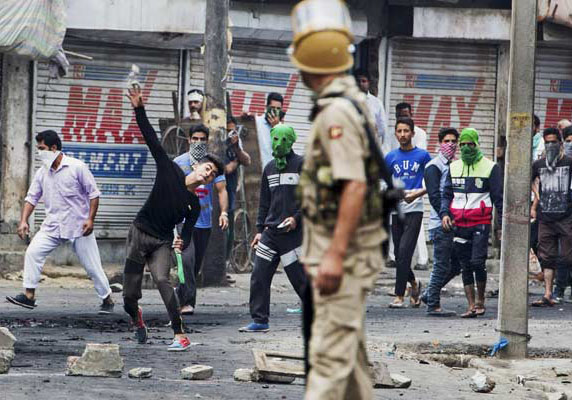
Between 9 July – when protests and violent clashes broke out in the state following the killing of a leader of the armed group Hizbul Mujahideen – and 6 October, authorities have detained over 400 people, including children, under the PSA, according to media reports.
“The government has a responsibility to address violence during protests, but indefinitely detaining people without charge only adds to the lawlessness,” said Meenakshi Ganguly, South Asia Director, Human Rights Watch. “Detaining children under the PSA is not only unlawful, but could have negative repercussions for years.”
On 16 September, Rayees Ahmad Mir, who is 16 years old according to his school records, was arrested in Baramulla district under ordinary criminal procedure for allegedly throwing stones at security forces.
Two days later, an executive official passed an order to detain him under the PSA, to preclude his release on bail.
The order incorrectly stated that he was 18 years old. Rayees Mir’s family challenged the order before the Jammu and Kashmir High Court, producing documents that proved he was only 16.
On 7 October, the court stated that Rayees Mir should be treated according to juvenile justice rules, as there was prima face evidence that he was a minor, and ordered his transfer to a juvenile home. The PSA detention order has not yet been quashed.
An official at the Kot Bhalwal jail said on 14 October that the prison authorities had not yet transferred Rayees Mir, as they had not received a copy of the court order.
Mir Shafqat Hussain, a lawyer representing many PSA detainees, said: “In a number of cases the families have not been informed about the grounds of detention. Arresting minors and booking them under PSA is definitely going to have an effect on their psyche. From schools and colleges, these boys end up in jails where they will be kept together with adults. It is definitely going to have an adverse effect on them.”
On 18 August, Waheed Ahmed Gojree, who is 16 according to his school records, was arrested in Kupwara district and detained at a police station.
According to his family, the police at first told them he would be released the next day, but then said that he had been detained under the PSA.
He was first taken to a jail in Baramulla, and then to the central jail in Jammu.
An official at the central jail confirmed that he had been detained under the PSA.
The family has not yet received a copy of the detention order, or been formally informed about the grounds of Waheed Gojree’s detention.
The authorities appear to have not taken his age into account before issuing his detention order.
“The central and state governments have spoken about following the principle of insaniyat, or humanity, in dealing with the crisis in Jammu and Kashmir,” said Aakar Patel, Executive Director at Amnesty International India. “But detaining children under the PSA is neither humane nor lawful.”
Amnesty International India, Human Rights Watch and the ICJ believe that anyone detained under the PSA must either be charged promptly with a recognizable criminal offence or prosecuted in a fair trial, or else be released.
Not prosecuting people suspected of committing offences can also violate the human rights of the victims of these offences.
Contact
Sam Zarifi, ICJ Asia & Pacific Regional Director (Bangkok), t: +66 807819002; email: sam.zarifi(a)icj.org
india-joint-statement-psa-news-press-release-2016-eng (full text of statement, in PDF)
Oct 11, 2016 | News
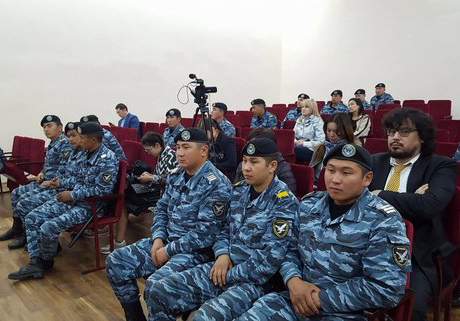
Today, the ICJ observed a hearing in the case of Azimzhan Askarov, a prominent human rights defender in Kyrgyzstan, convicted in 2011 of murder and incitement to ethnic hatred, after an unfair trial, and sentenced to life imprisonment.
Azimzhan Askarov is appealing against his conviction following a decision of the UN Human Rights Committee.
The Chuy Court began the appeal hearing in the case on 4 October, following the findings of the UN Human Rights Committee that Azimzhan Askarov’s arrest, detention and trial violated the International Covenant on Civil and Political Rights (ICCPR), including the prohibition on torture or other ill-treatment, the prohibition on arbitrary detention, and the right to fair trial.
As a result, the Supreme Court ordered a reconsideration of the case earlier this year.
At today’s hearing a witness who was Askarov’s former cellmate confessed that he beat Askarov up in detention, which is the first time that direct testimony about Askarov’s torture or other ill-treatment has been presented to the Court.
Previously such allegations were refuted by the prosecution.
The next hearing is scheduled for 18 October. The ICJ will continue monitoring the case in future hearings.
Contact
Róisín Pillay, e: roisin.pillay(a)icj.org
Dmitry Nurumov, e: dmitry.nurumov(a)icj.org
Background
Azimzhan Askarov, a prominent human rights defender, was convicted of murder and incitement to ethnic hatred and sentenced to life imprisonment in December 2011.
The charges concerned allegations of his participation in a murder of Myktybek Sulayamanov, a police officer, during the 2010 ethnic clashes in the South of Kyrgyzstan.
The ICJ observed the appeal hearing in the case before the Supreme Court on 20 December 2011.
Based on the results of the mission as well as the documents of the case, the ICJ published a detailed report on the arrest, detention and trial of Azimzhan Askarov.
In March 2016, the UN Human Rights Committee issued a decision in regard to Askarov’s complaint and found violations of Articles 7 (freedom from torture), Article 9 (prohibition of arbitrary detention); Article 10 (right to humane treatment in detention), Article 14 (right to a fair trial) of the International Covenant on Civil and Political Rights.
On 12 July 2016, the Supreme Court ordered a further reconsideration of the case on appeal.
The Chuy Regional Court is currently considering the case.
kyrgyzstan-askarov-trial-obs-news-web-story-2016-rus (full story in Russian, PDF)

Oct 3, 2016 | News
The government should drop all proceedings against human rights lawyer, Sirikan Charoensiri, including the specious accusation of sedition, which apparently relate to her organization’s representation of 14 student activists peacefully protesting in June 2015, the ICJ and other groups said today.
On 27 September 2016, Sirikan Charoensiri (photo), a lawyer and documentation specialist at Thai Lawyers for Human Rights (TLHR), received a summons from the Thai Police following accusations that she violated Article 12 of the Head of National Council for Peace and Order (NCPO) Order 3/2015, prohibiting the gathering of five or more people for political purposes, and Article 116 of the Thai Criminal Code, a ‘sedition’-type offence.
According to the summons, the accusations are made by an army officer, Lieutenant Colonel Pongsarit Pawangkanan.
Sirikan Charoensiri received the summons, dated 20 September 2016, when she returned to Thailand after attending the 33rd Session of the Human Rights Council in Geneva where she conducted advocacy on the human rights situation in Thailand on behalf of FORUM-ASIA and the ICJ.
Sirikan Charoensiri did not receive an earlier summons, dated 14 September 2016, the police claimed had been sent to her apartment, as she was not home at the time.
Sirikan Charoensiri has already been charged with two offences under the Criminal Code of Thailand: “giving false information regarding a criminal offence” and “refusing to comply with the order of an official” in relation to TLHR’s provision of legal aid to 14 student activists – the new summons appears to relate to the same case.
“The army’s accusation that Sirikan Charoensiri has violated the frequently abused sedition law with its extremely serious penalties and risk of a military trial is indefensible and must be withdrawn immediately,” said Wilder Tayler, Secretary General of the ICJ.
“The fact that the authorities have made these accusations more than one year after TLHR’s clients were charged with sedition in the same case suggest the accusations have been made in retaliation for her high-profile national and international human rights advocacy since the military coup,” he added.
The other groups who signed the statement are: Human Rights Watch, Amnesty International, Asian Forum for Human Rights and Development (FORUM-ASIA), the Observatory for the Protection of Human Rights Defenders (an FIDH–OMCT partnership), Protection International (PI), Lawyers’ Rights Watch Canada (LRWC), Fortify Rights, and the International Service for Human Rights (ISHR).
thailand-sirikan-charoensiri-conviction-news-press-releases-2016-eng (full text in PDF)
thailand-sirikan-charoensiri-conviction-news-press-releases-2016-tha (Thai version, in PDF)
Sep 20, 2016 | News
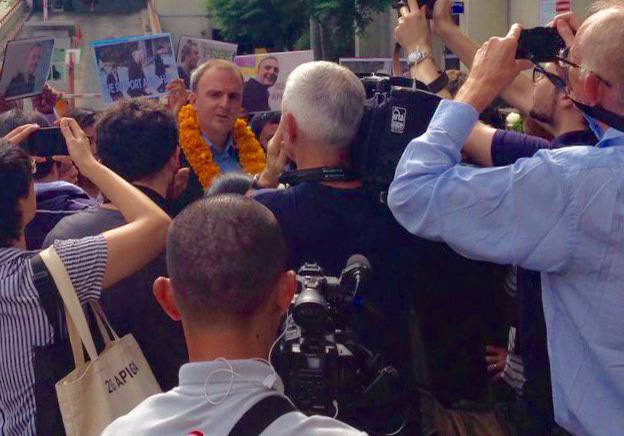
The ICJ expresses its disappointment with today’s verdict criminalizing the work of human rights defender, Andy Hall, and calls upon Thailand to decriminalize defamation and amend the Computer Crime Act in line with international standards protecting freedom of expression.
This morning, Thailand’s Southern Bangkok Criminal Court found Andy Hall guilty of defaming a Thai fruit processing company under Article 328 of the Thai Criminal Code and violation of Article 14(1) of the Computer Crime Act, and sentenced him to a fine of THB 200,000 (USD$ 5,700) reduced to THB 150,000 (USD $4,300); and four years imprisonment, reduced to three years and suspended for two years.
Andy Hall has said he will appeal the verdict.
“Human rights defenders such as Andy Hall have the right to exercise freedom of expression in advocating for the protection and realization of human rights – a right that Thailand has a duty to protect,” said Kingsley Abbott, Senior International Legal Adviser at the ICJ.
“Unfortunately, there are numerous examples of criminal defamation and the Computer Crime Act being used against human rights defenders in Thailand, a practice that must end, including through a substantial reform of these laws,” he added.
The ICJ and Lawyers Rights Watch Canada submitted a joint amicus curiae brief in the proceedings, arguing that the imposition of harsh penalties such as imprisonment or large fines on a human rights defender risk having a ‘chilling effect’ on the exercise of freedom of expression, which Thailand is bound to protect pursuant to its international legal obligations.
The ICJ anticipates the arguments contained in the joint amicus will be considered on appeal.
“It is also disappointing that the Court did not appear to take into account the recent decision of the Phuket Provincial Court in the Phuketwan case, which found that the Computer Crime Act was not intended to be used in cases of alleged defamation,” said Abbott.
On 1 September 2015, the Phuket Provincial Court acquitted two journalists of criminal defamation and violations of the Computer Crime Act after the Royal Thai Navy complained the journalists defamed it when, on 17 July 2013, the journalists reproduced a paragraph from a Pulitzer prize-winning Reuters article that alleged “Thai naval forces” were complicit in human trafficking.
The criminal defamation proceedings brought against Andy Hall are among several that have been brought against human rights defenders in Thailand in recent years.
Others examples include the charges laid against activists Pornpen Khongkachonkiet, Somchai Homloar and Anchana Heemina in July 2016 for raising allegations of torture in the deep South; and those brought against activists protesting various development projects in Thailand which are allegedly having an adverse impact on communities.
Background
Today’s case is one of four criminal and civil proceedings (two criminal and two civil) a Thai fruit processing company, Natural Fruit Company Ltd., has brought against Andy Hall in relation to the report of a Finnish NGO, Finnwatch, published in January 2013, called Cheap Has a High Price.
Andy Hall’s research was included in the report which alleged that labour rights violations were taking place at Natural Fruit Company Ltd., whose employees included migrant workers from Myanmar.
In September 2015, a Thai Appeal Court upheld the dismissal of the other criminal defamation proceeding Natural Fruit Company Ltd. brought against Andy Hall. That proceeding is currently before the Supreme Court. Two civil proceedings are also before the Thai courts but have been suspended pending resolution of the two criminal proceedings.
The use of criminal defamation laws, carrying penalties of imprisonment, against human rights defenders reporting on alleged human violations, constitutes a violation of Thailand’s obligations under the International Covenant on Civil and Political Rights (ICCPR), to which it is a state party.
thailand-verdict-andy-hall-case-news-press-release-2016-eng (full text in PDF)
thailand-verdict-andy-hall-case-news-press-release-2016-tha (full text in Thai, PDF)
Contact
Sam Zarifi, ICJ Asia Pacific Regional Director (Bangkok), t: +66 807819002; e: sam.zarifi(a)icj.org
Kingsley Abbott, ICJ Senior International Legal Adviser, t: +66 9 4470 1345, e: kingsley.abbott(a)icj.org
Sep 16, 2016 | Advocacy, Non-legal submissions
On 16 September 2016, the ICJ made a submission to the Universal Periodic Review of India.
The submission brings to the attention of the members of the Human Rights Council’s Working Group on the UPR issues concerning:
- discrimination and violence based on sexual orientation and gender identity;
- death penalty;
- impunity and accountability;
- freedom of speech, expression and association;
- ratification and implementation of international human rights instruments.
india-icj-upr-submission-advocay-non-legal-submission-2016-eng (full text in PDF)