Feb 7, 2014 | News
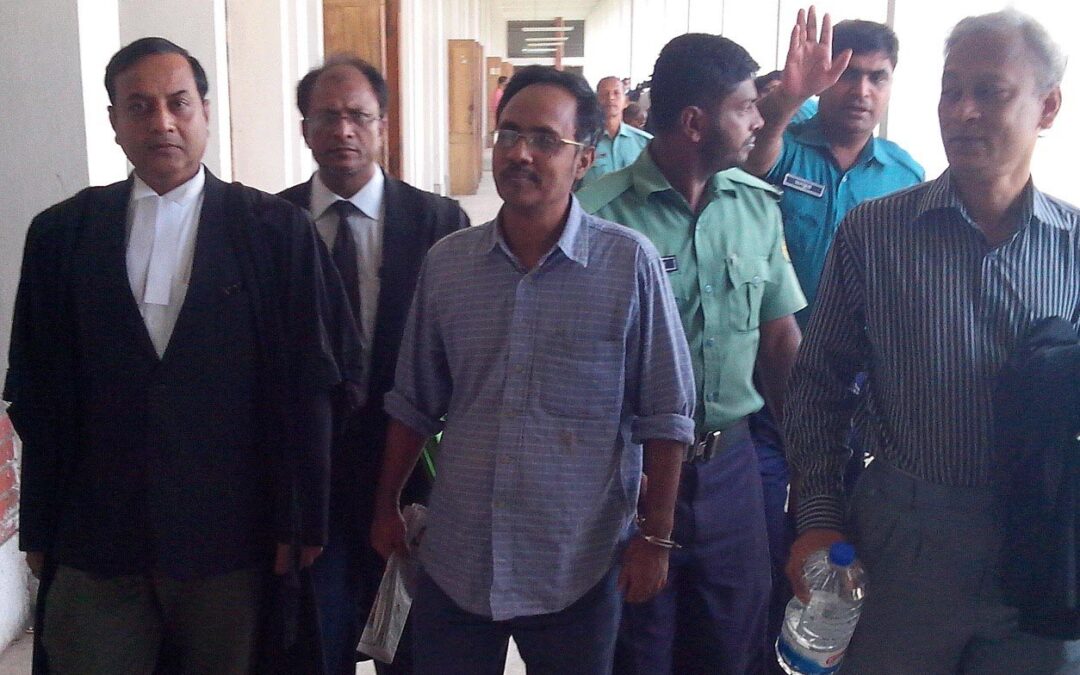
Bangladesh authorities must immediately cease their harassment of Adilur Rahman Khan, Secretary of Odhikar, a prominent human rights organization and ICJ affiliate, and members of his family, the ICJ said today.
On 5 February 2014, Odhikar reported that two officers of the Special Branch of Police followed a member of Adilur Rahman Khan’s family from his home. When he realized he was being followed he decided to return home. The security officers continued to follow him, and parked their motorcycle next to his house.
Odhikar previously reported that security forces monitor its Dhaka offices as well as Adilur Rahman Khan, his family and other staff. In August 2013, security forces raided Odhikar’s office, confiscating computers containing potentially sensitive material such as the identities of witnesses.
“These actions are deliberate acts of intimidation against Odhikar, its staff and their families, designed to silence the legitimate actions of human rights defenders,” said Ben Schonveld, the ICJ’s Asia Director.
Article 12 of the United Nations Declaration on the Right and Responsibility of Individuals, Groups, and Organs of Society to Promote and Protect Universally Recognized Human Rights and Fundamental Freedoms (Declaration on Human Rights Defenders), clarifies that States must take all necessary measures to ensure the protection of human rights defenders from any violence, threat, retaliation, pressure, or any other arbitrary action as a consequence of the legitimate exercise of rights, including the freedom of expression.
Background:
Adilur Rahman Khan and Nasiruddin Elan, Secretary and Director of Odhikar, have been charged under section 57 of the Information and Communication Technology (ICT) Act, 2006, for publishing a report on the Government crackdown on a Hefazat-e-Islam rally in May 2013. The report alleged that 61 people were killed in the protest; the Government disputes the number of casualties. Rahman and Khan were indicted on 8 January 2014 and are both currently on bail.
Contact:
Ben Schonveld, ICJ South Asia Director (Kathmandu), t: +977 14432651; email: ben.schonveld(a)icj.org
Reema Omer, ICJ International Legal Advisor (London), t: +447889565691; email: reema.omer(a)icj.org

Jan 21, 2014 | Advocacy, Non-legal submissions, Position papers
The ICJ submitted today its contribution to the public consultation of the European Commission on the future of home affairs policies in the European Union.
In its contribution, the ICJ highlighted the need to increase human rights protection in EU home affairs legislation and in its implementation.
The ICJ submission recommends an increased monitoring of the human rights compliance of draft legislation; calls for increased transparency in the legislative process; and for a better use of infringement proceedings by the European Commission to ensure the effective implementation of EU home affairs legislation with particular attention to the protection of human rights.
The ICJ addressed, in its contribution, the importance of a correct and human rights compliant implementation of the new Common European Asylum System, and the need of further reforms in the EU legislation on asylum, migration and border control.
Finally, the ICJ stressed the poor record of the EU institutions, besides the European Parliament, in ensuring accountability for human rights violations committed in countering terrorism, for example in the cases of the National Security Agency (NSA) surveillance programme scandal and in the cases of alleged complicity of European States in the US-led system of renditions and secret detentions.
EU-PublicConsultation-ICJ-FutureHomeAffairs-2014-Final (download the contribution)
Jan 10, 2014 | News
The ICJ calls on the Bangladeshi authorities to immediately and unconditionally drop ‘cybercrime’ charges against Nasiruddin Elan and Adilur Rahman Khan, President and Secretary of the human rights group Odhikar.
“These charges are a flagrant attempt to silence critical voices, and the Bangladeshi authorities must immediately and unconditionally drop all charges against the two human rights defenders,” said Sam Zarifi, ICJ’s Asia director.
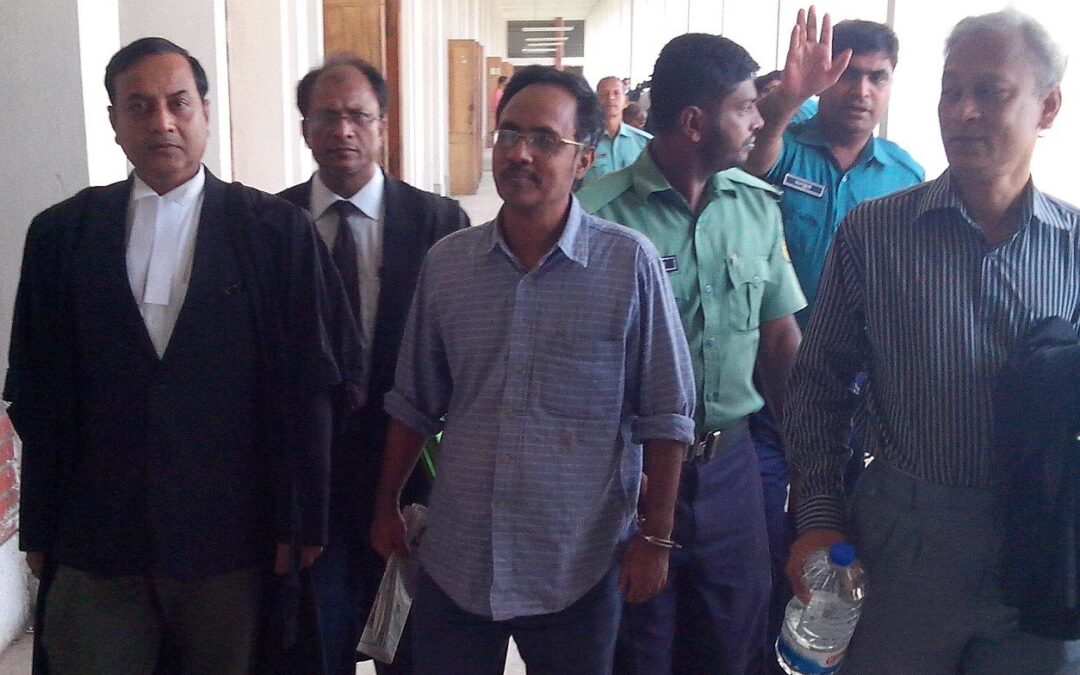
On 8 January 2014, a cyber crimes tribunal in Dhaka indicted Nasiruddin Elan (picture, on centre) and Adilur Rahman Khan under section 57 (1) and (2) of the Information and Communication Technology (ICT) Act, 2006, for publishing “fake, distorted and defamatory” information. Khan and Elan plead innocent to the charges.
The charges relate to a report by Odhikar that alleged that security forces had killed 61 people during a rally by the Islamist group Hefazat-e Islam in May 2013. The Government disputes the casualty numbers.
The trial is set to begin on 22 January 2014. Under the terms of the newly amended ACT the two human rights defenders face a minimum of seven and maximum of 14 years imprisonment.
“The ICJ has warned that the ICT Act can be used to attack freedom of expression in Bangladesh,” said Sam Zarifi. “As predicted, the Government is now using the newly amended law to silence political and public discourse through the threat of punitive sentences and deliberately vague and overbroad offences in clear violation of international law.”
In a briefing paper released on 20 November 2013, ICJ highlighted that provisions of the 2006 ICT Act (amended 2013), particularly section 57, violate Article 19 of the International Covenant on Civil and Political Rights (ICCPR), which Bangladesh ratified on 6 September 2000: the offences prescribed are poorly defined and overbroad; the restrictions imposed on freedom of expression go beyond what is permissible under Article 19(3) of the ICCPR; and the restrictions are not necessary and proportionate to achieve a legitimate purpose.
In addition, the UN Declaration on Human Rights Defenders underscores that States must take all necessary measures to protect human rights defenders “against any violence, threats, retaliation, de facto or de jure adverse discrimination, pressure or any other arbitrary action as a consequence of his or her legitimate exercise of his or her rights.”
Contact:
Sam Zarifi, ICJ Asia-Pacific Regional Director, (Bangkok), t: +66 807819002; email: sam.zarifi(a)icj.org
Ben Schonveld, ICJ South Asia Director, t: +61 422 561834; email: ben.schonveld(a)icj.org
Additional information
Adilur Rahman Khan was arrested his home on 10 August 2013 without an arrest warrant.On August 11, a Magistrate’s Court refused his bail application and remanded him for five days of custodial interrogation.
On August 12, the High Court Division of the Supreme Court stayed the remand order and directed that Adilur Rahman be sent back to jail, where he could be interrogated ‘at the gate of the jail.’
On 4 September 2013, the Detective Branch of Police filed a charge sheet against Adilur Rahman Khan and Odhikar’s Director, Nasiruddin Elan, under Section 57 of the International Communication and Technology Act 2006. On 30 October Adilur Rahman Khan was released on bail. On 6 November 2013, a Dhaka cyber crimes tribunal rejected Nasiruddin Elan’s bail application and ordered his detention in Dhaka Central Jail. Bail was granted on 24 November by the High Court. But the bail order was finally enforced after the appellate division’s order on 3 December 2013.
Dec 19, 2013 | News
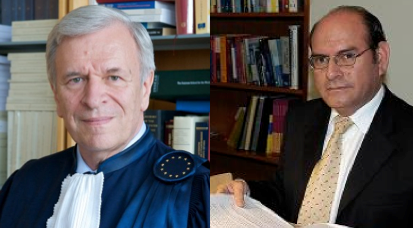
The ICJ is delighted to announce that two new Commissioners were elected in December 2013: Justice Sir Nicolas Bratza (UK) and Professor César Landa (Peru).
Justice Sir Nicolas Bratza is a former President of the European Court of Human Rights. His term on the court ended on 31 October 2012, and he resigned as a Justice of the High Court on 1 November 2012.
Professor César Landa is the Dean of the Faculty of Law at the Pontifical Catholic University of Peru. Prior to this, Processor Landa was the President of the Constitutional Court of Peru. He also served as a Judge on the Constitutional Court.
In a year of significant change within the ICJ Commission, Justice Bratza and Professor Landa are the 14th and 15th new members to join the Commission in 2013.
Biographies for all our Commissioners can be found here.

Dec 6, 2013 | News
The ICJ mourns with the rest of the world the passing on of former President Nelson Mandela.
He was a beacon of hope, justice and peace in the world and will be sorely missed. His life will remain a source of inspiration for our work in pursuit of justice, peace, tolerance and respect for human rights in the world.

![Smoke rises after an Israeli air strike on the village of Taybeh in southern Lebanon [Source: Al Jazeera]](https://www.icj.org/wp-content/uploads/2026/03/Screenshot-2026-03-20-at-15.56.24-300x200.png)