Sep 16, 2019 | Advocacy, News
Antonio Guterres should publicly condemn China’s widespread violations of the rights of its Muslim minority citizens, especially in Xinjiang Province, the ICJ demanded in a joint letter submitted along with Amnesty International, the International Federation for Human Rights (FIDH), Human Rights Watch, and the World Uyghur Congress.
The joint letter urged the UN Secretary-General to call for an end to widespread arbitrary detention of Muslim and minority communities through the immediate closure of Xinjiang’s ‘political education’ camps. Reports by the United Nations and human rights organizations have estimated that more than one million Muslims have been interned in extra-legal ‘political education’ detention camps.
“In the past few years, China’s violations in Xinjiang, including arbitrary detention, ill-treatment, pervasive surveillance and political indoctrination of Turkic Muslims, have intensified, and continue to worsen,” said Sam Zarifi, ICJ’s Secretary General.
“Quiet diplomacy has not worked. Mr. Guterres must exercise the full extent and power of his mandate as leader of the United Nations to demand and ensure protection of the rights of everyone in China, including all individuals in Xinjiang.”
The joint letter urged the UN Secretary-General to publicly support the creation of a UN fact-finding mission to assess the scale and nature of crimes under international law and human rights violations in Xinjiang. It further called on the UN Secretary-General to refrain from unqualified praise of China’s ‘Belt and Road’ Initiative – an investment initiative in which Xinjiang is a centerpiece – and to meet with representatives from the Uyghur community to hear first-hand of their plight.
“China has exerted immense and often inappropriate political pressure on individuals, governments and organizations criticizing its human rights violations,” said Zarifi. “The United Nations must push back against China’s political pressure and provide principled and steadfast leadership to end China’s political and cultural repression, and ongoing human rights violations in Xinjiang.”
Public criticism of China’s actions in Xinjiang has been growing. In August 2018, a member of the UN Committee on the Elimination of Racial Discrimination noted that China’s treatment of its Muslim minority citizens in Xinjiang had turned the region into a “‘no rights’ zone” with individuals being treated as “enemies of the State based on nothing more than their ethno-religious identity”. In March 2019, the UN High Commissioner for Human Rights, Michelle Bachelet, highlighted the need for her office to gain full access to facilitate independent and impartial investigation into ‘wide patterns of enforced disappearances and arbitrary detentions’ in the region. On 10 July 2019, 25 countries issued a joint statement calling on China to refrain from subjecting Uyghurs and other Muslim and minority communities in Xinjiang to arbitrary detention, surveillance and restrictions on freedom of movement.
Sep 16, 2019 | Advocacy, Non-legal submissions
The ICJ today put the spotlight the increase and “normalisation” of enforce disappearances and abductions worldwide, with examples about Turkey, Egypt and Saudi Arabia, speaking at the UN Human Rights Council in Geneva.
The statement, made during the general debate, reads as follows:
The International Commission of Jurists (ICJ) shares concerns highlighted by the Working Group on Enforced and Involuntary Disappearances in its report (UN doc. A/HRC/42/40) at the “increasing use of extraterritorial abductions” and at the “normalization of these practices” globally. ICJ previously documented such practices in our 2017 report, Transnational Injustices.
The killing of Jamal Khashoggi by Saudi Arabia is an example of particular concern, as is the reported abduction, by Turkish authorities, of persons they claim to be linked to “terrorist organisations.” Several of these people, who later reappeared in Turkish prisons, are currently facing serious challenges in mounting a proper legal defence. Complaints of the families have not been properly investigated.
In Egypt, the National Security Agency (NSA) has been abducting and forcibly disappearing hundreds as a technique to suppress dissent. This year, the ICJ and Adalah reported on the disappearance of 138 detainees for between 10 to 219 days, many of whom were subjected to torture.
The ICJ urges the Council to address these worrying developments and calls on all countries:
- to stop all practices of enforced disappearance, abduction or informal international transfer;
- to ratify the International Convention for the Protection of All Persons from Enforced Disappearance, and
- to provide to the victims of enforced disappearance and their families full access to their rights, including an effective remedy.
Sep 13, 2019 | Events, News
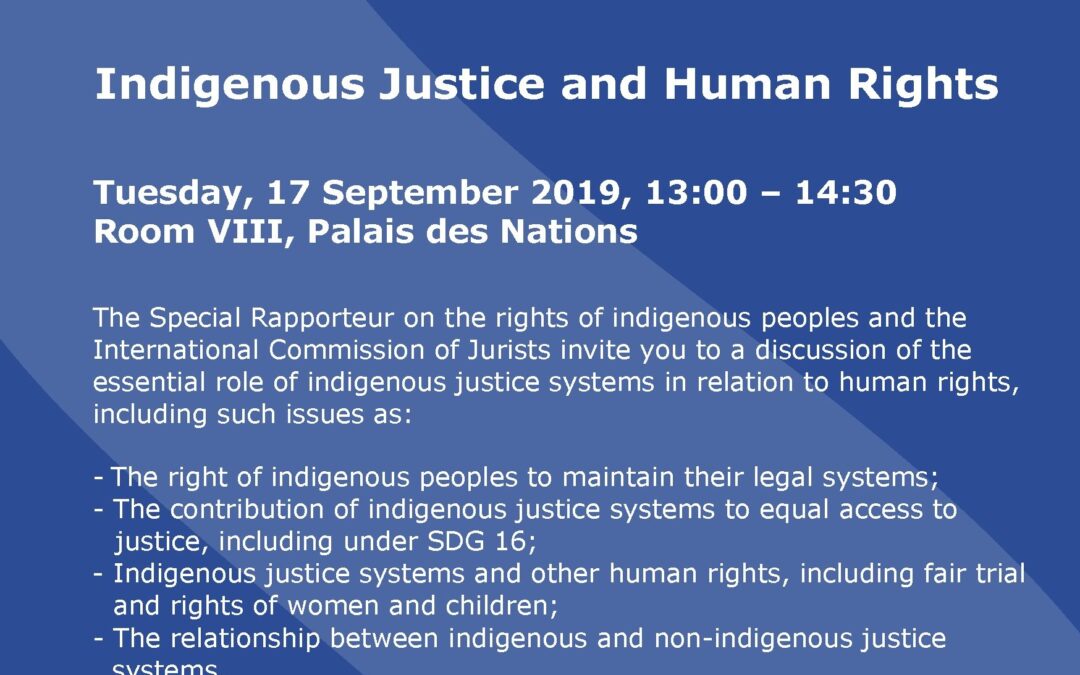
The ICJ and the UN Special Rapporteur on the rights of indigenous peoples are organizing a panel discussion on indigenous justice and human rights, at the UN Human Rights Council session in Geneva.
The event takes place Tuesday, 17 September 2019, at 13:00 – 14:30, Room VIII, in the Palais des Nations.
The event will discuss, among other aspects:
- The right of indigenous peoples to maintain their legal systems;
- The contribution of indigenous justice systems to equal access to justice, including under SDG 16;
- Indigenous justice systems and other human rights, including fair trial and rights of women and children;
- The relationship between indigenous and non-indigenous justice systems.
The panel will feature:
- Victoria Tauli Corpuz, UN Special Rapporteur on the rights of indigenous peoples.
- Ilaria Bottigliero, IDLO Director of Policy, Research and Learning.
- Jovita Tzul Tzul, indigenous lawyer from Guatemala.
- Matt Pollard, ICJ Senior Legal Adviser.
The event will allow for dynamic exchange between panelists and attendees, on current initiatives including: the Special Rapporteur’s report on indigenous justice systems; ICJ’s global initiative on indigenous and other traditional or customary justice systems; and IDLO’s series of publications titled ‘Navigating Complex Pathways to Justice: Engagement with Customary and Informal Justice Systems’, which aim to advance policy dialogue and distil lessons from programming and research to help realize SDG 16.
Spanish-English interpretation will be available.
A flyer in PDF format can be downloaded here: SideEvent-IndigenousJusticeandHumanRights
For more info contact un(a)icj.org
Sep 11, 2019 | Advocacy, Non-legal submissions
The ICJ today reiterated its call for the UN Human Rights Council to establish an international independent Commission of Inquiry on the human rights situation in Venezuela.
The statement, delivered in a general debate at the Council following the oral update by the UN High Commissioner for Human Rights mandated by the previous Human Rights Council resolution on Venezuela, read as follows:
“Mr. President,
The International Commission of Jurists (ICJ) welcomes the High Commissioner for Human Rights’ oral update on the situation in Venezuela.
The update and previous reporting point to a wide range of human rights violations, which continue to occur inside the country. These include arbitrary deprivation of liberty, serious violations of indigenous people’s rights, excessive use of force by security forces and attacks on freedom of expression, among others, as well as the impacts of laws, policies and practices that have adversely affected the independence of the judiciary.
Over the years, the International Commission of Jurists has monitored and documented the lack of judicial independence in Venezuela and the absence of accountability for those responsible for gross human rights violations.
The ICJ urges the Human Rights Council to establish an independent Commission of Inquiry on the human rights situation in Venezuela, given that Venezuelan authorities have been unable or unwilling to pursue effective domestic accountability, and judicial and prosecutorial mechanisms in the country lack independence and impartiality.
The Commission of Inquiry should be mandated to investigate reports of violations of international human rights law in Venezuela, establish the facts and circumstances of violations committed since at least 2014, and identify those responsible with a view to contributing to full accountability for all violations, including those that constitute crimes under international law.
Thank you.”
The oral update of the UN Human Commissioner for Human Rights, on the situation in Venezuela, may be accessed here.
In August 2019, the ICJ joined other NGOs in calling for an international commission of inquiry on Venezuela.
States are expected to discuss a further resolution on Venezuela at the current Human Rights Council session, for adoption on 26 or 27 September.
Sep 10, 2019 | Events, News
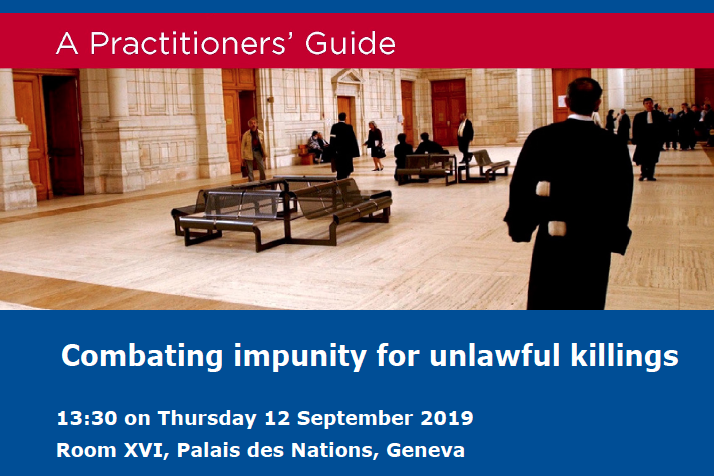
The ICJ invites you to a discussion of new tools to assist investigation and accountability for extrajudicial, summary or arbitrary executions, and other potentially unlawful deaths. The event takes place on Thursday, 12 September, 13:30, Room XVI, at the Palais des Nations in Geneva.
ICJ’s new Practitioners’ Guide No 14 on the Investigation and Prosecution of Unlawful Death helps legal practitioners ensure that investigation and accountability processes are implemented in accordance with international human rights law.
The Guide elaborates on the revised Minnesota Protocol on the Investigation of Potentially Unlawful Death (2016), a set of practical standards and guidelines that was updated by former UN Special Rapporteur on extrajudicial, summary or arbitrary executions, Christof Heyns, and published by the Office of the United Nations High Commissioner for Human Rights (OHCHR) in 2017.
The panel discussion will highlight key elements of the Protocol and Practitioners Guide, and their relevance to cases such as the 2016 killing of political commentator, Kem Ley, in Cambodia and the 2018 killing of Saudi Journalist, Jamal Khashoggi in Turkey.
Speakers
- Agnes Callamard, Special Rapporteur on extrajudicial, summary or arbitrary executions (by video conference, TBC).
- Stuart Maslen, Honorary Professor, Centre for Human Rights, University of Pretoria.
- Kingsley Abbott, Senior Legal Adviser & Coordinator of the ICJ’s Global Accountability Initiative.
Moderator
- Carolina Villadiego, ICJ Legal and Policy Adviser, Latin America
Printed copies of the ICJ’s Practitioners’ Guide No 14 on the Investigation and Prosecution of Unlawful Death will be available.
A flyer for the event is available here.
*** Room XVI is on the 5th floor of Building A, behind the Assembly Hall, accessible by the elevators at the Salle des Pas Perdus. Details here.