Mar 21, 2019 | News
In a letter to Assistant Secretary-General for Human Rights, Andrew Gilmour, the ICJ, the American Civil Liberties Union (ACLU) and the International Service for Human Rights (ISHR) call on the UN to address a clear case of intimidation and threat of reprisal by U.S. Secretary of State Michael Pompeo.
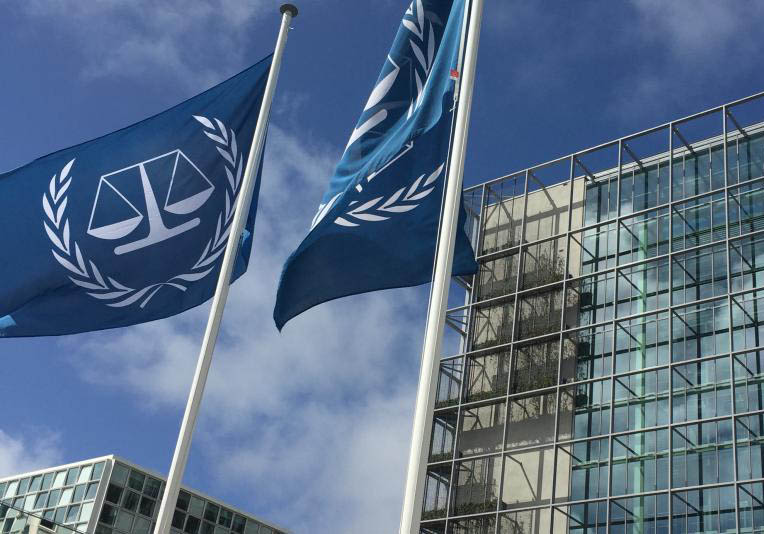
In remarks to the press on 15 March 2019, Pompeo explicitly threatened to revoke or deny visas to International Criminal Court (ICC) personnel who attempt to investigate or prosecute alleged violations committed by American nationals or against citizens of U.S. allies.
The ASG is mandated to lead efforts within the UN system to end all intimidation and reprisals against those cooperating with the UN on human rights. In keeping with this mandate, the ACLU, ICJ and ISHR call on the ASG to take urgent action, including by publicly denouncing the comments, and urging U.S. representatives to refrain from adopting any legislation, policy or practice that has the effect of undermining unhindered access to and communication with the ICC and other international bodies.
The letter states that ‘The purpose of the visa restrictions is to block and deter legitimate criminal investigation into serious crimes under international law. Not only might they have a chilling effect on ICC personnel and others advocating for accountability, but they will set a dangerous precedent with serious implications on the overall fight for impunity, especially the right of victims and their legal representatives to seek justice and reparations without fear of retaliation.’
A similar communication has also been sent to three UN experts – the Special Rapporteurs on the situation of human rights defenders, on the independence of judges and lawyers, and on the promotion of truth, justice, reparation and guarantees of non-recurrence. The experts are similarly called on to publicly denounce the comments and send a formal communication to the U.S.
“The policy announced by Pompeo is part and parcel of a concerning attack by the current U.S. administration on multilateralism, international rule of law, and global and regional bodies mandated to monitor and investigate human rights violations and fight impunity,” said Sam Zarifi, Secretary General of the ICJ.
Pompeo’s announcement comes on the heels of threats made by U.S. National Security Advisor John Bolton in a 10 September 2018 speech to the Federalist Society.
In that instance, Bolton explicitly threatened ICC judges, prosecutors, and personnel if they proceed with an investigation into alleged war crimes committed by U.S. military and intelligence forces in Afghanistan, as well as any company or state that assists the ICC.
“This is an unprecedented attempt to skirt international accountability for well-documented war crimes. It reeks of the very totalitarian practices that are characteristic of the worst human rights abusers, and is a blatant effort to intimidate and retaliate against judges, prosecutors, and advocates seeking justice for victims of serious human rights abuses,” said Jamil Dakwar, Director of the ACLU’s Human Rights Program.
The letter cites Human Rights Council Resolution 36/21 and the UN Declaration on Human Rights Defenders, which reaffirm the right of everyone, individually and in association with others, to unhindered access to and communication with international bodies.
“This latest attack by the US demands the strongest response from the UN, which until now has remained silent on the US’ bullying of the ICC,” said Madeleine Sinclair, Legal Counsel and New York Director of ISHR.
“Pompeo’s threats are a blatant violation of the right to cooperate with the ICC, undermine the ICC’s effectiveness and credibility, and amount to an attack on the international system itself,” she added.
Contact:
Sam Zarifi, International Commission of Jurists, e: sam.zarifi@icj.org ; t: +41 22 979 38 00
Abdullah Hasan, American Civil Liberties Union, e: ahasan@aclu.org, t: +1-646-905-8879
Madeleine Sinclair, International Service for Human Rights, e: m.sinclair@ishr.ch, t: +1-917-544-6148
Mar 20, 2019 | Advocacy, Non-legal submissions
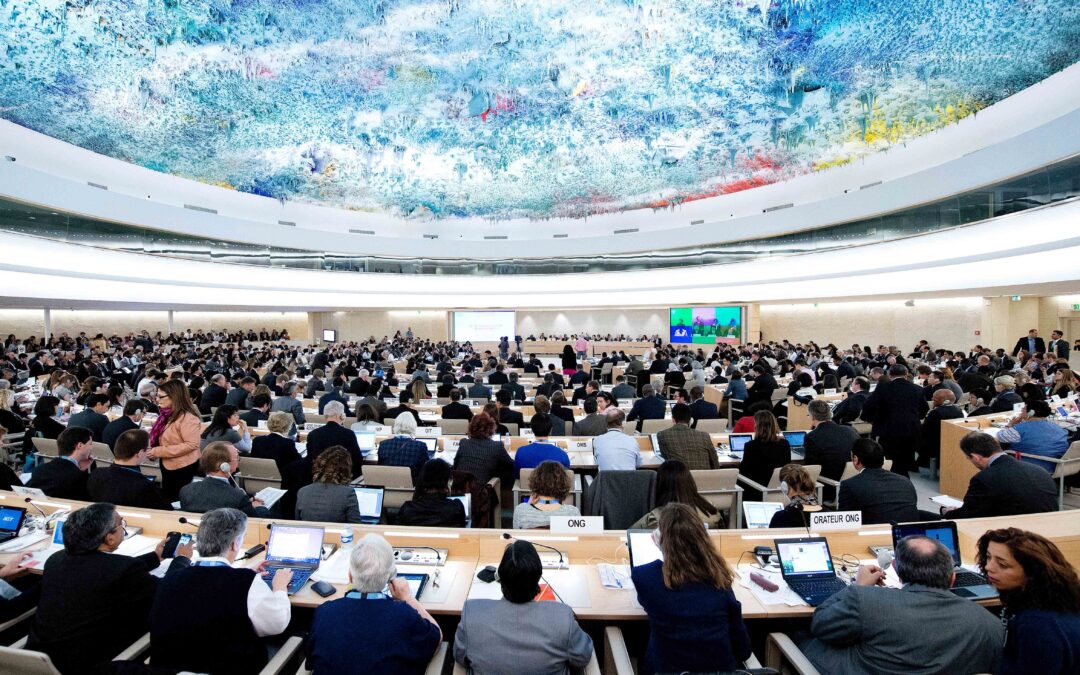
The ICJ today joined other NGOs in addressing the UN Human Rights Council session in Geneva, on the situation for human rights in Guatemala.
The statement, delivered by Franciscans International on behalf also of ICJ and other NGOs, read as follows (translation of Spanish original):
“We welcome the High Commissioner’s Report concerning the activities of her Office in Guatemala. We share the concerns and recommendations in the report, especially those related to the indigenous peoples, migrants and legislative initiatives that would impact in the full enjoyment of human rights.
As it was highlighted in the report, we are also concerned by the current discussions on the initiative to reform the National Reconciliation Law. This reform would give amnesty to those who committed serious crimes during the armed conflict, including those who have already been convicted. This puts at risk not only the fulfillment of the state’s obligations to end impunity, but also the security and access to justice of hundreds of victims and witnesses. Guatemala should dismiss immediately the initiative and refrain from promoting any other initiative that would promote impunity.
Additionally, the political and social tensions are intensifying towards the upcoming elections, and the inclusion of various groups, especially indigenous peoples, is at risk. Currently there is a low participation and representation of indigenous peoples in the political scene of the country. Out of 178 seats in the Congress, only 18 are occupied by Mayans (from which only two are women). The State must guarantee free participation, without intimidation or threats, of indigenous peoples running for different positions.
Lastly, the regional human rights situation of migrants is aggravating and the response by Guatemala, as evidenced in the last months, shows the lack of an effective policy to deal not only with migrants in transit, but also to create conditions to prevent forced migration of Guatemalans.
We thank the work that the Office of the High Commissioner for Human Rights has done, and we stress the importance of its activities in the country.”
The full statement may be downloaded in English and the original Spanish, in PDF format, here: HRC40-OralStatement-GDitem2-Guatemala-2019-EN-ESP
Mar 20, 2019 | Advocacy, Non-legal submissions
The ICJ today called at the UN for prompt establishment of a judicial accountability mechanism with international involvement, for Sri Lanka.The statement, delivered during an interactive dialogue on the OHCHR report on Sri Lanka at the Human Rights Council in Geneva, read as follows:
“The ICJ welcomes the comprehensive report of the OHCHR on promoting reconciliation, accountability and human rights in Sri Lanka (A/HRC/40/23). We share OHCHR’s observation that there is a lack of progress and absence of a comprehensive strategy for implementation of all commitments made under Resolution 30/1.
ICJ is particularly concerned about the lack of progress in the area of criminal accountability (as noted in Paragraph 27 of the report). We believe that there is an urgent need to establish a judicial mechanism with the involvement of foreign judges. We echo the sentiments of the OHCHR regarding the inability of the Sri Lankan courts, on their own, to address the impunity of security forces for crimes under international law.
Failure of the criminal justice system to effectively address emblematic cases (as reflected in Paragraph 38 of the report) clearly indicates the level of capacity and willingness on the part of the State even today to prosecute and punish perpetrators of serious crimes when they are linked to the security forces or other positions of power.
ICJ also notes that women are grossly under-represented in the judiciary in Sri Lanka, which prevents women human rights defenders and female victims from having confidence in the ordinary criminal justice system, impeding their full engagement and participation in pursuing accountability for crimes committed against them during the conflict and other transitional justice processes.
A judicial mechanism with the involvement of foreign judges is particularly urgent for women in conflict-affected areas who still live in a highly militarized environment and are compelled to live among their perpetrators – those who have been accused of war crimes including rape and other forms of sexual violence.
We therefore reject calls for a purely domestic mechanism. Indeed, the ICJ considers that the continuing failure of the Government to ensure justice means that referral to the International Criminal Court or the creation of another international mechanism to facilitate criminal accountability would be fully warranted. The draft resolution before this session of the Council, reaffirming all elements of resolution 30/1, thus already represents a deep compromise and anything less than the existing text would be wholly unacceptable.
Mar 19, 2019 | Events, Multimedia items, News, Video clips
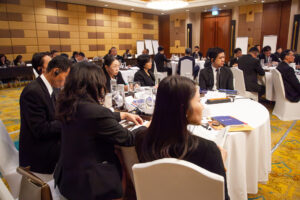
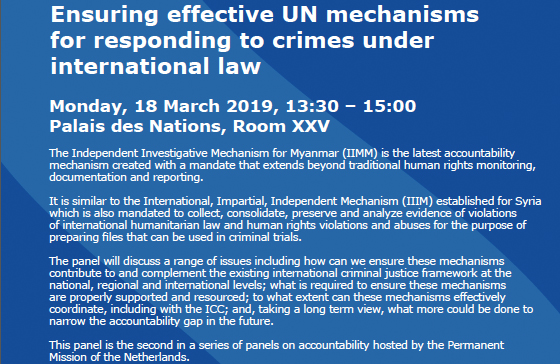
Watch on video this side event held on 18 March 2019 at the Human Rights Council.
The Independent Investigative Mechanism for Myanmar (IIMM) is the latest accountability mechanism created with a mandate that extends beyond traditional human rights monitoring, documentation and reporting.
It is similar to the International, Impartial, Independent Mechanism (IIIM) established for Syria which is also mandated to collect, consolidate, preserve and analyze evidence of violations of international humanitarian law and human rights violations and abuses for the purpose of preparing files that can be used in criminal trials.
The panel discussed a range of issues including how can we ensure these mechanisms contribute to and complement the existing international criminal justice framework at the national, regional and international levels; what is required to ensure these mechanisms are properly supported and resourced; to what extent can these mechanisms effectively coordinate, including with the ICC; and, taking a long term view, what more could be done to narrow the accountability gap in the future.
This panel was the second in a series of panels on accountability hosted by the Permanent Mission of the Netherlands.
Opening Remarks:
- Ambassador Monique van Daalen, Permanent Representative to the UN of the Kingdom of the Netherlands
Moderator:
- Saman Zia-Zarifi, Secretary General, International Commission of Jurists
Panelists:
- Andrew Clapham, Member of the Commission on Human Rights in South Sudan
- Sanji Monageng, former Judge/Vice-President of the ICC, and Commissioner of the ICJ
- Stephen Rapp, Chair, Commission for International Justice & Accountability (CIJA), Distinguished Fellow, US Holocaust Memorial Museum, and former United States Ambassador-at-Large for Global Criminal Justice
- Amady Ba, Head, International Cooperation Section, JCCD, OTP, International Criminal Court (ICC)
- Kingsley Abbott, ICJ Senior Legal Adviser for Global Redress and Accountability
Side event ICJ NL Accountability No2 (side event flyer, in PDF)
Watch on video:
https://www.facebook.com/ridhglobal/videos/347634279184620/UzpfSTQ3MTQ2NzA4NjIyMTM3MzoyNDc4ODQxODc4ODE3MjA3/
Mar 18, 2019 | Advocacy, Non-legal submissions
The ICJ today called for prompt release of a database of businesses involved in certain activities in the Occupied Palestinian Territory, that has been prepared by the UN Office of the High Commissioner for Human Rights (OHCHR).The statement, delivered in a general debate, read as follows:
“Regarding the Database of business enterprises involved in listed activities in the settlements on the Occupied Palestinian Territory, the ICJ recognizes the important work that has been done, but is deeply concerned at OHCHR’s failure to publicly release it.
All States, including the home States of the companies involved, have a responsibility to prevent companies from operating in breach of international law. Businesses themselves should see the database as an opportunity to more proactively incorporate respect for human rights within their policies and operations.
The prompt publication of the database should contribute to global efforts to hold all business enterprises accountable for their role in violations of human rights and humanitarian law and to give them an incentive to cease in such behaviour. The ICJ urges all States, including those that have supported the creation of this database, to redouble efforts to prevent business complicity in serious human rights abuses and to hold businesses legally accountable when abuses occur in their own territories as well as in the global operations of businesses for which they are the home State.”