Mar 1, 2016 | Events
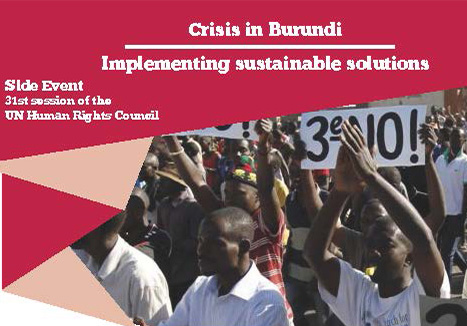
The ICJ is co-sponsoring a panel discussion on the situation for human rights in Burundi, as a side-event to the UN Human Rights Council, 4 March 2016.Details are available in the flyer available to download here: HRC31-sideeventflyer-burundi-2016
Feb 26, 2016 | Advocacy, Open letters
The open letter, which includes additional recommendations for a resolution on South Sudan to be adopted at the 31st ordinary session of the Human Rights Council (29 Feb – 24 Mar) is available here: Open Letter South Sudan
Feb 5, 2016 | News
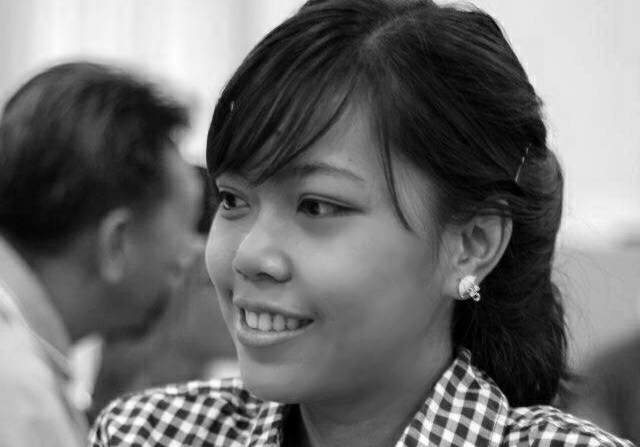
The ICJ today called on the Royal Thai Government to immediately drop criminal proceedings against human rights lawyer Sirikan Charoensiri.
On 2 February 2016, Sirikan Charoensiri received two summons to appear at the Chanasongkram Police Station on 9 February 2016 to be charged with two offences under the Criminal Code of Thailand: “giving false information regarding a criminal offence” and “refusing to comply with the order of an official”.
Such charges could result in punishment of up to two years’ imprisonment.
“The charges against Sirikan Charoensiri apparently relate to her efforts to protect the legal and human rights of her clients, students who never should have faced arrest or criminal proceedings for peacefully exercising their freedoms of expression and assembly in the first place,” said Matt Pollard of the ICJ’s Centre for the Independence of Judges and Lawyers.
“Prosecuting Sirikan Charoensiri for her efforts to defend human rights is totally unacceptable and will only put Thailand further in violation of its international obligations,” he added.
The charges appear to relate to the circumstances surrounding Sirikan Charoensiri’s provision of legal aid to 14 students who were arrested on 26 June 2015 after carrying out peaceful protests calling for democracy and an end to military rule.
Although the precise basis for the changes is not set out in the summonses, the complainant is named as Pol. Col. Suriya Chamnongchok, a police officer involved in the investigation of the 14 students.
Sirikan Charoensiri, a lawyer with Thai Lawyers for Human Rights (TLHR), has provided legal aid to many individuals, including activists and human rights defenders, since military rule was imposed in May 2014.
The ICJ first expressed concern about the Government’s targeting of Sirikan Charoensiri on 2 July 2015, after the Royal Thai Police threatened Sirikan Charoensiri with legal action, publically announced they were considering charging her with a crime, and visited her home and questioned her family.
These threats and harassment, like the currently pending charges, appeared to be in retaliation for her having refused consent for police to search her car after the students’ court hearing, and for having filed a complaint with the police when they proceeded to impound it.
The ICJ has brought the case to the attention of the United Nations Special Rapporteurs on the Independence of Judges and Lawyers, and on the Situation of Human Rights Defenders.
The situation of human rights in Thailand will be examined by the UN Human Rights Council in May 2016, as part of the Council’s Universal Periodic Review of all States.
“Ahead of Thailand’s human rights review by the United Nations in May, and against the background of the tabled ‘roadmap’ towards democratic rule, the need for the Royal Thai Government to restore respect for human rights only grows more urgent by the day,” said Pollard.
Contact
In Bangkok: Kingsley Abbott, International Legal Adviser for Southeast Asia, t +66 94 470 1345 ; e: kingsley.abbott(a)icj.org
In Geneva: Matt Pollard, ICJ Senior Legal Adviser, t: +41 22 979 38 12 ; e: matt.pollard(a)icj.org
Background
The International Covenant on Civil and Political Rights (ICCPR), to which Thailand is a Party, guarantees the right to peaceful assembly; the right to freedom of expression; the prohibition of arbitrary arrest or detention; the right to a fair and public hearing by a competent, independent and impartial tribunal established by law (including the right of prompt access to a lawyer and precluding jurisdiction of military courts over civilians in circumstances such as these); and the prohibition of arbitrary or unlawful interference with privacy, family, home and correspondence (which includes arbitrary searches or seizures).
The UN Declaration on Human Rights Defenders affirms the right of everyone peacefully to oppose human rights violations. It prohibits retaliation, threats and other harassment against anyone who takes peaceful action against human rights violations, both within and beyond the exercise of their professional duties. It protects the right of persons to file formal complaints about alleged violations of rights. The UN Basic Principles on the Role of Lawyers provide that governments are to ensure that lawyers are able to perform their professional functions without intimidation, hindrance, harassment or improper interference.
Thailand-Sirikan Charoensiri-News-Press releases-2016-THA (full text in PDF, Thai)
Dec 16, 2015 | Advocacy, Events
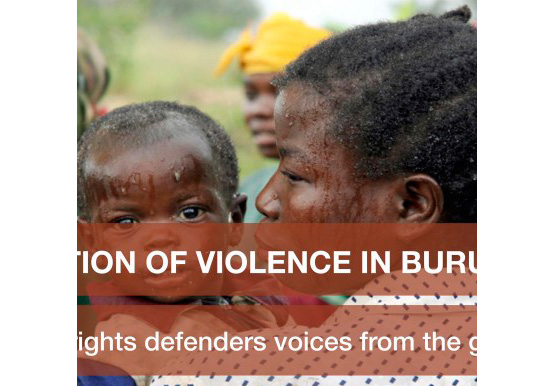
The ICJ joins other non-governmental organisations in co-sponsoring “Escalation of Violence in Burundi: Human rights defenders voices from the ground”, a side event to the Human Rights Council’s special session on Burundi, 17 December 2015.
The event will take place Thursday 17 December – 9.00-10.00 am in Room XII, Palais des Nations, Geneva
Panelists:
Mr Pierre Claver Mbonimpa, Association for the Protection of Human Rights and Incarcerated Persons (APRODH)
Ms Margaret Barankitse, Maison Shalom
Mr Anschaire Nikoyagize, Ligue ITEKA
Ms Carina Tertsakian, Human Rights Watch
The event will be moderated by Nicolas Agostini of FIDH.
The event will be webcast live by the International Service for Human Rights (ISHR).
Follow on twitter using the hash-tag #BurundiHRDs
A flyer for the event is available here: Burundi-UNHRC-Advocacy-SideEvent-2015
Oct 26, 2015 | News
Myanmar’s human rights record for the past four and a half years will be under scrutiny at the United Nations (UN) Human Rights Council (HRC), as the country goes up for its Universal Periodic Review (UPR) review on 6 November 2015.
Myanmar will be assessed on developments based on information provided by the government, UN human rights experts, institutions and treaty bodies; and stakeholders including Non-Governmental Organizations (NGOs).
The eleventh round of Pre-Sessions to discuss the human rights situations in Myanmar was held on 8 October 2015 and was organized by UPR-Info.
The event brought together various permanent missions and various Myanmar civil society organizations (CSOs) that presented their respective UPR recommendations.
This event also provided NGOs, including the ICJ, with an opportunity to contribute to the UPR process by informing several delegations at once about specific, actionable recommendations to the government to effectively address human rights violations and provide redress.
In its UPR stakeholder submission, the ICJ drew the attention of the HRC Working Group on the UPR, and that of the HRC itself, to the ICJ’s concerns about the independence of the judiciary and legal profession, the lack of legislation adequately protecting human rights and the environment, discriminatory laws targeting women and minorities, and the writ of habeas corpus in Myanmar.
The Office of the Commissioner for Human Rights referred to these issues in its summary to the HRC Working group on the UPR.
UPR discussions in Geneva led by NGOs reiterated that despite reforms, significant human rights challenges remain in Myanmar. These include, but are not limited to, the following:
- During its first UPR in 2011, Myanmar had supported recommendations to consider signing and ratifying core human rights treaties, but has made no significant progress;
- A recent parliament veto reserves the 25% of the seats in the legislative bodies for the military, thus continuing military impunity and preserving their hold over any constitutional or legislative amendment;
- The Myanmar National Human Rights Commission suffers from low credibility due to its lack of autonomy from the government and failure to investigate egregious human rights violations;
- The package of “race and religion protection” laws comes at a time of increasing ethnic and religious tension, and discriminates on grounds of gender and religion. Discrimination against religious minorities has led to mass displacement, deaths and rights violations;
- Lesbian, Gay, Bisexual and Transgender rights are routinely violated;
- The Environmental Conservation Law allowed government departments and private business abroad exemptions from environmental protection obligations;
- Judicial independence is compromised as judges in some instances still render decisions based on orders coming from military and the government.
Contact:
Vani Sathisan, ICJ International Legal Adviser, Myanmar, t: +95-09250800301; e: vani.sathisan(a)icj.org
The ICJ’s UPR stakeholder submission for Myanmar can be found here
The OHCHR summary to the UN Working Group for the UPR can be found here