Oct 1, 2018 | Comunicados de prensa, Noticias
La CIJ celebra la participación de diferentes Organizaciones No Gubernamentales, en la audiencia que la Comisión Interamericana de Derechos Humanos (CIDH) convocara de oficio, la cual permitió escuchar la posición de ambas delegaciones y llevar a cabo un diálogo franco sobre un tema trascendental para la población guatemalteca y el respeto de los derechos humanos en el país.
La CIJ participó por medio de su Director para Centroamérica, abogado Ramón Cadena, participación solicitada por el Instituto Centroamericano de Estudios para la Democracia Social (DEMOS), del Comité de Desarrollo Campesino (CODECA) y de la Red de Defensores Comunitarios.
El Bufete para Pueblos Indígenas, si bien había sido solicitado por dichas organizaciones para asistir, no pudo hacerlo en un último momento.
Si bien la Delegación Gubernamental alegó falta de competencia por parte del Sistema Interamericano de Derechos Humanos, la Comisión Interamericana no sólo sostuvo que sí era competente, según la Declaración Americana de Derechos Humanos y la Convención Americana de Derechos Humanos y otra legislación regional de Derechos Humanos, sino que además, en su calidad de “observadora externa”, se sintió “sorprendida” por las últimas decisiones tomadas por las autoridades gubernamentales al más alto nivel y advirtió al Estado de Guatemala, que el mensaje que el Estado de Guatemala estaba dando con sus últimos actos y decisiones de no prorrogar el mandato de la CICIG, ni permitir el ingreso del comisionado Iván Velásquez al país, era “excesivo” y que en nada fortalecía al Estado de Derecho de Guatemala.
Otro argumento de la delegación gubernamental fue afirmar que la CICIG actuaba como “fiscalía paralela”, lo cual afectaba el ordenamiento interno.
Al respecto, la delegación de las organizaciones no gubernamentales explicaron a la ilustre Comisión Interamericana de Derechos Humanos, que no se trataba de una fiscalía paralela, sino que de la figura del “querellante adhesivo” y que incluso antes de la aprobación del mandato de la CICIG, la Corte de Constitucionalidad emitió una opinión consultiva el 8 de mayo de 2007 (Expediente 791-2007), debidamente publicada en el Diario Oficial, en la que consideró que la constitución de la CICIG no violaba el ordenamiento constitucional, ni legal del Estado de Guatemala.
Específicamente, la Corte de Constitucionalidad consideró al referirise a la función de la CICIG que “la función de apoyar, coadyuvar y fortalecer a las instituciones estatales encargadas de la investigación en los delitos cometidos con ocasión de la actividad de los cuerpos ilegales de seguridad y aparatos clandestinos de seguridad…no excluye la posibilidad de recibir el apoyo de otras instituciones en la recolección de evidencia, siempre que la participación se haya establecido de manera legal, como sucede en el presente caso.”
La ilustre Comisión Interamericana de Derechos Humanos (CIDH) consideró que la pregunta esencial que había que responder, era si el Estado de Guatemala contaba ya con la fortaleza institucional, con la independencia judicial y con funcionarios e instituciones sólidas, como para poder luchar contra la corrupción en Guatemala, sin el apoyo de la CICIG.
La delegación de las organizaciones no gubernamentales fundamentaron con diferentes argumentos, que aún no se contaba con dicha solidez y que la presencia de la CICIG en el país, seguía siendo necesaria.
La Comisión Interamericana celebró la participación nutrida de la Sociedad Civil de Guatemala y la presencia de representantes del gobierno guatemalteco y manifestó que el haber convocado de oficio a esta audiencia, demostraba el interés de la CIDH en Guatemala.
Informó a la delegación gubernamental, que era su interés realizar una visita “in loco” a la mayor brevedad posible, ya que de esa forma podría conocer en forma más profunda todas las situaciones de derechos humanos que se estaban presentando en el país, para lo cual solicitó el apoyo de la delegación gubernamental.
Ramón Cadena, Director de la CIJ para Centroamérica expresó: “Lamentamos que el Gobierno de Guatemala solicitara a la Comisión Interamericana de Derechos Humanos que la audiencia se llevara a cabo a “puertas cerradas”, ya que todos los puntos discutidos fueron del interés de la ciudadanía en general y de la prensa.
Por ello, en lugar de mantener las discusiones cerradas, deberían abrirse al conocimiento de la prensa y del público en general. Exigimos a las autoridades correspondientes, que no vaya a haber represalias en contra del trabajo que realizan las organizaciones de derechos humanos y las y los defensores de derechos humanos.”
Sep 18, 2018 | Advocacy, Non-legal submissions
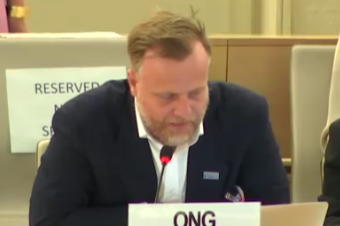
The ICJ today urged the UN Human Rights Council to establish a mechanism to preserve evidence of crimes under international law occurring in Myanmar, with a view to eventual prosecution of those responsible.
The statement, delivered during an interactive dialogue with the UN International Fact Finding Mission, read as follows:
“The International Commission of Jurists (ICJ) has monitored justice and human rights in Myanmar for more than five decades. The ICJ has an established presence in the country supporting justice actors to protect human rights through the rule of law.
With this experience, the ICJ views the Independent International Fact Finding Mission’s conclusions as painting an authoritative picture of the general situation in Myanmar, particularly in its highlighting of the pervasive damage of military impunity upon human rights, rule of law and the nascent democratic process.
The rule of law cannot be established, let alone flourish, without accountability for perpetrators of human rights violations and redress for victims and their families.
The Fact Finding Mission’s findings of crimes under international law, including crimes against humanity in Rakhine, Kachin and Shan states, and the identification of alleged perpetrators, necessitate immediate action.
The Government of Myanmar is unwilling and unable to effectively and genuinely provide justice for crimes, particularly when perpetrated by security forces. International action must not be deterred or delayed by the latest government inquiry, which is incapable of providing accountability or redress and may promote impunity by undermining credible international justice mechanisms.
The ICJ calls for a unified Council resolution at this session to establish an International Impartial and Independent Mechanism. This is urgently required to preserve evidence before its further deterioration, and to demonstrate a commitment to justice. Failing to act now risks further denying justice for victims and emboldening perpetrators.
Violations against Rohingya constitute an egregious yet emblematic example of systematic persecution of minority groups that has persisted in Myanmar for decades.
The ICJ would like to ask the Fact-Finding Mission: how can the Council best ensure accountability for the full range of crimes under international law committed against minorities throughout Myanmar and prevent their continuation and recurrence?”
For more information see:
Myanmar: why an IIIM and Security Council referral are needed despite the ICC ruling relating to Bangladesh
Myanmar: Government’s Commission of Inquiry cannot deliver justice or accountability
Sep 11, 2018 | Events, News
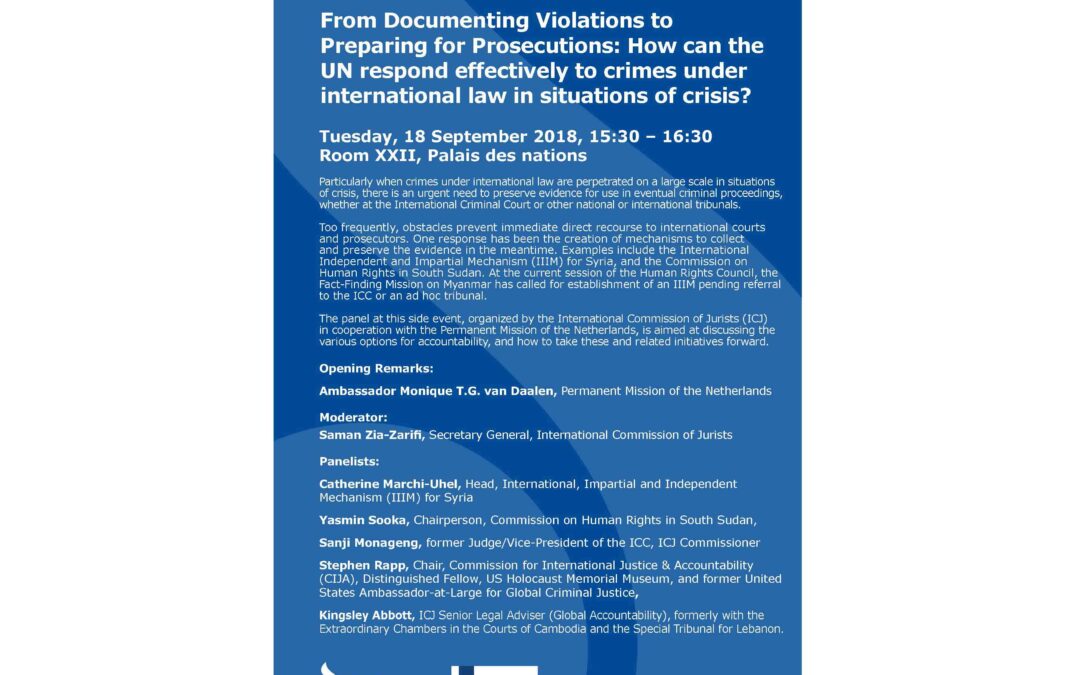
The ICJ will organize this side event, in cooperation with the Permanent Mission of the Netherlands, at the Human Rights Council on Tuesday 18 September 2018 from 15:30 – 16.30 in Room XXII of the Palais des Nations.
Particularly when crimes under international law are perpetrated on a large scale in situations of crisis, there is an urgent need to preserve evidence for use in eventual criminal proceedings, whether at the International Criminal Court or other national or international tribunals
Too frequently, obstacles prevent immediate direct recourse to international courts and prosecutors. One response has been the creation of mechanisms to collect and preserve the evidence in the meantime. Examples include the International Independent and Impartial Mechanism (IIIM) for Syria, and the Commission on Human Rights in South Sudan.
At the current session of the Human Rights Council, the Fact-Finding Mission on Myanmar has called for establishment of an IIIM pending referral to the ICC or an ad hoc tribunal.
The various options for accountability, and how to take these and related initiatives forward will be discussed.
Opening Remarks:
Ambassador Monique T.G. van Daalen, Permanent Mission of the Netherlands
Moderator:
Saman Zia-Zarifi, Secretary General, International Commission of Jurists
Panelists:
- Catherine Marchi-Uhel, Head, International, Impartial and Independent Mechanism (IIIM) for Syria
- Yasmin Sooka, Chairperson, Commission on Human Rights in South Sudan
- Sanji Monageng, former Judge/Vice-President of the ICC, and Commissioner of the ICJ
- Stephen Rapp, Chair, Commission for International Justice & Accountability (CIJA), Distinguished
Fellow, US Holocaust Memorial Museum, and former United States Ambassador-at-Large for Global Criminal Justice
- Kingsley Abbott, ICJ Senior Legal Adviser (Global Accountability), formerly with the Extraordinary Chambers in the Courts of Cambodia and the Special Tribunal for Lebanon
Universal-ICJ-NL-Side event-News-events-2018-ENG (flyer of the event in PDF)
Sep 10, 2018 | Events, News
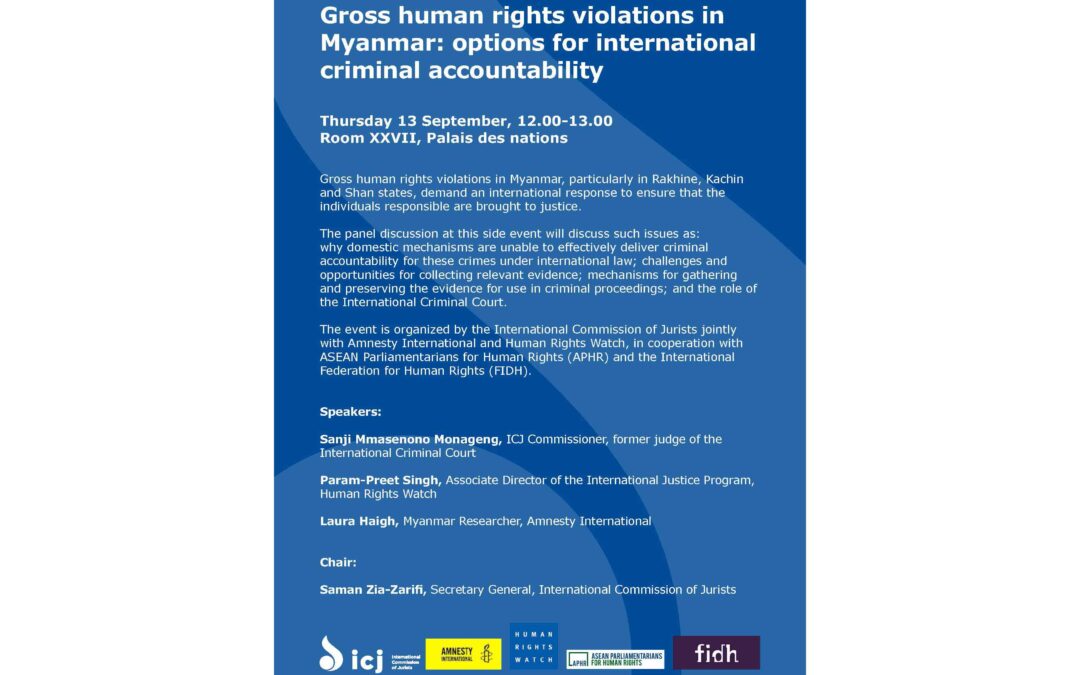
The ICJ will host the side event “Gross human rights violations in Myanmar: options for international criminal accountability” at the Human Rights Council on Thursday 13 September 2018 from 12:00 – 13.00 in Room XXVII of the Palais des Nations.
It is organized by the ICJ, Amnesty International and Human Rights Watch in cooperation with ASEAN Parliamentarians for Human Rights (APHR), the International Federation for Human Rights (FIDH) and Physicians for Human Rights (PHR).
The issues of documenting violations, possible evidence-gathering mechanisms and the role of the International Criminal Court will be discussed.
Speakers:
- Justice Sanji Mmasenono Monageng, Commissioner of the ICJ and former judge of the International Criminal Court
- Param-Preet Singh, Associate Director of the International Justice Program, Human Rights Watch
- Laura Haigh, Myanmar Researchers, Amnesty International
Moderator:
Saman Zia-Zarifi, Secretary General, International Commission of Jurists
Myanmar side event 13 Sept flyer (flyer of the event in PDF)

Sep 7, 2018
On 30 May 2018 the Government of Myanmar announced its latest “International Commission of Enquiry” (ICOE) to investigate human rights violations in Rakhine State.
Its creation follows at least eight other special government inquiries and boards conducted since 2012 in Rakhine State alone.
In a five-page legal briefing, the International Commission of Jurists (ICJ) assesses the inquiry in reference to standards on the conduct of investigations.
The ICJ finds that the ICOE cannot reasonably be seen as having any chance of being independent, impartial, or making an effective contribution to justice or accountability for the crimes under international law. To the contrary, giving any recognition to it is likely to undermine and delay effective international measures for justice and accountability.
On 28 August the spokesperson for the Office of the President stated that:
“We have formed the Independent Commission of Enquiry to response [sic] to false allegations made by the UN Agencies and other international communities.”
Indeed, the Chairperson of the ICOE stated at a press conference, that:
“[T]here will be no blaming of anybody, no finger-pointing of anybody… saying you’re accountable.”
Such prejudicial statements confirm the conclusion of the United Nations Independent International Fact-Finding Mission (IIFFM), that:
“The Government’s recently-created Commission of Inquiry will not and cannot provide a real avenue for accountability, even with some international involvement. The impetus for accountability must come from the international community.”
Crimes against humanity and war crimes have been committed in Myanmar, and an investigation of evidence of the crime of genocide is warranted, according to the summary report of the UN IIFFM, published on 27 August 2018.
Throughout Myanmar the rule of law is severely undermined by a lack of accountability for perpetrators of rights violations; lack of access to remedies and reparation for victims; and persistent challenges to the independence of the justice system.
In current circumstances it is impossible to rely on any national courts, prosecution services, or commissions of inquiry in Myanmar to deliver justice or accountability of security forces in relation to human rights violations constituting crimes under international law.
The UN Security Council should refer the situation to the International Criminal Court or a similarly constituted international tribunal without delay.
The UN Human Rights Council should promptly establish a robust International Impartial and Independent Mechanism (IIIM) or similar mechanism, to collect and analyse evidence for future prosecutions; action should be taken by the Council at its September 2018 session – waiting for or deferring to the UN General Assembly to act would risk further delaying or denying justice for victims, including because key criminal evidence could be irretrievably lost, destroyed, or deteriorate in the meantime.
Contact
Frederick Rawski, Asia and the Pacific Director, frederick.rawski(a)icj.org
Legal briefing
Myanmar-COI cannot deliver justice or accountability-Advocacy-Analysis brief-2018-ENG (full text, PDF)
Myanmar-COI cannot deliver justice or accountability-Advocacy-Analysis brief-2018-BUR (full text in Burmese, PDF)