Mar 28, 2018 | Advocacy, Non-legal submissions
The ICJ today submitted a report to the UN Committee against Torture, calling for recommendations to be made on prevention of and accountability for continued recourse to torture and ill-treatment in Tajikistan.
The ICJ’s submission is made ahead of consideration by the Committee against Torture in April to May 2018 of Tajikistan’s third periodic report on the implementation of its obligations under the Convention against Torture and Other Forms of Cruel, Inhuman or Degrading Treatment or Punishment.
The ICJ’s report draws from an earlier study on Achieving Justice for Gross Human Rights Violations in Tajikistan and calls on the Committee against Torture to make recommendations concerning:
- The obligation to adequately sanction torture;
- The obligation to prevent torture and other forms of ill-treatment, including in places of detention;
- The obligation to investigate allegations of torture and ill-treatment;
- The use of amnesties and pardons for torture;
- The prohibition against the use of evidence obtained by torture;
- The right to complain about torture and ill-treatment; and
- The right of victims to effective remedies and reparation.
Tajikistan-CAT-Advocacy-AlternativeReport-2018ENG (download the ICJ’s submission, in PDF)
Mar 19, 2018
The Government of the Philippines should reconsider and reverse its hasty and ill-conceived decision to withdraw as a State Party to the Rome Statute to the International Criminal Court, the ICJ said today.
In a letter transmitted to Philippine President Rodrigo Duterte, the ICJ questioned the stated basis for the decision to withdraw from the Rome statute, to which it has been party since 2011, and to commit itself to effectively investigate the numerous allegations of widespread and systematic extrajudicial killings and bring to justice those responsible.
The ICC has jurisdiction over certain serious crimes under international law including genocide, crimes against humanity, and war crimes.
“The Philippine government’s submitted justifications for withdrawing from the ICC are a litany of poorly thought out pseudo-legal arguments and self-serving statements that focus on President Duterte’s fear and resentment at facing questions for the horrific campaign of extrajudicial executions that his government has explicitly condoned,” said Sam Zarifi, ICJ’s Secretary General.
“At any rate, despite what the Philippine president may wish, withdrawal from the ICC will not prevent the Prosecutor from conducting a preliminary examination because the acts complained of were committed prior to the date when the withdrawal becomes effective,” he added.
Under the Rome Statute, withdrawal as a State Party takes effect only after one year from notification of the UN Secretary General, unless a later date is specified.
The ICJ’s letter to President Duterte highlights some of the legal and factual errors contained in the Philippine government’s official submission of the justifications for the withdrawal.
The letter points out that the launch of a preliminary examination does not violate the principle of presumption of innocence or due process.
In order to proceed with a full investigation, if the Prosecutor determines it is warranted, a pre-trial chamber of judges would still have to give approval.
The letter notes the Philippine government will have the opportunity to argue that it is willing to investigate and prosecute, and that its domestic processes are sufficient to address the crimes alleged.
Since President Rodrigo Duterte assumed office in June 2016, there has been a notable increase in the number of killings of persons allegedly involved in the trade and sale of illegal drugs.
It has been alleged that the number of persons killed has reached to the thousands, and that many of these killings were unlawful, amounting to extrajudicial executions.
“President Duterte has very publicly stated that he will block investigations into the conduct of his government and its role in the killings of thousands of people; he has insulted and threatened United Nations officials; he has bullied and belittled domestic critics and civil society. He’s now trying to avoid accountability under international law, too,” Zarifi said.
“There is no indication so far of a genuine, thorough, prompt, impartial, and independent investigations of these crimes in the Philippines, and the apparent unwillingness of the authorities to do so is one of the grounds on which the ICC can and should assert jurisdiction to undertake its own investigation,” he further said.
“Instead of engaging in legal maneuvers to facilitate impunity, President Duterte must unequivocally denounce extrajudicial killings, whether of alleged criminals or of any person in the Philippines, and allow a proper investigation of these crimes,” he added.
The ICJ calls on the Government to take immediate and effective measures to address the thousands of cases of extrajudicial killings in observance of its domestic laws and to respect its obligations under human rights law, including the International Covenant on Civil and Political Rights (ICCPR).
Investigations of extrajudicial, summary or arbitrary killings should be geared towards establishing the crime and bringing perpetrators to justice.
Contact
Emerlynne Gil, Senior International Legal Adviser for Southeast Asia, t +662 619 8499 (ext. 206) ; e: emerlynne.gil(a)icj.org
Philippines-ICJ Letter ICC Withdrawal-Advocacy-Open letters-2018-ENG (full letter, in PDF)
Mar 14, 2018 | Events, Multimedia items, News, Video clips
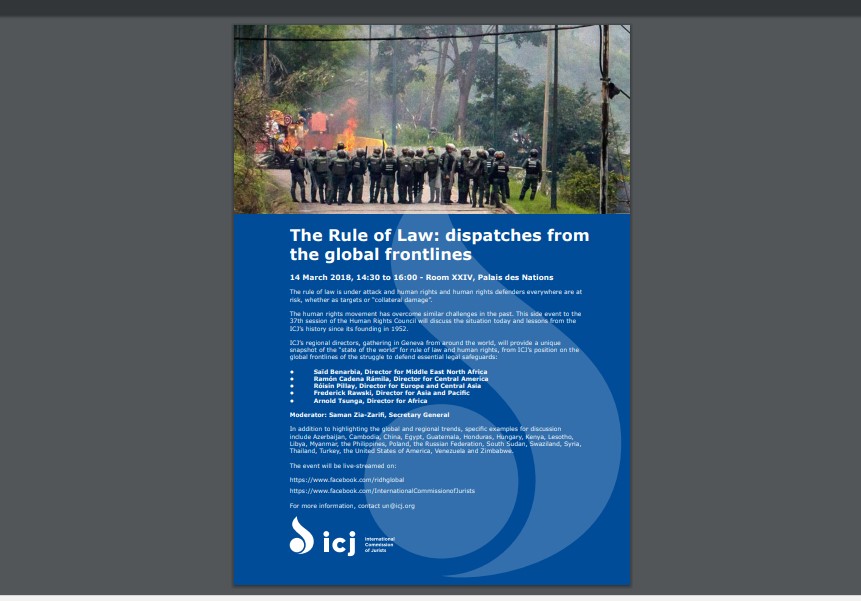
Today, the ICJ highlighted threats to and defenders of the rule of law around the world, at a side event to the UN Human Rights Council, at the Palais des Nations in Geneva.
The rule of law is under attack and human rights and human rights defenders everywhere are at risk, whether as targets or “collateral damage”.
The human rights movement has overcome similar challenges in the past. This side event to the 37th session of the Human Rights Council discussed the situation today and lessons from the ICJ’s history since its founding in 1952.
ICJ’s regional directors, gathering in Geneva from around the world, provided a unique snapshot of the “state of the world” for rule of law and human rights, from ICJ’s position on the global frontlines of the struggle to defend essential legal safeguards:
• Saïd Benarbia, Director for Middle East North Africa
• Ramón Cadena Rámila, Director for Central America
• Róisín Pillay, Director for Europe and Central Asia
• Frederick Rawski, Director for Asia and Pacific
• Arnold Tsunga, Director for Africa
Moderator: Saman Zia-Zarifi, Secretary General
In addition to highlighting the global and regional trends, specific examples for discussion included Azerbaijan, Cambodia, China, Egypt, Guatemala, Honduras, Hungary, Kenya, Lesotho, Libya, Myanmar, the Philippines, Poland, the Russian Federation, South Sudan, Swaziland, Syria, Thailand, Turkey, the United States of America, Venezuela and Zimbabwe.
For more information, contact un@icj.org
Watch the video:
https://www.facebook.com/ridhglobal/videos/10157996747579616/
Universal – Rule of law frontlines – News – Event – 2018 – ENG (Event flyer in PDF)
Mar 8, 2018 | News
The Sri Lankan government must act swiftly and in line with human rights to prosecute those responsible for recent communal violence.
Particularly for attacks against the minority Muslim community in Kandy district, while avoiding the abusive practices of the past, said the ICJ today.
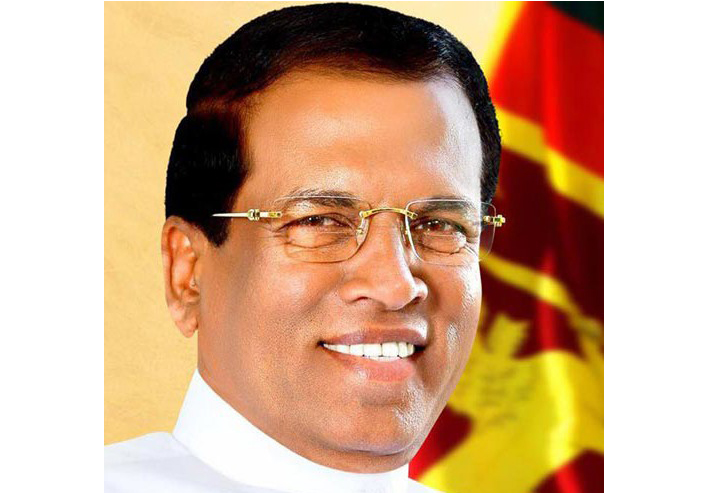
Sri Lanka’s President, Maithripala Sirisena, proclaimed an island-wide state of emergency on 6th March 2018, following a curfew imposed in several areas since Monday.
The action came following a spate of attacks against members of the Muslim community that was spreading in the Kandy district, following attacks in Ampara last week, in Gintota in 2016, and Aluthgama in 2014.
“The government must show that it will bring to account those who have incited communal violence, particularly notorious figures who have been emboldened by the pervading impunity to preach hatred openly and publicly. The arrest of key suspects yesterday is a start and convictions must follow,” said Frederick Rawski, ICJ’s Asia director.
“But the government must ensure that its investigation is impartial and effective and follows due process of the law,” he added.
The ICJ called upon the government of Sri Lanka to swiftly prosecute those responsible for inciting and carrying out the communal violence using existing legal provisions in the Penal Code and the ICCPR Act, the latter of which prohibits advocating “national, racial or religious hatred that constitutes incitement to discrimination, hostility or violence.”
The ICJ is concerned that the Emergency Regulations issued by the President through powers under the Public Security Ordinance, confer excessively broad powers on the army and the police to search, arrest and investigate.
“Given Sri Lanka’s experience of Emergency Regulations, the government should ensure that these regulations are time-bound and comply with Sri Lanka’s international human rights obligations, including under the International Covenant on Civil and Political Rights,” said Rawski.
The government has further restricted access to selected instant messaging applications and social media platforms “as an extraordinary but temporary response to limit the increasing spread of hate speech and violence through social media websites and phone messaging applications.”
“Blocking social media and other communication channels, even with the best of intentions, typically has the negative effect of restricting affected persons from seeking assistance, journalists from reporting around the situation and may actually undermine efforts to counter violence and hate speech. Any such measures should be narrowly targeted and limited in time,” said Rawski.
“A better approach would be for the Sri Lankan government to aggressively push back against these hateful narratives by demonstrating in actions as well as its rhetoric that Sri Lanka is a diverse country in which all of its citizens’ rights are respected and protected equally,” he added.
Background
Chapter XVIII of the Constitution and the Public Security Ordinance of Sri Lanka empowers the President to make emergency regulations in the interest of ‘public security and the preservation of public order or for the maintenance of supplies and services essential to the life of the community.’ Sri Lanka has a history of governance using emergency powers, which in the past has posed a challenge for democratic governance and human rights, providing law enforcement with wide powers, circumventing ordinary checks and balances.
The President, while justifying circumstances that led to his proclamation of a state of emergency, has stated that he “has given special instructions the Police and the tri-forces to take action in terms of these regulations, in a lawful manner in good faith while ensuring minimum disturbance to the life and well-being of people, in conformity with Fundamental Human Rights of people.”
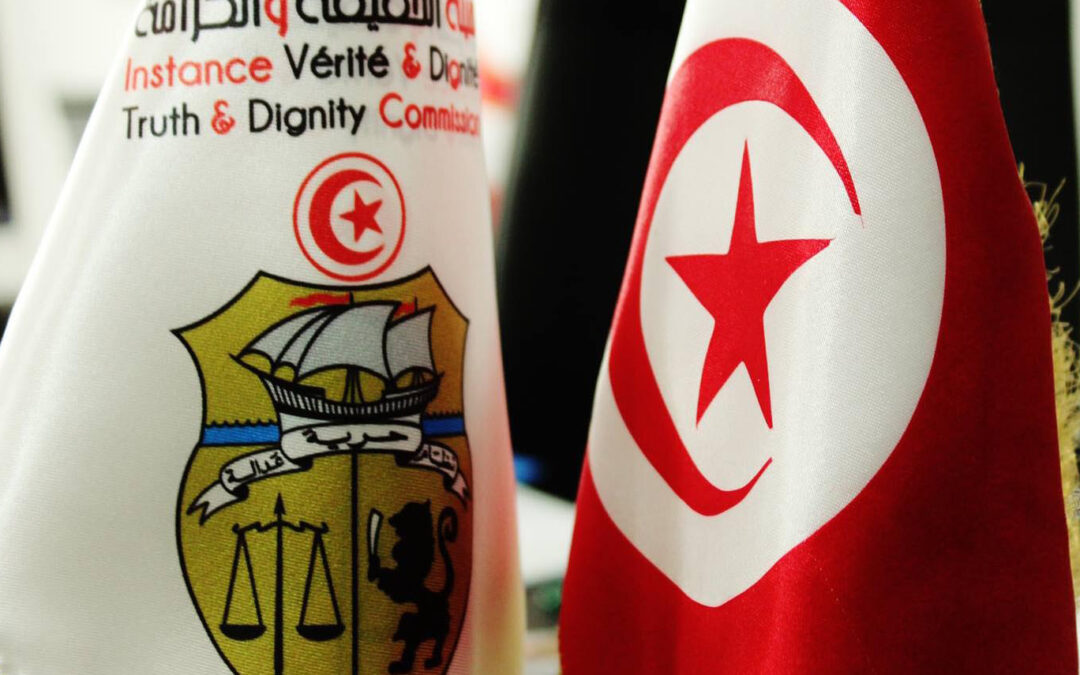
Mar 6, 2018 | News
The ICJ today welcomed the first referral of allegations of gross human rights violations to the recently constituted Specialized Criminal Chambers (SCC) at the Tribunal of First Instance of Gabés.
On 2 March 2018, the Truth and Dignity Commission (“Instance Vérité et Dignité”, IVD) transferred a case concerning 14 suspects and the crime of enforced disappearance to the SCC, established to bring justice and accountability for the legacy of serious human violations allegedly committed in Tunisia from 1 July 1955 to 31 December 2013.
“The IVD’s decision is an important first step in the process of ensuring accountability and dismantling the structural impunity that has prevailed over cases of gross violations of human rights in Tunisia,” said Said Benarbia, Director of the ICJ Middle East and North Africa Programme.
“We call on the responsible Tunisian authorities to fully support this process and remove the obstacles that continue to impede the IVD’s work, including by ensuring its full, rapid and unimpeded access to archives and to information related to the conduct of police and security forces under the former regime,” he added.
The ICJ also reiterated its previous call on the Tunisian authorities to remove the legal and practical obstacles that may hinder the SCC’s capacity to deliver justice effectively.
In two memos addressing the jurisdiction and the procedures to be applied by the SCC, the ICJ identified such obstacles and formulated recommendations for amendments and reform.
“The Government must reform the legal framework and procedures to be applied by the SCC so that they can effectively exercise their jurisdiction, establish the truth about past violations, hold those responsible to account, and deliver meaningful justice and reparation for victims,” Benarbia said.
Contact
Said Benarbia, Director of the ICJ Middle East and North Africa Programme, t: +41 798783546, e: said.benarbia(a)icj.org
Background
The SCC were formally established by Decree No. 2014-2887 of 8 August 2014 and have been set up within the Tribunals of First Instance of thirteen Courts of Appeal.
Under article 8 of the 2013 Transitional Justice Law, the SCC have jurisdiction over cases related to gross violations of human rights, as defined in international treaties applicable to Tunisia and in the provisions of the 2013 Law, involving “murder, rape and other forms of sexual violence, torture, enforced disappearances, and death penalty without fair trial guarantees”.
The 2013 Law attributes a leading role to the IVD with respect to how cases are brought before the SCC. According to article 42 of the 2013 Law, the IVD refers to the Office of the Public Prosecutor (OPP) “cases where gross human rights violations are proven”. As of 15 June 2016, the deadline for victims to submit files, the IVD has received over 60000 cases.
Tunisia-SSC disappearances-News-2018-ARA (full story in Arabic, PDF)