May 30, 2013 | Agendas, Events
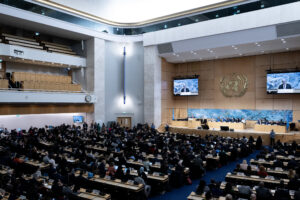
The event will be held Friday, 31 May 2013, from 16.00 to 18.00, in Geneva, Palais des Nations, Room XXVII. It marks the 5th anniversary of the HR Council adoption of the Framework “Protect, Respect and Remedy”.
It also promotes the publication of the ICJ Report on “Corporate complicity in international crimes”. It will highlight the fact that the business and human rights agenda in the Human Rights Council remains unfinished, especially in the critical areas of access to justice and accountability, as well as the need for bold Council action to provide States and other actors with the necessary tools to ensure remedy and justice to victims of serious human rights abuses committed by or with the complicity of corporations in home and host countries.
HR Council-UN SIDE EVENT Business-Event-2013 (full text in pdf)

May 7, 2013 | Advocacy, Legal submissions
The ICJ today submitted to the United Nations a written statement concerning corporate complicity in human rights abuses and access to justice for victims of such abuses.
The statement is made ahead of the UN Human Rights Council’s 23rd session (27 May to 14 June 2013) and comments on a report of the Council’s Working Group on human rights and transnational corporations and other business enterprises.
Setting out issues concerning obstacles to justice for victims of human rights abuses by business enterprises, the ICJ calls on the Working Group to take various steps to address such issues, including by:
- Exploring the further development of international standards;
- Raising specific allegations of corporate abuse with relevant State authorities and business enterprises; and
- Addressing more clearly the issue of access to justice in cases of corporate complicity.
HRC23-Item3-WGBHR-WrittenStatement-LegalSubmission-2013 (download statement in PDF)

Apr 8, 2013
 An opinion piece by Sam Zarifi, ICJ’s Asia-Pacific Regional Director and Benjamin Zawacki, ICJ Senior Legal Adviser for Southeast Asia.
The controversy surrounding Aung San Suu Kyi (photo) and a joint-venture copper mine project in Myanmar should give prospective foreign investors pause.
It should also prompt the international community to help the country establish a legal regime on which both investors and the people of Myanmar can rely for protection of their rights.
A government-backed investigation into the mine project, chaired by Suu Kyi, concluded that security forces used chemicals against villagers protesting against it.
It also recommended additional impact assessments, and either increased compensation or the return of farmland allegedly taken via fraud and coercion.
But, crucially, it concluded that the project should continue. Villagers vehemently disagreed and vowed to pursue a lawsuit.
Myanmar’s government has a duty to protect workers, consumers, landholders and indigenous people against rights violations.
Despite recent steps, however, there are not enough lawyers, judges and others adequately trained to monitor economic activity and provide accountability for violations of laws governing corporate action.
Corporations have a strong interest in supporting the development of robust accountability mechanisms in Myanmar.
Many now considering investing participate in a global corporate citizenship initiative known as the UN Global Compact, which asks its members to take action prior to investing, such as human rights and environmental impact assessments, and to monitor business activity once under way.
Yet all the compact’s “commitments” are non-binding. And even strict adherence would not serve as a defence for companies accused of committing human rights and environmental violations.
Increasingly, transnational corporations may be held legally responsible for abuses in the country where they occurred, and also in their home country.
Western companies are the most vulnerable, but the copper mine case shows Asian enterprises are not immune: the mine’s other joint-venture partner is the Chinese Wan Bao mining company, a subsidiary of weapons manufacturer Norinco.
The copper mine controversy also shows that the line between “government” and “company” in Myanmar can be blurry; large joint ventures often include the military-owned Union of Myanmar Economic Holdings Company.
Indeed, the army is deeply involved in many companies and has a long record of human rights and humanitarian law violations.
In one landmark case, villagers sued Unocal in a US court for complicity in security forces’ human rights violations during the construction of the Yadana gas pipeline.
The case was settled in 2004 before a final decision on liability was reached. What made it significant – and still relevant – is that the US law used is not limited to US corporations.
The Unocal case was allowed to progress in the US because the courts found that the judicial system in Myanmar was not independent of the military government of the time and therefore could not provide a proper venue for a lawsuit.
Today, despite ongoing legal reform, there is a long way to go to rebut this finding.
The copper mine case presents an opportunity for the judiciary to demonstrate whether it can render just decisions.
Investment in Myanmar, if done lawfully and with reliable legal remedies, can be a strong force for good.
The international community should support Myanmar’s reformers in making this happen.
Mar 21, 2013 | News
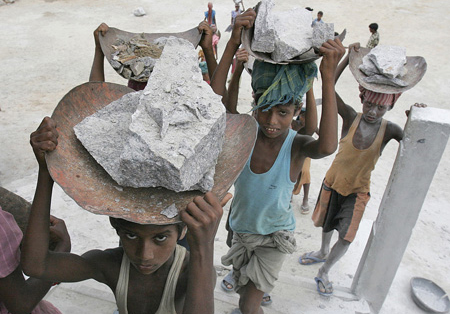
The ICJ welcomes the adoption by the UN Committee on the Rights of the Child of a General comment on State obligations regarding the impact of the business sector on children’s rights.
The ICJ stresses the Committee is the first UN human rights treaty body to address this issue directly in a General comment.
“The Committee on the Rights of the Child has taken a decisive step in clarifying standards under the Convention on the Rights of the Child and providing much needed guidance for States to better protect the rights of the child against business abuse,” said Carlos Lopez, ICJ’s Senior Legal Adviser on Business and Human Rights.
The UN Committee recognizes that while there is no international legally binding instrument on the business sector’s responsibilities vis-à-vis human rights, “duties and responsibilities to respect the rights of children extend in practice beyond the State and State-controlled services and institutions and apply to private actors and business enterprises. Therefore all businesses must meet their responsibilities regarding children’s rights and States must ensure they do so.”
The UN Committee also acknowledges that voluntary actions of corporate responsibility by business enterprises are not a substitute for State action and regulation of businesses or for businesses to comply with their responsibilities to respect children’s rights.
The General Comment was elaborated through a consultative process over nearly two years with the support of the ICJ, UNICEF and Save the Children International.
It gives interpretation and guidance for States in key areas:
- how they should ensure that the activities and operations of business enterprises do not adversely impact on children’s rights;
- how to create an enabling and supportive environment for business enterprises to respect children’s rights across their local or global operations; and
- how to ensure access to effective remedy for children whose rights have been infringed by a business enterprises.
“The recommendations and guidance provided by the Committee are a key contribution to national and international strategies by States and other actors,” Lopez added. “States now need implement these recommendations.”
BHR-FINAL CRC GC 16-comment-2013 (full text in pdf)

Feb 19, 2013
In two recent submissions to the Committee on the Elimination of Discrimination against Women (CEDAW), the ICJ called on CEDAW to address key barriers to justice faced by women.
The submissions came as the Committee embarks on drafting a General Recommendation on women’s access to justice.
In a joint submission, the ICJ and Friedrich-Ebert-Stiftung (FES) have called on the Committee on the Elimination of Discrimination against Women (CEDAW) to reaffirm obligations on States to effectively regulate the activities of business actors in order to ensure women’s access to justice.
The submission focuses on the issue of women’s access to justice for infringements of rights committed by non-State actors, and more specifically in the context of business activities and operations.
It makes recommendations on how States might more effectively regulate business activities so as to ensure women’s protection against discrimination and inequality and access to effective and accessible remedies when they face abuses.
In a standalone submission, the ICJ presented an overview of key barriers women face across jurisdictions when seeking justice. This submission draws on findings from ICJ in-country initiatives exploring barriers to justice faced by women.
The first general discussion on the General Recommendation took place during the CEDAW’s 54th session in Geneva on 18 February 2013.
CEDAW-Submission-A2J-BHR-LegalSubmission-2013 (download joint submission by ICJ and FES)
CEDAW-Submission-Women’sA2JNormativeObstacles-LegalSubmission-2013 (download ICJ submission)