Jul 2, 2013
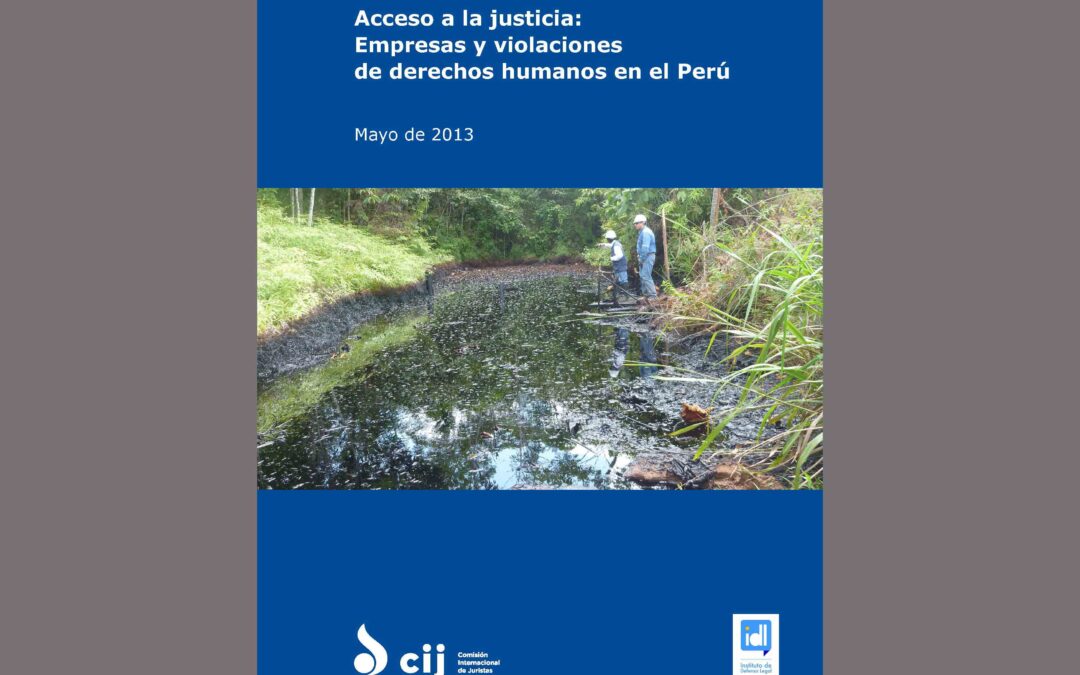
El informe revisa los recursos legales existentes en el país en virtud del derecho constitucional, derecho laboral, derecho civil y derecho penal, y examina la forma en que operan en la práctica a la luz de casos concretos.
Perú ha experimentado un rápido crecimiento económico y altos niveles de inversión extranjera durante más de una década, lo que ha llevado a importantes cambios sociales y económicos en el país.
Sin embargo, Perú no termina de adecuar su legislación y sus políticas al derecho y las normas internacionales en materia de derechos humanos y derechos laborales.
El acceso a la justicia, las vías jurídicas e institucionales para obtener un recurso y reparación en casos de abusos contra los derechos humanos cometidos con la participación de empresas, es una cuestión crítica en la que la legislación y las normas nacionales son deficientes.
Este informe, elaborado conjuntamente por la CIJ y el IDL-Perú, revela graves lagunas y deficiencias en el contenido de las leyes y su cumplimiento.
Si bien los recursos constitucionales parecen ser ampliamente utilizados, el derecho penal aún no se aplica a las empresas y los recursos legales civiles apenas son utilizados por los reclamantes.
Además, las enormes disparidades de poder y conocimiento existentes entre comunidades pobres o grupos indígenas y muchas veces corporaciones transnacionales en el sector minero o petrolero se traducen en serias deficiencias procesales que equivalen a negar el debido proceso y el juicio justo a muchas personas.
El informe recomienda una acción rápida de las autoridades peruanas y otros actores del país para mejorar la legislación, mejorar la independencia y la eficacia de las instituciones judiciales, impulsar la prestación de asistencia jurídica en todo el país y mejorar la educación jurídica, incluido en materia de derecho internacional.
Peru-Access to Justice-BHR-publications-report-2013-spa (informe en PDF)
Jul 2, 2013
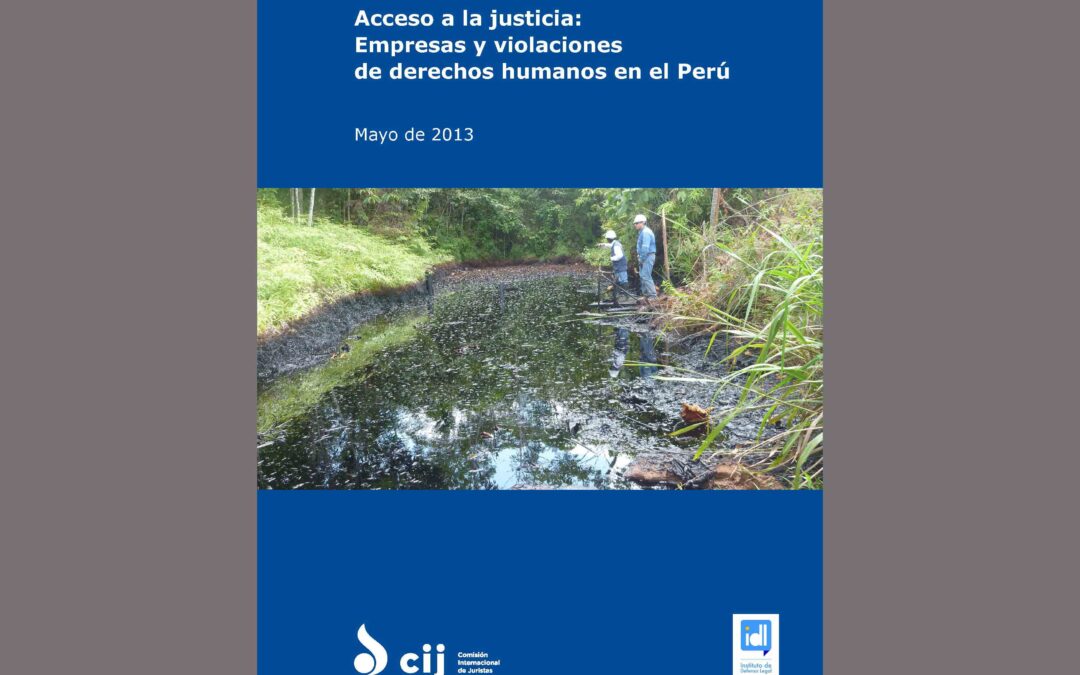
The report (in Spanish) reviews the country’s existing legal remedies under constitutional law, labour law, civil law and criminal law, and examines the way they operate in practice in the light of concrete cases.
Perú has experienced rapid economic growth and high levels of foreign investment for over a decade leading to important social and economic changes in the country.
However, Peru does not finish to bring its legislation and policies into line with international law and standards in the area of human rights and labour rights.
Access to justice, legal and institutional avenues to obtain a remedy in cases of human rights abuses committed with the participation of companies, is one critical are where national law and standards are sorely lacking.
This report, elaborated jointly by the ICJ and the IDL-Peru, reveals serious gaps and deficiencies in the content of laws and their enforcement.
While constitutional remedies seem to be widely used, criminal law is still not applied to corporations and civil law remedies are hardly used by complainants.
In addition, huge disparities of power and knowledge existing between poor communities or indigenous groups and many times transnational corporations in the mining or oil domain translate into serious procedural deficiencies that amount o denial of due process and fair trial for many.
The report recommends swift action by Peruvian authorities and other actors in the country to improve legislation, enhance the independence and effectiveness of judicial institutes, boost legal aid delivery across the country and improve legal education, including international law.
Peru-Access to Justice-BHR-publications-report-2013-spa (Full text in pdf)
Jun 24, 2013 | News
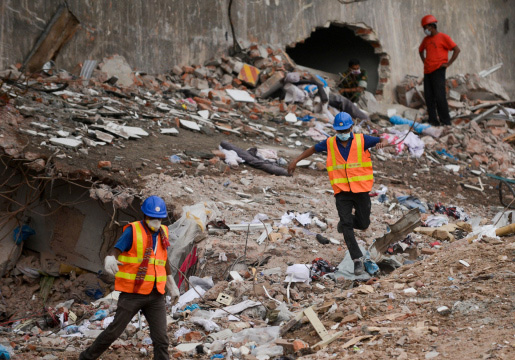
The recent Rana Plaza building disaster, in Bangladesh, could, and should, have been averted if the government had performed its obligation to adequately protect the workers, the ICJ said today.
“The Rana Plaza collapse, which killed 1,131 workers and injured close to 2,500 others, is the most recent in a long list of industrial disasters brought about by the government’s failure to regulate and monitor workplace conditions and sanction private entities violating the law,” said Sheila Varadan, ICJ Legal Advisor on South Asia. “To single out and focus solely on the role of multi-national companies does not reflect the full picture.”
“While the ICJ does not minimize the responsibility of private enterprises, unless the underlying systemic issues such as institutional weaknesses, corruption and lack of enforcement are addressed, such tragedies will continue to happen,” Varadan added.
Litigation is a vital tool to ensure accountability, remedy and reparations, where government agencies fail in their essential functions.
The Bangladesh Legal Aid and Services Trust (BLAST), a leading national human rights organization, has been petitioning the Supreme Court over the past decade, obtaining orders against government agencies and seeking compensation for victims and their families in work-related disasters.
“The government of Bangladesh must take active measures to ensure its regulatory framework is adequate and effective; its laws are rigorously enforced; and victims are adequately compensated,” Varadan also said. “Failing to do so not only violates Bangladeshi law but is also in breach of Bangladesh’s obligations to protect human rights under international law.”
CONTACT:
Sheila Varadan, ICJ Legal Advisor, South Asia Programme (Bangkok), t: +66 857200723; email: sheila.varadan(at)icj.org
Sam Zarifi, ICJ Asia-Pacific Regional Director, (Bangkok), t:+66 807819002; email: sam.zarifi(at)icj.org
Bangladesh-Rana Plaza-Public interest litigation-backgrounder-featured article-2013 (full text in pdf)
Bangladesh-WGBHR5-OralStatement-LegalSubmission-2013 (full statement to the Working Group on Business and Human Rights)
Jun 20, 2013
This is the Report of the Legal Seminar organized in Geneva by the ICJ with the support from Geneva for Human Rights, FIAN International and Al-Haq on 31 May 2013.
The seminar was convened to provide a space for in depth discussion of specific cases that illustrate many of the legal and political obstacles that victims of corporate human rights abuse face in their pursuit of justice.
It is one among several activities the ICJ is undertaking with a view to assessing the need for a new international instrument in the field of business and human rights.
The seminar was held under Chatham House rules.
Universal-Report Corporate Complicity Legal Seminar-publications-seminar report-2013 (full text in pdf)
Jun 19, 2013
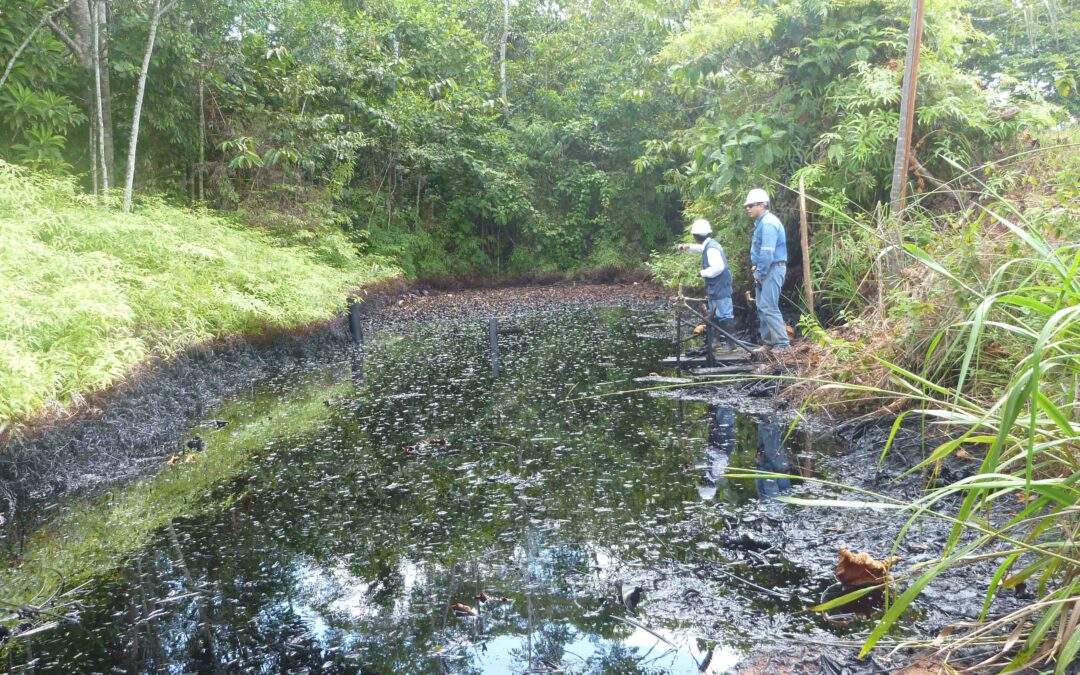
This side event was held recently at the UN Human Rights Council. If you missed it, you can read the summary report and/or watch it here. Listen also to interviews of human rights defenders from Ecuador and Uganda.
UNSideEvent-Corporate complicity-conference report-2013 (full text in pdf)
Watch the side event:
Listen to the interview in Spanish with Humberto Piaguaje Lucitante (Ecuador)
Listen to the interview in Spanish with Pablo Fajardo Mendoza (Ecuador)
Listen to the interview with Peter Kayiira (Uganda)