Dec 1, 2009
The ICJ sent a letter to the Prime Minister of Nepal, urging the Government to suspend the promotion of Major General Toran Bahadur Singh.
His promotion should be suspended until a credible, impartial and independent investigation is conducted into his alleged responsibility for systematic violations of human rights and humanitarian law committed by military units under his command, especially during the civil conflict in 2003‐4.
Nepal-letter Prime Minister promotion-open letter-2009 (full text, PDF)
Nov 19, 2009
The ICJ and other NGOs condemned the decision of the Damascus Section of the Syrian Bar Association to prohibit lawyer and human rights defender Muhannad Al-Hassani from practicing law for the rest of his life.
Among the grounds upon which the disbarment was ordered was that Muhannad Al-Hassani is “the President of an unauthorised organisation (the Syrian Organization for Human Rights)”.
The above-mentioned organisations called on the Syrian Bar Association to seriously reconsider the charges against Muhannad al-Hassani and the decision to permanently disbar him when it hears the case on appeal.
Syria-Persecution and Intimidation of Lawyers and Human Rights Defenders-Position Papers-2009 (full text, PDF)

Nov 1, 2009
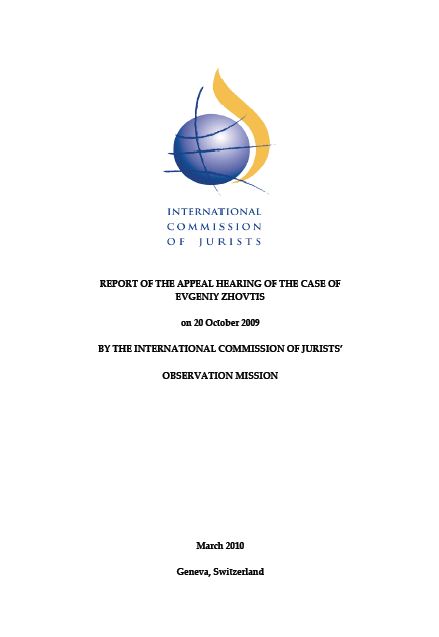
Report of a Mission of Observers to observe the appeal trial hearing of Evgeniy Zhovtis, a lawyer and one of Kazakhstan’s leading human rights defenders.
The ICJ decided to send a Mission of Observers to observe the appeal trial hearing of Evgeniy Zhovtis, a lawyer and one of Kazakhstan’s leading human rights defenders, having received reports that his initial trial had failed to meet international fair trial standards. Mr. Zhovtis was convicted for unintentional manslaughter following a car accident in July 2009. The present Report gives an account of the process, in which Evgeniy Zhovtis himself was not allowed to participate. It describes the conduct of the trial and makes legal assessment of certain particularly problematic issues. The report does not aim to replace the court minutes, which were not kept in this case, but rather gives an overall assessment of the hearing as well as some events taking place outside the courtroom. The legal analysis is based on internationally recognised standards relating to fair trial guarantees, including the jurisprudence of major human rights bodies. The observers would like to express their gratitude to all the parties to the proceedings who facilitated the observation process.
Kazakhstan-appeal hearing Zhovtis-trial observation report-2009-eng
Kazakhstan-appeal hearing Zhovtis-trial observation report-2009-rus

Oct 16, 2009
The ICJ has submitted a shadow report to the Committee against Torture for its consideration of the Periodic Report of Spain.
In the submission, the ICJ dealt with the law and procedure regarding incommunicado detention, and the limited safeguards the law provides for detainees. The ICJ also highlighted concerns regarding the credible allegations of Spain’s involvement in the CIA-run programme of renditions. Finally, the ICJ addressed a problem with Spain’s definition of the offence of torture and the recent attempts to limit the scope of Spanish universal jurisdiction to prosecute and try crimes under international law, including torture.
Spain-Consideration of the 5th Periodic Report-legal submission-2009 (full text, PDF)

Oct 13, 2009
What prisoners say or “confess” to under torture should never be admissible in any court proceedings, said the ICJ and other Human Rights groups.
Cambodia-torture-position paper-2009 (full text, PDF)
Cambodia-torture-web story-2009 (full text, PDF)