Mar 6, 2020 | Advocacy, Non-legal submissions
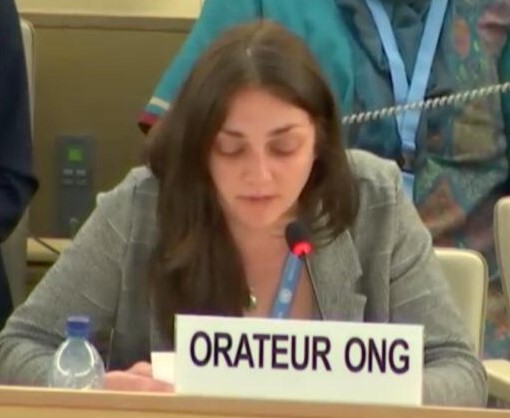
Speaking at the UN Human Rights Council, the ICJ today urged States to decriminalize consensual sexual relations, including between people of the same sex.
The statement, delivered during an interactive dialogue with the UN Special Rapporteur on the Right to Privacy, read as follows:
“The ICJ welcomes the report of the Special Rapporteur on privacy, particularly the recommendation to repeal laws criminalizing consensual sexual activity, cluding between people of the same sex.
The ICJ agrees that criminalization of consensual same-sex relations violates international law and standards, including the rights to privacy, non-discrimination and equal protection.
The ICJ advocates for the abolition of laws that criminalize consensual sexual relations – including between people of the same sex – that still exist in many countries around the world.
In Indonesia, for example, a draft Penal Code currently includes a provision that would criminalize “extramarital” sexual acts between consenting persons, including persons of the same sex. We note that the draft provision may superficially appear to be gender neutral because it would penalize both men and women, but studies have shown that, in practice, criminalization of “adultery” and extramarital sexual relations typically results in disparate, discriminatory impacts against women and girls. Malaysia and other States that are former British colonies in Asia, likewise, have similar provisions in their criminal laws penalizing consensual sexual relations.
Like the Special Rapporteur, the ICJ in urges States to repeal laws that criminalize consensual sexual activity – including between people of the same sex.”
Feb 28, 2020 | Advocacy, Non-legal submissions
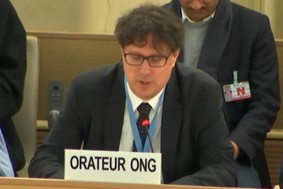
At the UN Human Rights Council, the ICJ today urged renewed international action to ensure justice and accountability for crimes under international law in Sri Lanka.
The statement, delivered during a discussion of updates and reports from the High Commissioner for Human Rights, read as follows:
“The ICJ deeply regrets the Sri Lankan Government’s withdrawal of support for the process under resolutions 30/1 and 40/1. ICJ supports the joint statement read by IMADR.
The Sri Lankan legal system and judicial institutions have for decades demonstrated a chronic inability to address systemic and entrenched impunity for crimes under international law perpetrated by the military and security forces.[1] The new President’s promises to protect the military from accountability, and senior command appointments of individuals credibly accused of crimes under international law, only deepen the concern.
As the High Commissioner notes,[2] the failure to deal comprehensively with impunity and to reform institutions may lead to more human rights violations.
The Tamil population have consistently and rightly rejected any reconciliation process that ignores justice and accountability, and it is obvious that no justice or accountability process that is left to domestic Sri Lankan institutions alone can be credible. The compromise national-international “hybrid” judicial accountability mechanism foreseen by resolution 30/1 already fell far short of what the situation actually warrants.
If the Government seeks now to abandon even that compromise, purely international processes, whether before the ICC or through creation of another international accountability mechanism by the Council, and the exercise of universal jurisdiction by other States, are the only remaining options for securing the justice required by international law and indispensable to any credible reconciliation process for Sri Lanka.”
[1] International Commission of Jurists, Authority without Accountability: The Crisis of Impunity in Sri Lanka, 2012, https://www.icj.org/sri-lanka-new-icj-report-documents-crisis-of-impunity/; Human Rights Council must respond to ongoing failure of Sri Lankan justice system to ensure accountability for human rights violations, 2014, https://www.icj.org/human-rights-council-must-respond-to-ongoing-failure-of-sri-lankan-justice-system-to-ensure-accountability-for-human-rights-violations/; Sri Lanka: the need for an international inquiry, 2014, https://www.icj.org/sri-lanka-the-need-for-an-international-inquiry/; Sri Lanka: Joint Open Letter to the Ambassadors of UN Human Rights Council Member States, 2015, https://www.icj.org/wp-content/uploads/2015/07/SriLanka-JointOpenLetter-Accountability-Advocacy-2015.pdf; Sri Lanka’s victims demand and deserve credible justice, 2016, https://www.icj.org/sri-lankas-victims-demand-and-deserve-credible-justice/.
[2] UN Doc A/HRC/43/19, para 36.
Feb 27, 2020 | Events, News
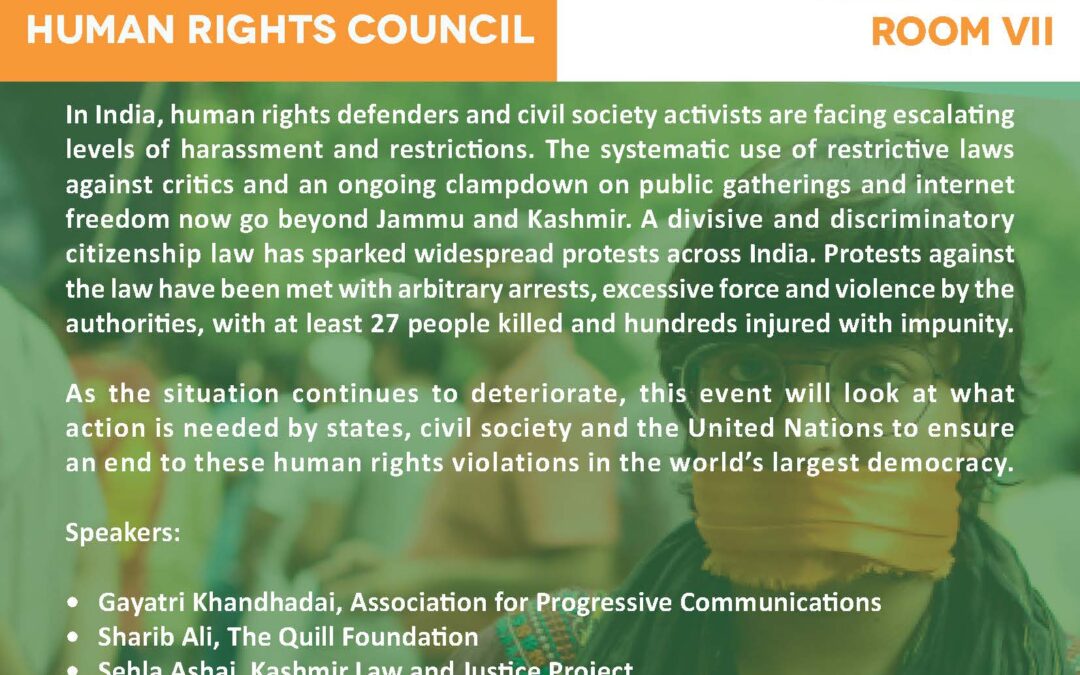
On 2 March, the ICJ and other NGOs will present discussion of the situation for human rights in India at a side event to the UN Human Rights Council in Geneva.
The event takes place Monday 2 March 2020, 14:00 – 15:00, in Room VII, Palais des Nations, Geneva.
In India, human rights defenders and civil society activists are facing escalating levels of harassment and restrictions. The systematic use of restrictive laws against critics and an ongoing clampdown on public gatherings and internet freedom now go beyond Jammu and Kashmir. A divisive and discriminatory citizenship law has sparked widespread protests across India. Protests against the law have been met with arbitrary arrests, excessive force and violence by the authorities, with at least 27 people killed and hundreds injured with impunity.
As the situation continues to deteriorate, this event will look at what action is needed by states, civil society and the United Nations to ensure an end to these human rights violations in the world’s largest democracy.
A flyer for the event can be downloaded here in PDF format: UN-Event-India-2019
Feb 27, 2020 | Events, News
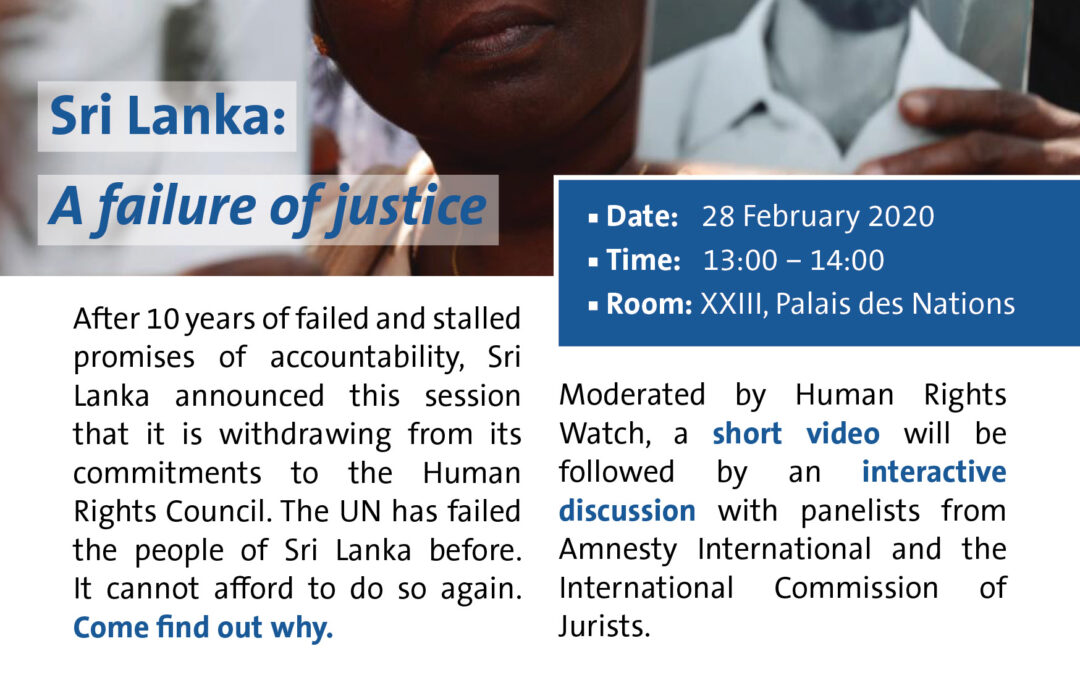
An event at the UN Human Rights Council on 28 February will highlight the continuing failure of Sri Lanka to secure justice for crimes under international law, and discuss ways forward for international efforts to fill the gap.
The event will take place 28 February 2020, 13:00 – 14:00, in Room XXIII of the Palais des Nations in Geneva.
It will be moderated by Human Rights Watch, with a short video will be followed by an interactive discussion with panelists from Amnesty International and the International Commission of Jurists.
A flyer for the event can be downloaded in PDF format here: HRC43 – Sri Lanka
Feb 27, 2020 | Advocacy, Non-legal submissions
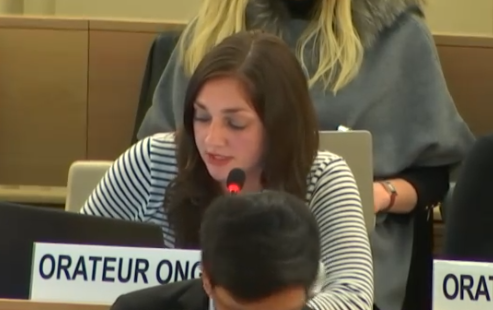
The ICJ today urged law reforms to address discrimination against minorities in Myanmar, during an interactive dialogue with the UN High Commissioner on Human Rights on her report on Rohingya and other minorities in Myanmar, at the Human Rights Council in Geneva.
The statement read as follows:
“The ICJ welcomes the report of the High Commissioner,[1] delivered against the background of continuing ethnic armed conflict in Myanmar.
With over 50 years’ experience monitoring and documenting Myanmar’s human rights situation, the ICJ concurs with the High Commissioner’s conclusions and recommendations.
While the root causes of violations and abuses against the Rohingya and other persecuted minorities in Myanmar may be complex, as the Fact-Finding Mission already reported to the Council in September 2018, the steps required to address them are by now “well known”.[2]
One essential step is comprehensive legal and justice sector reform within the country.
In a briefing paper last year, the ICJ recommended three immediately achievable, concrete areas of law reform available to the Government: 1) legislative reform, including most urgently of the 1982 Citizenship Law; 2) Constitutional reform, to protect the right of citizens to full political participation; and 3) interim measures to address discrimination on the basis of race or ethnicity.
At the same time, it is imperative the international community continues to support the various international accountability efforts underway, including the work of the International Criminal Court and Independent Investigative Mechanism for Myanmar.
The ICJ would like to ask: what role do you see for States and civil society in relation to monitoring and implementation of your recommendations, particularly with respect to law and justice sector reform?”
[1] UN Doc A/HRC/43/18
[2] UN Doc A/HRC/39/64 (12 September 2018), para 102.