Sep 26, 2018 | Advocacy, Non-legal submissions
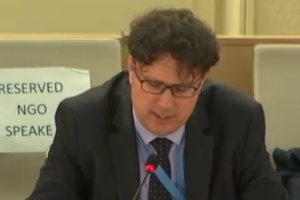
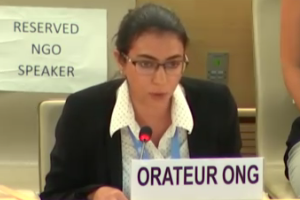
The ICJ today highlighted the steep decline for human rights and the rule of law in Cambodia, at the UN Human Rights Council in Geneva.
The statement, made during an interactive dialogue with the Special Rapporteur on the situation of human rights in Cambodia, read as follows:
“Mr President,
The findings reported by the Special Rapporteur on the situation of human rights in Cambodia (A/HRC/39/73; A/HRC/39/73/Add.1), detailing the steep decline for human rights and rule of law in Cambodia prior to and during the 2018 national elections, demonstrate the utter inadequacy of the Human Rights Council’s current focus on technical assistance and capacity-building in Cambodia.
The elections, neither free nor fair, resulted in the ruling party winning all seats in the National Assembly. Post-election, the Government continues to misuse laws to violate rights and harass journalists, human rights defenders, political opposition members and ordinary individuals, as evidenced by the following updates to cases highlighted by the Special Rapporteur.
Unjustified espionage charges hang over two journalists, who spent eight months in detention before being released pending trial.[1] A filmmaker, sentenced to imprisonment for alleged espionage after flying a drone over an opposition rally, was only released by royal pardon after more than a year in jail.
Days after release from two years in jail for conducting a peaceful protest, a land rights activist was handed a six-month suspended sentence for a politically-motivated charge from 2012.[2] Following his release after 18 months in prison for alleged defamation and incitement offences, a political commentator fled Cambodia when fresh politically-motivated charges were mounted against him.[3]
Treason charges remain active against Kem Sokha, leader of the now-dissolved main opposition party, now under house arrest.[4]
A barber and a school principal remain imprisoned for allegedly sharing information online in breach of a lese-majeste law.[5] A woman remains imprisoned for alleged insult and incitement offences for throwing a shoe at a ruling party billboard.[6]
Today, four senior staff from a prominent civil society organization and a National Election Committee official were convicted under politically-motivated charges and handed five-year suspended imprisonment sentences.[7]
Madam Special Rapporteur, what approach should the Council, governments and civil society take to ensure human rights and the rule of law in Cambodia, given that technical assistance and capacity-building alone seem clearly not to be having the necessary effect?
Thank you.”
[1] A/HRC/39/73/Add.1, para 42.
[2] A/HRC/39/73, para 13.
[3] A/HRC/39/73/Add.1, para 35.
[4] A/HRC/39/73/Add.1, paras 18 and 19.
[5] A/HRC/39/73/Add.1, para 46.
[6] A/HRC/39/73/Add.1, para 30.
[7] A/HRC/39/73, para 13; A/HRC/73/Add.1, para 35
Sep 26, 2018 | Advocacy, Non-legal submissions
The ICJ today emphasised the continuing failure of domestic accountability mechanisms to ensure proper accountability for crimes under international law in Libya, speaking at the UN Human Rights Council in Geneva.
The statement, made during an Interactive Dialogue with the UN High Commissioner for Human Rights on her oral update on the situation in Libya, at the Human Rights Council in Geneva, read as follows:
“Mr President,
The International Commission of Jurists (ICJ) remains concerned by the scale and magnitude of the human rights violations that continue in Libya, and the failure of domestic accountability mechanisms to address them.
Impunity prevails for crimes under international law committed during and after the 2011 uprising, including extrajudicial killings, torture and other ill-treatment, and enforced disappearances. Broad amnesty laws allow those responsible to avoid prosecution.
Even in the rare cases where former officials of the Gadhafi regime have faced trial,[1] the integrity of the justice process has been compromised by failures to respect international fair trial standards, including the right to legal counsel and the right to call and examine witnesses.
On August 15, 2018, following an unfair mass trial, 99 defendants were convicted for the killing of 146 anti-Gaddafi protesters in Tripoli during the 2011 uprising.[2] 45 were sentenced to death, violating the right to life.
Such unfair trials and unlawful sentences not only violate the human rights of the accused: they deprive the victims of the crimes of the right to know the truth about the legacy of past violations and the legitimate and untainted justice to which they are entitled. New, fair trials are required.
Political and security instability in Libya undermines the ability of the judiciary to administer justice independently and impartially, including with a view to combating impunity. Judges and prosecutors are threatened, intimidated, abducted and in some instances killed, particularly when attempting to address crimes by members of armed groups.
The ICJ would like to ask the High Commissioner, how can other States and civil society help ensure that Libya, while fully cooperating with the International Criminal Court, implements an effective legal and practical framework to address crimes under international law and eradicate impunity?
Thank you.”
[1] Case 630/2012.
[2] https://www.hrw.org/news/2018/08/22/libya-45-sentenced-death-2011-killings.
Sep 18, 2018 | Événements, Multimédia, Nouvelles
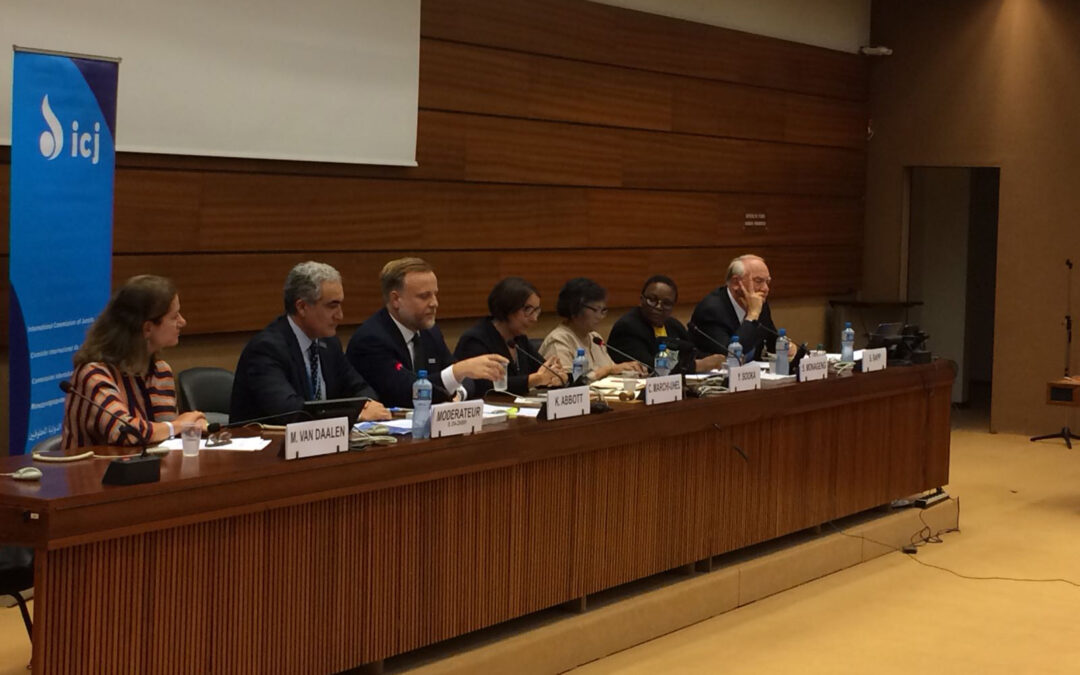
La CIJ a organisé cet événement parallèle aujourd’hui (mardi 18 septembre 2018) au Conseil des droits de l’Homme, en coopération avec la Mission permanente des Pays-Bas.
https://www.facebook.com/ridhglobal/videos/1005764152964172/
Contexte
En particulier lorsque des crimes de droit international sont perpétrés à grande échelle dans des situations de crise, il est urgent de préserver les preuves pouvant être utilisées lors de procédures pénales éventuelles, que ce soit devant la Cour pénale internationale ou d’autres tribunaux nationaux ou internationaux.
Trop fréquemment, des obstacles empêchent un recours direct aux tribunaux et procureurs internationaux. L’une des réponses a été la création de mécanismes pour collecter et conserver les preuves pendant ce temps. Les exemples incluent le Mécanisme international indépendant et impartial (IIIM) pour la Syrie et la Commission des droits de l’Homme au Sud Soudan.
À la présente session du Conseil des droits de l’Homme, la mission d’enquête sur le Myanmar a appelé à la création d’un IIIM dans l’attente d’une saisine de la CPI ou d’un tribunal ad hoc.
Discours d’ouverture
Ambassadeur Monique T.G. van Daalen, Mission permanente des Pays-Bas
Modérateur:
Saman Zia-Zarifi, Secrétaire général de la Commission internationale des juristes
Panélistes:
- Catherine Marchi-Uhel, cheffe du Mécanisme international indépendant et impartial (IIIM) pour la Syrie
- Yasmin Sooka, présidente de la Commission des droits de l’homme au Sud Soudan
- Sanji Monageng, ancienne juge / vice-présidente de la CPI et commissaire de la CIJ
- Stephen Rapp, président de la Commission pour la justice internationale et la responsabilité (CIJA), membre émérite du US Holocaust Memorial Museum, et ancien ambassadeur des États-Unis chargé pour la justice pénale mondiale
- Kingsley Abbott, conseiller juridique principal de la CIJ, anciennement aux Chambres Extraordinaires au sein des Tribunaux Cambodgiens et du Tribunal spécial pour le Liban
Universal-ICJ-NL-Side event-News-events-2018-ENG (prospectus de l’événement en PDF uniquement en anglais)
Sep 18, 2018 | Events, Multimedia items, News, Video clips
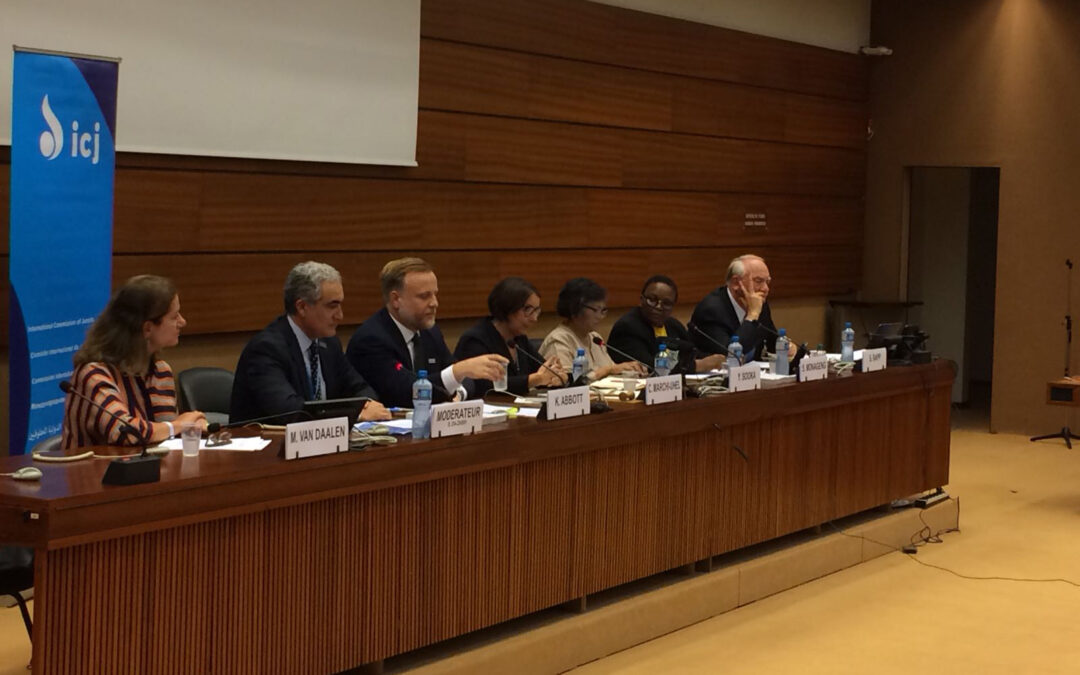
The ICJ organized this side event today (Tuesday 18 September 2018), in cooperation with the Permanent Mission of the Netherlands, at the Human Rights Council.
https://www.facebook.com/ridhglobal/videos/1005764152964172/
Background
Particularly when crimes under international law are perpetrated on a large scale in situations of crisis, there is an urgent need to preserve evidence for use in eventual criminal proceedings, whether at the International Criminal Court or other national or international tribunals
Too frequently, obstacles prevent immediate direct recourse to international courts and prosecutors. One response has been the creation of mechanisms to collect and preserve the evidence in the meantime. Examples include the International Independent and Impartial Mechanism (IIIM) for Syria, and the Commission on Human Rights in South Sudan.
At the current session of the Human Rights Council, the Fact-Finding Mission on Myanmar has called for establishment of an IIIM pending referral to the ICC or an ad hoc tribunal.
Opening Remarks:
Ambassador Monique T.G. van Daalen, Permanent Mission of the Netherlands
Moderator:
Saman Zia-Zarifi, Secretary General, International Commission of Jurists
Panelists:
- Catherine Marchi-Uhel, Head, International, Impartial and Independent Mechanism (IIIM) for Syria
- Yasmin Sooka, Chairperson, Commission on Human Rights in South Sudan
- Sanji Monageng, former Judge/Vice-President of the ICC, and Commissioner of the ICJ
- Stephen Rapp, Chair, Commission for International Justice & Accountability (CIJA), Distinguished Fellow, US Holocaust Memorial Museum, and former United States Ambassador-at-Large for Global Criminal Justice
- Kingsley Abbott, ICJ Senior Legal Adviser (Global Accountability), formerly with the Extraordinary Chambers in the Courts of Cambodia and the Special Tribunal for Lebanon
Universal-ICJ-NL-Side event-News-events-2018-ENG (flyer of the event in PDF)
Sep 18, 2018 | Plaidoyer
La CIJ a mis en lumière les graves menaces qui pèsent sur l’état de droit en Hongrie, en Pologne et en Turquie, lors de sa prise de parole au Conseil des droits de l’Homme à Genève.
La déclaration, faite pendant le débat général sur les situations nécessitant l’attention du Conseil, est la suivante:
«La Commission internationale de juristes (CIJ) voudrait attirer l’attention du Conseil sur les graves menaces qui pèsent sur l’état de droit en Hongrie, en Pologne et en Turquie.
En Pologne, le gouvernement a adopté une mesure législative pour imposer de manière arbitraire un «départ à la retraite» involontaire d’un tiers de ses juges à la Cour suprême, portant ainsi un coup fatal à l’indépendance du pouvoir judiciaire, déjà mis à mal par les réformes passées.
En Hongrie, de multiples réformes législatives ont affaibli l’indépendance des juges et puni les activités de certaines ONG de défense des droits de l’homme et restreint leur financement.
Enfin, en Turquie, la consolidation de mesures d’urgence en droit commun, des réformes constitutionnelles régressives, et le licenciements massif de juges et de procureurs a supprimé une protection essentielle pour le fonctionnement d’un pouvoir judiciaire indépendant.
La CIJ est en outre préoccupée par l’interdiction des manifestations des mères du samedi qui prévoit d’organiser des manifestations hebdomadaires à la mémoire des membres de leur famille disparus, en violation de leur droit à la liberté de réunion.
La CIJ est profondément préoccupée par l’escalade de telles menaces aux principes fondamentaux de l’état de droit en Europe, sans que des mesures spécifiques soient prises par le Conseil pour y remédier.
La CIJ exhorte le Conseil à prêter attention à ces développements, qui s’inscrivent dans le cadre d’une attaque mondiale plus vaste contre la primauté du droit [1] et à observer la situation des droits de l’homme dans ces pays.
[1] Voir la CIJ, «L’état de droit sous la menace mondiale» (déclaration lors du débat général sur le compte rendu oral du Haut Commissaire), 11 septembre 2018: https://www.icj.org/hrc39-gd2-hc/