Sep 24, 2014
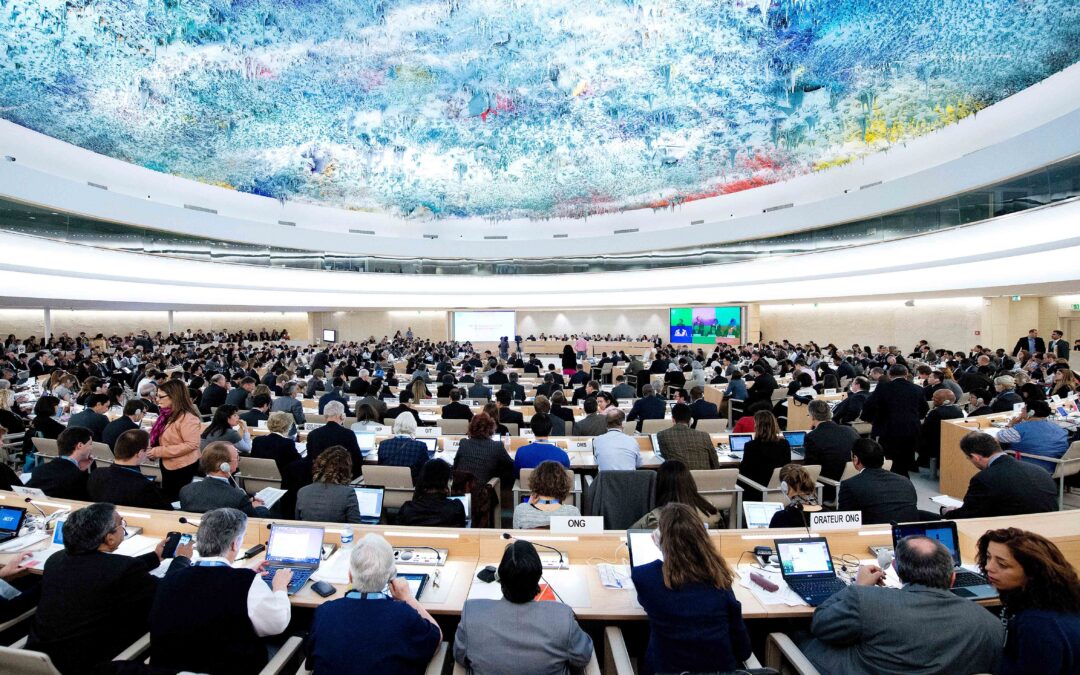
The ICJ today joined International Service for Human Rights (ISHR) and other NGOs in emphasising that members of the UN Human Rights Council must reject procedural tactics that prevent the Council from engaging in substantive debates on human rights issues.
The NGOs are particularly concerned about the use of a so-called “no action motion”. A ‘no-action motion’ is a procedural motion by a member of the Council that prevents the discussion of a proposal or matter in the Council.
At the Council’s 26th session in June 2014, a ‘no-action motion’ was used to prevent the consideration of an amendment to the resolution on the ‘Protection of the family and all its members’ that would have added long-agreed UN language on diversity of family forms to the resolution. The “no-action” motion passed, with 22 votes in favour, 20 against, and 4 abstentions (with one member State being absent from the room). A minority of the Council membership was therefore able to prevent substantive debate on the amendment. Delegations were therefore never given the chance to express themselves (whether in terms of support or not) by voting on the proposal.
This was the first time that this stifling procedure was used in the Human Rights Council in connection with a thematic issue. The NGOs are concerned about the prospect of similar tactics at the current session.
The use of procedural tactics such as the “no action motion” to prevent consideration of issues by the Council is inconsistent with the purpose and mandate given to the Council by the General Assembly. (The “no action motion” is available at all in the Council only because the Council uses the generic rules of procedure for Committees of the General Assembly rather than rules of procedure specifically designed for the Council. Whatever its appropriateness in those other very different contexts, the “no action motion” rule should have no role to play in blocking discussion and consideration of any human rights issue of any kind by the Council.) Delegations that oppose a measure have every opportunity to vote against it after a full debate.
The NGOs affirm that a vote in support of a ‘no-action motion’ is censorship tantamount to opposition to the substantive question itself and will be seen that way, and urge all delegations not to support any such motions.
The joint open letter to States members of the UN Human Rights Council can be downloaded in PDF format here: Universal-HRCNoActionMotion-Advocacy-OpenLetter-2014-ENG
Sep 16, 2014 | Advocacy, Non-legal submissions
ICJ affiliate the Colombian Commission of Jurists today delivered an oral statement at the UN Human Rights Council, concerning enforced disappearances in Thailand.
The statement noted that of the 81 cases transmitted by the Working Group on Enforced or Involuntary Disappearances to the Royal Thai Government between 1980 and 2014, the Government has clarified only two (A/HRC/27/49, 5 August 2014).
The statement highlighted the case of Somchai Neelapaijit, a lawyer and human rights defender, who was subjected to enforced disappearance more than 10 years ago but whose case remains unresolved. I also described the recent disappearance of Pholachi “Billy” Rakchongcharoen, a Karen minority human rights activist, who has not been seen since April 2014, when he was last seen in the custody of certain public officials with whom he and his community were engaged in an ongoing legal dispute.
The statement emphasised that Thailand must effectively investigate all cases and provide victims, including family members, withfull remedies and reparation. Enforced disappearance should be a distinct crime in domestic law, with penalties reflecting its extreme seriousness. Thailand should also accept the 30 June 2011 visit request of the Working Group and ratify the Convention for the Protection of All Persons from Enforced Disappearance, which it signed on 9 January 2012.
Thailand exercised its right of reply to respond to the oral statement.
The statement can be downloaded in PDF format here: Thailand-EnforcedDisappearance-Advocacy-non legal submission-2014-ENG
The statement and reply can be viewed in the UN video archive, here.
A written version of the reply by Thailand (unofficial, the official reply is as delivered in the video above) can be downloaded in PDF format here: Thailand_R of Reply_GD_18
Sep 12, 2014 | Advocacy, Non-legal submissions
The Colombian Commission of Jurists, an ICJ affiliate, delivered an oral statement during the Interactive Dialogue with the UN Special Rapporteur on Truth, Justice, Reparations and Guarantees of Non-recurrence, and the Working Group on Arbitrary Detention, at the Human Rights Council.
Aug 29, 2014
The International Commission of Jurists has joined other non-governmental organisations to urge the UN Human Rights Council to take action on the situation in Egypt.
The organisations urge the Human Rights Council to adopt a resolution that clearly and unequivocally condemns the ongoing crackdown and increasing restrictions to basic freedoms in Egypt and calls upon the Government of Egypt to fully respect its human rights obligations and to ensure accountability and justice for past and ongoing gross human rights violations.
The letter is available for download in pdf format here: ICJ-UN-HRC-Egypt-OpenLetter-29082014.
Aug 26, 2014 | Advocacy, Non-legal submissions
The ICJ and other leading NGOs have called on the President and member states of the Human Rights Council, as well as the government of Sri Lanka, to take action to ensure no-one faces reprisals for cooperating with the United Nations.