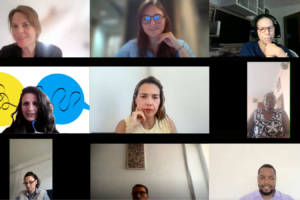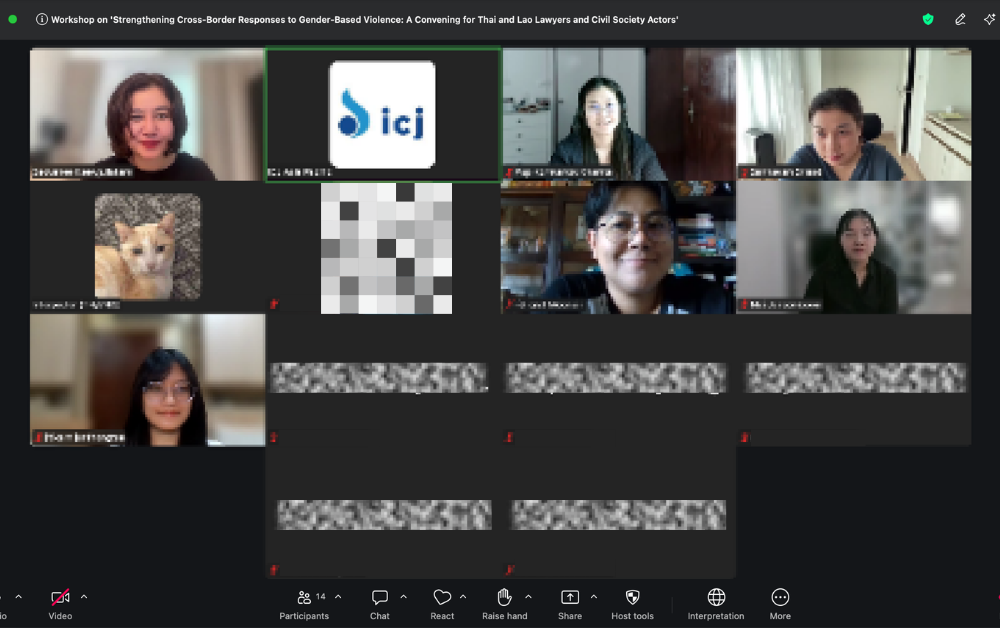
On 26 May 2026, the International Commission of Jurists (ICJ), with the support of the Embassy of The Netherlands in Bangkok, held a virtual half-day workshop bringing together 12 lawyers and civil society representatives from Lao PDR and Thailand to strengthen cross-border responses to sexual and gender-based violence (GBV).
The workshop followed up on an earlier convening held on 23-24 March 2026 in Bangkok, which had brought the same group together to discuss international human rights law and standards and to build cross-border networks among Lao and Thai lawyers and civil society actors working on addressing SGBV, including technology-facilitated forms of gender-based violence (TFGBV).
On 26 May, participants divided into small groups for an interactive exchange, following up on issues raised during the March 2026 dialogue. The first group focused on the use of technology to support gender-sensitive reporting of GBV cases, examining how to develop a shared platform to support survivors across the two countries. Participants considered features such as secure and confidential reporting channels, referral pathways linking survivors to legal aid, psychosocial support and shelters, and safeguards to protect survivors’ identities and data given the sensitive nature of the cases. They also discussed existing platforms already in use in Thailand and how such facilities could be adapted to Lao PDR—given the two countries’ differing legal and institutional contexts—building on existing tools rather than duplicating them.
A second group focused on eradicating gender stereotyping in the courtroom, contributing directly to ICJ’s ongoing work with the Thai judiciary in developing institutional recommendations on how to make members of the judiciary more gender-responsive, both during trial and in management of cases and court infrastructure. Participants shared challenges they had encountered, including inadequate facilities for victims of sex crimes and for women and children more broadly, the use of sexist language, and reliance on gender stereotypes when assessing consent in sex crime cases.
A dedicated session with Bandana Rana, member of the Committee on the Elimination of Discrimination against Women (the CEDAW Committee or the Committee) was a central highlight of the workshop. Her presentation discussed harmful practices, gender stereotypes, domestic violence legislation, and the engagement of men and boys in addressing GBV. She traced how the Committee has elaborated international law and standards on GBV, including through General Recommendation No. 19 (1992), which first recognized violence against women as a form of discrimination; General Recommendation No. 35 (2017), updating General Recommendation No. 19, and strengthening the framework around State accountability, survivor-centred responses, and intersectionality; and General Recommendation No. 33 on women’s access to justice, which emphasizes that justice must be accessible, affordable, safe, and responsive, not merely available on paper.
Drawing on regional experience, Rana outlined common barriers to access to justice for GBV survivors across Asia, including limited access in rural areas, a shortage of shelters and forensic and medical services, inadequate legal aid, entrenched stigma, and an overreliance on informal mediation that often pressures survivors to prioritize “family harmony” over protection and justice. She noted that these barriers fall hardest on ethnic minority, migrant, refugee and rural women, as well as on women with disabilities.
To illustrate how gender stereotypes can infiltrate judicial reasoning itself, she discussed the CEDAW Committee’s jurisprudence in Tayag Vertido v. Philippines, a case concerning a rape acquittal in which the Committee held that the trial court’s reasoning had relied on myths about how a survivor was expected to behave, rather than on the law itself.
Rana then briefed participants on the CEDAW Committee’s forthcoming General Recommendation No. 41 on gender stereotypes. The draft Recommendation addresses how gender stereotypes operate across employment, family life, business, the digital space, health, and the judiciary, and is expected to be adopted at the Committee’s October 2026 session. Participants discussed how the draft Recommendation is likely to be directly relevant to their ongoing legal and advocacy work in both Lao PDR and Thailand.
The workshop concluded with a question-and-answer session and a discussion on next steps, reaffirming participants’ commitment to continued cross-border exchange in addressing SGBV across Lao PDR and Thailand.
Speakers included:
- Bandana Rana, member of the CEDAW committee
- Christiaan A. Bergwerff, Deputy Head of the Political and Economic Department and First Secretary, Netherlands Embassy in Bangkok
- Kornkanok Khumta, Cracked, but Unbroken Group
- Sanhawan Srisod, Senior Legal Adviser, ICJ
Further readings:
Lao PDR: Addressing gaps in access to justice for survivors of sexual and gender-based violence
Contact:
Sanhawan Srisod, Senior Legal Adviser, Legal and Policy Office, e: sanhawan.srisod@icj.org
Saovanee Kaewjullakarn, Associate Legal Adviser, ICJ Asia and the Pacific Programme, e: saovanee.kaewjullakarn@icj.org