Sep 24, 2014 | News
The ICJ expressed concern at the promulgation of a constitutional amendment that empowers the Bangladesh Parliament to impeach judges of the Supreme Court.
The ICJ urges the Government to ensure the impeachment provision meets its obligations under the International Covenant on Civil and Political Rights and international standards on the independence of the judiciary.
“Parliament must prescribe adequate safeguards to ensure the newly enacted impeachment provision meets international standards for protecting the independence of the judiciary and the right to a fair trial,” said Sam Zarifi, ICJ’s Director for Asia and the Pacific. “Without such safeguards, the looming fear of arbitrary and politically motivated impeachment would create an environment in which judges would be unable to exercise their judicial functions independently and impartially, especially in cases involving the Government.”
On 22 September 2014, President Abdul Hameed gave his assent to the 16th constitutional amendment, which was passed unanimously by the Bangladeshi Parliament on 17 September 2014.
The amendment empowers Parliament to impeach judges of the Supreme Court on the grounds of “proven misbehavior or incapacity” by passing a resolution supported by at least a two-third majority of parliamentarians.
To exercise this power, Parliament has to first pass a law to regulate the procedure in relation to investigation and proof of the misbehavior or incapacity of a judge that would lead to an impeachment.
International standards on the independence of the judiciary, including the UN Basic Principles on the Independence of the Judiciary, the Commonwealth Principles on the Accountability of and the Relationship between the Three branches of Government, and the Beijing Statement of Principles of the Independence of the Judiciary, stipulate that judges shall be subject to suspension or removal only for “reasons of incapacity or behavior that renders them unfit to discharge their duties”.
The phrase “proven misbehavior or incapacity” in the Bangladeshi amendment will have to be interpreted and applied in line with this relatively high threshold.
“Impeachment of judges must be an exceptional measure, reserved for cases of gross misconduct,” said Zarifi. “Unless Parliament takes great care to ensure the law regulating and clarifying the impeachment procedure follows international law and standards on the removal of judges, the constitutional amendment can only be interpreted as an assault on the independence of the judiciary.”
Any removal proceedings must meet international standards on fair trial and due process.
A judge at risk of being disciplined or removed must be accorded the right to be fully informed of the charges; the right to be represented at the hearing by council of choice; the right to make a full defense; and the right to be judged by an independent and impartial tribunal.
“The actions that Parliament might take under the impeachment amendment are particularly worrying given the Awami League Government’s recent record of passing a series of regressive laws and policies relating to human rights,” added Zarifi. “After clamping down on the operation of civil society groups and restricting freedom of expression of the media and human rights defenders, it appears that the Government is now looking to target the judiciary.”
An independent and impartial judiciary is central to the protection of human rights and the rule of law.
The ICJ therefore urges the Bangladesh Parliament to safeguard judicial independence by ensuring that the laws governing the impeachment procedure meet international law and standards on the independence of the judiciary and the right to a fair trial.
Contact:
Sam Zarifi, ICJ Asia Pacific Regional Director (Bangkok), t: +66 807819002; e: sam.zarifi(a)icj.org
Reema Omer, ICJ International Legal Adviser (London), t: +44 7889565691; e: reema.omer(a)icj.org

Sep 24, 2014
The ICJ has provided a submission to the UN Human Rights Committee for its consideration during the examination of the Second and Third Periodic Reports of Malta under the International Covenant on Civil and Political Rights.
During its 112th session, from 7 to 31 October 2014, the Committee will examine Malta’s implementation of the provisions of the International Covenant on Civil and Political Rights (ICCPR).
In this submission, the ICJ expresses concern that the State party has violated its obligations under the Covenant in relation to the continued criminalization of abortion and its interference with the enjoyment of Covenant rights in connection with sexual orientation and gender identity. Further, the ICJ raises questions about the continuing necessity of Malta’s reservations to the Covenant.
Malta-CCPR-Advocacy-LegalSubmission-2014-ENG(rev)

Sep 24, 2014
The ICJ today joined 42 other NGOs to express deep concern regarding proposed amendments to the draft resolution on civil society space at the UN Human Rights Council.
The draft resolution on civil society space identifies key elements required to ensure that civil society can exercise its critical role in strengthening democracy, providing essential services, and promoting human rights.
It reaffirms States’ existing obligations under international human rights law to guarantee the rights to freedom of expression, assembly and association, and public participation, among other rights, and to protect civil society space and actors from threats, attacks or reprisals. The Resolution, if adopted, would be an important contribution to efforts to bridge implementation gaps and overcome obstacles in protecting civil society space.
However, in the days before the resolution is to be considered for adoption by the Council, some States have presented amendments that seek to undermine the spirit of the resolution and to detract from States’ obligations to protect and promote civil society space.
In a joint open letter, the 43 NGOs explain why each of the proposed amendments is unacceptable, and calls on all member States of the Council to support the draft resolution as tabled, and vote against the proposed amendments should they be brought to a vote.
The joint open letter may be downloaded in PDF format here: Universal-CivilSocietySpaceLetter-Advocacy-OpenLetter-2014-ENG
Sep 24, 2014
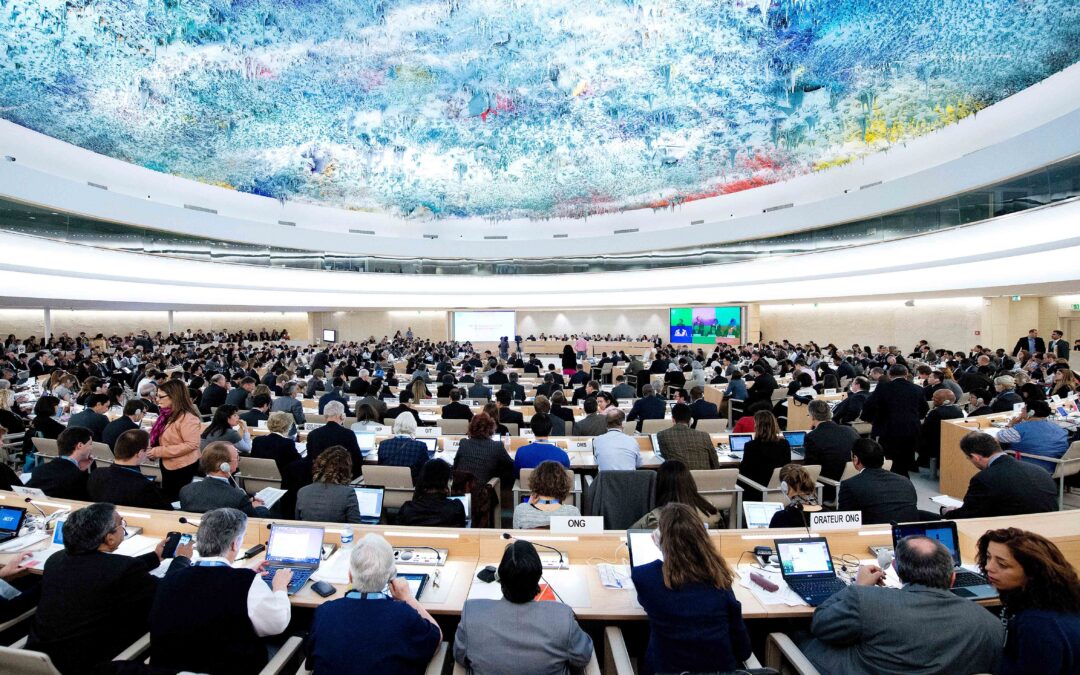
The ICJ today joined International Service for Human Rights (ISHR) and other NGOs in emphasising that members of the UN Human Rights Council must reject procedural tactics that prevent the Council from engaging in substantive debates on human rights issues.
The NGOs are particularly concerned about the use of a so-called “no action motion”. A ‘no-action motion’ is a procedural motion by a member of the Council that prevents the discussion of a proposal or matter in the Council.
At the Council’s 26th session in June 2014, a ‘no-action motion’ was used to prevent the consideration of an amendment to the resolution on the ‘Protection of the family and all its members’ that would have added long-agreed UN language on diversity of family forms to the resolution. The “no-action” motion passed, with 22 votes in favour, 20 against, and 4 abstentions (with one member State being absent from the room). A minority of the Council membership was therefore able to prevent substantive debate on the amendment. Delegations were therefore never given the chance to express themselves (whether in terms of support or not) by voting on the proposal.
This was the first time that this stifling procedure was used in the Human Rights Council in connection with a thematic issue. The NGOs are concerned about the prospect of similar tactics at the current session.
The use of procedural tactics such as the “no action motion” to prevent consideration of issues by the Council is inconsistent with the purpose and mandate given to the Council by the General Assembly. (The “no action motion” is available at all in the Council only because the Council uses the generic rules of procedure for Committees of the General Assembly rather than rules of procedure specifically designed for the Council. Whatever its appropriateness in those other very different contexts, the “no action motion” rule should have no role to play in blocking discussion and consideration of any human rights issue of any kind by the Council.) Delegations that oppose a measure have every opportunity to vote against it after a full debate.
The NGOs affirm that a vote in support of a ‘no-action motion’ is censorship tantamount to opposition to the substantive question itself and will be seen that way, and urge all delegations not to support any such motions.
The joint open letter to States members of the UN Human Rights Council can be downloaded in PDF format here: Universal-HRCNoActionMotion-Advocacy-OpenLetter-2014-ENG
Sep 23, 2014 | News
The ICJ today called on the Syrian authorities to request that all pending criminal charges against Mazen Darwish (photo), Hussein Gharir and Hani Al-Zitani be quashed, and to release the three prominent Syrian human rights defenders immediately and unconditionally.