Sep 13, 2014 | News
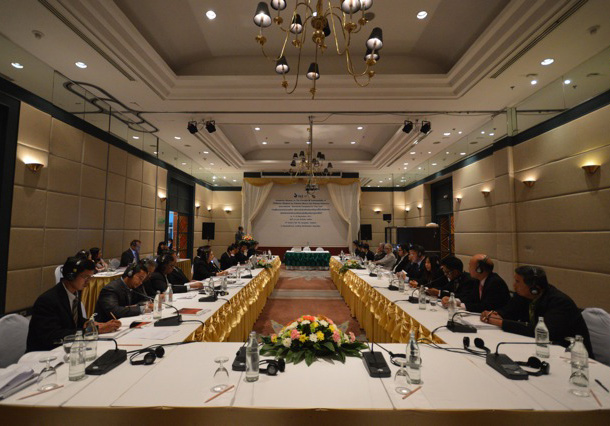
On 11-12 September 2014, the ICJ held an academic seminar on “The Principle of Inadmissibility of Evidence Obtained by Unlawful Means and Hearsay Evidence: International Standards Compared to Thai Law” for Judges, prosecutors and lawyers working in Thailand’s deep South.
The objective of the seminar held in Hat Yai was to discuss the provisions of the Thai Criminal Procedure Code that address hearsay and unlawfully obtained evidence and compare them to international standards.
Speakers at the seminar included Justice Jaran Pakdeethanakul of the Constitutional Court of Thailand; Associate Professor Narong Jaiharn, Dean of the Faculty of Law, Thammasat University; and two international Judges who spoke about the approach to hearsay and unlawfully obtained evidence in the inquisitorial and adversarial legal systems.
Sep 12, 2014 | Advocacy, Non-legal submissions
The Colombian Commission of Jurists, an ICJ affiliate, delivered an oral statement during the Interactive Dialogue with the UN Special Rapporteur on Truth, Justice, Reparations and Guarantees of Non-recurrence, and the Working Group on Arbitrary Detention, at the Human Rights Council.

Sep 12, 2014
The ICJ has submitted information to the UN Human Rights Committee in advance of its examination of Sri Lanka’s fifth periodic report under the International Covenant on Civil and Political Rights (ICCPR).

Sep 12, 2014 | News
The ICJ urgently calls on the Pakistani Government to halt the imminent execution of Shoaib Sarwar, scheduled to take place on 18 September 2014.

Sep 12, 2014 | Advocacy
ICJ supported a joint written statement by civil society organizations highlighting threats to privacy and other human rights engendered by electronic surveillance, and calling for the establishment of a UN mechanism on the issue, as the UN Human Rights Council discussed the issue in Geneva.
The organizations urge the Council to establish a dedicated special procedure mandate on the right to privacy for the following reasons:
- A dedicated mandate holder would play a critical role in developing common understandings and furthering a considered and substantive interpretation of the right across a variety of settings, as recommended by the report. A dedicated mandate holder would also be an independent expert, allowing for a neutral articulation of the application of the right to privacy that draws on the input of all stakeholders.
- Establishing a separate mandate for privacy would allow for the development of a coherent and complementary approach to the interaction between privacy, freedom of expression, and other rights.
- A dedicated mandate holder would help assess the implementation by state and non-state actors of their applicable international responsibilities and obligations in a sustained and systematic way. Functions should include carrying out country visits; collecting best practices; receiving and seeking information from states, businesses, and other stakeholders; and issuing recommendations.
The full written statement, submitted by Human Rights Watch and endorsed by the other organisations, can be downloaded here (ICJ-UN-HRC27-JointStatementPrivacy-12092014) in PDF format.