Jul 2, 2013
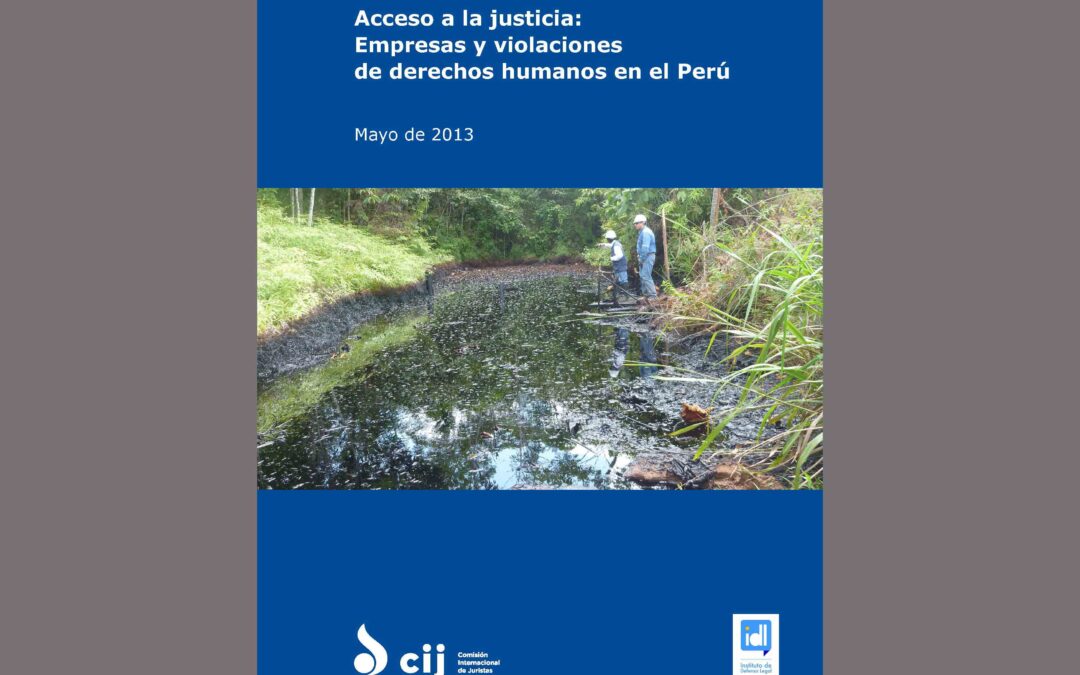
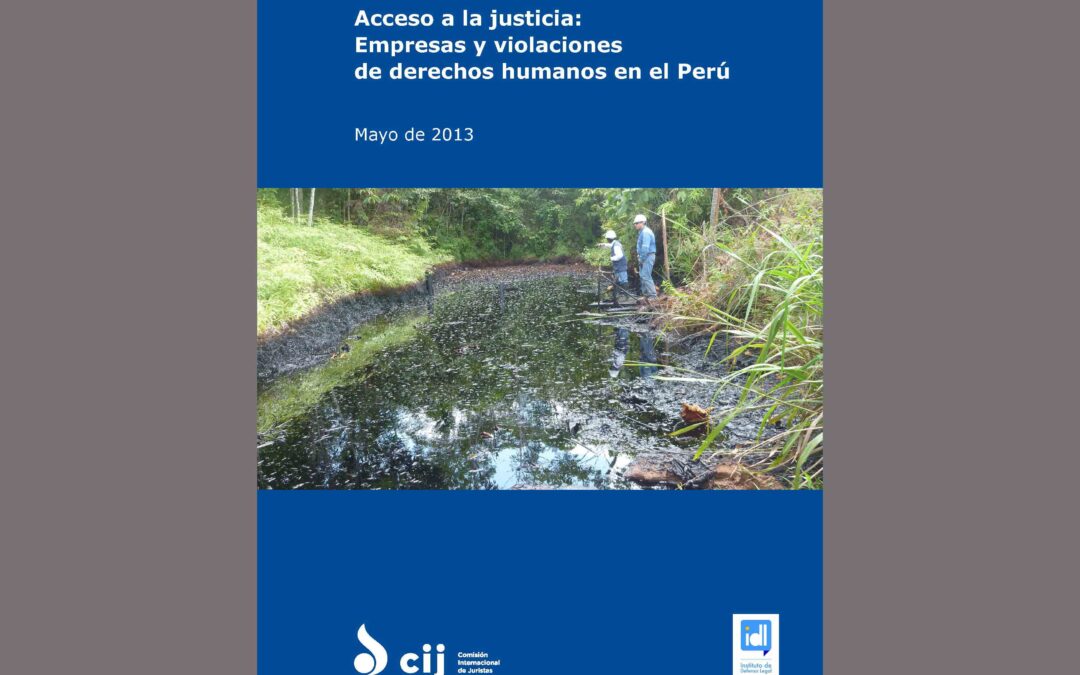
El informe revisa los recursos legales existentes en el país en virtud del derecho constitucional, derecho laboral, derecho civil y derecho penal, y examina la forma en que operan en la práctica a la luz de casos concretos.
Perú ha experimentado un rápido crecimiento económico y altos niveles de inversión extranjera durante más de una década, lo que ha llevado a importantes cambios sociales y económicos en el país.
Sin embargo, Perú no termina de adecuar su legislación y sus políticas al derecho y las normas internacionales en materia de derechos humanos y derechos laborales.
El acceso a la justicia, las vías jurídicas e institucionales para obtener un recurso y reparación en casos de abusos contra los derechos humanos cometidos con la participación de empresas, es una cuestión crítica en la que la legislación y las normas nacionales son deficientes.
Este informe, elaborado conjuntamente por la CIJ y el IDL-Perú, revela graves lagunas y deficiencias en el contenido de las leyes y su cumplimiento.
Si bien los recursos constitucionales parecen ser ampliamente utilizados, el derecho penal aún no se aplica a las empresas y los recursos legales civiles apenas son utilizados por los reclamantes.
Además, las enormes disparidades de poder y conocimiento existentes entre comunidades pobres o grupos indígenas y muchas veces corporaciones transnacionales en el sector minero o petrolero se traducen en serias deficiencias procesales que equivalen a negar el debido proceso y el juicio justo a muchas personas.
El informe recomienda una acción rápida de las autoridades peruanas y otros actores del país para mejorar la legislación, mejorar la independencia y la eficacia de las instituciones judiciales, impulsar la prestación de asistencia jurídica en todo el país y mejorar la educación jurídica, incluido en materia de derecho internacional.
Peru-Access to Justice-BHR-publications-report-2013-spa (informe en PDF)
Jul 2, 2013
The report (in Spanish) reviews the country’s existing legal remedies under constitutional law, labour law, civil law and criminal law, and examines the way they operate in practice in the light of concrete cases.
Perú has experienced rapid economic growth and high levels of foreign investment for over a decade leading to important social and economic changes in the country.
However, Peru does not finish to bring its legislation and policies into line with international law and standards in the area of human rights and labour rights.
Access to justice, legal and institutional avenues to obtain a remedy in cases of human rights abuses committed with the participation of companies, is one critical are where national law and standards are sorely lacking.
This report, elaborated jointly by the ICJ and the IDL-Peru, reveals serious gaps and deficiencies in the content of laws and their enforcement.
While constitutional remedies seem to be widely used, criminal law is still not applied to corporations and civil law remedies are hardly used by complainants.
In addition, huge disparities of power and knowledge existing between poor communities or indigenous groups and many times transnational corporations in the mining or oil domain translate into serious procedural deficiencies that amount o denial of due process and fair trial for many.
The report recommends swift action by Peruvian authorities and other actors in the country to improve legislation, enhance the independence and effectiveness of judicial institutes, boost legal aid delivery across the country and improve legal education, including international law.
Peru-Access to Justice-BHR-publications-report-2013-spa (Full text in pdf)
Jul 2, 2013 | News
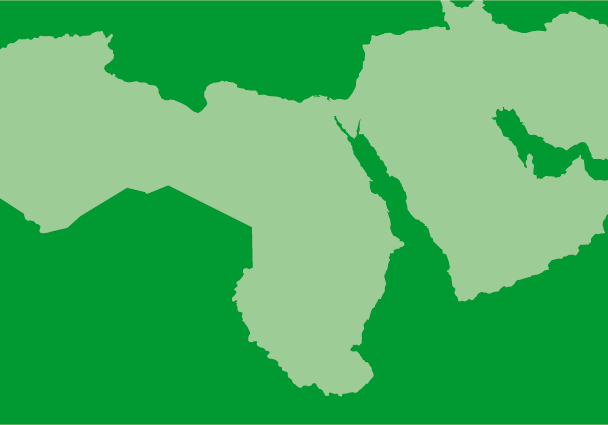
The ICJ calls on the UAE authorities to take urgent measures to ensure the extinguishment of the convictions of the 68 individuals convicted in the UAE 94 case, and to immediately and unconditionally release those detained.
The ICJ also calls for the withdrawal of any remaining charges against each of the 94 accused.
Sixty-eight individuals were convicted today by the State Security Chamber of the UAE Federal Supreme Court and sentenced to varying sentences.
These include 56 accused who were sentenced to 10 years imprisonment and 8 accused who were tried in absentia and sentenced to 15 years imprisonment.
The convicted individuals were found guilty of “establishing, founding and administering an organization, with the aim of challenging the basic principles upon which the government of the State is based, taking control of the government and establishing a secret structure for the organization”.
“The legal provisions on which these convictions are based fail to meet international law requirements of legal certainty and criminalize the enjoyment and exercise of the rights to freedom of expression and association”, stated Said Benarbia, Senior Legal Adviser of the ICJ Middle East and North Africa Programme.
The ICJ considers that the trial against the accused has failed to comport with international law and standards governing fair trials, including the rights of accused persons to be informed of the reasons for their arrest and the charges against them.
The rights of the accused to be presumed innocent was also undermined by provisions of UAE law that effectively impose a presumption of guilt and allow for the indefinite renewal of pre-trial detention orders.
Further, most of the detainees were held in secret pre-trial detention, including prolonged incommunicado detention and solitary confinement.
Their right of access to family members and to a lawyer during the first months of detention was denied, and most of the detainees were unable to challenge the lawfulness of their detention.
They also reported being subjected to torture and other ill-treatment, including severe beatings, pulling out detainees’ hair, sleep deprivation, exposure to extreme light during the day and night, death threats and other threats and verbal abuse.
None of these allegations of ill-treatment were investigated and prosecuted by the UAE authorities. Instead, “confessions” and other information obtained as a result of torture and other ill-treatment were heavily relied upon as evidence to “prove” the charges against the accused.
The rights of the accused to defence were also severely restricted, including by denying defence lawyers’ access to detainees in pre-trial detention, in particular during interrogation; delaying their access to cases files until a few days before the trial; subjecting them to various forms of intimidation and harassment, including criminal prosecution; and severely curtailing their right to cross-examine witnesses.
Two ICJ observers, together with other international observers and international media, were denied access to the first and second hearings of the trial in contravention of international standards on the right to a public hearing.
Further restrictions on this right included relatives being forced to sign statements agreeing not to disclose information about the trial hearings as a condition to being granted access.
Some of the relatives who reportedly disclosed information about the trial have been subjected to various forms of harassment by UAE authorities.
One individual was prosecuted, convicted and sentenced to a 10-month prison term for “tweeting with bad intent about the trial”.
The ICJ notes that under UAE law, decisions of the Supreme Court cannot be reviewed by any other court, which denies the right of the convicted individuals to an appeal.
“The UAE 94 trial has been marred with a catalogue of violations of fair trial guarantees that have undermined the fairness of the proceedings at every stage. Consequently, any remaining charges against the accused must be withdrawn and those detained must be immediately and unconditionally released”, Benarbia added. “Allegations of torture and ill-treatment must also be promptly, independently and impartially investigated and those responsible held accountable”, he added.
An analytical report on the charges and trial of the UAE 94 in light of international law and standards will be published this month.
Contact:
Said Benarbia, ICJ Senior Legal Adviser of the Middle East and North Africa Programme, tel: 41 22 979 38 17, e-mail: said.benarbia(a)icj.org
Jun 27, 2013 | Новости, Пресс-релизы
Международная комиссия юристов (МКЮ) приветствует решение Высшей квалификационно-дисциплинарной комиссии Украины (ВКДК) о восстановлении статуса адвоката Ларисы Герасько, который был ранее прекращён вследствие подачи документов на регистрацию местной организации адвокатов.
В результате слушания 21 июня, на котором присутствовала комиссар МКЮ Гульнора Ишанханова, ВКДК не обнаружила законных оснований для прекращения адвокатского статуса.
Решение ВКДК вынесено в контексте серии дисциплинарных процедур в отношении адвокатов в Украине, последовавшими после принятия в 2012 году закона «Об адвокатуре и адвокатской деятельности».
«После вступления в силу данного закона были созданы две параллельные структуры самоуправления адвокатуры, только одна из которых была зарегистрирована», – сказала Гульнора Ишанханова.«В результате конфликта, в отношении ряда адвокатов было возбуждено дисциплинарное производство за организацию и участие в ‘альтернативном съезде’, а также по другим связанным и несвязанным с этим основаниям».
Комиссар МКЮ посетила Киев с 20 по 22 июня с целью изучения ситуации и проведения встреч с основными заинтересованными сторонами, включая адвокатов, в отношении которых ведётся дисциплинарное производство, соответствующих органов Национальной ассоциации адвокатов и ВКДК, а также представителями неправительственных организаций.
21 июня она провела наблюдение за дисциплинарными слушаниями в отношении нескольких адвокатов в том числе Ларисы Герасько, статус адвоката которой был прекращён на том основании, что она представила документы для государственной регистрации совета адвокатов Закарпатской области, а также Романа Мартыновского, члена ВКДК, чей статус адвоката был приостановлен на период шесть месяцев из-за отсутствия на одном заседании данного органа.
Решение по делу в отношении адвоката Мартыновского было отложено до следующего заседания ВКДК.
«Мы обеспокоены тем, что дисциплинарные процедуры в ряде дел в отношении адвокатов, участвовавших в создании незарегистрированной Национальной ассоциации адвокатов, остаются в производстве», – добавила Гульнора Ишанханова
МКЮ напоминает, что в соответствии с Основными принципами ООН, касающимися роли юристов, «все дисциплинарные меры определяются в соответствии с кодексом профессионального поведения и другими признанными стандартами и профессиональной этикой юриста и в свете настоящих принципов».
Дисциплинарное производство в отношении адвоката может быть возбуждено только при нарушениях опубликованных стандартов профессионального поведения, и любые дисциплинарные санкции должны быть соразмерны совершенному нарушению.
В случаях, когда дисциплинарная система позволяет практически любой поступок рассматривать в качестве достаточного основания для прекращения статуса адвоката, санкция, вероятнее всего, будет произвольной и будет нарушать международное право прав человека.
МКЮ выражает благодарность Украинскому Хельсинскому союзу по правам человека, ВКДК и всем, кто способствовал проведению или сотрудничал с миссией.
МКЮ будет продолжать следить за развитием событий в продолжающихся дисциплинарных процессах в отношении адвокатов в Украине и в надлежащее время опубликует более подробный отчёт о визите в Украину с рекомендациями.
Контакты:
Роушин Пиллей, директор Региональной программы МКЮ по Европе, roisin.pillay(a)icj.org
Ukraine-ICJ welcomes decision to reinstate disbarred lawyer-press release-2013-rus (полный текст, PDF)
Фото Сердара Йагси
Jun 27, 2013 | News
The ICJ welcomes the decision of Ukraine’s High Qualification-Disciplinary Commission to reinstate Larisa Gerasko, a lawyer previously disbarred because of her involvement in seeking to register a local lawyers’ association.
Following a hearing on 21 June, which was attended by ICJ Commissioner Gulnora Ishankhanova, the High Qualification-Disciplinary Commission (HQDC) found that there were no valid grounds for disbarment.
The decision of the HQDC came in the context of a series of disciplinary proceedings against lawyers in Ukraine, which followed a law on “Advokatura and Lawyers’ Activities” adopted in 2012.
“Following the enactment of the new law, two parallel structures of self-governance of the legal profession were established, only one of which was registered,” said Gulnora Ishankhanova. “As a result of the conflict, disciplinary sanctions have been initiated against a number of lawyers on the grounds of organization and participation in ‘an alternative congress’ as well as other related and unrelated grounds.”
The ICJ commissioner visited Kiev on 20-22 June to examine the situation and meet with the main stakeholders including lawyers subjected to disciplinary action, relevant bodies of the Association of Lawyers and the HQDC and NGO representatives.
On 21 June, she observed disciplinary hearings against several lawyers including Larisa Gerasko, who had been disbarred on the grounds of submitting documents for state registration of a lawyers’ association of Zakarpatk Region, and Roman Martynovsky, a member of the HQDC, whose status as a lawyer was suspended for a period of six months for non-attendance of one meeting of this body.
The decision regarding lawyer Martynovsky was postponed until the following meeting of the HQDC.
“We are concerned that disciplinary action remains pending in a number of cases against lawyers involved in the creation of the unregistered lawyers’ association, the National Association of Lawyers,” Gulnora Ishankhanova added.
The ICJ recalls that, according to the UN Basic Principles on the Role of Lawyers, “all disciplinary proceedings shall be determined in accordance with the code of professional conduct and other recognized standards and ethics of the legal profession and in the light of these principles”.
Disciplinary action against a lawyer may only be initiated for violations of published standards of professional conduct, and any disciplinary sanctions must be proportionate to the offence committed.
Where a disciplinary system allows for practically any form of conduct to be construed by the responsible disciplinary body as grounds sufficient for disbarment, the sanction is likely to be arbitrary and to violate international human rights law.
The ICJ expresses its gratitude to the Ukrainian Helsinki Human Rights Union, the HQDC and others who facilitated or co-operated with the mission.
The ICJ will continue to monitor developments in the ongoing disciplinary action against lawyers in Ukraine and will in due course publish a more detailed report on the visit to Ukraine with recommendations.
Contact:
Róisín Pillay, Director, ICJ Europe Programme: +41 22 979 3830; e-mail: roisin.pillay(a)icj.org
Ukraine-ICJ welcomes decision to reinstate disbarred lawyer-press release-2013-rus (full text in pdf)
Photo by Serdar Yagci