May 26, 2021 | Advocacy, Non-legal submissions
At a UN dialogue on counter-terrorism, the ICJ warned States and UN institutions against the use of overbroad and ill-defined concepts in the 7th revision of the UN Global Counter-Terrorism Strategy, because they could breach the principle of legality and undermine protections under international human rights law.
The ICJ intervened today in the virtual two-day dialogue with human rights and civil society partners on the theme of “Building a Better Paradigm to Prevent and Counter Terrorism,” organised by the United Nations Office of Counter-Terrorism (UNOCT) and the Permanent Mission of Spain to the United Nations.
The Dialogue brings together Member States, UN entities, human rights representatives, women groups, youth and civil society actors, as well as experts and other stakeholders for a practical exchange of views on how to address terrorism and violent extremism while safeguarding and promoting human rights, in particular the rights of women, children and victims of terrorism.
The ICJ Statement reads as follows:
“Madam Special Rapporteur, Your Excellencies, Colleagues,
Thank you very much for the organizing this consultation.
The International Commission of Jurists has been working for decades to ensure that counter-terrorism measures are compliant with, and do not lead to violations and abuses of human rights and the rule of law.
The ICJ has produced authoritative guidance, such as the ICJ Berlin Declaration on Upholding Human Rights and the Rule of Law in Combating Terrorism of 2004 and a four-year study concluded in 2009 by the ICJ Eminent Jurists Panel on Terrorism, Counter-Terrorism and Human Rights, the result of 16 hearings across the globe.
That Panel concluded that the approach many States had taken in short-circuiting foundational rule of law and human rights principles caused “enduring long term harm.”
The ICJ has been insistent that countering terrorism and protecting human rights are important objectives that not only are not in conflict, but are part of a single shield of protection that States must provide for.
This finding is as valid today as it was then, as the Global Counter-Terrorism Strategy itself recognizes that “when counter-terrorism efforts neglect the rule of law … and violate international law … they not only betray the values that they seek to uphold, but they may also further fuel violent extremism that can be conducive to terrorism.”
In this regard, we are concerned at the possible use in the UN Global Counter-Terrorism Strategy of undefined concepts and terms, like “violent extremism”, “violent nationalism”, political concepts of “far right” and “far left” or “extremism”.
The abusive invocation of these terms carries risks for the protection of freedom of expression, freedom of religion and belief, freedom of association and the right to political participation, all protected under international human rights law.
Critically, from a rule of law perspective, legal certainty is a key principle of human rights law that informs the requirement that any legitimate restrictions of human rights including when countering terrorism must be prescribed by law.
Any undefined or widely defined concept of terrorism or extremism should not be promoted or applied in international instruments, standards or strategies, that, where incorporated into national laws and practice, would lead to violations of this international human rights law violations.
In this regard, we share the assessment by the Special Rapporteur on the promotion and protection of human rights while countering terrorism in her 2020 report to the UN Human Rights Council (A/HRC/43/46) and by the OHCHR in its Report on best practices on countering violent extremism (A/HRC/33/29, para. 19).
Concepts like “violent extremism”, nationalism, political opinions and other forms of religious, ethnic, or other belief or opinion, however extreme, cannot be part of the GCTS, as they are otherwise protected by international human rights law guarantees to protect the rights to freedoms of expression, religion or belief, and/or of association.
Furthermore, their insertion would water down the anti-terrorism focus of the strategy and lead the way to the application of very pervasive measures clearly restrictive of human rights for conduct that is not linked to terrorism.
The Global Strategy should focus exclusively on countering terrorism. Any more expansive approach will risk leading to measures in breach of human rights law and, therefore, of the founding values of the UN under article 2 of the Charter.
I thank you.”
(The ICJ Statement is at minute 2:48:21)
ICJStatement-OCTSpainVirtualDialogue-SessionI-final (download the statement)
Contact:
Massimo Frigo, ICJ UN Representative, e: massimo.frigo(a)icj.org, t: +41797499949
May 26, 2021 | News
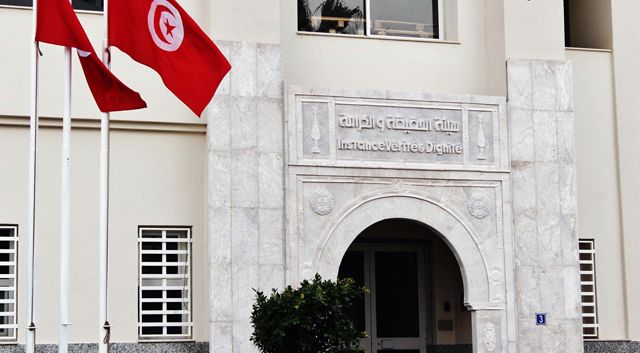
Prosecutors must perform an active role in proceedings before Tunisia’s Specialized Criminal Chambers (SCC), including by prosecuting the cases referred by the Truth and Dignity Commission (IVD) without indictment, and by ensuring the effective and timely execution of court decisions, such as judicial summons and other orders to compel the presence of the accused in court, the ICJ said today.
هذا البيان الصحفي متوفر باللغة العربية أيضاً
To date, prosecutors have automatically transferred around 200 cases, to the SCC pursuant to the Law on Transitional Justice. Beyond this, however, they have played little or no part in the conduct of trials thus far.
“Prosecutors are abdicating their primary responsibility to uphold the rule of law and the rights of victims, and, in so doing, they are contributing to perpetuate decades of impunity in Tunisia,” said Said Benarbia, ICJ MENA Director.
Accused are absent in most of the SCC trials. Measures ordered by the courts to compel their presence have remained mere ink on paper.
“The systematic absence of the accused defeats the very purpose of setting up the SCC as transitional justice mechanisms, including their role in establishing the truth about past abuses, and in granting victims their long overdue day in court,” added Benarbia.
Tunisian prosecutors and law enforcement officers acting under their authority must ensure that court summons and related orders be implemented in a timely manner.
Prosecutors should also ensure that effective investigations be conducted, evidence collected, and prosecutions instituted, when warranted, in those cases that the IVD referred to the SCC without indictment.
“The automatic transfer of cases to the SCC does not absolve prosecutors from their obligations under Tunisian and international law, including in respect of their duties as public interest representatives,” Benarbia added. “It’s high time for the prosecutorial authorities to live up to these obligations and uphold the rights of victims to truth, justice and effective remedies.”
Background information
The Specialized Criminal Chambers were established in 2014 to adjudicate cases involving alleged “gross human rights violations” perpetrated between 1955 and 2013 and referred by the Truth and Dignity Commission (Instance Verité et Dignité, IVD) to the SCC.
The 2013 Transitional Justice Law empowered the IVD to investigate crimes, collect evidence and refer cases to the SCC for prosecution.
At the end of its mandate in December 2018, the IVD’s referred to the SCC 200 cases of arbitrary deprivations of life, arbitrary deprivations of liberty, torture and other ill-treatment, enforced disappearance, rape and sexual assault and crimes against humanity committed by the past regime.
For more information see the ICJ Practical Guide Series on Accountability Through the Specialized Criminal Chambersand findings on the role of international law and standards in proceedings before the SCC (Practical Guide 1), the investigation and prosecution of gross human rights violations under Tunisian and international law (Practical Guide 2), and the application of principles and best practices on evidence in the administration of justice before the SCC (Practical Guide 3).
Download this press release in PDF form here.
Contact:
Said Benarbia, Director, ICJ Middle East and North Africa Programme, t: +41-22-979-3817; e: said.benarbia(a)icj.org
Valentina Cadelo, Legal Adviser, ICJ Middle East and North Africa Programme, e: valentina.cadelo(a)icj.org
Asser Khattab, Research and Communications’ Officer, ICJ Middle East and North Africa Programme, e: asser.khattab(a)icj.org
May 25, 2021 | News
As the third anniversary of the opening of trials before Tunisia’s Specialized Criminal Chambers (SCC) is approaching, the ICJ denounces the Tunisian authorities’ failure to adopt reforms necessary to advance accountability and justice for victims of gross human rights violations.
هذا البيان الصحفي متوفر باللغة العربية أيضاً
Trials before the SCC started on 29 May 2018. Since that first hearing, evident gaps and shortcomings in the Tunisian Criminal Code, the Code of Criminal Procedure and the Transitional Justice law have undermined efforts to hold perpetrators to account, bring justice to victims and prevent recurrence of gross human rights violations in the future.
“The Tunisian authorities have abdicated their responsibility to ensure the effective functioning of the SCC, depriving judges of basic tools to ensure that trials are conducted without undue delay and consistent with international fair trial standards,” said Said Benarbia, the ICJ’s MENA Programme Director.
Many offences referred by the Truth and Dignity Commission to the SCC are not adequately defined in the Tunisian law. Judicial rotation occurs mid-way through SCC trials, impacting the continuity of trials. Prosecutors are not effectively engaged in the conduct of trials. Accused are absent in most of the SCC trials, and the transitional justice framework does not provide for appeal chambers.
“By failing to address these obstacles, the Tunisian authorities are undermining the right of victims to truth and to effective remedies, and betraying the very promise of the transitional justice process to end impunity,” added Benarbia.” It’s high time for them to reverse course and live up to that promise.”
Background information
The ICJ has recommended reform to ensure the compliance of SCC proceedings with international law and standards, including through:
- Ensuring the adequate criminalization of gross human rights violations amounting to crimes under international law;
- Fully ensuring the rights of the accused to a fair trial;
- Ensuring the rights of victims, including their families, to an effective remedy and reparation;
- Ensuring the protection of victims and witnesses;
- Ensuring that the collection, admissibility and assessment of evidence guarantee the right of the accused to a fair trial and the victims’ right to an effective remedy.
In addition to the above reforms, the Tunisian authorities should remove all obstacles preventing the SCC and other judicial authorities from exercising their function in a manner that complies with international standards. To this end, the authorities should:
- Ensure that the Office of the Public Prosecutor and other investigative authorities carry out their mandate in an independent and impartial manner, as defined under the Code of Criminal Procedure;
- Ensure that the annual judicial rotation, as regulated by Organic Law No. 34 on the High Judicial Council, be consistent with the right of the accused to a fair trial
- Ensure that newly appointed SCC judges and prosecutors receive timely and adequate training in transitional justice as provided for by Organic Law No. 53 on Establishing and Organizing Transitional Justice;
- Ensure that, if the annual judicial rotation occurs mid-way through trials, safeguards be implemented with the view to ensuring that newly appointed judges hearing the case have the appropriate understanding of the evidence and arguments.
These recommendations are informed by the ICJ Practical Guide Series on Accountability Through the Specialized Criminal Chambers and findings on the role of international law and standards in proceedings before the SCC (Practical Guide 1), the investigation and prosecution of gross human rights violations under Tunisian and international law (Practical Guide 2), and the application of principles and best practices on evidence in the administration of justice before the SCC (Practical Guide 3).
The SCC were established in 2014 to adjudicate cases involving alleged “gross human rights violations” perpetrated between 1955 and 2013 and referred by the Truth and Dignity Commission (Instance Verité et Dignité, IVD) to the SCC.
At the end of its mandate in December 2018, the IVD’s referred to the SCC 200 cases of arbitrary deprivations of life, arbitrary deprivations of liberty, torture and other ill-treatment, enforced disappearance, rape and sexual assault and crimes against humanity committed by the former government.
In a briefing paper published in October 2020, the ICJ called on the Tunisian authorities to undertake substantial legal and policy reforms with a view to strengthening accountability and removing all obstacles preventing the SCC from functioning effectively.
Download this press release in PDF form here.
Contact:
Said Benarbia, Director, ICJ Middle East and North Africa Programme, t: +41-22-979-3817; e: said.benarbia(a)icj.org
Valentina Cadelo, Legal Adviser, ICJ Middle East and North Africa Programme, e: valentina.cadelo(a)icj.org
Asser Khattab, Research and Communications’ Officer, ICJ Middle East and North Africa Programme, e: asser.khattab(a)icj.org

May 25, 2021 | News
The ICJ joined other international human rights organisations to call on the Cambodian government to immediately stop its assault on freedom of expression in the context of the COVID-19 pandemic.
In recent months, the government has warned against public criticism of its actions, prevented independent journalists from reporting on the pandemic, prosecuted individuals for criticising the inoculation campaign, and threatened journalists and social media users with legal actions on the spurious grounds of provoking “turmoil in society.
While Cambodia was spared from high numbers of severe COVID-19 cases in 2020, beginning in February 2021 there has been a spike in cases to which the government responded with disproportionate and unnecessary measures in violation of Cambodia’s international human rights obligations. This includes a campaign against freedom of expression that further constricts media freedom and promotes fear and self-censorship in the country. These measures serve to undermine, not advance, efforts to stop the spread of COVID-19.
The Cambodian authorities placed a de facto ban on independent reporting in Phnom Penh’s red zones—areas deemed to be high risk for COVID-19 transmission. On 3 May 2021, the Ministry of Information announced that only state media or journalists invited by the government would be permitted to report from red zones. The next day, the Ministry of Information issued a letter warning journalists not to disseminate information that could “provoke turmoil in society” and threatening legal action against those who disobey. The letter followed viral livestream footage from multiple Facebook news outlets of long queues of COVID-19 patients outside government treatment centres.
The government’s campaign to silence critical commentary has extended beyond journalists to ordinary people, in a manner incompatible with international human rights standards.
In a press release dated 1 May 2021, the Government Spokesperson Unit demanded the immediate cessation of social media posts intended to “provoke and create chaos” in the context of the COVID-19 pandemic, referring to such posts as “acts of attack” that must be punished. The press release concluded by praising the efforts of government officials to curb the spread of COVID-19 but did not provide any legal justification for imposing these possible restrictions on the right to freedom of expression.
On 30 April 2021, Kandal provincial authorities warned farmers in Sa’ang district not to post images of vegetables spoiling in their fields due to the closure of markets, stating that such communications are bad for morale. One farmer, Tai Song, was pressured by the provincial authorities to sign a document agreeing not to post such content again after he shared a photo on Facebook showing his vegetables rotting and stating that he had to clear and throw away his crops.
The Cambodian authorities have arrested dozens of individuals for expressing critical opinions about the government’s COVID-19 response, including at least six individuals for their criticism of the government’s vaccination campaign. One Chinese journalist, Shen Kaidong, was subsequently deported for publishing a story deemed ‘fake news’ in which multiple Chinese nationals reported receiving a text offering them the Sinopharm vaccine for a service fee.
Authorities have also prosecuted at least three individuals—Korng Sambath, Nov Kloem, and Pann Sophy—for posting TikTok videos criticising the use of Chinese-made vaccines under the new, overly broad and vague Law on Measures to Prevent the Spread of COVID-19 and other Serious, Dangerous and Contagious Diseases (the COVID-19 Law).
These actions are consistent with the government’s systematic and relentless crackdown on freedom of expression and information spanning far beyond the beginning of the COVID-19 pandemic. This latest surge contributes to the government’s broader efforts to silence all critical voices in Cambodia.
The right to freedom of expression is protected by Article 19 of the International Covenant on Civil and Political Rights, to which Cambodia acceded in 1992, and by Article 41 of Cambodia’s Constitution.
Protecting public health is the grounds on which the government is purporting to restrict freedom of expression. While there is a legitimate need to counter the spread of misinformation online to protect public health during a pandemic, this objective must be provided by a clear and accessible law and pursued using the least intrusive means, rather than unnecessary and disproportionate measures like unwarranted arrests, detentions, and criminal prosecutions.
In its General Comment 34, the UN Human Rights Committee emphasised the essential role of the media in informing the public and stated that “in circumstances of public debate concerning public figures … the value placed [on] uninhibited expression is particularly high.” A 2017 Joint Declaration of four independent experts on freedom of expression stressed that “general prohibitions on the dissemination of information based on vague and ambiguous ideas” are incompatible with international human rights standards.
Download
To read the full statement with a list of co-signatories, click here.
May 21, 2021 | News
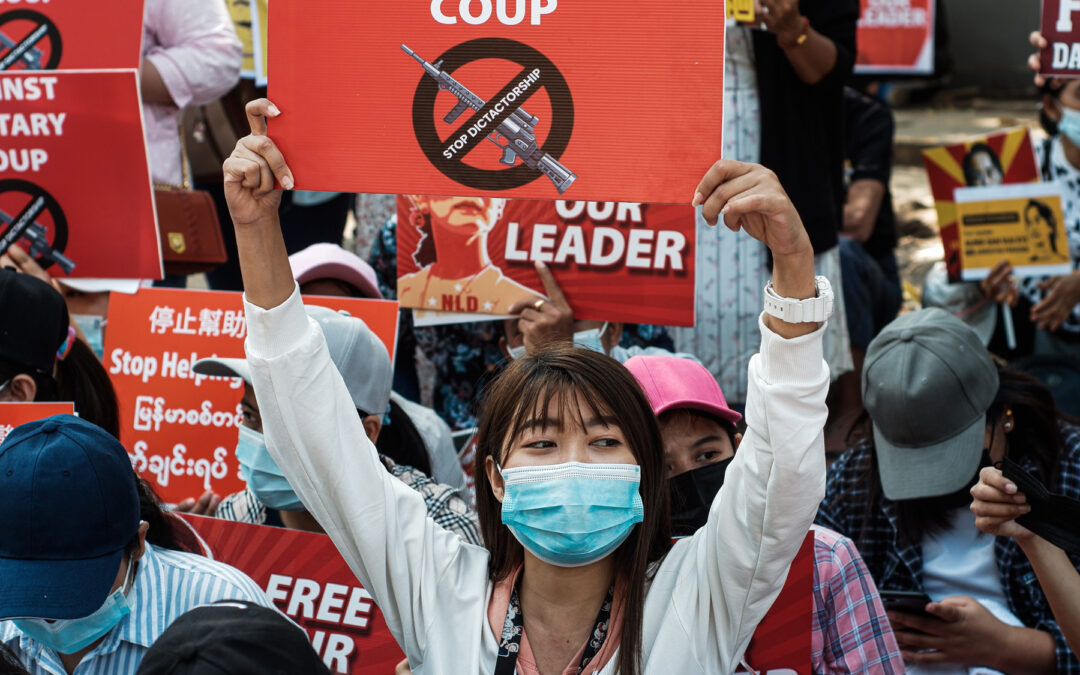
The Myanmar military government must urgently reverse recent amendments to the Legal Aid Act that place impermissible restrictions on legal defense for detainees, particularly for those detained on criminal charges, and already vulnerable people such as stateless people, asylum seekers, and migrants, said the ICJ today.
The ICJ stressed that military regime was unlawfully assuming legislative powers it did not possess, in defiance of the core principle of separation of powers.
“The Myanmar military has usurped power illegally and now it is improperly changing the laws to make it even more difficult to get legal aid necessary to defend the rights of thousands of people facing arbitrary arrest and detention,” said Sam Zarifi, ICJ’s Secretary General.
In May 2021, the military regime made key amendments to the 2016 Legal Aid Law, formally entitled The Pyidaungsu Hluttaw Law No. 10, 2016, The 9th Waning Day of Pyartho, 1377, M.E.
The new amendment removes legal aid services at least during pre-trial detention, a critical phase when detainees are particularly at risk of arbitrary detention, torture and ill-treatment and other forms of coercion and tampering with evidence.
The amendments to Section 2(b) prevent all persons from certain vulnerable groups from receiving legal aid, including but not limited to stateless persons, asylum seekers, foreigners, migrant workers.
“These amendments will prevent legal aid for precisely the people who need it most, those facing criminal charges and those from marginalized groups, at precisely the time they need it most, during the pretrial detention when their rights are most at risk,” Zarifi said.
All reference to international standards have been removed as per Section 3(b), thus leaving the terms unbound by normative requirements and restrictions and more vulnerable to be subjected to arbitrary decisions of the Government. The revocation of 3(e) means that the fair standards and procedures concerning how long victims can be arrested and kept in custody do not have to be adhered to.
“In the context of Myanmar, where those pro-bono lawyers and organizations representing detainees continue to face threats, intimidation, abduction and arrest warrants, the possibility of getting legal defense through the legal aid system is critically important to provide access to justice to those thousands of detainees to ensure their right to equality before the law, the right to legal counsel and the right to a fair trial,” Zarifi said.
The United Nations Principles and Guidelines on Access to Legal Aid in Criminal Justice System requires all States to guarantee the right to legal aid in their national legal systems, without discrimination on any grounds.
The latest amendments have removed all independence of the legal aid bodies, and instead given full control to the Supreme Court, supported by the Cabinet—both bodies dominated by the military.
“With a number of lawyers being arbitrarily detained in recent days, these new amendments are another threat tactic by the military, to ensure that those are arrested and detained do not get a fair trial,” Zarifi added.
Contact
Osama Motiwala, ICJ Asia-Pacific Communications Officer, t: +66-62-702-6369 e: osama.motiwala(a)icj.org