Mar 26, 2021 | News
In a joint communication to five United Nations Special Procedures, the ICJ and its partners urged the mandate holders to call on the Tunisian authorities to immediately stop hampering the transitional justice process.
The organizations expressed their concern at the ongoing attempts to undermine the transitional justice process and accountability efforts for past gross human rights violations.
“The Tunisian transitional justice process has been under serious attack since its inception in 2013. Today, the ICJ and its partners are urging the United Nations Special Procedures to take urgent action to deter such attacks, demand justice for the victims and secure accountability for the perpetrators,” said the Director of ICJ’s Middle East and North Africa Programme, Said Benarbia.
The joint communication highlights the following areas of concern:
- The recent political initiatives to dismantle the transitional justice process;
- The incessant attacks against the Truth and Dignity Commission (Instance Verité et Dignité, IVD) and its 2018 final report’s findings;
- The lack of support to the Specialized Criminal Chambers (SCC) and the numerous obstacles that risk to severely impair access to justice and effective remedies for victims of gross human rights violations.
The communication is addressed to the following United Nations Special Procedures:
- The Special Rapporteur on the promotion of truth, justice, reparation and guarantees of non-recurrence;
- The Special Rapporteur on torture and other cruel, inhuman or degrading treatment or punishment;
- The Special Rapporteur on the independence of judges and lawyers;
- The Working Group on Arbitrary Detention; and
- The Working Group on Enforced or Involuntary Disappearances.
The communication was submitted jointly by the ICJ along with:
- The World Organisation Against Torture (OMCT)
- The Ligue tunisienne des droits de l’homme (LTDH)
- The Forum Tunisien pour les Droits Economiques et Sociaux (FTDES)
- Avocats Sans Frontières (ASF)
- The Association of Tunisian Magistrates (AMT)
- Al Bawsla
- International Alert
- The Association KARAMA
- The Association INSAF pour les anciens militaires
- No Peace Without Justice
- The Organisation Contre la Torture en Tunisie (OCTT)
- The Organisation Dhekra we Wafa, pour le martyr de la liberté Nabil Barakati
- The Coalition Tunisienne pour la Dignité et la Réhabilitation
- The Association Tunisienne pour la Défense des Libertés Individuelles
- The Association des Femmes Tunisiennes pour la Recherche sur le Développement
- The Association Internationale pour le Soutien aux Prisonniers Politiques
- The Réseau tunisien de la justice transitionnelle
Contact
Valentina Cadelo, Legal Adviser, ICJ Middle East and North Africa Programme, e: valentina.cadelo(a)icj.org
Asser Khattab, Research and Communications’ Officer, ICJ Middle East and North Africa Programme, e: asser.khattab(a)icj.org
Download
Tunisia-Special-Procedures-Joint-Submission-2021 (PDF, in French)
Mar 25, 2021 | Agendas, Events, News
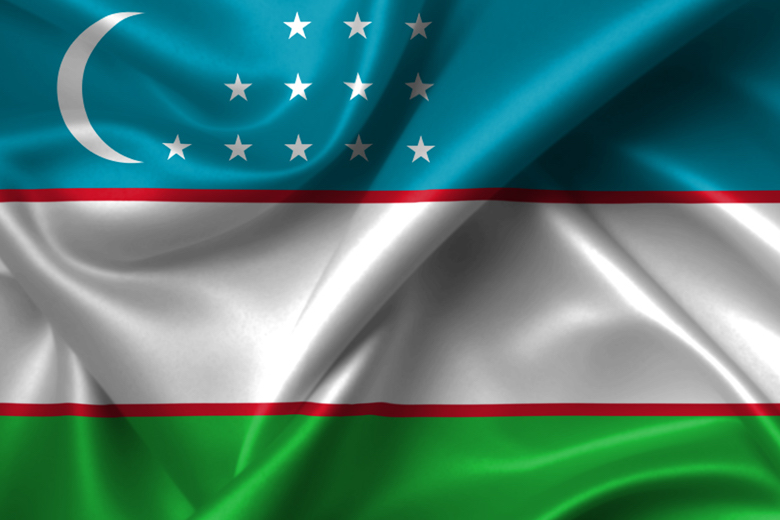
Today, the ICJ, the Office of the High Commissioner for Human Rights (OHCHR) Regional Office for Central Asia (ROCA) and the Supreme School of Judges of the Republic of Uzbekistan (SSJ) are holding a final conference on the implementation of international law on economic, social and cultural rights in the national legal framework of Uzbekistan.
This is the final event of a three-year project “Advancing Civil Society in Promoting economic, social and cultural rights Standards” (ACCESS), implemented by the ICJ, funded by the European Union.
Participants will discuss the obstacles to the enjoyment of economic, social and cultural (ESC) rights in Uzbekistan and how to strengthen protection of these rights through access to justice and legal remedies. The discussions will aim to strengthen the implementation of international law on ESC rights, including rights to housing, healthcare and rights to equal protection in the workplace, and ensure that the justice system provides effective protection and remedies where they are violated.
The OHCHR for Central Asia, the SSJ, Tashkent State University of Law, the Nationwide Movement “Yuksalish,” national and international experts will participate in the final conference.
“This is a very important project, which was timely but also challenging to implement during the period of COVID-19 pandemic. The right time to raise awareness around economic, social and cultural rights in particular. This is about accompanying the important reforms of the Government of Uzbekistan, it is about promoting human rights and the rule of law, which is also an important part of our EU Central Asia Strategy,” said H.E. Charlotte Adriaen, Ambassador of the European Union to Uzbekistan.
Ryszard Komenda, Regional Representative of the UN Human Rights Office for Central Asia noted that “this project to promote economic, social and cultural rights in Uzbekistan was and remains highly relevant and needed, including for the dissemination of legal knowledge on human rights among lawyers and representatives of civil society. The implementation of this project during the period of ongoing reforms in the country and participation of UN experts from CEDAW and CRC, makes the project especially effective, unique and timely.”
“Uzbekistan has a solid legal basis to meet its obligations to protect economic, social and cultural rights. But to realize the law’s potential in practice, people whose rights are violated need effective access to the justice system, and the courts need to apply the rights set out in international law,” said Róisín Pillay, Director of the ICJ Europe and Centra Asia Programme.
“We are happy to share our recommendations designed to ensure that people’s economic and social rights, as guaranteed in international law, are protected in practice, including through the justice system. I look forward to discussions with national and international partners during our final event,” she added.
“This project is a clear example of international cooperation of the Supreme School of Judges, which is fully consistent with its priorities. Of course, the implementation of international law on economic, social and cultural rights at the national level in Uzbekistan is one of the most significant national priorities, which requires active interaction between State authorities, the academic and expert community, and of course cooperation with international organizations,” said Khadji-Murod Isakov, the Director of the Supreme School of Judges under the Supreme Judiciary Council of the Republic of Uzbekistan.
Agenda in English
Agenda in Russian
Compilation of papers in Uzbek, Russian and English: Realising economic, social and cultural rights-2021
Contacts:
Ms. Dilfuza Kurolova, ICJ Legal consultant, t: +998 90 9050099 ; e: dilfuza.kurolova(a)icj.org
Ms. Guljakhon Amanova, National Program Officer, Uzbekistan, Regional Office of the UN High Commissioner for Human Rights (OHCHR), e:gamanova@ohchr.org
Mr. Utkir Khalikov, Head of the international department The Supreme School of Judges under the Supreme Judicial council of the Republic of Uzbekistan for Central Asia, e: inter.dep.ssj@mail.ru
The Project is financed by the European Instrument for Democracy and Human Rights (EIDHR) Delegation of the European Union to the Republic of Uzbekistan
Watch the video
Mar 24, 2021 | Advocacy, Non-legal submissions
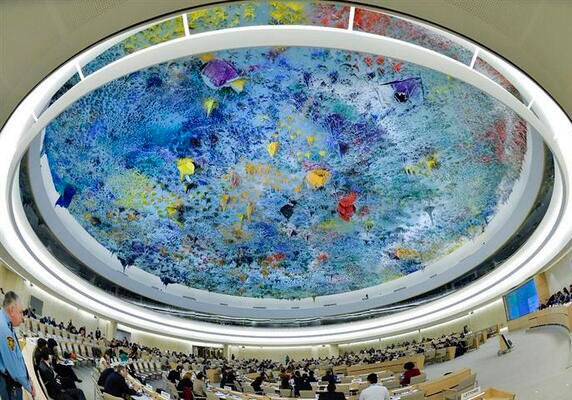
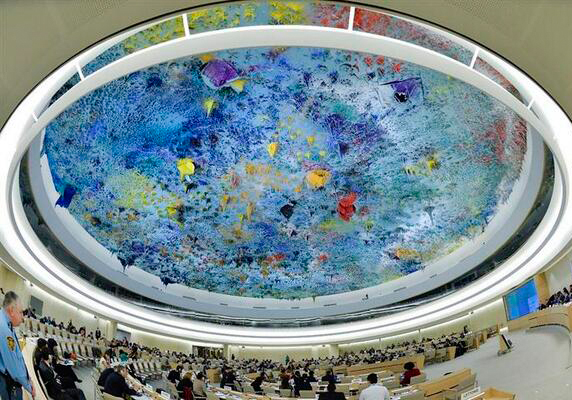
Today, at the close of the 46th regular session of the UN Human Rights Council in Geneva, the ICJ and other NGOs highlighted key achievements and failures.
The joint civil society statement, delivered by International Service for Human Rights (ISHR) on behalf of the group, outlines the main achievements and shortfalls of this last 46th regular session.
In the statement, the undersigned organisation comment on the engagement of civil society in online sessions, welcome the adoption of the resolution on vaccines and of resolutions to sustain scrutiny and accountability including in Belarus, Iran, Myanmar, Nicaragua, Sri Lanka, South Sudan and Syria. The NGOs have underlined the fact thatover 30 States have united in a long-overdue condemnation of Egypt’s misuse of counter-terrorism measures to imprison peaceful critics, and over 40 States raised concern over the shrinking civic space in Russia.
The civil society organisations have urged the Council to take prompt action on Algeria, Cameroon, China, India, and in Kashmir, and for the upcoming session, to set up an international accountability mechanism on the Philippines, and independent monitoring on pushbacks and other violations faced by migrants and refugees.
The statement is endorsed by:
- International Service for Human Rights;
- Franciscans International;
- Egyptian Initiative for Personal Rights (EIPR);
- International Commission of Jurists (ICJ);
- International Movement Against All Forms of Discrimination and Racism (IMADR);
- Asian Forum for Human Rights and Development (FORUM-ASIA);
- African Centre For Democracy And Human Rights Studies;
- International Federation for Human Rights Leagues (FIDH);
- MENA Rights Group;
- International Lesbian and Gay Association;
- Impact Iran;
- Ensemble contre la Peine de Mort (ECPM);
- Siamak Pourzand Foundation;
- Cairo Institute for Human Rights Studies (CIHRS);
- ARTICLE 19;
- CIVICUS: World Alliance for Citizen Participation.
Read the full statement: UN-JointStatement-UNHRC46-Advocacy-EndOfSession-ENG-2021
Contact:
Massimo Frigo, ICJ UN Representative, e: massimo.frigo(a)icj.org, t: +41797499949

Mar 24, 2021
Women human rights defenders are at a heightened risk of sexual or gender-based violence as a result of the nature of their work in defence of human rights, the ICJ said in a new report published today.
The 28-page report Sexual and Gender-Based Violence in Zimbabwe: Women Human Rights Defenders’ Experiences and Legal Challenges concluded that gaps within the Zimbabwean legal framework on sexual offences hinder women human rights defenders from seeking and receiving redress for sexual or gender-based violence suffered in the course of or due to the nature of their work.
The report explores the main legal gaps identified and makes recommendations to a number of actors, including the Zimbabwe Republic Police, the Judicial Service Commission and Parliament of Zimbabwe.
“The police, the Judicial Service Commission, and ultimately the Parliament must improve their approach to SGBV for the benefit of all women, including women human rights defenders,” said Blessing Gorejena, ICJ Senior Legal Adviser.
In 2019, the ICJ commissioned a study of the experiences of women who are human rights defenders in Zimbabwe based on the following research questions:
- Does the work of WHRDs increase their risk of being subjected to sexual and gender-based violence (SGBV)?
- What are the key legal challenges that WHRDs encounter when seeking redress for SGBV perpetrated against them due to or as a result of their work?
This report builds on the discussions held at a regional colloquium organized by the ICJ in 2015 in Eswatini. Those discussions were presented in a reflection paper entitled Sexual and Gender-based Violence, Fair Trial Rights and the Rights of Victims: Challenges in Using Law and Justice Systems Faced by Women Human Rights Defenders.
Contact
Blessing Gorejena, Senior Legal Adviser and Team Leader of ICJ Zimbabwe Project, e: blessing.gorejena(a)icj.org
Elizabeth Mangenje, Legal Adviser, e: elizabeth.mangenje(a)icj.org
Download
Zimbabwe-SGBV-WHRD-Publications-Reports-Thematic reports-2021-ENG
Mar 24, 2021 | News
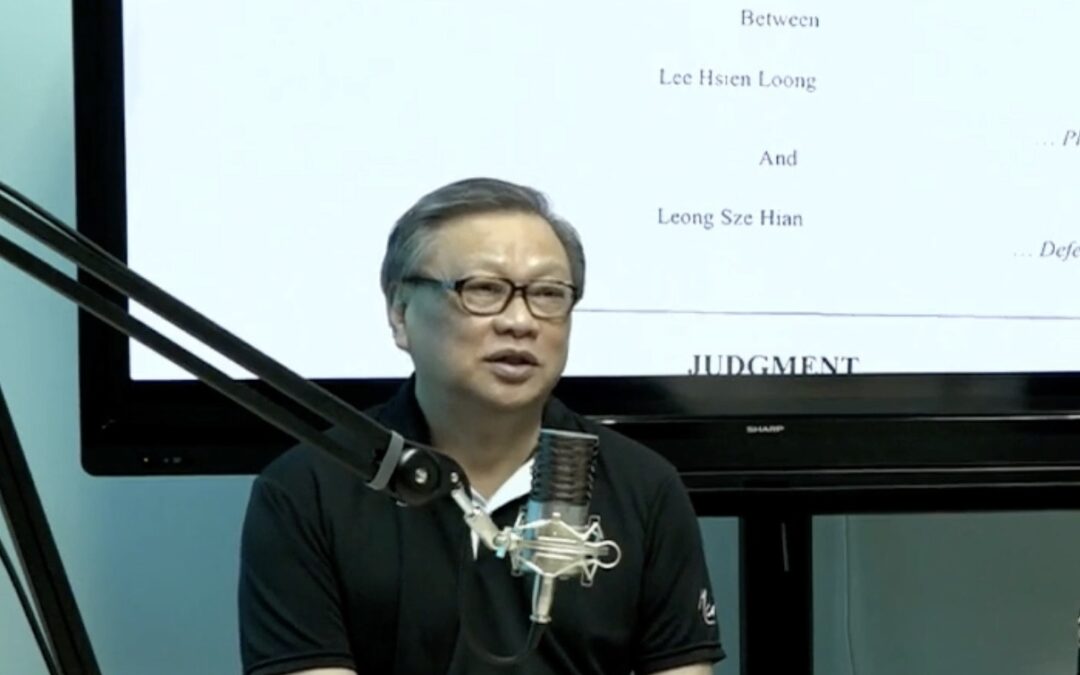
The High Court of Singapore decision ordering a blogger to pay the Prime Minister thousands of dollars in a defamation suit continues the country’s troubling trend of restricting online freedom of expression, the ICJ said today.