Mar 16, 2021 | News
The participation of private actors including pharmaceutical companies in the development and delivery of COVID-19 vaccines has important implications for human rights, in particular the rights to life and to health, that have not been properly considered, a panel of experts asserted in a webinar organized by the South African Institute for Advanced Constitutional, Public, Human Rights and International Law (SAIFAC), the ICJ and the Konrad Adenauer Stiftung (KAS) on March 11.
Taking place exactly one year after the World Health Organization declared COVID-19 a global pandemic, the webinar, entitled “What are the obligations of States and corporations to ensure access to a COVID-19 vaccine?”, brought together Dr Sharifah Sekalala from the University of Warwick, Fatima Hassan, the founder and head of the Health Justice Initiative, and Prof. David Bilchitz, the director of SAIFAC.
As the United Nations Committee on Economic, Social and Cultural Rights (CESCR) has recently reaffirmed, vaccine access raises human rights issues relating to both the obligations of States and the responsibilities of businesses.
Carlos Lopez, ICJ’s Senior Legal Adviser stressed:
“It is clear that States have a duty to protect the right to health which entails an obligation to appropriately regulate private actors in health – including those involved in vaccine production and distribution – to retain the affordability and accessibility of COVID-19 vaccines for all. Corporate entities, for their part, have a responsibility to respect the right to health which they violate when they adopt practices which limit or inhibit non-discriminatory vaccine access to all people around the world.”
One of the main elements in the debate is the issue of people’s access to vaccines that are adequate and affordable, and how the capacity of the States to fulfil this key aspect of their international law obligations is being constrained by the operation of certain trade and intellectual property rights law, in particular the Trade-Related Intellectual Property Rights (TRIPS) Agreement of the WTO.
Dr Sekalala, pointed to a fundamental underlying issue relating to the predominant rationale of States and companies:
“One of the things that bothers me as a global health lawyer is the lack of transparency around this process and also, in some ways, the fact that States are still clinging on this research and development rationale, maintaining intellectual property rights”.
This also raises serious questions about the nature of the responsibilities that corporate entities may have to respect the right to health, as has been clarified in General Comment 24 of the CESCR and the UN Guiding Principles on Business and Human Rights.
“There is a moral dimension to the question about vaccine access: what should society expect of the corporations? And there is also a legal one: what does the law require? Fundamental rights are essentially urgent moral claims that demand legal institutionalization. Fundamental rights recognized in international law, in the South African Constitution and many other constitutions around the world require, in my view, that corporations have positive obligations but if such positive obligations are not recognized in legal systems, domestically or internationally, the claim is they ought to be”, said Professor Bilchitz.
Although vaccine access may implicate human rights responsibilities of a range of private business entities, such considerations are especially pronounced with regard to pharmaceutical companies given the direct impact of their business operations on vaccine access. Vaccine access raises clear issues about the protection of human rights and the rule of law both internationally and in particular domestic jurisdictions like South Africa.
“Pharmaceutical companies and some wealthier governments that have actually co-funded a lot of the accelerated vaccine research are basically using their own law… right now they are acting as if they are God, they are determining access for the entire world, including the Global South. The Constitution has been thrown out of the window, particularly in the domestic context of South Africa”, said Hassan.
Watch the webinar here.
A powerpoint for Dr Sekalala’s presentation is available here.
A powerpoint for Professor Bilchitz’s presentation is available here.
A powerpoint for Fatima Hassan’s presentation is available here.
CONTACT:
Timothy Fish Hodgson, Legal Adviser on Social, Economic and Cultural Rights, e: timothy.hodgson@icj.org
Tanveer Rashid Jeewa, Communications and Legal Officer, e: tanveer.jeewa@icj.org
Mar 16, 2021 | News
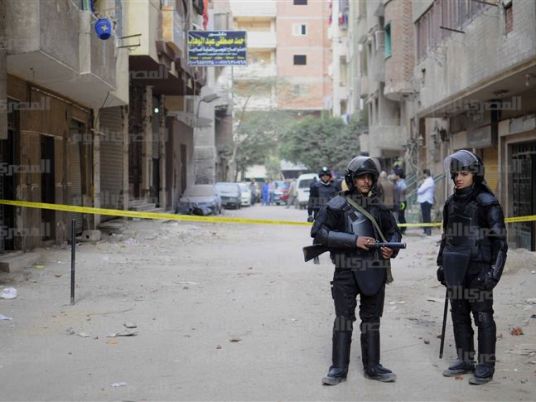
On the first day of the trial before the eastern Cairo criminal military court of those accused in connection with the 2016 explosion in the Haram district of Giza, the ICJ calls on the Egyptian authorities to: investigate allegations of torture and other ill-treatment; ensure reparation for those arbitrarily detained; and end the trials of civilians before military courts.
“The case has been under investigation by the State Security Prosecution for more than five years, involving prolonged pre-trial detention and severe restriction on the right to legal counsel, in a flagrant violation of Egyptian and international law,” said Said Benarbia, the ICJ’s MENA Programme Director. “Detaining people pending trial for that length of time makes this case yet another example of how the authorities are using pre-trial detention as a tool of repression and to punish, in violation of Egypt’s obligations under international human rights law”.
In January 2016, hundreds of people were arrested, and some forcibly disappeared in connection with an explosion in the Haram district of Giza that killed seven police officers and four civilians, and injured 15 others.
A number of those detained have reportedly been subjected to ill-treatment and denied fair trial rights guaranteed by Egyptian and international law, including the right to receive family visits. In addition, to the ICJ’s knowledge, while all the accused may have briefly met their lawyers in highly restrictive circumstances at the state prosecution office each time they have been remanded into custody, over the years, they have been denied their right to legal counsel before trial as their lawyers have not been allowed to visit them in prison.
The ICJ calls on the Egyptian authorities to investigate the incidents of enforced disappearance, ill-treatment and other human rights violations with a view to bring those responsible to justice.
“Notwithstanding the gravity of the charges involved, civilians should not be brought before military courts,” said Benarbia. “the jurisdiction of military courts should be limited to trials of military personnel in cases of strictly military offences; it should not extend to crimes over which civilian courts have jurisdiction, human rights violations or crimes under international law,” he added.
Contact
Said Benarbia, Director, ICJ Middle East and North Africa Programme, t: +41-22-979-3817; e: said.benarbia(a)icj.org
Asser Khattab, Research and Communications’ Officer, ICJ Middle East and North Africa Programme, e: asser.khattab(a)icj.org
Download
Press release in English and Arabic.
Mar 16, 2021 | Advocacy, Non-legal submissions
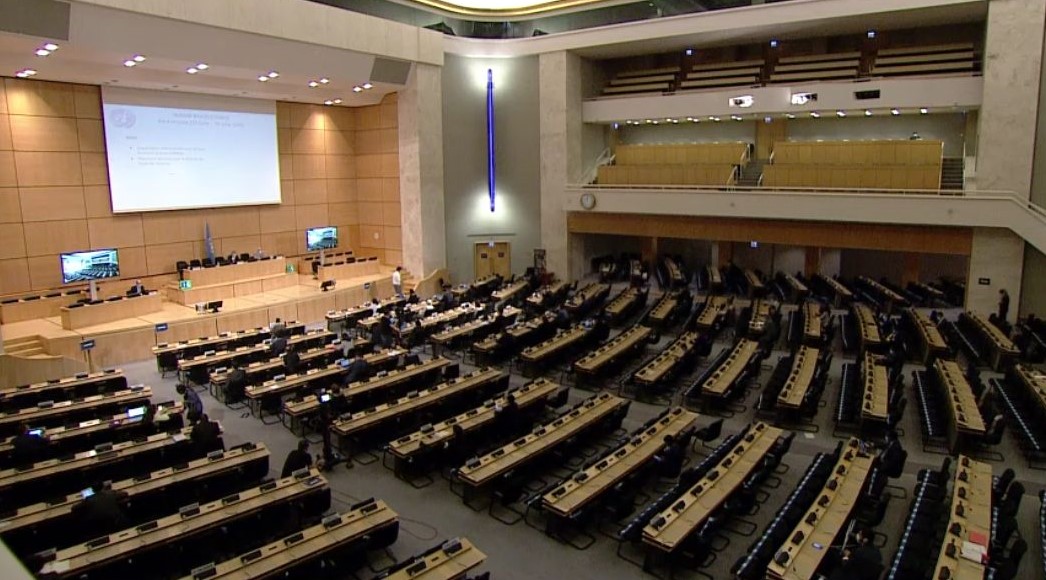
Today, during a debate on the outcome of the Universal Periodic Review of Libya, the ICJ called on Lybian authorities to bring the country’s criminal legislation in line with international law, in particular by defining clearly crimes under international law.
The statement reads as follows:
“Madame President,
The International Commission of Jurists (ICJ) welcomes Libya’s acceptance of the recommendation to cooperate fully with the Independent Fact-Finding Mission on Libya and ensure that it has unfettered access throughout the country’s territory (148.7-8, 148.11-17).
The ICJ regrets that Libya has only taken note of – as opposed to accepting ‒ Estonia’s recommendation (148.80) to bring the Penal Code in line with international standards, and Libya’s rejection of Zambia’s recommendation (148.70) to define crimes under international law in Libya’s domestic legal system clearly.
Libyan domestic law fails to criminalize: arbitrary deprivation of life; torture and other ill-treatment; enforced disappearance; rape and other forms of sexual and gender-based violence; slavery; war crimes; and crimes against humanity, in line with international law and standards.
The ICJ further welcomes Libya’s acceptance of the recommendations (148.144-146, 148-149, 151-161, 165-166) to investigate effectively crimes under international law and bring perpetrators to justice.
The ICJ expresses concern, however, at the prevailing impunity in the country. Crimes under international law are not being effectively investigated and prosecuted, largely because of the absence of political will, inadequate resources, and the frequent threats against justice actors, particularly by armed groups.
The ICJ also regrets that Libya failed to accept the recommendations of: Ukraine (148.25); Costa Rica (148.31); Cyprus (148.32); France (148.33); the Holy See (148.34); Liechtenstein (148.35); Namibia (148.36); Portugal (148.37); Rwanda, Croatia and Slovakia (148.37); Argentina (148.38); Australia (148.39); Honduras (148.40); Iceland (148.41); Italy (148.42); and Latvia (148.43). These recommendations call on Libya to establish a moratorium on executions, and to accede to the Second Optional Protocol to the International Covenant on Civil and Political Rights with a view to abolishing the death penalty. The death penalty constitutes a violation of the right to life and of the absolute prohibition of torture and other cruel, inhuman or degrading treatment or punishment.
I thank you.”
Contact:
Massimo Frigo, ICJ UN Representative, e: massimo.frigo(a)icj.org, t: +41797499949
Vito Todeschini, Legal Adviser, ICJ MENA Programme, e: vito.todeschini(a)icj.org
Mar 16, 2021 | Advocacy
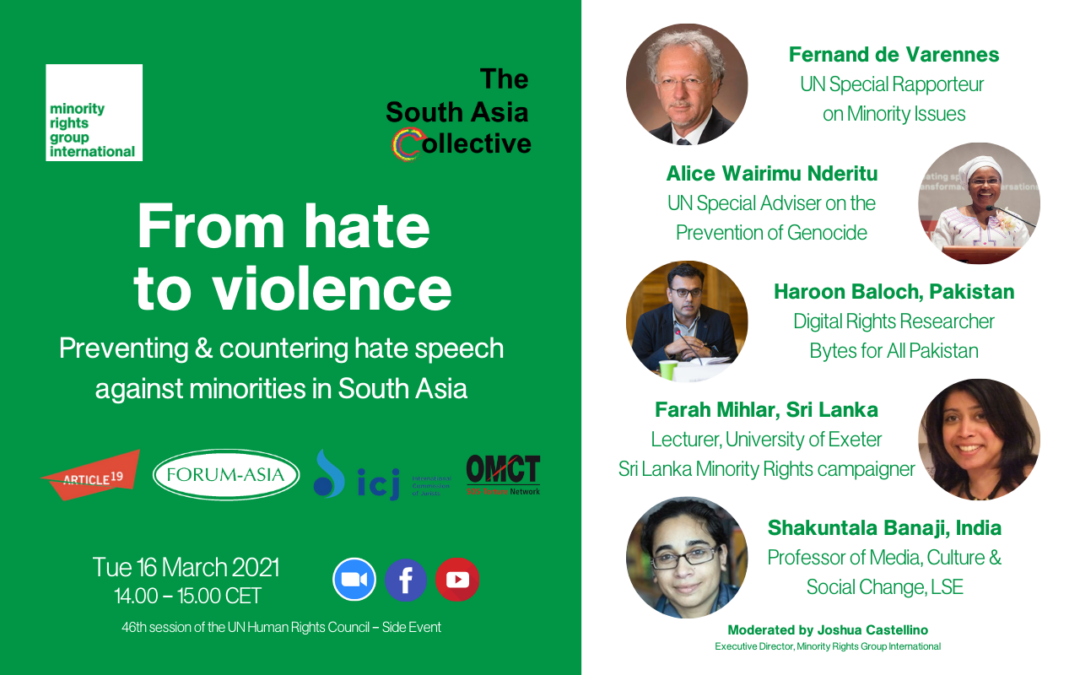
This side event will take place on Tuesday 16 March 2021, from 14:00-15:00 (CET) at the 46th session of the UN Human Rights Council. For registration: https://bit.ly/3llCCMF
Minority Rights Group International and South Asia Collective, along with ICJ, OMCT, Article 19 and FORUM-ASIA, are hosting a side event at 46th session of the Human Rights Council, on hate speech and incitement in South Asia. The aim is to instigate discussion on the causes and consequences of hate speech in South Asia, in the hope of encouraging UN and its agencies to engage better on preventive and early warning actions in the region.
Speakers
- Fernand de Varennes – UN Special Rapporteur on Minority Issues
- Alice Wairimu Nderitu – UN Special Advisor on the Prevention of Genocide
- Haroon Baloch, Pakistan – Digital Rights Researcher, Bytes for All Pakistan
- Farah Mihlar, Srilanka – Lecturer, University of Exeter; Srilanka Minority Rights campaigner
- Shakuntala Banaji, India – Professor of Media, Culture and Social Change at London School of Economics
Moderator
- Joshua Castellino – Executive Director, Minority Rights Group International
Mar 15, 2021 | News
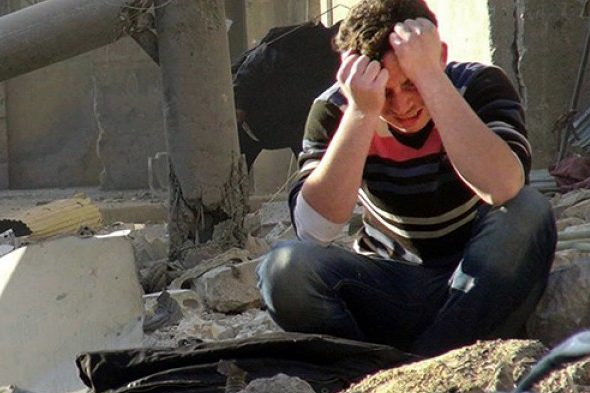
As Syria marks 10 years of a devastating armed conflict, the UN Security Council continues to abdicate its responsibility to address the gross human rights abuses committed by the Syrian government and various other actors in the country, including the use of chemical weapons and the perpetration of other crimes against humanity, likely genocide and war crimes, the International Commission of Jurists (ICJ) said today.
Since a popular uprising began in March 2011, the regime’s unabated repression has driven Syria into a full-scale civil war. Hundreds of thousands have been killed; tens of thousands have been tortured and forcibly disappeared; over 11 million have been forcibly displaced, either internally or to host countries; and tens of thousands continue to to be arbitrarily detained.
Notwithstanding this, Russia and China have vetoed at least 15 Security Council resolutions seeking to address and deter the perpetration of crimes under international law in Syria, including through the establishment of investigations into the use chemical and other weapons, by imposing sanctions over such use, and by referring the Syria situation to the International Criminal Court (ICC).
“The SC’s failure to address the Syrian conflict has been chronic and structural, and so wrong about so much and at the expense of so many”, said Said Benarbia, MENA Programme Director at the ICJ. “The SC’s failure calls into question its very role as a guarantor of peace and security and its relevance in upholding a rule-based order.”
To end impunity and ensure victims’ right to justice and effective remedies, the SC must reform its accountability practices, including by ensuring that decisions on the investigation of crimes under international law, the referral of these crimes to the ICC, and the establishment and operationalization of other forms of accountability be based on the existence of overwhelming evidence of such crimes, rather than political expediency.
In the meantime, individual UN Member States must act to begin filling the accountability gap in Syria, including by supporting United Nations accountability mechanisms, such as the the International, Impartial and Independent Mechanism, and by seeking out, prosecuting and punishing those responsible for the atrocities committed in the country pursuant to the principle of universal jurisdiction, as the recent, first-ever guilty verdict against a former official of the Syrian regime delivered by the Higher Regional Court in Koblenz, Germany, shows.
Contact:
Asser Khattab, Research and Communications Officer, ICJ Middle East and North Africa Programme, asser.khattab@icj.org