Dec 18, 2020 | Agendas, Events, News
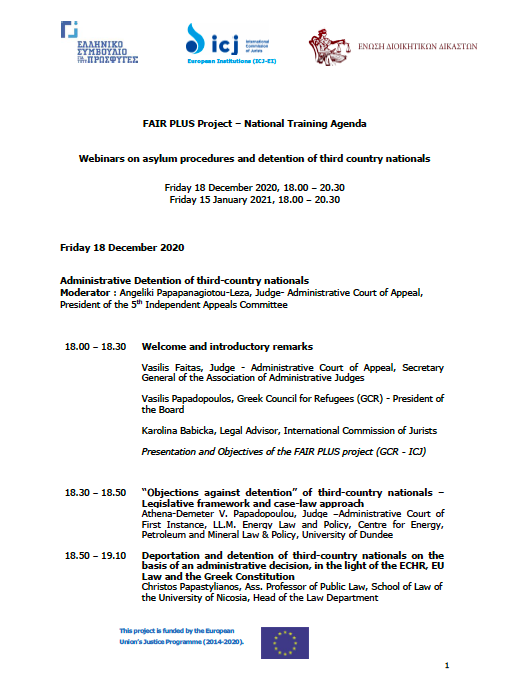
The ICJ and the Greek Council for Refugees (GCR) today hold the first part of the online training for Greek judges and lawyers on asylum procedures and detention of third country nationals as a part of the FAIR PLUS project.
The training brings together experts from the Greek Administrative Court of Appeal, Administrative Court of First Instance, European Court of Human Rights, GCR, ICJ and academics for a discussion on administrative detention on third-country nationals with a focus on the current situation in Greece.
Among the topics to be discussed today are domestic remedies to detention of third-country nationals; as well as deportation and detention of third country nationals in light of the European Convention on Human Rights (ECHR), EU law and Greek constitutional and European Court of Human Rights (ECtHR) case-law regarding immigration detention.
The second part of the training, on fair and effective asylum procedures, is planned for 15 January 2021, and will focus on Directive 2011/95/EE (inclusion clause in refugee protection status); asylum procedure and procedural guarantees; case-law of the CJEU on asylum and common issues of asylum applications – credibility and safe third country.
This is the third training delivered as part of this project, the first two having been held in person this January in Dublin and last December in Pisa.
See the agenda for both parts of the training in English and in Greek.
This training is a part of FAIR PLUS project. It was carried out with the financial support of the European Union. Its contents are the sole responsibility of ICJ and do not necessarily reflect the views of the European Union.
Dec 17, 2020 | News
The ICJ and the Human Rights Joint Platform released today a joint statement, calling attention to a variety of obstacles faced by those seeking access to justice for human rights violations in Turkey.
The statement includes 13 recommendations to the Turkish government to ensure the justice system can uphold human rights.
In Turkey, victims of human rights violations remain unable to access justice, particularly effective remedies and reparation for violations of their rights, and there is little accountability of the State or State authorities for what are often serious violations.
Access to Justice has suffered by the immense damage done to the justice system in Turkey in recent years. The systematic undermining of judicial independence, and of the work of prosecutors and lawyers, through the widespread practice of arbitrary arrest and detention, unfounded prosecutions and dismissals of legal professionals as well as other human rights defenders, have fatally undermined the capacity of the justice system to provide reliable protection for human rights.
The Joint Statement is the fruit of three years of intensive work on access to justice for human rights violations in Turkey by the ICJ and IHOP.
During the last three years, the two organizations had the opportunity to gather the views of a wide range of stakeholders, including civil society, judges, lawyers, prosecutors, government officers, international experts, international organizations, human rights defenders and victims of human rights violations. The conclusions by ICJ and IHOP are a reflection of these opinions.
Drawing on this work and their decades-long experience in access to justice, the ICJ and IHOP have outlined the measures needed to begin to restore effective access to justice in Turkey.
The Joint Statement is part of the REACT project: implemented jointly by ICJ and IHOP, this project seeks to support the role of civil society actors in turkey in ensuring effective access to justice for the protection of human rights. This project is funded by the European Union. The views portrayed here do not necessarily reflect the opinion of the EU.
ICJIHOP-JointStatement-2020-ENG (download the statement in English)
ICJIHOP-JointStatement-2020-TUR (download the statement in Turkish)
Dec 16, 2020
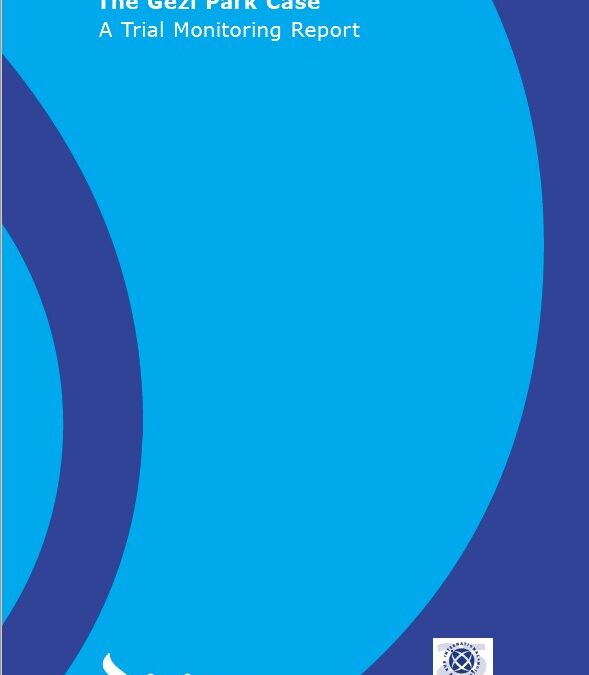
In a report published today, the ICJ and the International Bar Association’s Human Rights Institute (IBAHRI) have documented a range of human rights violations in the “Gezi Park” trial, which took place in Istanbul before the 30th Assize Court from 24 June 2019 to 18 February 2020.
Further, the organizations call for the immediate release of Osman Kavala who was acquitted of all Gezi Park trial-related charges, but is in detention, and for all the remaining charges against all defendants to be dropped.
Following the joint trial observation, the ICJ and IBAHRI found that the trial of leading figures in the Gezi Park protests failed to comply with fair trial guarantees under Turkish and international law.
In the re, the organizations concluded that the trial did not meet the requirement of a fair trial under Article 6 of the European Convention on Human Rights (ECHR) and Article 14 of the International Covenant on Civil and Political Rights (ICCPR). Specifically, the proceeding failed to comply with the rights to be tried by an independent and impartial court, the presumption of innocence and to call and cross examine witnesses.
The ICJ and IBAHRI further affirmed that the trial was compromised due to the clear violation of the principle of legality in relation to the criminal law applied, as well as in respect of the grounds for detention, which failed to satisfy articles 9 and 15 of the ICCPR, and articles 5 and 7 of the ECHR.
The Gezi Park protests began in May 2013 as an effort by a group of environmentalists to save a park in central Istanbul from being rezoned, but soon grew into nationwide demonstrations. Police quelled the protests in Taksim Square with the use of tear gas and water cannons.
“While the acquittal of some is welcome, the charges against the defendants were patently baseless and unsubstantiated, and should not have been brought to begin with,” said Massimo Frigo, Senior Legal Adviser of the Europe and Central Asia Programme of the ICJ. “The renewed detention of Osman Kavala under fresh charges related to the same facts as those he is acquitted upon is a deplorable abuse of process and he should be released immediately.”
Baroness Helena Kennedy QC, Director of the International Bar Association’s Human Rights Institute, commented: “Following our extensive trial observation, we are greatly disappointed to see that Osman Kavala will again face trial from 18 December 2020 on new and wholly unsubstantiated charges. Mr Kavala and the Gezi Park protestors should never have been charged, which only makes the failure to uphold fair trial guarantees more disconcerting. Such disregard for due process is sadly now commonplace in Turkey, and we hope this trial report alerts the international community to the true disintegration of the independence of the judiciary and the rule of law in the country.”
The criminal charges brought against the defendants related to offences that are overly broad and prone to unduly restrict the exercise of human rights, notably the freedoms of expression, association and assembly, political participation and privacy.
The defendants in the trial were Mehmet Osman Kavala, Gokçe Yilmaz, Ali Hakan Altinay, Hanzade Hikmet Germiyanoglu, Yigit Aksakoglu, Cigdem Mater Utku, Yigit Ali Ekmekci, Memet Ali Alabora, Handan Meltem Arikan, Can Dundar, Ayse Mucella, Serafettin Can Atalay, Tayfun Kahraman, Inanç Ekmekçi, Mine Ozerden and Ayse Pinar Alabora.
The defendants were charged under the following articles of the Turkish Criminal Code:
- Article 312: an attempt to overthrow the Turkish government or an attempt to prevent it from fulfilling its duties;
- Article 151: damage to property;
- Article 152: qualified damage to property;
- Article 174: possession or exchange of hazardous substances without permission;
- Article 153: damaging places of worship and cemeteries;
- Article 149: qualified robbery;
- Article 86: intentional injury;
- crimes under the Law on Firearms, Knives and Other Tools No 6136; and
- crimes under the Law on Protection of Cultural and Natural Assets No 2863.
The detention of Osman Kavala was declared unlawful under articles 5 and 18 of the ECHR by the European Court of Human Rights during the trial, and the Committee of Ministers of the Council of Europe has called three times for his immediate release despite newly raised charges of espionage.
Download the report:
In English: Turkey-GeziParkTrial-TrialObservation-Publications-Reports-2020-ENG
In Turkish: Turkey-GeziParkTrial-TrialObservation-Publications-reports-2020-TUR
Contact:
Massimo Frigo, Senior Legal Adviser, ICJ Europe and Central Asia Programme, t: +41 79 749 99 49, e: massimo.frigo(a)icj.org

Dec 16, 2020 | News
Dialogue between Swazi Women Human Rights Defenders and CEDAW Committee Members highlights the obstacles faced by local women in the enjoyment of their human rights.
On 14 December 2020, the ICJ and the Southern Africa Human Rights Defenders Network (SAHRDN) facilitated a fruitful dialogue between Swazi Women Human Rights Defenders (WHRD) and members of the UN Committee on the Elimination of Discrimination against Women (the CEDAW Committee) on the key human rights concerns facing Swazi women and possible advocacy strategies to address them.
The CEDAW Committee monitors State parties’ compliance with and implementation of their human rights obligations under the UN Convention on the Elimination of All Forms of Discrimination against Women (the Convention), by which Eswatini is bound.
In light of the Eswatini government’s failure to submit a report to the CEDAW Committee, as required under the Convention, more than 20 Swazi WHRDs’ organizations had a preparatory meeting on 8 December to discuss and prioritize the human rights concerns they wished to bring to the CEDAW Committee members’ attention.
They hoped that, by coming together and agreeing on these issues, they may raise awareness and put pressure on the Eswatini government to comply with its obligations under the Convention, including by promptly submitting the country’s overdue report.
In the wake of this preparatory meeting, on 14 December Swazi WHRDs briefed the CEDAW Committee members about the most critical human rights violations faced by women in Eswatini. This meeting was broadcasted live on Facebook.
The dialogue focused on the Eswatini authorities’ failure to implement their human rights obligations under the Convention, including the previous Concluding Observations of the CEDAW Committee.
High rates of teenage pregnancy, women’s inadequate access to education, healthcare and adequate housing, and ways in which customary and religious laws are used to justify discrimination against them were among the key human rights concerns affecting women discussed during the dialogue.
Watch the animation on CEDAW
Dec 16, 2020 | Advocacy, Non-legal submissions
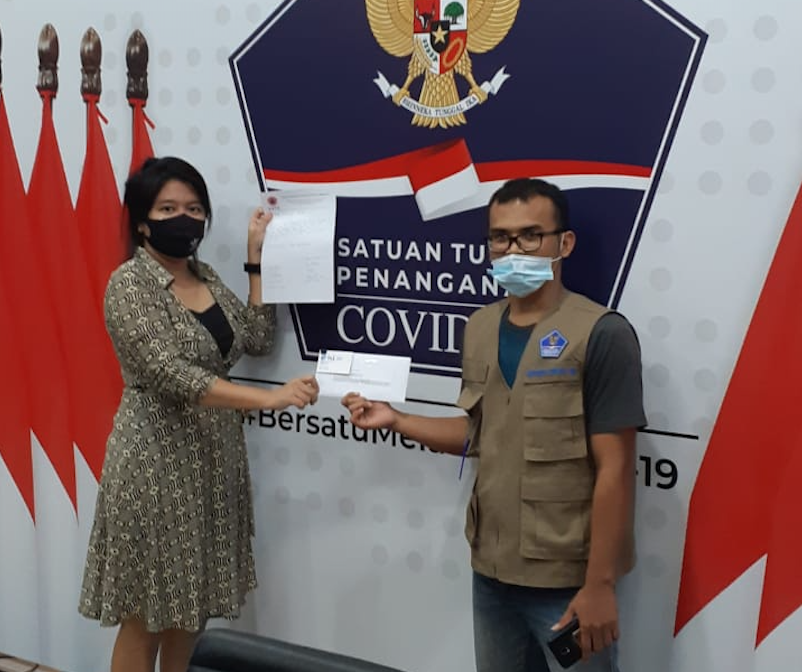
In an open letter, the ICJ today called on Indonesia’s COVID-19 Mitigation Task Force to provide detailed guidance to the Government of Indonesia, in taking actionable steps to implement gender responsive measures in the country.
Since the beginning of the outbreak of the pandemic, the mortality rate of Indonesia is reportedly among the highest in the world.
In addressing the pandemic, the Government has established regulations and repeatedly advised people to restrict social gatherings and stay at home. These measures have a particularly disparate impact on Indonesian women, exacerbating the pre-existing gender inequalities in Indonesia.
The ICJ has previously highlighted the challenges faced by women in its report “Living Like People who die slowly.” Similar concerns has been expressed by the UN Committee on Economic, Social, and Cultural Rights.
The ICJ called the task force to take proactive and special measures to protect women workers in its COVID-19 response, in line with the recommendations of the UN Committee on the Elimination of Discrimination against Women’s Guidance Note on COVID-19.
Specifically, the ICJ has recommended that it promote government responses to:
- Ensure that women receive basic needs support
- Provide more working opportunities for women to work from home
- Provide online counseling or mental health support for women workers
The ICJ considers that the failure to recognize the gender dynamics affecting women workers, particularly public health emergencies, limits the effectiveness of the overall Government’s response efforts and impedes the full realization of women’s human rights in Indonesia.
Download