Dec 15, 2020 | News
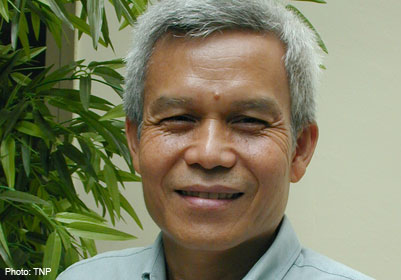
On 15 December 2020, the eighth anniversary of the enforced disappearance of Lao civil society leader Sombath Somphone, the ICJ joined 53 organizations and 19 individuals in reiterating its calls on the Government to reveal his fate and whereabouts and to investigate his and all other cases of alleged enforced disappearance in the country.
The statement condemned the Government’s ongoing failure to adequately investigate all allegations of enforced disappearance in Laos, which has been compounded by years of near complete lack of commitment to address this serious crime or provide an effective remedy or reparation to its victims and their families.
In June 2020, during the third Universal Periodic Review (UPR) of Laos, the Government refused to accept all five recommendations that called for an adequate investigation into Sombath’s enforced disappearance. The Government failed to support another eight recommendations that called for investigations into all cases of alleged enforced disappearances in Laos. Despite the government accepting that “the search for missing Lao citizens, including Sombath Somphone, is the duty of the Lao government”, it has failed to evidence any political will to effectively execute or fulfill this duty.
Sombath Somphone was last seen at a police checkpoint on a busy street in Vientiane on the evening of 15 December 2012. Footage from a CCTV camera showed that Sombath’s vehicle was stopped at the police checkpoint and that, within minutes, unknown individuals forced him into another vehicle and drove him away in the presence of police officers. CCTV footage also showed an unknown individual driving Sombath’s vehicle away from the city center. The presence of police officers at Sombath’s abduction and their failure to intervene strongly indicates State agents’ participation in Sombath’s enforced disappearance.
Lao authorities have repeatedly claimed they have been investigating Sombath’s enforced disappearance, but have failed to disclose any new findings to the public since 8 June 2013. They have not met with Sombath’s wife, Shui Meng Ng, since December 2017. No substantive information about the investigation has been shared by the authorities with Ng or Sombath’s family, indicating that, for all intents and purposes, the police investigation has been de facto suspended.
The statement reiterated a call for the establishment of a new independent and impartial investigative body tasked with determining Sombath’s fate and whereabouts, with the authority to seek and receive international technical assistance to conduct a professional and effective investigation in accordance with international standards. This is a call which multiple signatory organizations have been making since his enforced disappearance in 2012.
The statement further urged the Lao government to ratify the International Convention for the Protection of All Persons from Enforced Disappearance (ICPPED), which Laos signed in September 2008; incorporate its provisions into the country’s legal framework, implement it in practice, and recognize the competence of the Committee on Enforced Disappearances to receive and consider communications from or on behalf of the victims.
The full statement is available here.
Contact
Kingsley Abbott, ICJ Senior Legal Adviser, e: kingsley.abbott(a)icj.org

Dec 15, 2020 | Agendas, Events
Join ICJ and IHOP in this online conference in which Turkish and international experts will discuss the current challenges in Turkey to promptly and fully implement the judgments of the Court and how to improve the execution of judgments in the Turkish national system.
Turkey is the Council of Europe member state with the third highest number of European Court of Human Rights judgments awaiting execution, after the Russian Federation and Ukraine. As a Party to the European Convention on Human Rights and founding member of the Council of Europe, Turkey has committed to implement all rulings of the Strasbourg Court, yet the results of this commitment are far from clear.
Implementation of the European Court judgments is a key indicator in Europe of a country’s commitment to human rights and the rule of law, and failure to implement judgments fundamentally undermines access to justice for victims of human rights violations by watering down the impact of their litigation before the Court.
Failure to implement judgments through general implementation measures reforming laws, policies and practices, also leads to persistent, repeated violations of the States’ obligations under the European Convention on Human Rights. This problem has existed for many years in Turkey, leaving long-standing systemic human rights problems unsolved. Recently civil society has denounced the Turkish authorities’ attempts to circumvent the general application of certain new key rulings of the European Court.
In this conference, Turkish and international experts will discuss the current challenges in Turkey to promptly and fully implement the judgments of the Court and how to improve the execution of judgments in the Turkish national system:
– Justice Egbert Myjer, Former Judge at the European Court of Human Rights and Commissioner of the ICJ,
– Prof. Philip Leach, Professor of Human Rights Law at Middlesex University
– George Stafford, Director at European Implementation Network
– Emma Sinclair-Webb, Turkey Director, Human Rights Watch
– Kerem Altıparmak, ICJ Legal Consultant
– Ayşe Bingöl Demir, Turkey Human Rights Litigation Support Project Co-Director, Lawyer
– Prof. Başak Çalı, Professor of International Law, Co-Director of the Centre for Fundamental Rights at the Hertie School
The event will be introduced and moderated by Feray Salman, General Coordinator of the Human Rights Joint Platform (IHOP), Roisin Pillay, Director of the ICJ Europe and Central Asia Programme, and Massimo Frigo, Senior Legal Adviser of the ICJ Europe and Central Asia Programme.<
TO REGISTER WRITE TO: ihop@ihop.org.tr
IHOPICJ-ZoomConference-ExecutionECtHRTurkey-Agenda-2020-ENG (download the agenda in English)
IHOPICJ-ZoomConference-ExecutionECtHRTurkey-Agenda-2020-TUR (download the agenda in Turkish)
The event is part of the REACT project: implemented jointly by ICJ and IHOP, this project seeks to support the role of civil society actors in turkey in ensuring effective access to justice for the protection of human rights. This project is funded by the European Union. The views expressed in the event do not necessarily reflect the opinion of the EU.

Dec 14, 2020
The ICJ today joined the Association des Magistrats Tunisiens (AMT), Avocats Sans Frontières (ASF), and the World Organisation Against Torture (OMCT) in publishing a paper entitled No Reconciliation Without Justice: Current Situation and Prospects of the Specialized Criminal Chambers in Tunisia.
The paper analyses the challenges that the Specialized Criminal Chambers are facing since the opening of trials in May 2018 and formulates recommendations to Tunisian authorities to address these obstacles.
The paper was endorsed by members of the Transitional Justice Coalition.
It is available in Arabic and French:
Tunisia-SCC assess-Advocacy-Analysis brief-2020-ARA
Tunisia-SCC assess-Advocacy-Analysis brief-2020-FRA
Dec 11, 2020 | Доклад миссии установления фактов, Доклады, Новости, Публикации
Сегодня, опубликовав отчет о миссии, касающейся судебной системе Таджикистана, Международная комиссия юристов (МКЮ) призвала госорганы Таджикистана принять комплексные меры по реформированию судебной системы с тем, чтобы обеспечить ее независимость и уполномочить эффективно защищать права человека.
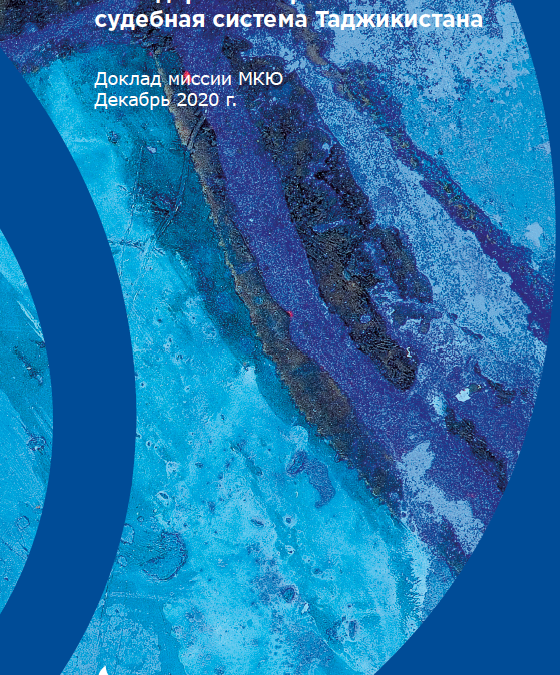
В отчете МКЮ Без сдержек и противовесов: судебная система Таджикистана дается подробный обзор организации и функционирования судебной системы при отправлении правосудия в Таджикистане. На основе анализа законов и информации, полученной во время миссии в страну МКЮ обнаружила некоторые слабости судебной системы и предложила рекомендации относительно институтов и процедур судебного управления.
«В Таджикистане имели место неоднократные попытки реформировать систему правосудия, как мы это смогли продемонстрировать в докладе, но к настоящему моменту они не привели к созданию судебной системы с сильными институтами самоуправления, которые были бы способны защищать и поддерживать судей в независимом применении права», – сказал Тимур Шакиров, старший правовой советник Программы МКЮ по Европе и Центральной Азии. «Среди многих иных вопросов, доклад указывает на проблему практически полного отсутствия оправдательных приговоров в Таджикистане, феномен, который можно рассматривать как лакмусовую бумажку судебной власти в ее способности выполнять свою роль самостоятельно», – подчеркнул он.
В докладе содержится ряд рекомендаций, в частности, в отношении руководящих органов судебной власти, системы назначения судей, судебной гарантии пребывания в должности и дисциплинарной системы для судей, с целью повышения независимости и эффективности судебных органов.
«Существует очевидная необходимость в осуществлении серьезной институциональной реформы для изменения системы саморегулирования, которая позволила бы осуществлять независимое отправление правосудия без формальной или неформальной проверки или одобрения со стороны руководства», – добавил Шакиров.
Отчет доступен на русском и английском языках.
Дополнительная информация:
В апреле и мае 2019 года МКЮ провела исследовательскую миссию по вопросам независимости судебной власти в Таджикистане. По завершении миссии МКЮ выразила озабоченность относительно независимости судей, а также функционирования судебных институтов и процедур в законодательстве и на практике.
Tajikistan-Judiciary-Publications-Reports-Mission report-2020-RUS
Dec 11, 2020
Today, as it publishes its mission report on the country’s judiciary, the ICJ calls on the Government of Tajikistan to adopt comprehensive measures to reform the judiciary, in order to ensure its independence and enable it to effectively protect human rights.
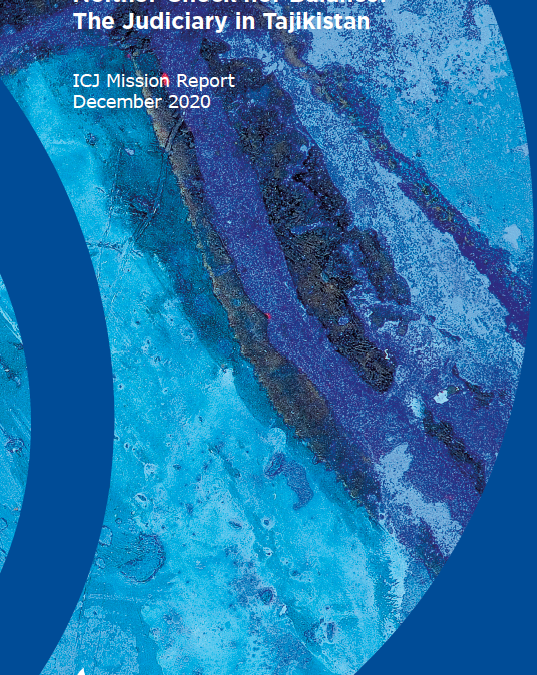
The ICJ report Neither Check nor Balance: the Judiciary in Tajikistan provides a detailed overview of the organization and functioning of the judiciary in administering justice in Tajikistan. Through an analysis of laws and information obtained during a mission to the country the ICJ has identified the weaknesses in the judiciary and made recommendations concerning the institutions and procedures of judicial governance.
“There have been many attempts to reform the justice system in Tajikistan, as we demonstrate in the report, but they have so far failed to result in a judiciary with strong self-governance institutions which are capable of protecting and supporting judges in independently applying the law,” said Temur Shakirov, Senior Legal Adviser of the ICJ Europe and Central Asia Programme.
“Among many other issues, the report points to the problem of an almost complete absence of acquittals in Tajikistan, which can be seen as a litmus paper of the judiciary’s ability to fulfil their role independently.”
The report provides a set of recommendations, in particular, in regard to the governing bodies of the judiciary, the system of appointment of judge, judicial security of tenure, and the disciplinary system for judges, with a view to strengthening the independence and effectiveness of the judiciary.
“There is a conspicuous need for a significant institutional reform to re-design a system of self-regulation that would allow for the independent administration of justice, without a formal or informal check or approval from superiors,” Shakirov added.
Background:
In April and May 2019, ICJ conducted a research mission on the independence of the judiciary in Tajikistan. Following the mission, the ICJ expressed concerns about the independence of individual judges as well as the functioning of judicial institutions and procedures in law and in practice.
Download
Tajikistan-Judiciary-Publications-Reports-Mission report-2020-ENG (full report in English, PDF)