Dec 10, 2020 | News
ICJ’s 16 Days of Activism Against Gender-Based Violence underscores the need for justice systems to be more responsive.
The campaign commenced on 25 November, International Day for the Elimination of Violence against Women, and ended today on Human Rights Day. The campaign presented “an impact story” poster series, Facebook live interviews and opinion pieces on gender-based violence in Africa, Asia, Latin America, Middle East and North Africa.
The campaign underscored that harmful traditional norms and gender stereotypes provide the backdrop for the systematic and widespread abuse of women and girls’ human rights across the globe; it also emphasized the need to maintain essential services for survivors of gender-based violence (GBV) during COVID-19 lockdowns, including ensuring a continuum of adequate criminal justice response.
“Violence against women and girls around the world has increased in this global pandemic. Governments have a duty to ensure that their response to Covid-19 includes preventing such violence. For instance, all hotline services for reporting domestic violence must remain open during lockdowns and be considered part of essential services. The police must likewise be ready to act speedily if required. They must be made aware that women and girls are especially vulnerable at this time,” said ICJ Commissioner Ambiga Sreenevasan from Malaysia.
Throughout the campaign, the ICJ also underscored the ongoing need to support civil society organizations’ and women human rights defenders’ response to GBV, as well as the need to strengthen the judiciary’s capability to respond to GBV by enhancing its reliance on international human rights law and standards.
“The authorities have turned a blind eye to gender-based violence for far too long and it is time to prioritize combatting the phenomenon effectively, including through legislative reform and awareness raising,” said ICJ Commissioner Marwan Tashani from Libya.
Poster Series
Imrana Jalal (ICJ Commissioner, Fiji)
Mikiko Otani (ICJ Commissioner, Japan)
Ambiga Sreenevasan (ICJ Commissioner, Malaysia)
Marwan Tashani (ICJ Commissioner, Libya)
Kaajal Ramjathan-Keogh (ICJ Africa Regional Programme Director)
Saïd Benarbia (ICJ MENA Programme Director)
Carolina Villadiego Burbano (ICJ Legal and Policy Adviser, Latin America)
Sexual Violence & Criminal Law in Zimbabwe
Amy Alabado Avellano (Family Court Judge, Philippines)
Savithri Wijesekera (Executive Director of Women In Need, Sri Lanka)
Nahla Haidar (ICJ Commissioner, Lebanon)
Saman Zia-Zarifi (ICJ Secretary General)
Tshabalala v S (South African Constitutional Court judgment on the doctrine of common purpose applied to rape)
Infographic
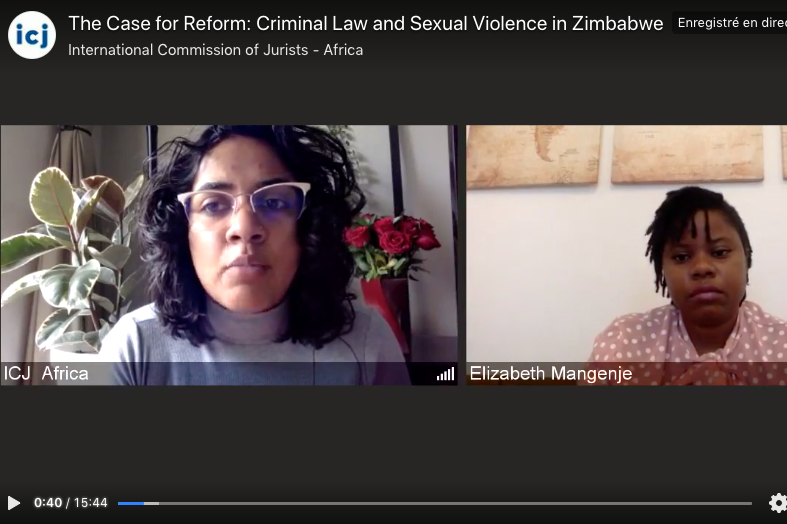
The Case for Reform: Criminal Law and Sexual Violence in Zimbabwe
Facebook Live Interviews
The Case for Reform: Criminal Law and Sexual Violence in Zimbabwe with Elizabeth Mangenje (ICJ Legal Adviser, Africa Regional Programme)
The State of GBV in the Middle East and North Africa Region with Nahla Haidar El Addal (ICJ Commissioner, Lebanon)
Women’s Access to Justice – What does justice mean for women in the context of COVID-19? (Joint initiative of ICJ, UN Women, and OHCHR)
Women’s Access to Justice – What does justice mean for women prisoners? (Joint initiative of ICJ, UN Women, and OHCHR)
Op-eds
Mujeres, justicia y pandemia, by Carolina Villadiego Burbano
Yet another treaty aims to protect African women. But how will it be enforced? by Nokukhanya Farisè and Tanveer Rashid Jeewa
Dec 9, 2020
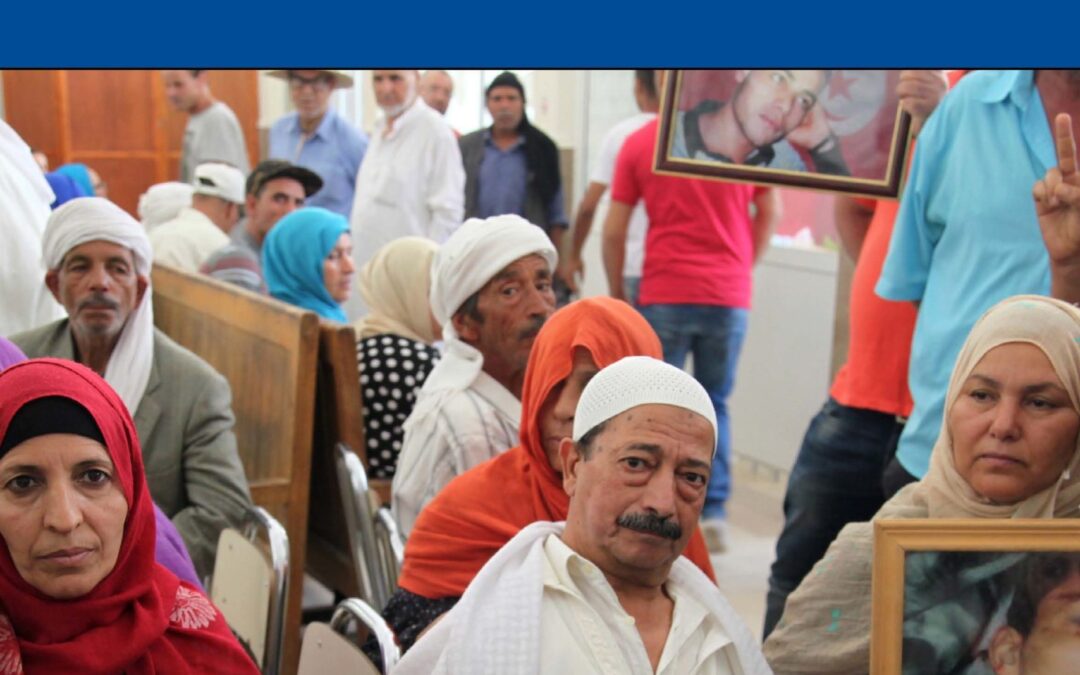
The ICJ today released two practical guides aimed to assist practitioners to advance accountability and justice through the Specialized Criminal Chambers (SCC) in Tunisia.
Practical Guide 2 addresses the investigation and prosecution of gross human rights violations under Tunisian and international law, while Practical Guide 3 covers the principles and best practices on evidence in the administration of justice. Practical Guide 1, which was released in December 2019, considered the role of international law and standards in proceedings before the SCC.
Trials before the SCC started in May 2018. Since the opening of the first hearing, it has been evident that gaps in the rules and procedures governing the investigation, prosecution and evidence in the SCC cases have served to endanger efforts to hold perpetrators to account and bring justice to victims for past violations of human rights.
“The credibility of SCC trials largely depends on their capacity to ensure effective and fair investigations and prosecutions based on strong, compelling and untainted evidence,” said Said Benarbia, the ICJ’s MENA Programme Director.
“These practical guides should serve to assist those working in the Tunisian justice sector to make the most of this opportunity to end impunity and enable victims to obtain redress, all while ensuring the highest possible fair trial standards.”
Practical Guide 2 sets out the international law and standards governing the obligation to investigate and prosecute gross human rights violations, the accused’s right to a fair trial, and the rights of victims and their families to participate in proceedings and to an effective remedy.
Practical Guide 3 describes the principles and best practices under international law that apply to the collection, admissibility and evaluation of evidence in the investigation and prosecution of gross human rights violations.
Both guides aim to provide options for applying Tunisia’s law and procedures on investigation, prosecution, and evidence in SCC cases in compliance with international law and standards.
“Tunisians have waited so long to see justice for the many human rights abuses that were committed in the past,” said Kate Vigneswaran, the ICJ’s MENA Programme Senior Legal Adviser.
“The SCC holds out the promise that this wait might end, but only if the trials are grounded on solid proceedings that put accountability, human rights and fairness at the forefront.”
Contact
Said Benarbia, Director, ICJ Middle East and North Africa Programme, t: +41-22-979-3817; e: said.benarbia(a)icj.org
Kate Vigneswaran, Senior Legal Adviser, ICJ Middle East and North Africa Programme, t: +31-62-489-4664; e: kate.vigneswaran(a)icj.org
Background information
The SCC were established in 2014 to adjudicate cases involving alleged “gross human rights violations” between 1955 and 2013 referred by the Truth and Dignity Commission (Instance Verité et Dignité, IVD).
At the end of its mandate in December 2018, the IVD’s referred to the SCC 200 cases of arbitrary deprivations of life, arbitrary deprivations of liberty, torture and other ill-treatment, enforced disappearance, rape and sexual assault and crimes against humanity committed by the past regime.
Practical Guides 2 and 3 are preceded by Practical Guide 1 on The Adjudication of Crimes Under Tunisian and International Law, which examines the principles of legality and non-retroactivity under international law and their application in the domestic system, and conducts an analysis of the definition of crimes under Tunisian law vis-à-vis international law for arbitrary deprivations of life, arbitrary deprivations of liberty, torture and other ill-treatment, enforced disappearance, rape and sexual assault and crimes against humanity. The three Guides will also be followed by Practical Guide 4 on modes of liability under Tunisian and international law.
In a briefing paper published in October 2020, the ICJ also called on the Tunisian authorities to undertake substantial legal and policy reforms with a view to strengthening accountability and removing the obstacles that impede the SCC work.
Download
Tunisia-SSC guide series no2-Publications-Reports-Thematic reports-2020-ENG (Guide 2 in English, PDF)
Tunisia-SSC guide series no3-Publications-Reports-Thematic reports-2020-ENG (Guide 3 in English, PDF)
Tunisia-Launch Guides-News-2020-ARA (story in Arabic, PDF)
Tunisia-SSC guide series no2-Publications-Reports-Thematic reports-2020-ARA (Guide 2 in Arabic, PDF)
Tunisia-SSC guide series no3-Publications-Reports-Thematic reports-2020-ARA (Guide 3 in Arabic, PDF)
Dec 9, 2020
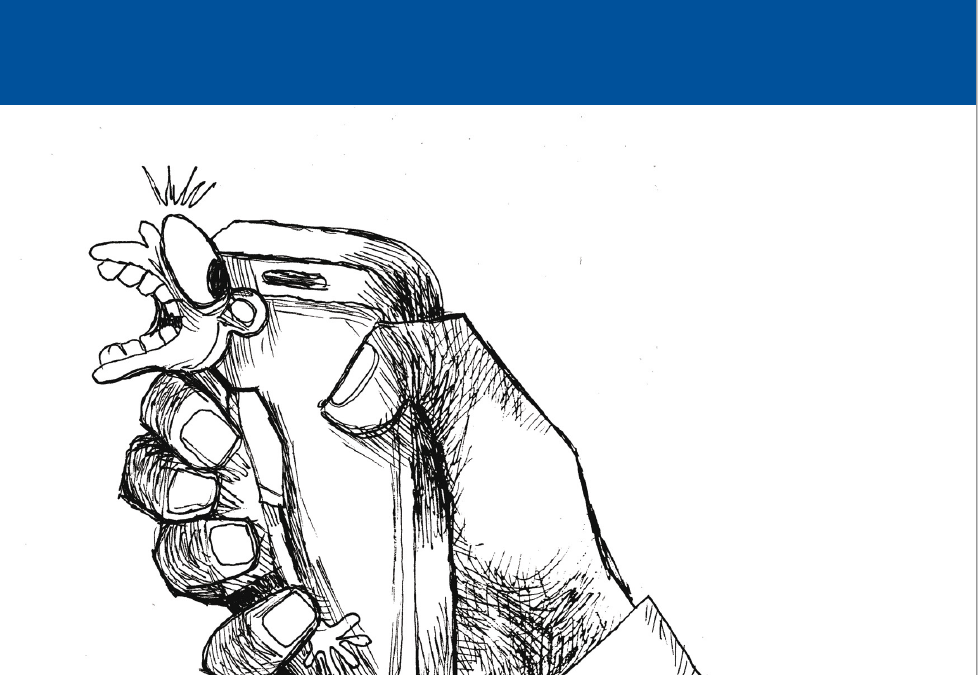
In a new report released today, the ICJ called on the Vietnamese authorities to take swift measures to reform its laws and practices around the use of the internet and to stem the pattern of accelerating human rights abuse of individuals online.
The paper, Dictating the Internet: Curtailing Free Expression and Information Online in Vietnam, details the deteriorating human rights environment online in Vietnam. The paper tracks, in particular, how State authorities have increasingly abused laws and the administration of justice to violate the rights to freedom of expression, opinion and information online.
The paper follows on from the ICJ’s 2019 regional report entitled Dictating the Internet: Curtailing Free Expression, Opinion and Information Online in Southeast Asia assessing non-human rights compliant legal frameworks and case studies across Southeast Asia, including Vietnam.
The paper outlines emerging developments and trends in 2020 and tracks interferences not only with freedom of expression, opinion and information online, but also the rights to privacy, liberty, fair trial, freedom of association and assembly, life and health.
Multiple case studies highlight how affected individuals have been subject to harassment, investigation, criminal charges, prosecution, and imprisonment for exercising their rights to free expression and information on online platforms. The Dong Tam dispute and trial – which reflected the abuse of rights online and offline of individuals seeking to bring to light human rights violations relating to the land rights dispute – is also highlighted as an emblematic case study.
The paper further explains how, within the context of the COVID-19 pandemic, freedom of expression and information online has been arbitrarily curtailed by the State in the misguided name of protecting public health.
Along with applying ill-conceived laws to harass individuals, Vietnamese authorities have continued to employ other tactics to ensure State control of expression and content online, including through cybersurveillance and policing of online platforms, and applying pressure on technological companies to comply with demands for censorship by silencing human rights defenders on their platforms.
The paper provides specific recommendations to the Vietnamese Government to safeguard in law and practice the rights to freedom of expression, opinion and information online as well as offline, in line with the State’s international human rights obligations.
The full report is available in English here. (PDF)
Contact
Kingsley Abbott, ICJ Senior Legal Adviser, email: kingsley.abbott@icj.org
See also
ICJ, ‘Southeast Asia: ICJ launches report on increasing restrictions on online speech’, 11 December 2019
Dec 8, 2020 | News
The ICJ with partners has intervened in European Court for Human Rights case concerning collective expulsions, including of children from Croatia.
The ICJ and partners (European Council for Refugees and Exiles, Dutch Council for Refugees, AIRE Center and the Hungarian Helsinki Committee) intervened today in the case S.B. v Croatia (Application No. 18810/19) at the European Court for Human rights.
The case concerns collective expulsion of migrants, including children, from Croatia to Bosnia and Herzegovina, and excessive use of force.
In the intervention, the organisations have highlighted international legal standards regarding the principle of non-refoulement and prohibition of collective expulsions. They also point to the need to take into account specific vulnerabilities of asylum seekers and children in order to guarantee enhanced safeguards afforded to them under international and EU law.
The organisations also note that in operations aimed at imposing restrictions on freedom of movement or deprivation of liberty to carry out an expulsion, the use of force should only be employed exceptionally and subject to strict necessity and proportionality requirements. The lack of resistance to law enforcement officials, per se renders force unlawful.
Please find the third party intervention here.
Dec 8, 2020 | Editorial, Noticias
Una opinión editorial de Carolina Villadiego Burbano, Asesora Legal para America Latina de la CIJ, y Carlos Lusverti, Consultor de la CIJ.
Los derechos humanos de las mujeres se han visto severamente afectados durante la pandemia de COVID-19 alrededor del mundo y Venezuela no es una excepción a esta tendencia. En medio de la crisis de derechos humanos generalizada que el país atraviesa desde 2014, y que ha tenido un impacto desproporcionado en mujeres y niñas, la COVID-19 y las medidas extraordinarias adoptadas por el gobierno para atender la pandemia han agravado la situación de derechos humanos de las mujeres.
En octubre de 2020, esta situación fue reconocida por el Consejo de Derechos Humanos de las Naciones Unidas.
Teniendo en cuenta lo anterior, en este texto analizamos las afectaciones al derecho a la salud y al derecho a una vida libre de violencia que enfrentan las mujeres en Venezuela durante la pandemia, con el objetivo de presentar algunas recomendaciones.
La salud de las mujeres está en riesgo
De acuerdo con la Comisión Económica para America Latina (CEPAL), las mujeres en Latinoamérica están significativamente afectadas durante la pandemia, y en el sistema de salud “representan el 72,8% del total de personas ocupadas en ese sector en la región.”
En Venezuela, el sistema de salud ya se encontraba en estado crítico antes que la pandemia envolviera al país, y la COVID-19 ha agravado la situación.
Durante varios años, distintas instituciones y organizaciones han descrito el terrible estado del sistema de salud en el país, y desde que estalló la pandemia, la Comisión Interamericana de Derechos Humanos (CIDH) y Human Rights Watch han mencionado la necesidad de proteger el derecho a la salud de las personas en Venezuela; la Alta Comisionada de las Naciones Unidas para los Derechos Humanos ha dado declaraciones similares.
Durante la pandemia, los limitados servicios de salud fueron direccionados principalmente a atender la COVID-19.
Esto tuvo como resultado una disminución del acceso a los servicios de salud no relacionados con COVID-19, incluidos aquellos necesarios para la atención en salud sexual y reproductiva y para mujeres gestantes.
Así, un grupo de 91 organizaciones de la sociedad civil y varias personas expresaron su preocupación por casos de mujeres embarazadas con sospechas de COVID-19 a quienes se les habría negado la atención oportuna, así como la suspensión de servicios pre y post natales en los centros de salud materna.
Este grupo destacó la necesidad de que las autoridades garanticen los derechos de las mujeres y niñas, incluyendo la atención en salud sexual y reproductiva.
Además, en cantidades alarmantes, las mujeres son responsables principales del cuidado de personas dependientes o que necesitan cuidado en el hogar, lo que las ha expuesto a riesgos adicionales durante la pandemia.
La Asociación Venezolana de Educación Sexual Alternativa (AVESA), una ONG local, ha documentado cómo las medidas de encierro y cuarentena han incrementado las tareas domésticas y han profundizado los problemas económicos que las mujeres ya estaban experimentando antes de la pandemia.
Las autoridades venezolanas deben actuar de manera más efectiva para proteger los derechos de las mujeres durante la pandemia de conformidad con sus obligaciones legales derivadas del derecho internacional de los derechos humanos.
En efecto, Venezuela es parte de varios tratados de derechos humanos que prevén estas obligaciones, incluyendo la Convención Interamericana para Prevenir, Sancionar y Erradicar la Violencia contra la Mujer (“Convención de Belém do Pará”) y la Convención de la ONU sobre la Eliminación de todas las Formas de discriminación contra la mujer (“CEDAW” por sus siglas en inglés).
El Comité de la CEDAW ha declarado que los Estados deben “[a]bordar el impacto desproporcionado de la pandemia en la salud de la mujer”; “[g]arantizar los servicios de salud sexual y reproductiva en tanto servicios esenciales”; “[p]roteger a las mujeres y niñas de la violencia de género”; y “[f]ortalecer la respuesta institucional, la difusión de información y la recopilación de datos”, entre otras recomendaciones.
Adicionalmente, las autoridades venezolanas deben adoptar políticas para la prevención y tratamiento de la COVID-19 con perspectiva de género, considerando un enfoque interseccional y los diferentes contextos en los que las mujeres pueden vivir en Venezuela, incluyendo la situación de pobreza.
Además, las autoridades deben asegurar la asignación adecuada de recursos al sistema de salud, garantizar el derecho a la salud del personal de la salud, y brindar servicios de salud sexual y reproductiva para todas las mujeres.
El hogar es un lugar inseguro para las mujeres
En 2019, organizaciones de la sociedad civil venezolana reportaron que en el 58.6% de los casos de violencia contra las mujeres, los perpetradores fueron sus parejas. Adicionalmente, en un 7,7% de los casos, los ataques fueron perpetrados por exparejas. De acuerdo con el monitoreo de medios que realiza COTEJO, durante ese año, 107 mujeres fueron víctimas de feminicidios.
El representante en Venezuela del Fondo de Población de las Naciones Unidas (UNFPA) dijo que, durante el primer semestre de 2020, ocurrieron más feminicidios que muertes por COVID-19. Por su parte, el Ministerio Público reportó el ingreso de 185 causas del delito de feminicidio durante 2020.
De otro lado, desde el inicio de la pandemia y hasta comienzos de octubre, la mayoría de juzgados y tribunales estuvieron cerrados, por lo cual, las mujeres han enfrentado mayores obstáculos para acceder a la justicia durante la pandemia.
Además, la Oficina de la ACNUDH dijo en julio que ha observado “una falta de diligencia debida en los procesos de investigación relativos a casos de violencia de género” en Venezuela.
Asimismo, según informó el Centro de Justicia y Paz (CEPAZ), una ONG local, existen varios obstáculos para el acceso a la justicia de las mujeres, incluida la evasión de las responsabilidades policiales cuando las mujeres acuden a presentar denuncias o la falta de respuestas rápidas por parte las fiscalías que dan lugar a que las víctimas tengan que pedir información de manera reiterada.
Por este motivo, las autoridades venezolanas deben abordar la violencia de género de conformidad con sus obligaciones legales derivadas del derecho internacional, incluyendo aquellas contenidas en la Convención Interamericana de Belem Do Pará que enfatiza que el Estado debe “actuar con la debida diligencia para prevenir, investigar y sancionar la violencia contra la mujer” (artículo 7b).
Asimismo, las autoridades venezolanas deben garantizar que el sistema de justicia brinde servicios a las mujeres víctimas de violencia de género, e incluir la adopción de protocolos específicos para la investigación efectiva y la protección de las víctimas.
Las autoridades deben cumplir la reciente sentencia de la Corte Interamericana de Derechos Humanos (caso Lopez Soto de 2018), y deben implementar programas de capacitación permanentes y obligatorios para los servidores públicos que laboran en el sistema judicial y en el sistema de salud, y que intervienen en los casos de mujeres víctimas de cualquier tipo de violencia.
Finalmente, las autoridades venezolanas deben permitir la acción legítima de las organizaciones humanitarias, quienes pueden brindar ayuda humanitaria con perspectiva de género durante la pandemia.