In a briefing paper published today, the ICJ called on the Tunisian authorities to comply with their international law obligations and undertake substantial legal and policy reforms, strengthening accountability and delivering justice to victims of gross human rights violations.
Reforms are particularly needed to enhance the effectiveness of the Specialized Criminal Chambers (SCC).
They are also required to ensure that Tunisia fulfills its obligations under international law to criminalize, investigate and prosecute gross human rights violations, and to ultimately guarantee the rights of victims to an effective remedy and reparation.
Organic Law No. 53 of 2013 established the SCC to adjudicate past gross human rights violations; they have been operating since May 2018 but are currently facing a number of hurdles. Urgent amendments to the Criminal Code, the Code of Criminal Procedure and other relevant domestic law, as well as institutional, judicial and policy reforms are required to overcome these obstacles.
“The conduct of SCC trials in the absence of these reforms risks to seriously impede their effective operation in the short term, and to hamper Tunisia’s accountability efforts in the long term,” said Said Benarbia, the ICJ’s MENA Programme Director.
“The success of the transitional justice process and the fight against impunity rests largely on the political will of the Tunisian authorities to introduce these reforms, and to ensure that the SCC are able to carry out their work without hindrance.”
Tunisia’s domestic law fails to adequately criminalize crimes under international law over which the SCC have jurisdiction. Further, the application of a special procedure under the transitional justice framework for the investigation and prosecution of gross human rights violations has resulted in the Office of Public Prosecutor and other investigative authorities playing little to no role in the prosecution of SCC cases. In addition, this special regime gives rise to concerns about the collection, admission, exclusion and assessment of evidence during the trial stages.
All these obstacles have the potential to adversely impact the fair trial rights of the accused, the victims’ right to an effective remedy and reparation, as well as the participation and protection of victims and witnesses at trial.
Additionally, Tunisia’s domestic law does not sufficiently guarantee the rights of the accused, nor does it fully ensure the rights of the victims and their families or adequate protective measures for victims and witnesses.
The briefing paper addresses these issues and makes key recommendations on three areas of outstanding concern, namely:
Adequate criminalization of crimes under international law and applicability of the principle of legality and non-retroactivity;
Investigation and prosecution of gross human rights violations; and
Collection, admissibility and assessment of evidence in the investigation, prosecution and adjudication of gross human rights violations.
In addition, in light of the recent annual judicial rotation, which has resulted in many of the SCC not having quorums and on trials been delayed, the ICJ calls on the High Judicial Council to ensure that the SCC judges have security of tenure, and that annual rotations do not undermine the SCC’s ability to conduct their work and dispense justice and ensure accountability for decades of gross human rights violations in Tunisia.
“The High Judicial Council should rapidly fill the posts that are currently vacant in the SCC and ensure that newly appointed judges receive timely and adequate training in transitional justice, as required by Organic Law No. 53 of 2013,” said Kate Vigneswaran, the ICJ’s MENA Programme Senior Legal Adviser.
“Moreover, safeguards should be put in place to ensure that changes in the composition of the bench mid-way through trials do not prejudice the fairness of the proceedings, and to ensure that those judges who continue hearing cases have the appropriate understanding of the evidence and arguments.”
Contact:
Said Benarbia, Director, ICJ Middle East and North Africa Programme, t: +41-22-979-3817; e: said.benarbia(a)icj.org
Kate Vigneswaran, Senior Legal Adviser, ICJ Middle East and North Africa Programme, t: +31-62-489-4664; e: kate.vigneswaran(a)icj.org
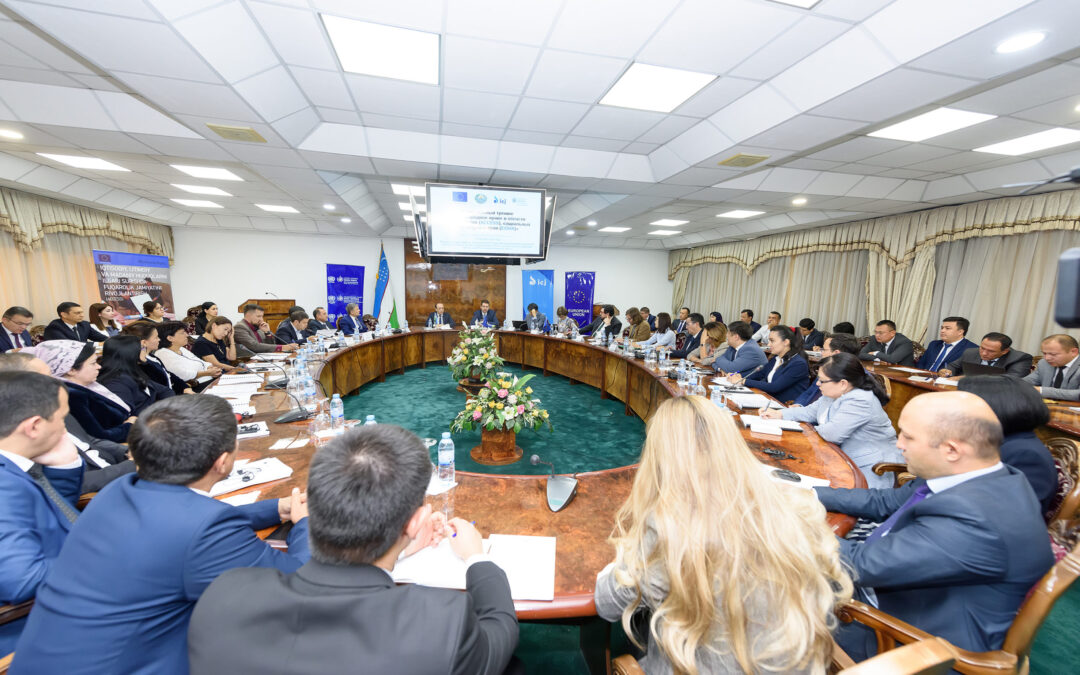
Сегодня Международная комиссия юристов (МКЮ), Региональное отделение Верховного комиссара ООН по правам человека (УВКПЧ) для Центральной Азии и Высшая школа судей Республики Узбекистан (ВШС) организуют национальный тренинг на тему «Международные стандарты в области экономических, социальных и культурных прав (ЭСК)». Этот двухдневный онлайн-тренинг является вторым из серии тренингов по ЭСК правам, включающие право на здравоохранение, образование, жилье, защиту прав детей и право на труд.
Целью данного онлайн-тренинга является укрепление потенциала судей, адвокатов, прокуроров, ученых-юристов и других представителей гражданского общества в области международных стандартов по ЭСК правам. Тренеры поделятся передовым опытом в области соблюдения государствами своих международных обязательств, в том числе посредством судебной практики, связанной с обеспечением доступа к правосудию в защите ЭСК прав. Онлайн-тренинги создают возможность конструктивного взаимодействия сотрудников судебных органов и других практикующих юристов, и представителей гражданского общества.
Каждый тренинг состоит из четырех модулей: (1) введение в международное право об ЭСК правах; (2) международные обязательства, касающиеся доступа к правосудию и средствам защиты ЭСК прав в национальных судах; сравнительные примеры положительной практики; (3) ЭСК права детей и (4) ЭСК права женщин. В тренинге примут участие офис Специального докладчика ООН по вопросам независимости судей и адвокатов и представители Комитета ООН по ликвидации дискриминации в отношении женщин и Комитета ООН по правам ребенка.
«Никто не мог представить себе, с какими проблемами мир столкнется всего через несколько месяцев после моего визита в Узбекистан. Мы являемся свидетелями и живем с этой беспрецедентной проблемой для отдельных людей, обществ и государств в ответ на кризис на глобальном и национальном уровне, чтобы защитить право на жизнь и здоровье, а также защитить людей от воздействия запретов и ограничений. В основе этих вызовов лежат экономические, социальные и культурные права», – сказал Диего Гарсиа-Саян, Специальный докладчик ООН по вопросам независимости судей и адвокатов, в своем видеообращении к участникам тренинга.
Франсуа Бежо, глава отдела сотрудничества Представительства Европейского Союза в Республике Узбекистан, отметил: «Пандемия коронавируса COVID-19 показала актуальность и важность экономических, социальных и культурных прав, которые должны быть обеспечены государствами, даже в чрезвычайных ситуациях. Принимая на себя международные обязательства, Узбекистан обязан уважать, защищать и соблюдать права человека, включая во время чрезвычайного положения, и обеспечивать доступ к правосудию и средствам правовой защиты».
Контакты:
Дилфуза Куролова, Консультант Международной комиссии юристов по правовым вопросам (МКЮ), dilfuza.kurolova@icj.org
Гульжахон Аманова, Координатор национальных программ Региональное отделение УВКПЧ ООН для ЦА, gamanova@ohchr.org
Уткир Халиков, Глава международного отдела Высшая школа судей при Высшем судейском совете Республики Узбекистан, inter.dep.ssj@mail.ru
Today, the ICJ, the Regional office of the UN High Commissioner for Human Rights (OHCHR) for Central Asia and the Supreme School of Judges of the Republic of Uzbekistan (SSJ) are beginning a national training on “International law on economic, social and cultural (ESC) rights.”
This two-day online-training is the second of a series of trainings on ESC rights, including, the right to health, education, housing, child protection and rights in the workplace.
The online-training aims to build the capacity of judges, lawyers, prosecutors, legal academics and other representatives of civil society to apply international law and standards on ESC rights. Trainers will share best practices on implementation by States of their international obligations, including through judicial practice, and in ensuring access to justice for ESC rights. The online-training will also allow for exchanges between members of the judiciary, other legal practitioners, and members of civil society.
The training will be based on four modules: (1) introduction to international law on ESC rights; (2) international obligations concerning access to justice and effective remedies for ESC rights in national courts and comparative examples of good practices; (3) children`s ESC rights and (4) women`s ESC rights. The office of the UN Special Rapporteur on independence of judges and lawyers and representatives of the UN Committee on the Elimination of Discrimination against Women will participate in the training.
“Nobody could imagine the challenges the world will face only in few months after my visit to Uzbekistan. We are witnessing and living this unprecedently challenge for individuals, societies and states to response to crisis at global and national level to protect right to life and health, and to protect individuals from impact of lockdowns and restrictions. Economic, social and cultural rights are the heart of these challenges,” said Diego Garcia-Sayan, the UN Special Rapporteur on independence of judges and lawyers in his video-address to the participants of the training.
Francois Begeot, Head of Cooperation of the Delegation of the European Union to the Republic of Uzbekistan pointed out, “COVID-19 pandemic showed the urgency and importance of economic, social and cultural rights that have to be ensured by the states, even in the emergency situations. Taking international obligations, Uzbekistan has to respect, protect and fulfil human rights including during the state of emergency and ensure access to justice and legal remedies.”
Ms. Dilfuza Kurolova, Legal Consultant, ICJ Europe and Central Asia Programme, e: dilfuza.kurolova@icj.org
Ms. Guljakhon Amanova, National Program Officer, Uzbekistan, Regional Office of the UN High Commissioner for Human Rights (OHCHR), e:gamanova@ohchr.org
Mr. Utkir Khalikov, Head of the international department The Supreme School of Judges under the Supreme Judicial council of the Republic of Uzbekistan for Central Asia, e: inter.dep.ssj@mail.ru
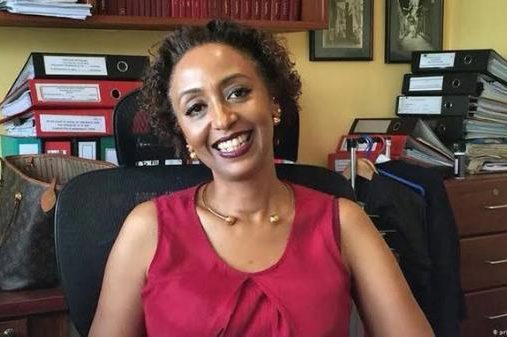
The ICJ today called for reinstatement of Tanzania lawyer Fatma Karume, characterizing a permanent prohibition from her practicing law as a violation of her rights and the independence of the legal profession.
In September 2019, the High Court of Tanzania issued an order suspending senior lawyer Fatma Karume from practising law in mainland Tanzania.
The High Court directed the Advocates’ Disciplinary Committee of Tanzania to conduct a disciplinary hearing and make a final determination on whether Fatma Karume, a former president of Tanganyika Law Society, which is the Bar association of mainland Tanzania, should be allowed to practice law.
Allegations of misconduct against Fatma Karume arose from her written submissions in a constitutional challenge to President Magufuli’s appointment of Professor Adelardus Kilangi as the Attorney General of Tanzania.
The State’s counsel complained that the language used by Fatma Karume in her submissions was unprofessional and disrespectful of the Attorney General, who was the subject of the constitutional challenge.
A year later, on 23 September 2020, the Advocates’ Disciplinary Committee found Fatma Karume guilty of the alleged misconduct and directed that she be permanently disbarred from practising law in Tanzania.
“The ICJ views the decision to permanently disbar Fatma Karume from legal practice, as a grave violation of Tanzania’s domestic, regional and international legal obligations relating to Fatma Karume’s right to be heard, her right to work and a violation of the independence of lawyers,” said ICJ Africa Director, Kaajal Ramjathan-Keogh.
“Fatma Karume’s right to be heard was violated in many ways. First, the complaint of misconduct was made in the State’s rejoinder submissions and Ms Karume was not afforded an opportunity to respond on record, before the High Court made the decision to temporarily suspend her from practice. Secondly, her right to a speedy hearing was violated because it took the Advocate’s Disciplinary Committee of Tanzania a year to make a final determination in her case,” she added.
The ICJ also considers that the substance of the charges of misconduct against Fatma Karume was inconsistent with international and regional standards, in so far as they were based on written submissions made in good faith as part of the due discharge of her professional functions.
The ICJ urges the authorities in Tanzania to rescind the decision to disbar Fatma Karume from legal practice and restore her right to work and in particular, her right to practice law.
In the meantime, ICJ welcomes the decision of the Tanganyika Law Society to support Fatma Karume to appeal against her disbarment.
Background
Articles 21 and 13 (6) (a) of the Constitution of Tanzania guarantee every person with the right to work and the right to a fair hearing respectively. In terms of regional law, Article 7(1) of the African Charter on Human and People’s Rights obliges governments to respect and protect the right of every individual to be presumed innocent until proven guilty by a competent court or tribunal; the right to present a defense; and, the right to be tried within a reasonable time by an impartial court or tribunal. Similar rights are recognised in Article 14 of the International Covenant on Civil and Political Rights (ICCPR). In addition, Principle 27 of the United Nations Basic Principles on the Role of Lawyers (UN Basic Principles) states that “Charges or complaints made against lawyers in their professional capacity shall be processed expeditiously and fairly under appropriate procedures. Lawyers shall have the right to a fair hearing, including the right to be assisted by a lawyer of their choice.”
Principle 20 of the UN Basic Principles provides that “Lawyers shall enjoy civil and penal immunity for relevant statements made in good faith in written or oral pleadings or in their professional appearances before a court, tribunal or other legal or administrative authority.” Similar provisions are included in Part I of the African Principles and Guidelines.
Contact
Kaajal Ramjathan-Keogh, Director of ICJ’s Africa Regional Programme, c: +27845148039, e: Kaajal kaajal.keogh@icj.org
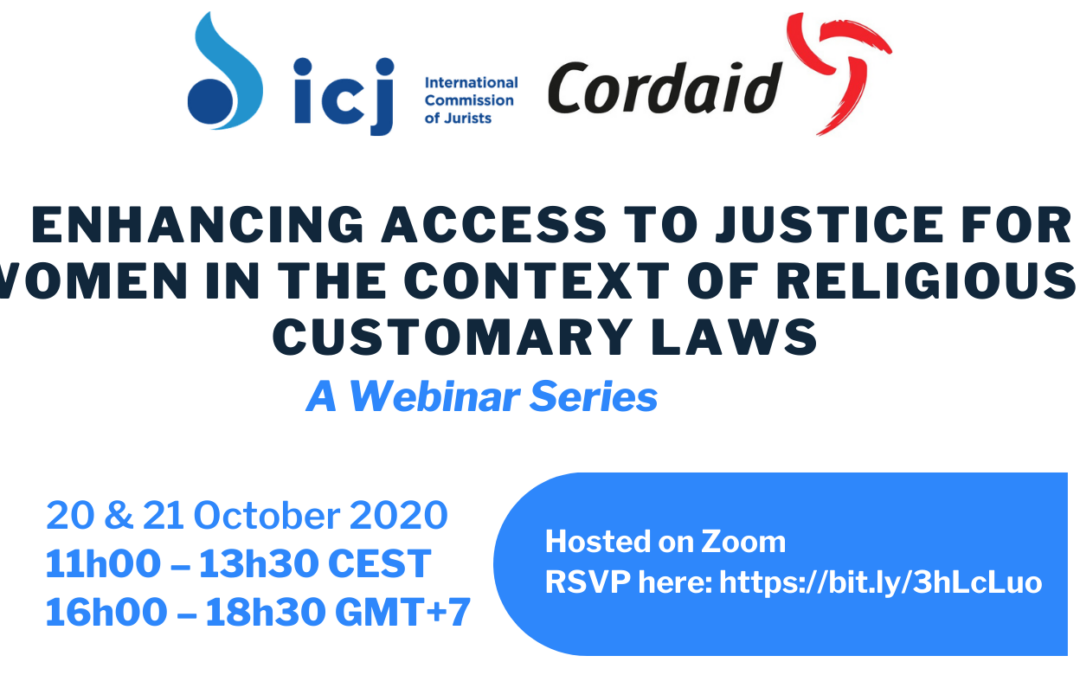
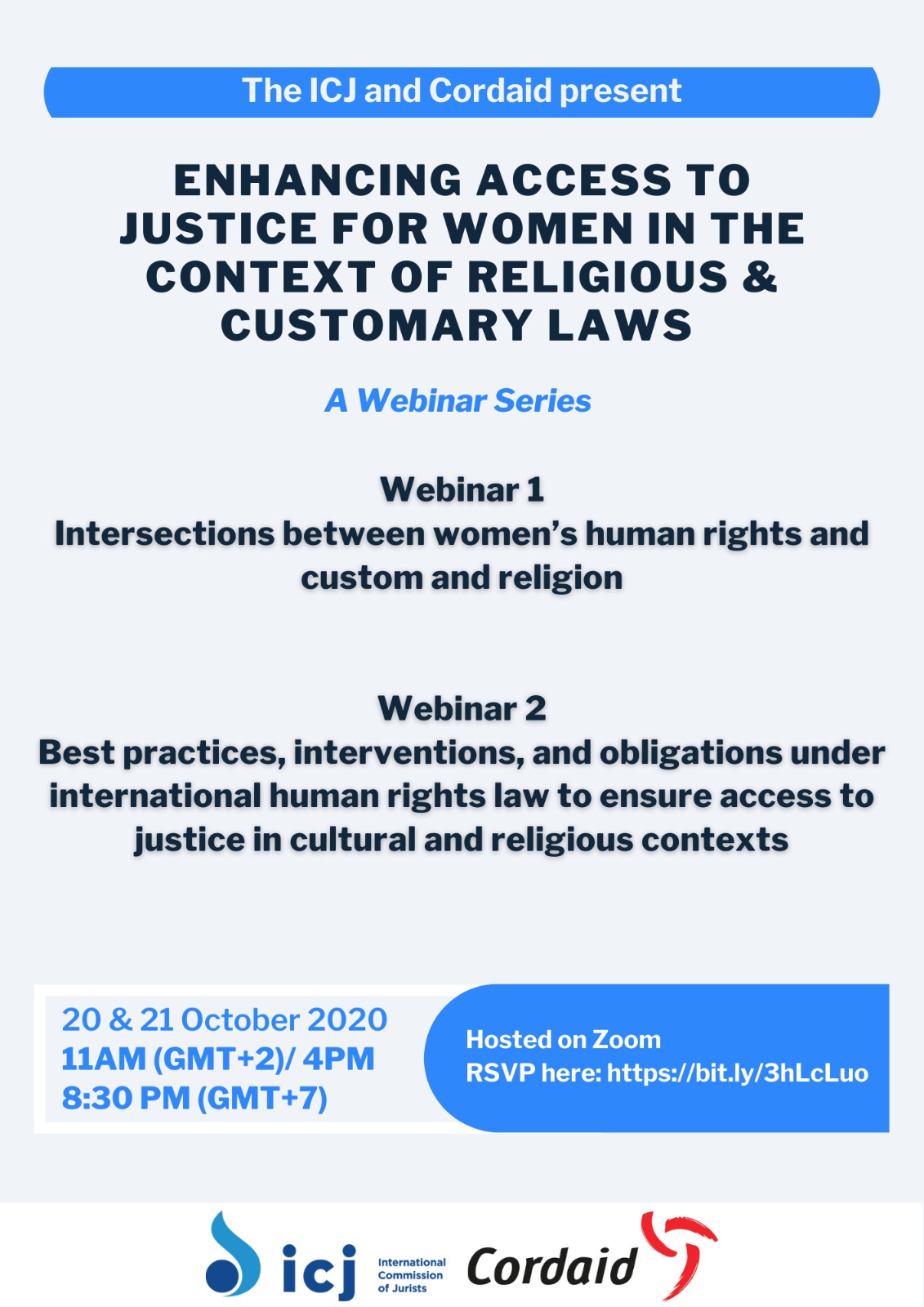
The ICJ and Cordaid are convening a webinar series to foster dialogue among women human rights defenders and religious and customary justice actors.
This public online event takes place 20 & 21 October 2020 11:00-13:30 (CEST) / 16h00 – 18h30 GMT+7
Women’s empowerment in every aspect of their lives is reliant upon ensuring that systems of law and justice work for women. Over the years, many countries have seen an expansion of women’s legal entitlements and enhancement of their right to access justice; however, in many contexts, there is also a growing trend of invoking religion and custom to violate women’s human rights. It is in these contexts where laws and policies exist that expressly discriminate against women, posing a continuing serious challenge to women’s ability to access justice.
In response, Cordaid and the ICJ will convene a webinar series to foster dialogue among women human rights defenders (WHRDs) and religious and customary justice actors.
The focus of the exchange will be on ensuring the protection of women’s human rights and access to justice in contexts where religious and customary laws are prevalent, within a framework of rule of law and international human rights standards. Diverse WHRDs and religious and customary justice actors from Asia, Africa, and the Middle East and North Africa will come together in two consecutive sessions:
Webinar 1 (Oct 20): Intersections between women’s human rights and custom and religion
Webinar 2 (Oct 21): Best practices, interventions, and obligations under international human rights law to ensure access to justice in cultural and religious contexts
Both sessions will be held on Zoom with simultaneous translation in Bahasa, Dari, English and French.
During the first webinar, the discussion will be focused on responding to the questions below:
How do custom and religion shape the ability of women to access justice?
Do pathways to justice based in custom and religion promote women’s human rights?
Do you perceive a clash between women’s human rights and pathways to justice based on custom and religion? If so, how?
Are there religious and cultural practices, which have an impact of exacerbating inequalities between men and women, and negatively affect women’s ability to defend their human rights?
How have women created space within customary and religious law to advocate for women’s human rights?
During the second webinar, the discussion will be focused on responding to the questions below:
What are the best practices and interventions, which can be adopted by States, international organisations and civil society to support positive impacts of custom and religion on women’s access to justice?
What practical measures can be adopted by States, international organisations and civil society to eliminate practices, which exacerbate women’s inequality and are barriers to pathways to justice?
What are the obligations of these actors when customary and religious law discriminate against women and prevents them from being able to defend their rights?
How have women successfully created space for advocacy within customary and religious contexts?
Documents:
Cordaid Publication: Diverse Pathways to Justice for All: Supporting Everyday Justice Providers to Achieve SDG16.3
ICJ Publication: Indigenous and other Traditional or Customary Justice Systems – Selected International Sources
IDLO report: Navigating Complex Pathways to Justice: Women and Customary and Informal Justice System
ICJ Publication: Access to Justice Challenges Faced by Victims and Survivors of Sexual and Gender-Based violence in Eswatini
Human Rights Council: Report of the Special Rapporteur on freedom of Religion or Belief
Report of the 2017 Geneva Forum on traditional and customary justice systems
Report of the 2018 Geneva Forum on indigenous and other traditional or customary justice systems in Asia
Report of the 2020 Geneva Forum on indigenous and other traditional or customary justice systems in Africa
2019 Report of the UN Special Rapporteur on the rights of indigenous peoples, on indigenous justice
Obstacles to Women’s and Girls’ Access to Justice for Gender-based Violence in Morocco (June 2019), in English and in Arabic
Gender-based Violence in Lebanon: Inadequate Framework, Ineffective Remedies (July 2019), in English and in Arabic
🍪 We use cookies on our website to improve your experience. By clicking "Accept all", you consent to the use of all the cookies. If you'd like to control which cookies we use, please visit "Cookie settings". To find out more, read our privacy policy and cookie policy.
Functional
Always active
The technical storage or access is strictly necessary for the legitimate purpose of enabling the use of a specific service explicitly requested by the subscriber or user, or for the sole purpose of carrying out the transmission of a communication over an electronic communications network.
Preferences
The technical storage or access is necessary for the legitimate purpose of storing preferences that are not requested by the subscriber or user.
Statistics
The technical storage or access that is used exclusively for statistical purposes.The technical storage or access that is used exclusively for anonymous statistical purposes. Without a subpoena, voluntary compliance on the part of your Internet Service Provider, or additional records from a third party, information stored or retrieved for this purpose alone cannot usually be used to identify you.
Marketing
The technical storage or access is required to create user profiles to send advertising, or to track the user on a website or across several websites for similar marketing purposes.