Sep 1, 2020 | News
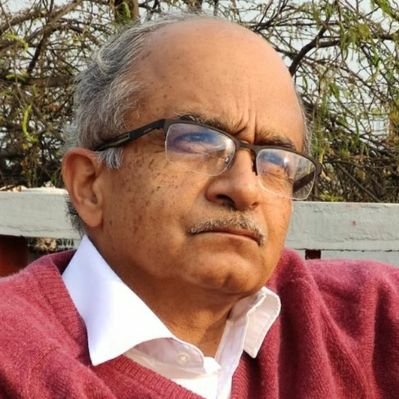
The ICJ today expressed its concern regarding the 31 August 2020 and 14 August 2020 decisions of the Indian Supreme Court to convict prominent human rights lawyer Prashant Bhushan for criminal contempt of court, on the basis of two twitter posts in which the lawyer criticized the performance of the Indian judiciary.
While the Court only imposed a symbolic fine of one rupee, rather than imprisonment, the ICJ considers that the conviction appears to be inconsistent with international standards on freedom of expression and the role of lawyers.
The ICJ stressed that the ruling risks having a chilling effect on the exercise of protected freedom of expression in India and urged a review of the laws and standards on criminal contempt as applied by the Indian courts.
The two tweets published by Prashant Bhushan referred to the Chief Justice of India riding an expensive motorbike belonging to a BJP leader “when he keeps the SC in Lockdown mode denying citizens their fundamental right to access justice” and asserted that the Supreme Court and the last four Chief Justices of India had contributed to how, in his view, “democracy has been destroyed in India even without a formal Emergency”
The Court in its 31 August judgment held that the tweets were a serious attempt to “denigrate the reputation of the institution of administration of justice” which, it said, is “capable of shaking the very edifice of the judicial administration and also shaking the faith of common man in the administration of justice.”
The Court considered that its ruling was consistent with freedom of speech and expression under Article 19 of the Indian Constitution, saying that it will have to balance its exercise of power to punish for contempt for itself (Article 129) with freedom of speech and expression.
The ICJ is concerned, however, that the conviction appears inconsistent with international law on freedom of expression as guaranteed by the International Covenant on Civil and Political Rights (Article 19, ICCPR) to which India is a party.
While some restrictions of freedom of expression are permitted by international standards, a particularly wide scope must be preserved for debate and discussion about such matters as the role of the judiciary, access to justice, and democracy, by members of the public, including through public commentary on the courts.
Any restrictions must be strictly necessary and proportionate to meet a legitimate purpose, such as protecting public order or the rights and reputations of others.
“There is a general concern that the protection of freedom of expression is rapidly eroding in India,” said Ian Seiderman, ICJ Legal and Policy Director.
“We have seen this recently around the COVID 19 crisis in relation to the imprisonment of human rights defenders, on draconian charges of sedition, rioting and unlawful assembly for protesting against the Citizenship (Amendment) Act.”
“While the Indian Supreme Court has over the years generally been an institution that has served to advance human rights in India and globally, we fear it now may be perceived as silencing criticism and freedom of expression by invoking outdated criminal contempt laws,” Seiderman added.
The ICJ joins the 1800 Indian lawyers in calling for the Supreme Court “to review the standards of criminal contempt”, emphasizing that the law is overbroad and should be aligned with international law and standards on the limited scope for restrictions on freedom of expression and criminal contempt.
“Prashant Bhushan is a lawyer and lawyers being part of the legal system have a ring-side view and understanding of the state of the court. Convicting a leading lawyer for contempt for expressing his views in this manner may have a chilling effect on lawyers, in particular considering his involvement in many public interest litigation cases,” said Mandira Sharma, ICJ South Asia Senior Legal Adviser.
Contact
Ian Seiderman – ICJ Legal and Policy Director; e: ian.seiderman(a)icj.org , t: +41 22 979 38 00
Matt Pollard – ICJ Senior Legal Adviser, Director, ICJ Centre for the Independence of Judges and Lawyers; e: matt.pollard(a)icj.org, t: +41 79 246 54 75
Download
India-Criminal-Contempt-of-Court-Press-Release-2020-ENG (PDF, with additional background information)
Aug 31, 2020 | Advocacy, News
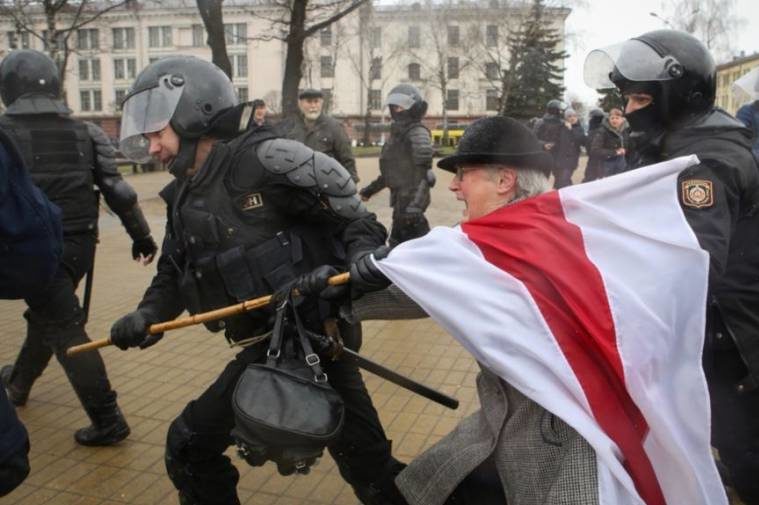
Today, the ICJ called on Belarus to comply with its international human rights law obligations in its response to the protests taking place in the aftermath of the presidential elections and in the treatment of those detained.
This includes immediately releasing persons arbitrarily detained, providing prompt access to lawyers for those still detained, accounting for the fate and whereabouts of missing protestors and promptly and effectively investigating torture and other ill-treatment.
The widespread arbitrary arrests of peaceful protesters, and credible allegations of torture and ill-treatment and enforced disappearances of detainees, are particularly alarming in light of obstacles faced by detainees in accessing lawyers, the ICJ said.
The ICJ recalls that under international human rights law, all persons have the right to peaceful assembly, and any restriction of this right must be provided in law be strictly necessary and proportionate to a specified legitimate purpose. The mass arrest of protesters does not appear to meet these requirements.
Belarus has obligations, including under treaties to which it is party, to respect the right to liberty and refrain from arbitrary arrests or other unwarranted interferences with the freedom of assembly, or freedom of expression, of protesters, protected under international law.
Law enforcement authorities must respect the right to life and the prohibition on torture or other ill-treatment at all times. Allegations of arbitrary killing, enforced disappearances and torture and other ill-treatment must be promptly, thoroughly and independently investigated, and those responsible brought to justice.
Effective remedies must be provided to victims of such serious human rights violations.
The ICJ is concerned about reports of the widespread denial of access to a lawyer and further obstacles that lawyers face while carrying out their professional duties in the current context in Belarus.
Reportedly, lawyers are not provided with access to the case file or further information necessary for the provision of effective legal assistance to their clients. This is of particular concern in light of multiple reports of torture or other ill-treatment of those detained following the election.
The ICJ stresses that the right of access to qualified legal representation is crucial for the protection of the human rights of those arrested in connection with the current political upheaval in Belarus.
The right of access to a lawyer is recognized as an essential element of the right to a fair trial and the right to liberty, protected under the International Covenant on Civil and Political Rights, to which Belarus is a party.
The UN Basic Principles on the Role of Lawyers provide that governments should ensure that lawyers are able to perform all of their professional functions without intimidation, hindrance, harassment or improper interference and should be able to consult with their clients freely and have access to appropriate information, files and documents in their possession or control in sufficient time to provide effective legal assistance to their clients.
It is essential that lawyers and other human rights defenders can carry out protection of human rights of their clients especially in times of emergency.
The ICJ also calls on the Belarus Republic Bar Association to bolster its efforts in protecting its members who provide legal representation in cases related to the ongoing protests.
Background:
The Republic of Belarus ratified the International Covenant on Civil and Political Rights in 1973
Following the presidential elections of 9 August 2020 in Belarus, widespread protests across Belarus took place following the discredited result, which were recognized as neither free nor by the European Union and other observers. Following the initial dispersal of these protests by the authorities, more than 6000 people were arrested and detained, many arbitrarily. There is credible evidence that many of those arrested or detained have been subjected to torture or other ill-treatment and that decisions regarding their arrest and detention have been made by courts temporarily established in detention centres.
While estimates of numbers differ, the whereabouts of at least tens of those who took part in the protest have not been established to date. One of the missing persons, Nikita Krivtsov, was recently found dead in a forest near Minsk.
The reports that defence lawyers were denied access to those arrested include high-profile cases, such as the case of the former presidential candidate Victor Babaryka whose lawyer was not allowed to see his client in the detention centre for more than a week.
According to the Belarusian Republican Bar Association, lawyers face problems with meeting their clients held in the detention centres and access to the case files and further information necessary to carry out their professional duties.
Aug 30, 2020 | News, Publications, Reports, Thematic reports
The ICJ marked the International Day of the Victims of Enforced Disappearances today by releasing a baseline study (in Spanish) which identifies key obstacles to accountability for serious human right violations in Colombia.
“The report finds that although Colombia has a comprehensive legal framework aimed at providing accountability for serious human rights violations, victims still face many challenges in obtaining access to justice,” said Kingsley Abbott, Coordinator of the ICJ’s Global Accountability Initiative.
“A robust domestic legal framework is important, but without effective Government implementation at every level full accountability for these violations will remain out of reach,” added Abbott.
Among other challenges, some victims still encounter difficulties in participating in criminal proceedings or obtaining information about investigations and prosecutions of those alleged to be responsible for violations.
The study recommends steps Colombia should take to improve the implementation of the domestic legal framework, including:
- raising the awareness of civil servants, including judicial employees, of victims’ rights and the appropriate legal mechanisms employed to search for “disappeared” persons;
- improving coordination between the State’s institutions, including the Search Unit for Persons Presumed Disappeared in the context and by Reason of the Armed conflict, the Special Jurisdiction for Peace, and the Office of the Attorney General; and
- ensuring that the investigation and prosecution of enforced disappearances and extrajudicial killings take place within the civilian rather than the military justice system.
The study also stresses the importance of Colombia recognizing the competence of the UN Committee on Enforced Disappearances (CED) to receive and consider individual communications. Considering the high levels of impunity, the recognition has been requested by Colombian civil society organizations and victims to improve the protection and guarantee of rights of victims of enforced disappearances.
The baseline study has been produced as part of the ICJ’s regional project addressing justice for extrajudicial killings and enforced disappearances in Colombia, Guatemala and Peru, sponsored by the European Union.
The baseline study is available in Spanish.
Background
The ICJ has long been monitoring laws, policies and practices concerning the investigation and prosecution of serious human rights violations and abuses in Colombia, including enforced disappearances and extrajudicial killings, as part of its efforts to promote accountability, justice and the rule of law around the world.
Enforced disappearances and extrajudicial killings are among the most prevalent human rights violations committed in Colombia, particularly in the context of the ongoing internal armed conflict. In Latin America, Colombia has one of the highest figures of people who have been subject to enforced disappearance or unlawfully killed.
The project is implemented under the ICJ’s Global Accountability Initiative which has also produced baseline studies for Eswatini, Nepal, Myanmar, Venezuela, Cambodia, Tajikistan and Tunisia.
Contacts
Kingsley Abbott, Coordinator of the Global Accountability Initiative, e: kingsley.abbott(a)icj.org
Carolina Villadiego, Legal and Policy Adviser, Latin America, and Regional Coordinator of the Project, e: carolina.villadiego(a)icj.org
Rocío Quintero M, Legal Adviser, Latin America, e: rocio.quintero(a)icj.org
Download
Colombia-GRA-Baseline-Study-Publications-Reports-Thematic-reports-2020-SPA (full report, in Spanish, PDF)
Aug 30, 2020
En conmemoración del día internacional de las víctimas de desapariciones forzadas, la CIJ presenta un estudio de línea base que examina los obstáculos que existen para la investigación y judicialización de los responsables de graves violaciones a los derechos humanos en Colombia.
“El reporte enfatiza que, si bien Colombia tiene un comprensivo marco jurídico para la rendición de cuentas por graves violaciones a los derechos humanos, las víctimas todavía enfrentan serios obstáculos para obtener justicia”, dijo Kingsley Abbott, Coordinador de la Iniciativa Global de Rendición de Cuentas de la CIJ.
Abbott también manifestó que “aunque un marco jurídico es importante, sin una efectiva implementación, no será posible que se garantice la rendición de cuentas de los responsables.
Entre otros obstáculos, se destaca el hecho que algunas víctimas han tenido problemas para participar en los procesos penales o obtener información sobre las investigaciones penales que se están adelantando.
El estudio ofrece recomendaciones para que se mejore la implementación del marco jurídico colombiano. Entre estas recomendaciones están:
- Realizar capacitaciones a los funcionarios públicos, incluidos los funcionarios judiciales, sobre los derechos de las víctimas y los mecanismos legales disponibles para la búsqueda de personas desaparecidas.
- Mejorar la coordinación entre las entidades del Estado que tienen funciones en materia de desaparición forzada.
- Evitar que la investigación y judicialización de los responsables de desapariciones forzadas y ejecuciones extrajudiciales se adelanten ante la justicia penal militar.
En esa misma línea, el estudio resalta la importancia que Colombia le otorgue competencia al Comité contra las Desapariciones Forzadas de las Naciones Unidas para recibir y considerar comunicaciones individuales. Dado los altos niveles de impunidad, el reconocimiento de competencia al Comité ha sido solicitado por organizaciones colombianas de la sociedad civil y víctimas, con el fin de mejorar la protección y garantía de los derechos de las víctimas de desaparición forzada.
Documento anexo a la Línea Base: Instituciones con funciones en materia de desaparición forzada en Colombia.
La elaboración del estudio fue posible gracias al apoyo del Instrumento Europeo para la Democracia y los Derechos Humanos (IEDDH) de la Unión Europea.
Antecedentes
La CIJ, en cumplimiento de su objetivo de promover la rendición de cuentas, la justicia y el estado de derecho en Colombia, ha estado monitoreando continuamente la investigación y el enjuiciamiento de violaciones y abusos graves a los derechos humanos, incluyendo los fenómenos de ejecuciones extrajudiciales y desapariciones forzadas.
Se trata de dos crímenes que se encuentran profundamente arraigados en la historia colombiana, en particular, a su conflicto armado. Adicionalmente, las dimensiones de las ejecuciones extrajudiciales y las desapariciones forzadas en Colombia son una de las más alarmantes del continente.
El estudio de línea base fue elaborado como parte del proyecto “Promoviendo justicia para ejecuciones extrajudiciales y desapariciones forzadas en Colombia, Guatemala y Perú”, que hace parte de la Iniciativa Global de la CIJ sobre Rendición de Cuentas (Global Accountability Initiative). Bajo esta iniciativa, la CIJ ha elaborado otros estudios de línea base en Eswatini, Nepal, Myanmar, Venezuela, Cambodia, Tajikistán y Túnez.
Contactos:
Kingsley Abbott, Coordinador de la iniciativa global de rendición de cuentas de la CIJ. Correo electrónico: kingsley.abbott(a)icj.org
Carolina Villadiego, Asesora Legal, América Latina y coordinadora regional del proyecto. Correo Electrónico: carolina.villadiego(a)icj.org
Rocío Quintero M, Asesora Legal, América Latina. Correo electrónico: rocio.quintero(a)icj.org
Colombia-GRA-Baseline-Study-Publications-Reports-Thematic-reports-2020-SPA
Aug 30, 2020 | Advocacy, News
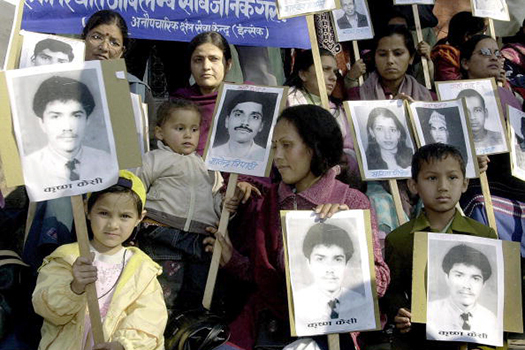
While commemorating the International Day of the Disappeared 2020, the ICJ and 47 other national and international organizations and groups of victims, in Nepal, call on the responsible authorities to undertake immediate steps towards reinvigoration of the transitional justice (TJ) process, adopting a transparent and consultative process.
On this occasion, the victims’ groups and human rights organizations in Nepal commend the patience and resilience shown by the family members of those subjected to enforced disappearance during the 10-year-long internal armed conflict from 1996-2006. They have worked tirelessly advanced the TJ process (Truth, Justice, Reparation and Institutional Reform) in Nepal for more than a decade through their peaceful struggle, despite many difficult hurdles.
In 2015 the Supreme Court found several sections of the Truth and Reconciliation Commission (TRC) Act, including the one empowering the commissions to offer amnesty and facilitate mediation/reconciliation between victims and perpetrators, including those involved in gross human rights violations, to be unconstitutional and non compliant with Nepal’s international obligations. More recently, on 26 April 2020 the Court rejected the petitions of the Government to review and revise the 2015 decision.
To date, the Government has not initiated any effort to amend the law as per these decisions. Rather, it has been misusing these Commissions in a manner that has prevented victims from accessing remedies through the regular criminal justice system and has made no efforts to strengthen these Commissions to delivery their mandates effectively. Two years back, Nepal recognized enforced disappearance as a distinct crime for the first time when enacting a new Penal Code. While this step is commendable, these legal provisions have not ensured justice for victims, the police typically refuse to investigate cases from the conflict period,arguing that they come under the jurisdiction of the TJ mechanisms.
Despite civil society’s repeated calls to appoint the Commissioners after amending the TRC Act following wider consultations with victims and civil society, the Government recently appointed Commissioners under the same Act that the SC had deemed flawed five years ago. Moreover, the Government has not addressed the repeated calls and concerns regarding the political interference and lack of transparency in the appointment of the Commissioners and the overall TJ process.
Human rights organizations and many victims groups have lost confidence in and stopped supporting to these Commissions.
The undersigned organizations call upon the Government of Nepal:
- To ensure the Commissions provide for, rather than delay and deny, truth and justice to
victims;
- Start fresh consultations to amend its law in compliance international human rights law
and Supreme Court directives, including by removing of amnesty for the perpetrators
provisions;
- Appoint a new set of commissioners under the revised Act that respects victims basic right
to truth and justice;
- Immediately ensure the social, cultural, economic, psychological and legal support
suffered by the victims and families of enforced disappearance as part of victims’ rights
to reparation;
- Revise the Penal Code to bring it in line with international standards. As a minimum, this
should include:
- amending the definition of enforced disappearances to bring it in line with Nepal’s international obligations and the Convention on the Protection of All Persons from Enforced Disappearance
- revising the penalty for enforced disappearance in the Penal Code to make it proportionate to the gravity of the crime
- removal of the statute of limitations for enforced disappearance cases
- Ratify International Convention for the Protection of All Persons from Enforced Disappearances Punishment.
Download
Full joint-statement with detailed information in English and Nepali. (PDF)
Contact
Ian Seiderman: ICJ Legal and Policy Director, e: ian.seiderman(a)icj.org
Mandira Sharma: ICJ Senior Legal Adviser, e: mandira.sharma(a)icj.org