
Nov 24, 2023 | Events, News
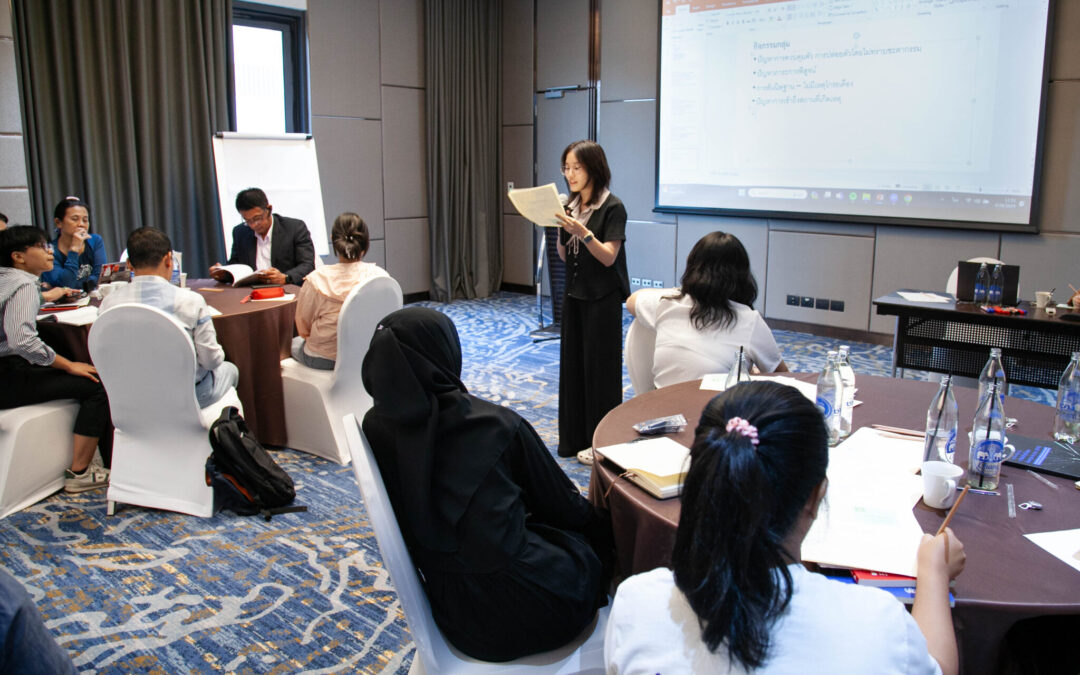
“The law governing the development of Thailand’s Eastern Economic Corridor (EEC) must be evaluated and revised to address concerns raised by local communities, and align with Thailand’s international human rights obligations,” concluded participants at a dialogue hosted by the International Commission of Jurists (ICJ), Land Watch Thai, EEC Watch, ENLAW Thai Foundation, and Thai Public Broadcasting Service (Thai PBS) in Bangkok, on 22 November 2023.
Participants shared recommendations aimed at improving the Eastern Special Development Zone Act B.E. 2561 (2018) (‘EEC Act’), which governs the operation of the EEC, to better serve the rights and interests of persons in affected communities. These suggestions will be compiled by the organizers and submitted as part of the official consultation process during the 2024 evaluation by the Office of the Eastern Special Development Zone Policy Committee (‘EEC Office’).
The EEC is a special economic zone in Thailand being developed in the eastern coastal provinces of Rayong, Chonburi, and Chachoengsao, along the Gulf of Thailand. Its objective is to promote investment in next-generation industries utilizing innovation and high technology.
“The EEC Act, however lofty are its stated aim, fails to incorporate adequate protection of human rights. While the EEC Act nominally acknowledges international human rights standards such as the United Nations Guiding Principles on Business and Human Rights’ protect, respect, and remedy framework, as well as the principle of promoting and protecting human rights in policy preparation, it fails to provide for adequate means to ensure implementation of these and other human rights standards,” said Sanhawan Srisod, ICJ’s Legal Adviser.
“According to Thai law, the evaluation must achieve goals that include aligning the law with Thailand’s international obligations under international law. Therefore, the EEC Office cannot complete the evaluation process without thoroughly addressing current gaps in compliance,” added Srisod.
The ICJ recommendations presented include the need to incorporate safeguards against forced eviction, in accordance with international human rights law, and to recognize the social, cultural, spiritual, economic, environmental, and political value of land for communities, with special emphasis on the significance for tenant farmers and small-scale food producers. Responsible land-based investments and implementing human rights due diligence are also critical elements.
A survey conducted before the dialogue with 44 affected individuals in Chonburi and Rayong provinces revealed a pattern of practices that fail to comply with Thailand’s international human rights obligations. They include:
- Lack of adequate participation of residents in the consultation process of the EEC Act.
- Absence of representation of locally affected individuals/communities in the Committee overseeing the EEC, primarily composed of governmental authorities and representatives from business sectors.
- The EEC Committee and Office hold overly broad powers without adequate checks and balances.
- The absence of effective grievance and compliance mechanisms within the EEC Office.
- Disregard for the impact of activities on local livelihoods during policy implementation.
- Ineffectiveness and inadequacy of remedies provided for individuals affected by EEC operations.
Participants suggested amending the EEC Act to address these concerns and ensure real participation, inclusiveness, adequate livelihood, a healthy environment, effective remedies, and other human rights of communities in the area.
Additionally, it addressed ongoing litigation initiated by communities challenging town planning within the EEC, specifically challenging the re-designation of agricultural, natural, and environmental reserved zones to industrial zones, which is currently pending before the Central Administrative Court.
Background
The participants comprised 30 affected individuals living in the areas of the EEC and civil society actors. This is the second dialogue following the initial one in June 2023, addressing the same topic.
According to the Act on Legislative Drafting and Evaluation of Law B.E. 2562 (2019), all Thai laws must undergo outcome evaluation at least every five years.
Speakers at the dialogue included:
- Chanchao Chaiyanukit, Former Permanent Secretary of the Ministry of Justice
- Pornpana Kuaycharoen, Land Watch Thai
- Sanhawan Srisod, ICJ
- Saowaruj Rattanakhamfu, Thailand Development Research Institute (TDRI)
- Somnuck Jongmeewasin, EEC Watch
- Sondhi Kodchawat, Environmental Researcher
- Sumitchai Hattasan, Center for Protection and Revival of Local Community Rights
- Supaporn Malailoy, ENLAWThai Foundation
- Sutthikiat Kodchaso, ENLAWThai Foundation
Contact
Sanhawan Srisod, ICJ Associate International Legal Adviser, e: sanhawan.srisod@icj.org
Further reading
Thailand: laws governing development of Eastern Economic Corridor and Special Economic Zones fail to adequately protect human rights – ICJ report
Nov 22, 2023 | Advocacy, Joint Statement
In light of credible allegations of ongoing violations of international humanitarian law arising from the protracted armed conflict in Israel and the Occupied Palestinian Territory, in particular in the Gaza Strip, the International Commission of Jurists (ICJ), Amnesty International (AI), and Human Rights Watch (HRW) support the call by a number of High Contracting Parties to the 1949 Geneva Conventions addressed to Switzerland, in its capacity as the depository of the four Geneva Conventions, to convene an urgent Conference of High Contracting Parties to the Geneva Convention Relative to the Protection of Civilian Persons in Time of War of 12 August 1949 (“the Fourth Geneva Convention”).
This call is based on Common Article 1 to the four Geneva Conventions, which states that “The High Contracting Parties undertake to respect and to ensure respect for the present Convention in all circumstances”. Underscoring the continued relevance of this body of law, the ICJ, AI, and HRW recall operative paragraph 1 of the UN Security Council Resolution 2712 on the situation in the Middle East, including the Palestinian question, of 15 November 2023 demanding “that all parties comply with their obligations under international law, including international humanitarian law, notably with regard to the protection of civilians, especially children.” In the same vein, our organisations recall operative paragraph 2 of the UN General Assembly, entitled Protection of civilians and upholding legal and humanitarian obligations, of 26 October 2023 demanding “that all parties immediately and fully comply with their obligations under international law, including international humanitarian law and international human rights law, particularly in regard to the protection of civilians and civilian objects, as well as the protection of humanitarian personnel, persons hors de combat, and humanitarian facilities and assets”.
The ICJ, AI, and HRW call on all High Contracting Parties to uphold the fundamental principle of international law that treaties must be executed in good faith, and fulfil their obligations under Common Article 1 “to ensure respect” for the Fourth Geneva Convention by participating in the Conference and acting collectively to prevent further violations of international humanitarian law in the Occupied Palestinian Territory and Israel.
The ICJ, AI, and HRW consider that in the circumstances currently prevailing in Israel and the Occupied Palestinian Territory, including, in particular, the Gaza Strip, ensuring respect for international humanitarian law requires, at a minimum, a suspension of arms transfers to the parties to the conflict; ensuring accountability for serious violations of international humanitarian law; supporting and cooperating with the Independent International Commission of Inquiry on the Occupied Palestinian Territory, including East Jerusalem, and Israel, and with the International Criminal Court’s ongoing Palestine investigation; and supporting other pathways to accountability including through the principle of universal jurisdiction.
Contact:
Said Benarbia, Director, ICJ Middle East and North Africa Programme, email: said.benarbia@icj.org
Katherine Iliopoulos, Legal Adviser, ICJ Middle East and North Africa Programme, email: katherine.iliopoulos@icj.org
Nov 17, 2023

Photo by Amir Shiri on Unsplash
LEGAL BRIEFER: States’ Duty to Prevent Genocide under the 1948 Genocide Convention
This legal briefer focuses on States’ duty to prevent genocide under international law. However, the International Commission of Jurists (ICJ) notes that there are credible allegations of other serious crimes under international law having been committed in the course of the ongoing hostilities in Israel and the Occupied Palestinian Territory, including the Gaza Strip.
Given the scale and severity of Israel’s ongoing attacks on Gaza, reports that Israel has now killed over 11,000 civilians, including over 4,000 children, in the Gaza Strip since 7 October 2023 and recent warnings, including by a group of independent United Nations human rights experts on 16 November that, “grave violations committed by Israel against Palestinians in the aftermath of 7 October, particularly in Gaza, point to a genocide in the making”, the ICJ urges States to fulfil their international legal obligations, including in particular under the Convention on the Prevention and Punishment of the Crime of Genocide of 1948 (hereafter the Genocide Convention), and take immediate action to prevent acts of genocide in Gaza.
Acts of Genocide
Article II of the Genocide Convention defines the crime of genocide outlining its two main elements:
(1) specific underlying acts, namely, the material elements of the crime; and
(2) specific intent, namely, the mental state required of the person committing the material elements of the crime.
The Genocide Convention and the Rome Statute of the International Criminal Court (ICC) outline the following five specific underlying acts, any one of which may be constitutive of the crime of genocide:
- Killing members of a national, ethnical, racial or religious group;
- Causing serious bodily or mental harm to members of the group;
- Deliberately inflicting on the group conditions of life calculated to bring about its physical destruction in whole or in part;
- Imposing measures intended to prevent births within the group; and
- Forcibly transferring children of the group to another group.
The ICC Elements of Crimes define the term “conditions of life” as including but not limited to “deliberate deprivation of resources indispensable for survival, such as food or medical services, or systematic expulsion from homes.”
The ICJ considers that the complete blockade of Gaza – coupled with depriving civilians of water, food, medicine, electricity and fuel – may constitute the specific underlying act of “deliberately inflicting on the group conditions of life calculated to bring about its physical destruction”, as per the genocide definition set out above.
Some of the underlying acts of the crime of genocide may also simultaneously constitute the material elements of certain war crimes or crimes against humanity.
Specific Intent
The distinguishing feature of genocide is that the perpetrator commits the specific underlying acts of the offence with the specific intent to destroy, in whole or in part, a national, ethnical, racial or religious group, as such.
The Palestinian people constitute a national group for the purposes of the Genocide Convention. The Palestinians of the Gaza Strip constitute a substantial proportion of the Palestinian nation.
The ICJ is concerned that certain statements by senior officials and politicians in Israel disclose evidence of what may be characterised as intent to destroy Palestinians of the Gaza Strip.
For example, on 9 October, the Israeli Defence Minister Yoav Gallant said, “I have ordered a complete siege on the Gaza Strip. There will be no electricity, no food, no fuel, everything is closed. We are fighting human animals and we act accordingly.” On 10 October, the head of the Israeli Army’s Coordinator of Government Activities in the Territories (COGAT), Maj. Gen. Ghassan Alian, addressed a message directly to Gaza residents: “Human animals must be treated as such. There will be no electricity and no water, there will only be destruction. You wanted hell, you will get hell”. On 13 October, the Israeli Defence Minister said: “Gaza won’t return to what it was before. We will eliminate everything.”
The ICJ is concerned that such statements by officials responsible for Israel’s ongoing military offensive in Gaza, with their expressed emphasis on siege on the Gaza Strip, on depriving the population of essential needs, on the total destruction and elimination of everything and everyone in the Gaza Strip and on evacuation – taken together with well-documented patterns of reported crimes under international law in Gaza, such as indiscriminate bombardment of densely populated areas, including airstrikes resulting in extensive civilian casualties, attacks on medical units, transports and personnel, refugee camps, evacuation routes, humanitarian corridors and other vital civilian infrastructure, collective punishment and the forced transfer of over one million Palestinians from northern Gaza to the south – disclose evidence sufficient to trigger the duty of each State to take reasonable action to seek to prevent acts of genocide in Gaza.
The Duty to Prevent
Notwithstanding individual criminal liability for acts of genocides outlined above, under international law, States have a duty to prevent acts of genocide.
It is not necessary for a definitive determination that genocide is taking place. As the International Court of Justice (“the Court”) held in Bosnia v Serbia, a “State’s obligation to prevent, and the corresponding duty to act, arise at the instant that the State learns of, or should normally have learned of, the existence of a serious risk that genocide will be committed.” The ICJ considers, based on the above, that such threshold has been reached in Gaza, triggering States’ duty under international law to take measures to prevent acts of genocide.
The totality of destruction by Israeli forces against Palestinians in Gaza, as documented in numerous open sources, should guide an assessment by the international community and individual States as to whether genocide is underway or whether there exists a serious risk of genocide, triggering the corresponding duty to prevent it. States’ legal obligation to prevent genocide is not a passive obligation, but rather, according to the Court in Bosnia v Serbia, “implies that each State party must assess whether a genocide or a serious risk of genocide exists”.
When the Court issued its order for provisional measures in The Gambia v. Myanmar in January 2020, it held that there was no requirement of demonstrating violations of obligations under the Genocide Convention, but rather that “the acts complained of … are capable of falling within the provisions of the Genocide Convention”.
The Genocide Convention imposes a minimum legal obligation on States to each take reasonable action to contribute toward preventing genocide, a duty that extends extraterritorially and applies regardless of whether any one State’s actions alone are sufficient to prevent genocide. The Court in Bosnia v. Serbia held that States with strong political links to the State concerned have a greater duty to use their influence in this regard, as the duty to prevent varies from State to State depending on its:
“capacity to influence effectively the action of persons likely to commit, or already committing, genocide. This capacity itself depends, among other things, on the geographical distance of the State concerned from the scene of the events, and on the strength of the political links, as well as links of all other kinds, between the authorities of that State and the main actors in the events”.
The Court also held that, “if the State has available to it means likely to have a deterrent effect on those suspected of preparing genocide, or reasonably suspected of harbouring specific intent, it is under a duty to make such use of these means as the circumstances permit”. Third State responsibility may be incurred if a State manifestly fails to take all measures that are within its power to prevent acts of genocide, and that might contribute to preventing such acts.
Recommendations
In light of the above, the ICJ calls upon States who have a position of influence with the Government of Israel – particularly the United States – to take all reasonable measures within their power to prevent genocide in Gaza, including by calling for a ceasefire, taking steps to ensure the lifting of the siege and preventing the displacement of Palestinians outside the Gaza Strip, and to discontinue any military assistance, including arms sales, that would enable or facilitate genocide, and other crimes under International law.
The ICJ urges other States to immediately act under article VIII of the Genocide Convention, by calling on the competent organs of the United Nations, including the UN Security Council, and particularly the UN General Assembly, to take urgent action under the UN Charter appropriate for the prevention and suppression of any acts of genocide in Gaza, including calling for an immediate ceasefire.
The ICJ also calls on UN Independent International Commission of Inquiry on the Occupied Palestinian Territory, including East Jerusalem, and Israel, and the Office of the Prosecutor of the ICC, to rapidly expand their investigations in relation to the situation in Palestine to include genocide.
Contact:
Said Benarbia, Director, ICJ Middle East and North Africa Programme, email: said.benarbia@icj.org
Katherine Iliopoulos, Legal Adviser, ICJ Middle East and North Africa Programme, email: katherine.iliopoulos@icj.org
Nov 16, 2023 | Advocacy, News
The International Commission of Jurists (ICJ) strongly condemns the Government of Pakistan’s decision to expel over 1.4 million Afghan nationals, including unregistered refugees, forcibly removing them to a country where many, especially women and girls, have a well-founded fear of persecution. The organization is deeply concerned for the safety and well-being of people who have been left with no choice but to flee under threats of arrest or deportation, as cases of arbitrary arrests and detention, and instances of ill-treatment, are reported.
“The forcible removal of Afghans is particularly egregious considering the ongoing humanitarian crises in Afghanistan and the current political climate following the Taliban takeover. Returning anyone there, especially women and girls, is fraught with risks. The expulsion of refugees and asylum seekers violates the principle of non-refoulement under international law, which prohibits the forcible removal of anyone to a country or place where they would have a well-founded fear of persecution, such as a real risk of being tortured or otherwise ill-treated or other serious human rights violations”, said Melissa Upreti, ICJ Asia Director.
Estimates indicate that there are over 1.4 million undocumented Afghans in Pakistan, in addition to some 1.3 million registered Afghan refugees. On 3 October 2023, the Government of Pakistan announced its plans to repatriate “illegal foreigners.” This was followed by a circular stating that Afghan Citizen Cardholders and those with Proof of Registration would be exempted. The deadline for Afghan nationals to leave Pakistan was 1 November, and has recently been extended to 31 December 2023, following significant international pressure. However, there have been reports of these exemptions not being applied and Afghans facing increasing harassment and pressure from local authorities.
UN agencies have called attention to the possibility of a serious escalation in human rights violations resulting from the separation of families and deportation of minors as the Pakistani authorities implement their plans. Since August 2021, the UN High Commissioner for Refugees has urged States not to return Afghan nationals to Afghanistan given that the country continues to be affected by recurrent conflict, instability and climate-induced disasters.
The ICJ and its partners have documented detailed evidence of gender-based persecution of women and girls in Afghanistan, as a direct result of the mounting draconian restrictions on their human rights and freedoms since the Taliban takeover in August 2021, in a joint report released earlier this year with Amnesty International. In light of the gravity and systematic nature of the restrictions and prohibitions that women and girls face in Afghanistan, the two human rights organizations recommended that all Afghan women and girls outside Afghanistan should be considered prima facie refugees and granted international protection.
“There is no evidence of a change in the de facto authority’s mode of governance, which centres on the oppression of women and girls and severe deprivation of their fundamental rights. If anything, there is evidence that the situation for women and girls in Afghanistan has become worse. Expelling Afghan nationals from Pakistan, especially women and girls, along with their families and forcing them back to Afghanistan puts them at a real risk of persecution or other forms of serious harm for which no legal recourse is available in Afghanistan,” added Upreti.
Citing concerns about a breach of international law obligations by Pakistan, a number of UN Special Rapporteurs have said in a joint letter that, “the lack of domestic asylum laws and procedures does not absolve States of their obligations to uphold the principles of non-refoulement under international human rights and customary law.”
Pakistan’s National Commission for Human Rights (NCHR) has urged the Government to refrain from conducting the deportations and called for adherence to relevant provisions in national and international law pertaining to refugees.
Thousands of Afghans have already crossed the border and with the recent postponement of the deadline to leave the county, the fate of over a million Afghans hangs in the balance. The ICJ calls on the Government of Pakistan to immediately:
- Rescind the expulsion order, cease further deportations and harassment of Afghans and comply instead with its international law obligations,
- Create pathways for women, girls and their families who have been forced to leave under the order to safely return.
- Consult with civil society, members of the Afghan community living in Pakistan, the NCHR, and relevant international organizations in the development of appropriate policies.
Contact:
Raquel Saavedra, ICJ Legal Adviser, e: raquel.saavedra@icj.org