Thailand: Exchange of best practices from Latin America on litigating enforced disappearance cases

Thailand: Exchange of best practices from Latin America on litigating enforced disappearance cases

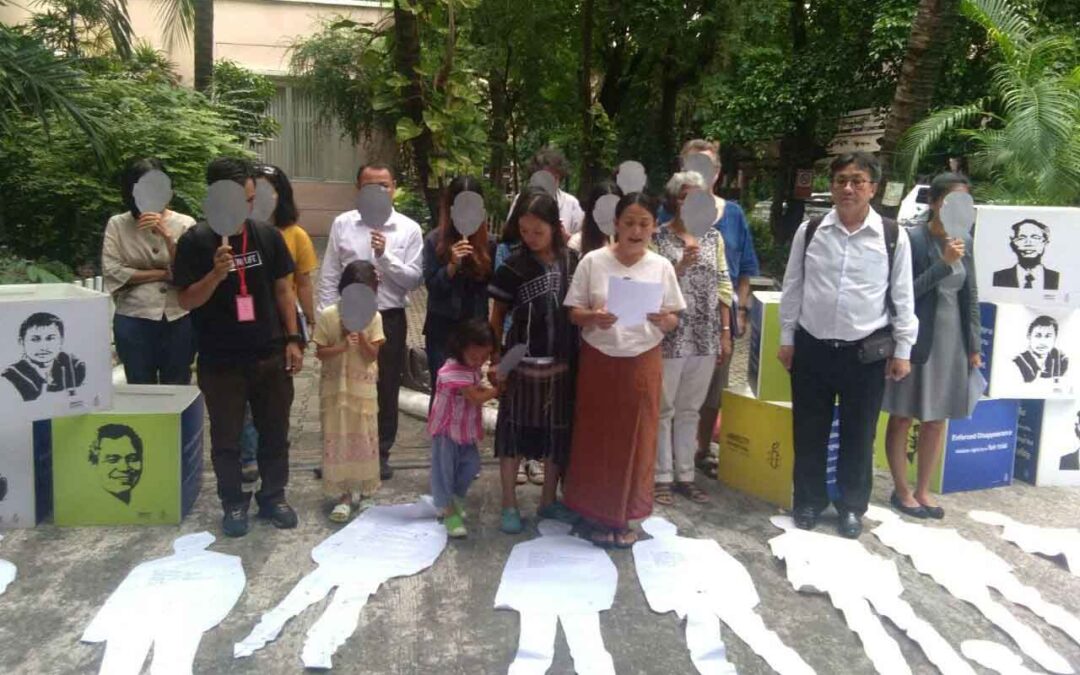
On 29 November 2023, the ICJ co-hosted a dialogue among Thai lawyers, academics, and Santiago A. Canton, Secretary General of the ICJ to exchange best practices from Latin America, specifically focusing on insights from the Inter-American Court of Human Rights and domestic courts in the region – to address ongoing challenges in litigating cases involving suspected enforced disappearances within Thai courts.

The Dialogue involved challenges encountered in litigating cases of enforced disappearances, particularly in terms of accessing, collecting, and admitting evidence within Thai courts. These challenges are notably complex, especially when the crimes have occurred beyond Thailand’s borders.

Additionally, participants discussed the difficulties related to establishing the responsibility of individuals for these serious crimes and how courts have handled evidence submitted in previous enforced disappearance cases. This included instances where evidence, such as telecommunications, as well as various forensic evidence like biological evidence and DNA evidence, was dismissed, and the failure to identify the perpetrator in cases where the victims’ bodies or remains could not be located.

“The crime of enforced disappearance completely eradicates any trace of the victim, with no acknowledgment by the authorities and no effective investigation. The requirement to locate the disappeared individuals’ bodies and remains contradicts the very nature of the crime of enforced disappearance,” said Santiago A. Canton, Secretary General of the ICJ.

While highlighting that the criteria for evaluating evidence within the Inter-American Court of Human Rights (IACtHR) are less formal compared to domestic criminal legal systems, Canton noted IACtHR’s jurisprudence relevant to the admissibility of circumstantial and indicative evidence, which was particularly instructive as enforced disappearances typically involve deliberate attempts by state officials to destroy direct evidence, aimed at securing impunity.

“The standard of proof in the Inter-American Court of Human Rights allows lawyers, under certain circumstances, to only establish a demonstrable ‘practice’ of enforced disappearances at the time of a specific case. When combined with circumstantial evidence, this can result in a judicial presumption of enforced disappearance,” said Canton.

Participants also discussed the ‘continuous nature’ of enforced disappearance crimes, which are recognized under Thai law and enable cases from the past, where the fate and whereabouts of victims remained unknown, to be prosecutable before the court, notwithstanding the fundamental principle of non-retroactivity.

Closing remarks by Angkhana Neelapaijit, a Member of the UN Working Group on Enforced or Involuntary Disappearances, whose husband Somchai Neelapaijit was a victim of enforced disappearance, detailed the role of the Working Group and the steps taken globally to address the crime.

Background

More than 20 Thai experts, lawyers, and academics, who represent or have experience researching cases of enforced disappearances in Thailand, participated in the discussion.

Thailand’s Act on Prevention and Suppression of Torture and Enforced Disappearance became effective in February 2023. However, its implementation has been slow. The majority of cases involving suspected torture, ill-treatment, and enforced disappearances are still in the investigation phase, and not yet moved into the adjudication phase. Limited information about its progress has been made available to the public.

Prior to the enactment of this new law, only two cases of apparent enforced disappearances reached Thai courts: the case of prominent Muslim lawyer Somchai Neelapaijit and Karen activist Pholachi ‘Billy’ Rakchongcharoen. Unfortunately, these cases concluded with limited success, mainly due to challenges surrounding the evidence submitted to the court.

Contact

Sanhawan Srisod, ICJ Associate International Legal Adviser, e: sanhawan.srisod@icj.org

Further reading

Thailand: a report on the criminal trial and investigation of the enforced disappearance of the Thai human rights lawyer, Somchai Neelapaichit

Ten Years Without Truth: Somchai Neelapaijit and Enforced Disappearances in Thailand

Indonesia: ICJ asks court to ensure that defamation and “false information” laws not be used to silence and criminalize human rights defenders

Indonesia: ICJ asks court to ensure that defamation and “false information” laws not be used to silence and criminalize human rights defenders

The International Commission of Jurists (ICJ), in an amicus curiae brief submitted today, has requested the East Jakarta District Court to give effect to Indonesia’s international legal obligations concerning freedom of expression and information in their adjudication of a case concerning criminal charges against two human rights defenders, Haris Azhar and Fatia Maulidiyanti.

Germany: Verdict in Gambia Atrocity Case

Germany: Verdict in Gambia Atrocity Case

FOR IMMEDIATE RELEASE

Berlin, November 28, 2023 – A German court in the city of Celle is expected to deliver a verdict on November 30, 2023, in the first trial in Germany for crimes committed in The Gambia, Gambian and international civil society groups said today in releasing a question and answer document about the trial.

The groups are: the African Network against Extrajudicial Killings and Enforced Disappearances (ANEKED), the European Center for Constitutional and Human Rights (ECCHR), the Gambian Center for Victims of Human Rights Violations, Human Rights Watch, the International Commission of Jurists, Reporters Without Borders (RSF), the Rose Lokissim Association, the Solo Sandeng Foundation, and TRIAL International.

This trial is possible because Germany recognizes universal jurisdiction over certain serious crimes under international law, allowing for the investigation and prosecution of these crimes no matter where they were committed and regardless of the nationality of the suspects or victims.

The trial concerns Bai L., an alleged member of the “Junglers,” a paramilitary unit also known as the “Patrol Team,” which was set up by then-president Yahya Jammeh in the mid-1990s. Jammeh’s 22-year rule was marked by systematic oppression and widespread human rights violations, including torture, extrajudicial killings, enforced disappearances, and sexual violence against actual and perceived opponents.

German prosecutors accuse Bai L. of being a Junglers driver involved in the attempted murder of Ousman Sillah, a lawyer; the murder of Deyda Hydara, a journalist; the attempted murder of Ida Jagne and Nian Sarang Jobe, who worked with the independent newspaper Hydara; and the murder of a former Gambian soldier, Dawda Nyassi

The verdict in the Bai L. case represents a major step in the search for justice for years of abuses committed under Jammeh’s rule in The Gambia, the groups said. The Bai L. trial reinforces the role that governments like Germany can play in advancing justice for atrocities committed abroad under the principle of universal jurisdiction.

Civil society groups will hold a news conference online on Thursday, November 30 after the verdict is issued – scheduled for 3:30 pm CET – at the following link: https://us06web.zoom.us/j/81236784593?pwd=tvLgbtT3I8N9rF2Db2XTIRyH3Kn1gv.1

To read the question-and-answer document, please see the attached PDF:

Questions and Answers on first German trial for serious crimes

For more information, please contact:
For Reporters Without Borders, in Dakar, Sadibou Marong (English, French): +221-70-960-40-92 (mobile); or smarong@rsf.org. Twitter: @cheikhsadbu
For TRIAL International, in Geneva, Babaka Mputu (English, French, German): +41-775-07-04-56 (mobile); or media@trialinternational.org. Twitter: @Trial
For Human Rights Watch, in New York, Elise Keppler (English, French): +1-917-687-8576 (mobile); or kepplee@hrw.org. Twitter: @EliseKeppler
For Solo Sandeng Foundation, in Germany, Fatoumatta Sandeng (English, German, Mandinka, Wollof): +49-163-174-7519 (mobile); or solosandengfoundation@gmail.com. Twitter: @solosandengfound
For ANEKED, in New York, Nana-Jo Ndow (English, French, Spanish, Portuguese): +1-929-684-5734 (mobile); or nanajo.ndow@aneked.org. @theANEKED
For Reporters Without Borders, in Berlin, Nicola Bier (German, English, French, Spanish, Italian): +49-160-9957-6073 (mobile); or nicola.bier@reporter-ohne-grenzen.de. Twitter: @ReporterOG
Lawyer for Baba Hydara and Omar and Modou Nyassi, in Celle, Patrick Kroker (German, English, French): +49-170-813-6258 (mobile); or info@patrickkroker.net. Twitter: @pkroker2
For International Commission of Jurists, in New York, Reed Brody (English, Spanish, French, Portuguese): +1-917-388-6745 (mobile); or reedbrody@gmail.com. Twitter: @reedbrody

EU: Protecting Judicial Independence: Lawyers’ strategic litigation workshop

EU: Protecting Judicial Independence: Lawyers’ strategic litigation workshop

The International Commission of Jurists (ICJ), in collaboration with aditus, Human Rights in Practice, Forum for Human Rights, Free Courts organized a workshop for lawyers on judicial independence and strategic litigation in Malta on 23 and 24 November 2023. The event focused on critical issues of judicial independence, including, appointment procedures, administration of justice, and freedom of expression and association of judges.

Judicial independence is essential for democracy and human rights protection, yet it is frequently under attack or pressure. Judicial independence is possible only with independent organisation and governance, and when judges’ human rights are guaranteed. This includes strict selection criteria and transparency in the appointment of judges and prosecutors, and it implies respect of freedom of expression and association of judges.

The participants discussed the challenges in guaranteeing both institutional and individual independence of judges, and in ensuring fairness and transparency in the appointment procedures. The workshop also focused on the possible limitations of the freedom of expression and association of judges. It was noted that judges  often fear repercussions for expressing their opinions and participating in associations or protests.

The workshop brought together experts and practitioners from six EU Member States – the Czech Republic, Hungary, Malta, Poland, Romania and Slovakia – to discuss their experiences. The participants discussed the international legal framework and the possible ways to protect judicial independence focusing on the role of strategic litigation.

The event was the second of a series of workshops, each considering different aspects of judicial independence. These workshops aim to contribute to the development of the Final Mapping Report with recommendations on strategic litigation for practitioners in the EU, as part of the ROLL (Rule of Law for Lawyers) project.

Please see the workshop agenda here.

Please find recordings of some of the workshop presentations here.

Translate »