Feb 10, 2020 | Advocacy, News
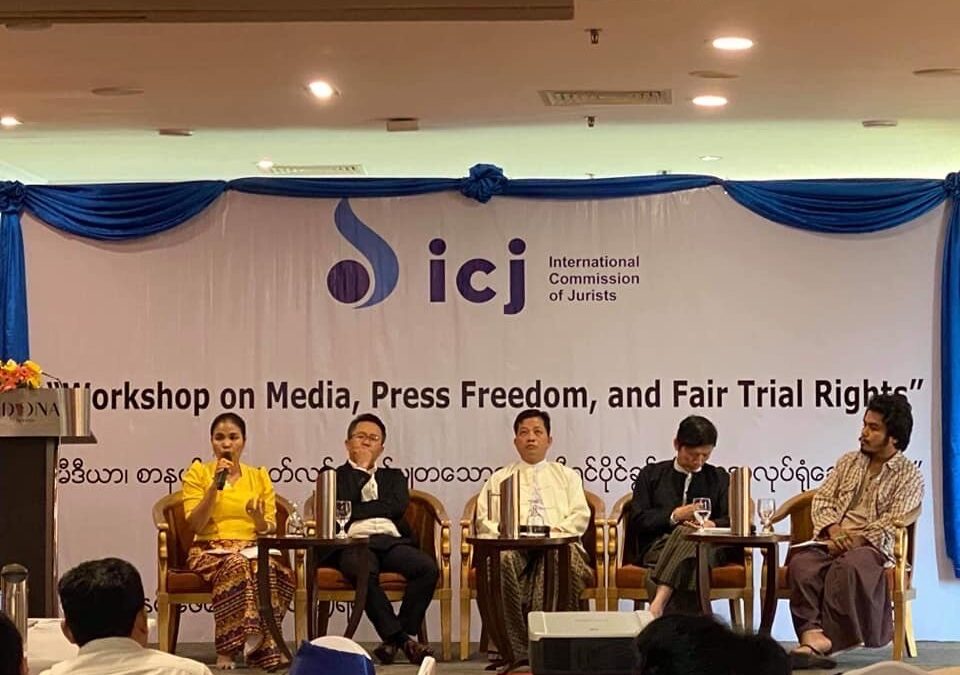
The ICJ conducted a workshop for journalists on fair trial rights and due process on 9 February 2020 in Yangon to help them respond to situations of arrest and prosecution
Some 25 journalists across Myanmar participated in the event, including media representatives from ethnic communities in Shan and Kachin states. Members of nationwide journalism networks, the Myanmar Media Lawyers Network, and the Myanmar Press Council also participated.
The workshop apprised journalists of the guarantees and rights of persons arrested and prosecuted under international human rights law, and the limited protections available under Myanmar law in comparison. It provided a space for participants to collectively identify gaps in journalistic protection. It also intended to foster greater collaboration between journalists and lawyers in safeguarding a free press in Myanmar.
The workshop opened with remarks from Linda van der Horst, head of the political section of the Embassy of the Kingdom of the Netherlands in Myanmar, and Ross Clarke, Team Leader at the ICJ. Both stressed the role of the media in ensuring a robust democracy that adheres to the rule of law, especially in light of the upcoming 2020 national elections. Linda Van der Horst noted that the workshop could also help journalists more deeply understand legal concepts useful for their reporting.
ICJ Associate Legal Adviser Jenny Domino addressed the rights of arrested persons and fair trial guarantees in criminal proceedings under international law. She highlighted the unlawfulness of arresting a journalist as punishment for his work in ensuring that individuals receive information in a free and democratic society. In a comparative context, she discussed the various writs available under Philippine law to protect journalists from unlawful arrests, extralegal killings and enforced disappearances.
ICJ Legal Adviser Hnin Win Aung then discussed Myanmar criminal procedure and the pre-trial rights of criminal defendants. She introduced the writ of habeas corpus remedy under the 2014 Law on the Application for Writs for contesting arbitrary detention. She explained the limitations of this remedy and the practical challenges of litigating in the Myanmar courts.
The presentations were followed by a panel discussion on fair trial rights challenges in Myanmar. The panel was composed of U Myint Kyaw of the Myanmar Press Council, U Brang Mai of Myitkyina Journal, U Myo Aung of Dawei Watch and U Than Zaw Aung of Myanmar Media Lawyers’ Network. The speakers agreed that there is no equality before the law and pushed for greater advocacy on judicial independence and impartiality.
To conclude the workshop, the participants shared their thoughts on how lawyers and the ICJ could help local media moving forward. The participants suggested a human rights analysis of how fair trial rights are undermined in practice by various actors in Myanmar’s criminal justice system. They also expressed their interest to work more closely with lawyers towards better reporting of current events.
The workshop marks the ICJ’s effort to support journalists and empower persons from minority groups towards greater participation in Myanmar’s democratic transition.
Contact
Jenny Domino, ICJ Associate Legal Adviser, e: jenny.domino(a)icj.org
Hnin Win Aung, ICJ Legal Adviser, e: hninwin.aung(a)icj.org
Related material
Strategic Litigation Handbook for Myanmar
Briefing Paper, Citizenship Law and Human Rights in Myanmar
Event, ICJ hosts workshop with civil society on freedom of religion or belief
Feb 6, 2020 | Advocacy, News, Non-legal submissions
The ICJ has made a submission to the UN Human Rights Committee in advance of its forthcoming examination of Tunisia’s sixth periodic report under the International Covenant on Civil and Political Rights (ICCPR).
In its submission, the ICJ highlights a number of ongoing concerns with respect to the country’s implementation of and compliance with the provisions of the ICCPR, including in relation to:
- Tunisian authorities’ implementation of the transitional justice law, particularly on issues pertaining to criminal accountability for gross human rights violations;
- Judicial independence and accountability, particularly on issues pertaining to the development of a Judicial Code of Ethics, and
- Tunisia’s failure to establish a Constitutional Court.
The submission is relevant for the Committee’s evaluation of Tunisia’s implementation of the State’s obligations and related Covenant rights under articles 2, 3, 6, 7, 9, 14, 15, 16, 18, 19, 21, 22 and 26 of the ICCPR.
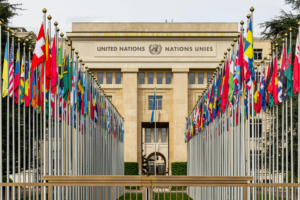
The Human Rights Committee will examine Tunisia’s sixth periodic report during its 128th session, which will be held in Geneva from 2 March to 27 March 2020.
Tunisia submitted its sixth periodic report to the Committee in June 2019 according to the approved simplified reporting procedure and in response to the list of issues identified by the UN Human Rights Committee in April 2018. Among these issues, the Committee requested Tunisia to provide information in relation to: the Constitutional and legal framework within which the Covenant is implemented; transitional justice; and the independence and impartiality of the judiciary.
Download
Tunisia-ICJ-Submission-UNHRC-Advocacy-Non-Legal-Submissions-2020-ENG (full submission, in PDF)
Jan 18, 2020 | Advocacy, News
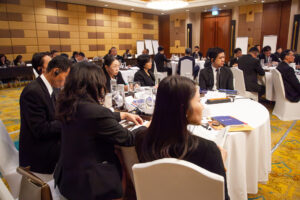
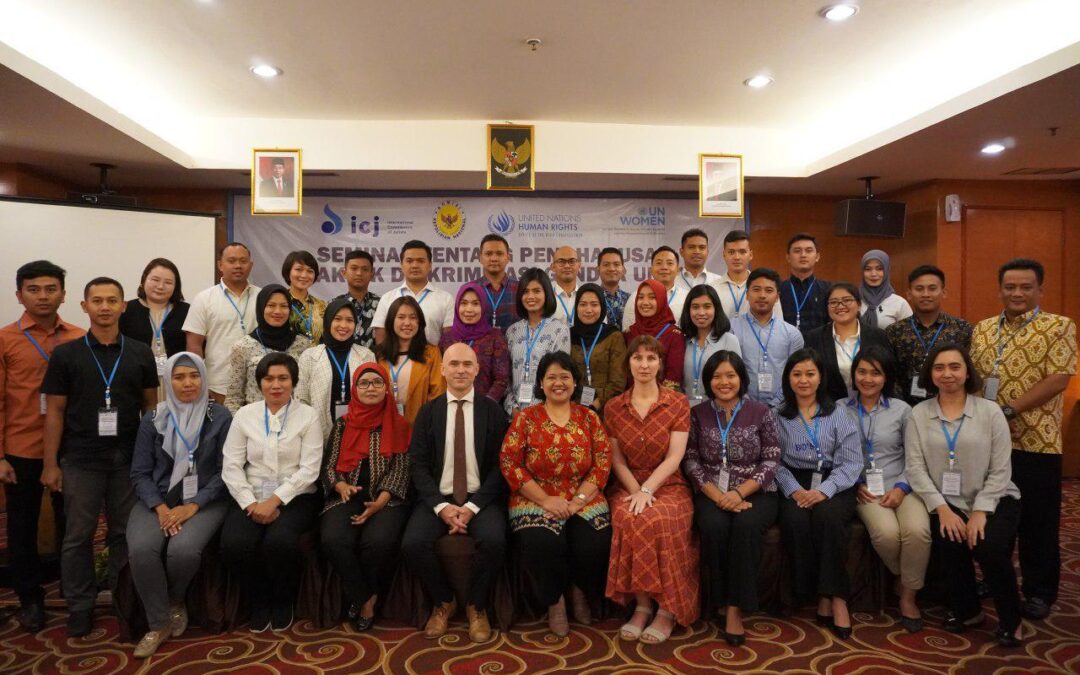
From 16 to 17 January 2020, the ICJ, in collaboration with the National Police Commission (KOMPOLNAS), UN Women, and the Office of the United Nations High Commissioner for Human Rights (OHCHR) organized a Seminar on Eliminating Gender Discriminatory Practices for the Police.
It was held in Bogor, Indonesia and gathered 30 law enforcement officers from Indonesian provinces that are reported to have the highest rate of incidents of violence against women.
Frederick Rawski, ICJ’s Asia and the Pacific Regional Director, stressed to participants that, “Police officers are the first point of contact for women who try to access justice for violations committed against them. It is important therefore for these officers to be well-trained on gender sensitivity and women’s human rights.”
“Only 40 percent of women speak out on violence, and only 10 percent of these report to the police because they are often blamed for the violence they experience or humiliated by those who should protect them,” added Ms. Doreen Buettner, Programme Specialist on Access to Justice of UN Women.
Indonesia is a State Party to the Convention on Elimination of All Forms of Discrimination Against Women (CEDAW), having ratified it on 13 September 1984. It has established a gender mainstreaming mechanism under Presidential Instruction No. 9 of 2000 on Gender Mainstreaming in National Development, which obliges all government representatives and agencies, including the police, to mainstream gender in their work in order to eliminate gender-based discrimination.
Ms. Poengky Indarti, Commissioner from the National Police Commission (KOMPOLNAS), stressed that “Gender-responsive police training should not a one-time thing, we need to institutionalize the training for it to be sustainable.”
At the seminar, the discussions were aimed at strengthening the understanding of the members of police officers on women’s human rights, and the importance of eliminating gender stereotyping in their work to enhance access to justice for women.
Ms. Siti Aminah, Commissioner of the National Commission of Violence Against Women in Indonesia (Komnas Perempuan) and Professor Meg Garvin, Executive Director of the National Crime Victim Law Institute (NCVLI) and Clinical Professor of Law at the Lewis & Clark Law School facilitated discussions on common gender stereotypes in Indonesia and strategies, protocols and good practice relating to all aspects of responses to incidents of violence against women.
Contact
Ruth Panjaitan, National Legal Advisor for Indonesia, International Commission of Jurists, e: ruthstephani.panjaitan(a)icj.org
Resources
To access pictures from the event, click here.
Jan 16, 2020 | Advocacy, Non-legal submissions
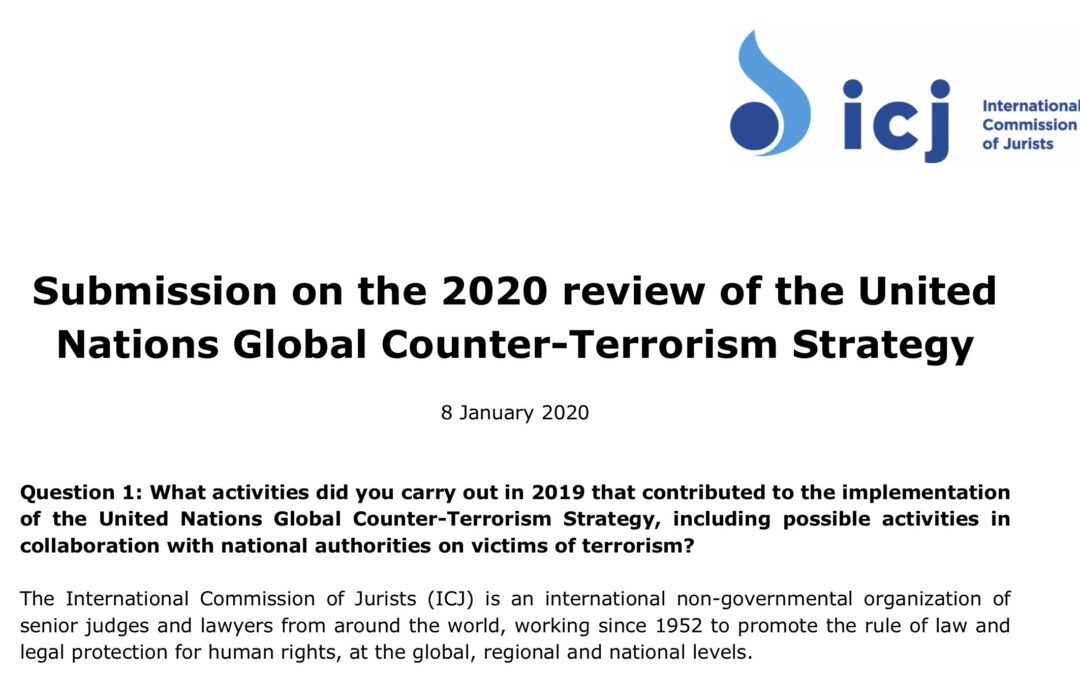
The ICJ has submitted information and recommendations for the upcoming review of the UN Global Counter-Terrorism Strategy, emphasising the need to strengthen the role of human rights in the framework and implementation of the strategy.
The submission was prepared in response to a call for civil society input, from the UN Office of Counter-Terrorism (UNOCT).
It summarizes recent ICJ activities relevant to implementation of the strategy, and urges among other things:
- removal of impediments to civil society participation in certain UN or other global policy-making processes;
- recognition that not only is violation of human rights in the context of countering terrorism, whether through arbitrary application or deliberate abuse, in itself unlawful and unacceptable, it also undermines the credibility and effectiveness of the struggle against terrorism;
- better recognition and implementation of the human rights of victims of terrorism;
- mainstreaming of human rights throughout the text and implementation measures for the Strategy as a whole;
- establishment of an independent human rights oversight entity within the UN counter-terrorism architecture;
- creation of a Civil Society Unit within UNOCT;
- increased resources for the UN Special Rapporteur on the promotion and protection of human rights and fundamental freedoms while countering terrorism;
- increased engagement of the UN counter-terrorism architecture with OHCHR and with other UN Special Procedures;
- benchmarks and indicators for assessing States’ compliance with human rights obligations in implementation of the GCTS.
The complete submission can be downloaded in PDF format here: UN-Advocacy-GCTStrategy-2019
For more information contact un(a)icj.org
Dec 27, 2019 | Advocacy
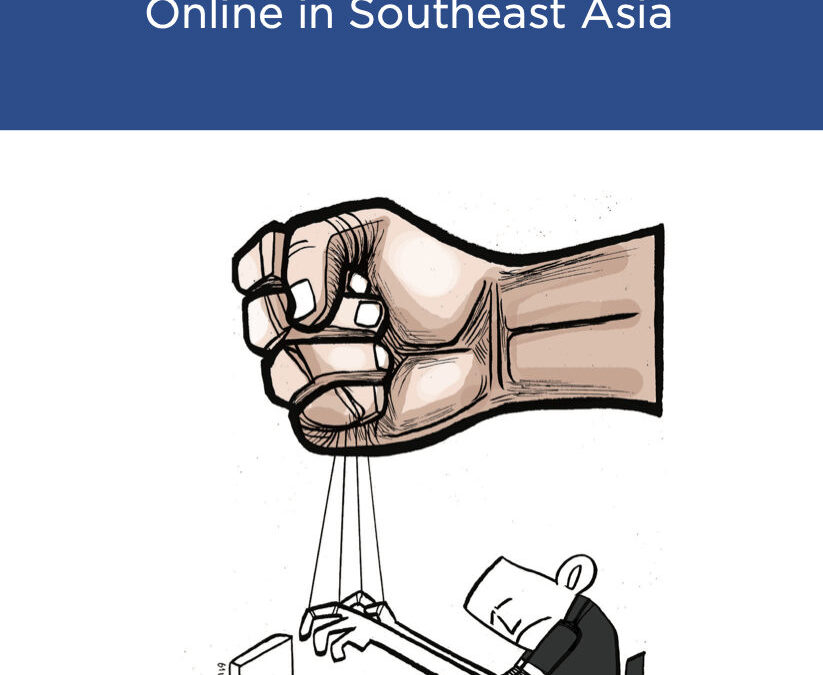
In December 2019, the ICJ launched its report Dictating the Internet: Curtailing Free Expression, Opinion and Information Online in Southeast Asia. The report looked at selected legal frameworks and case studies across ten countries in the region
The Myanmar section maps out a general pattern of abuse of legal frameworks by the government to restrict and control content online to the detriment of individuals’ rights to freedom of expression, opinion and information.
Download
Full report in Burmese.
The chapter on Myanmar in English and Burmese.