Mar 28, 2019 | Advocacy, Non-legal submissions
Today, the ICJ and Adalah for Rights and Freedoms (Adalah) filed a submission to the Human Rights Council’s Working Group on the Universal Periodic Review in advance of its review of Egypt’s human rights record in November 2019.
In their submission, the ICJ and Adalah drew the the attention of the Working Group on the UPR to the following concerns:
- arbitrary arrests and detentions and systematic use of pre-trial detention;
- the systematic use of torture, ill-treatment and enforced disappearance;
- the imposition of death penalty following unfair trials; and
- the politicization of the judiciary and the use of courts as a tool of repression.
The ICJ and Adalah called on the Working Group and the Council to urge the Egyptian authorities to :
- End the practice of holding detainees incommunicado;
- End all other forms of arbitrary detention;
- Comprehensively reform the pre-trial detention framework, including by ensuring that resort to it is exceptional, and that such detention may be ordered only when it is determined on the basis of evidence that it is necessary, proportionate and reasonable in the circumstances of the individual case;
- Ensure that pre-trial detention is not mandatory for all individuals charged with a particular category of felony or misdemeanor, or based on the potential sentences for the offences alleged;
- Ratify the International Convention for the Protection of All Persons from Enforced Disappearance (CED);
- Enact a crime of enforced disappearance in the Egyptian Criminal Code consistent with article 2 of the CED;
- Amend article 126 of the Criminal Code with a view to enacting a crime of torture consistent with article 1 of the CAT;
- Accept independent monitoring of detention facilities by allowing independent observers immediate access to detainees and prisoners, and to that end, accede to the Optional Protocol to the CAT;
- Implement all the recommendations of the CAT following its article 20 inquiry;
- Amend Egyptian law and abolish the use of the death penalty;
- Pending abolition, implement an immediate moratorium on all executions and on the imposition of capital punishment, including in cases of involving intentional killings;
- Pending abolition, ensure that proceedings in death penalty cases conform to the highest standards of judicial independence, competence and impartiality, and strictly comply with all fair trial rights;
- Pending abolition, ensure that the right to appeal in death penalty cases include review of both the factual and the legal aspects of the case by a higher ordinary, independent and impartial tribunal;
- Pending abolition, provide for the right of individuals convicted in death penalty cases to seek a pardon, commutation of sentence or clemency.
- Ensure that all convictions in death penalty cases that followed unfair trails are quashed;
- End Executive interference in judicial affairs;
- Limit the jurisdiction of military courts to trials of military personnel only for breaches of military discipline; and
- Abolish Emergency State Security Courts.
Egypt-Adalah_ICJ UPR-Advocacy-Non Legal Submissions-2019-ENG (full text of submission, in PDF)
Mar 22, 2019 | Advocacy, Non-legal submissions
The ICJ has joined with ten other leading human rights organisations to highlight the key outcomes of the 40th regular session of the UN Human Rights Council in Geneva, at its conclusion on 22 March 2019.
The joint NGO statement, delivered at the end of the session, reads as follows:
“We welcome the positive step the Council has taken in the direction to effectively protect environmental human rights defenders (EHRDs) from the grave reality they face every day. By adopting the resolution by consensus, the Council has collectively and explicitly recognized the vital role of EHRDS, including in attaining the SDGs sustainable development goals and ensuring that no-one is left behind, and called for their protection. We also welcome the call on States to provide a safe and empowering context for initiatives organised by young people and children to defend human rights relating to the environment. We, however, regret that the resolution does not squarely address the obligations of international financial institutions and investors.
We welcome South Africa’s leadership to put on the Council’s agenda emerging human rights issues, in bringing attention to the multiple and intersecting forms of discrimination that women and girls face in the field of sports, especially on the basis of race and gender.
The Council has ensured its continued attention to grave rights violations across the globe.
While we welcome the extension of Council attention on Sri Lanka for another two years, a concrete, transparent, and time-bound action plan is urgently needed to implement its commitments under resolution 30/1 in collaboration with OHCHR. Given the lack of progress and political will to implement these commitments, in the absence of immediate progress, the Council should consider additional measures or mechanisms for ensuring victims’ rights to truth, justice and reparations. Individual States need not wait to exercise universal jurisdiction.
We welcome the resolution on Myanmar and its strong focus on ending impunity and ensuring accountability, and we call for the swift operationalisation of the Independent Investigative Mechanism (IIM). We welcome steps taken to review the UN’s involvement in Myanmar. We urge the UN Secretary-General to ensure that it is independent and transparent, and present the findings and recommendations at the Council’s 43rd session.
We welcome the renewal of the mandate of the Commission on Human Rights in South Sudan, a vital mechanism for human rights reporting and evidence gathering. It sends the right message to the government and all parties to the conflict: There can be no lasting peace without justice.
The Council continued this session to initiate action on country situations based on objective criteria through resolutions and joint statements.
By adopting a resolution on Nicaragua, the Council sent a signal to victims of the current crisis that the international community will not allow impunity for the serious ongoing violations to prevail. We look forward to robust reporting from the OHCHR and we urge the Nicaraguan government to fully engage with the Office to ensure the victims’ rights to truth, justice and reparation.
The Council sent a strong message of support to human rights defenders in Saudi Arabia through the joint statement by 36 States, led by Iceland, calling for the release of detained women human rights defenders and called on the Saudi government to fully cooperate with the Special Rapporteur on extrajudicial, summary or arbitrary executions in her investigation into the killing of journalist Jamal Khashoggi. We urge the Saudi authorities to respond fully to these calls, and States to follow up with a resolution at the June session to maintain attention to the situation until meaningful progress, including the release of defenders, is made.
LGBT people in Chechnya are being abducted, locked up in secret detention sites, tortured and sometimes killed purely because of their sexual orientation. We welcome the joint statement on Chechnya delivered by more than 30 States and join the call on the Russian authorities for the persecution to stop: for the immediate and unconditional release of all detained for their actual or perceived sexual orientation or gender identity, and for swift, thorough, and impartial investigations.
We welcome the Cameroon joint statement which advances both Council membership standards and its prevention mandate, and urge the Council to keep the matter under scrutiny.
While we have welcomed the Council’s attention to several situations of gross rights violations, we remain concerned about the lack of consistent and principled leadership by States, in particular by Council members.
We are disappointed that even though the demands of several EU and WEOG States to move the resolution on accountability for crimes committed in the Occupied Palestinian Territories from item 7 to item 2 was met, they still failed to support the resolution. This suggests that no matter the item number, some WEOG members continue in failing to protect the human rights of Palestinians, effectively shielding Israel from accountability.
We regret that States have yet again failed to initiate Council action on the Philippines amidst continued unlawful killings in the government’s so-called war on drugs, and increased targeting of independent media, civil society organisations, and human rights defenders. We reiterate our call on the Council to take action to mandate an independent investigation to establish the facts of human rights violations including extrajudicial executions and attacks against media and civil society, address impunity, and take steps towards justice and reparations for the victims and their families, and hope action will be taken in this regard at the next Council session.
We are deeply disappointed that the resolution adopted on Libya again lacks any meaningful accountability mechanism or mandate, despite the impunity for the widespread and systematic violations of international humanitarian and human rights law that prevail there.
We deplore that despite credible reports of the detention of up to 1 million Uyghurs and other Turkic Muslims in western China, the Council has yet again given a pass to China, permitting impunity for widespread and severe human rights violations. The efforts China has made to keep States silent, exemplified by intimidation and threats on the one hand and whitewashing the situation on the other, demonstrate the degree to which Council action could have had meaningful results if States had instead called clearly and collectively for an independent, unrestricted fact-finding mission.
On the resolution on the rights of the child, we regret the Council’s inability to emphasize the empowerment, autonomy and capacity of children with disabilities, and including to ensure that their sexual and reproductive health and rights must be respected, protected and fulfilled.
We applaud Mexico and other States’ resolve to safeguard the independence of the mandate of the Special Rapporteur on the promotion and protection of human rights while countering terrorism and to resist any attempts to dilute, distract or distort its essential focus, ensuring that the Rapporteur can continue to have positive impacts both in preventing and responding to human rights violations committed in the name of countering terrorism and in relation to the human rights of victims of terrorism. We urge States to remain vigilant to resist future attempts to undermine the Special Procedures system- the eyes and ears of the Council.
We welcome the Council’s renewal of the mandates of the Special Rapporteur on Iran and the Commission of Inquiry on Syria, so that both can continue to perform their vital work fulfilling their respective mandates and addressing the dire human rights situations in both countries. We urge the Iranian and Syrian authorities to change their posture of noncooperation with the respective mandate .
Several of our organisations have urged the UN High Commissioner to publish the database on businesses in Israeli settlements and were alarmed at its further delay. We urge the High Commissioner to release the database with all due haste.
We welcome the renewal of the Special Rapporteur on freedom of religion or belief mandate, and the maintenance of consensus on the Council resolution 16/18 framework for addressing religious intolerance . Rising intolerance and hate is a global concern, and States must move beyond rhetoric to action in implementing these standards.
The High Commissioner’s update on Venezuela during this session reflected the dire human rights situation in Venezuela. We urge all States to consider what more the Council can do to address the worsening human rights crisis in the country and to support all victims.
We note the highly disturbing report by the Special Rapporteur on adequate housing concerning grave reprisals by the Egyptian government against those who cooperated with her during her recent visit to the country and urge this Council to take action to address these attacks.
We welcome the passage of the resolution on Georgia and the continued attention devoted to the importance of full and unimpeded access for the Office of the High Commissioner and international and regional human rights mechanisms.”
Signatories:
- Amnesty International
- ARTICLE 19
- Asian Forum for Human Rights and Development (FORUM-ASIA)
- DefendDefenders (East and Horn of Africa Human Rights Defenders Project)
- Center for Reproductive Rights
- CIVICUS
- Human Rights House Foundation
- Human Rights Watch
- International Commission of Jurists
- International Federation for Human Rights (FIDH)
- International Service for Human Rights
Mar 20, 2019 | Advocacy, Non-legal submissions
The ICJ today joined other NGOs in addressing the UN Human Rights Council session in Geneva, on the situation for human rights in Guatemala.
The statement, delivered by Franciscans International on behalf also of ICJ and other NGOs, read as follows (translation of Spanish original):
“We welcome the High Commissioner’s Report concerning the activities of her Office in Guatemala. We share the concerns and recommendations in the report, especially those related to the indigenous peoples, migrants and legislative initiatives that would impact in the full enjoyment of human rights.
As it was highlighted in the report, we are also concerned by the current discussions on the initiative to reform the National Reconciliation Law. This reform would give amnesty to those who committed serious crimes during the armed conflict, including those who have already been convicted. This puts at risk not only the fulfillment of the state’s obligations to end impunity, but also the security and access to justice of hundreds of victims and witnesses. Guatemala should dismiss immediately the initiative and refrain from promoting any other initiative that would promote impunity.
Additionally, the political and social tensions are intensifying towards the upcoming elections, and the inclusion of various groups, especially indigenous peoples, is at risk. Currently there is a low participation and representation of indigenous peoples in the political scene of the country. Out of 178 seats in the Congress, only 18 are occupied by Mayans (from which only two are women). The State must guarantee free participation, without intimidation or threats, of indigenous peoples running for different positions.
Lastly, the regional human rights situation of migrants is aggravating and the response by Guatemala, as evidenced in the last months, shows the lack of an effective policy to deal not only with migrants in transit, but also to create conditions to prevent forced migration of Guatemalans.
We thank the work that the Office of the High Commissioner for Human Rights has done, and we stress the importance of its activities in the country.”
The full statement may be downloaded in English and the original Spanish, in PDF format, here: HRC40-OralStatement-GDitem2-Guatemala-2019-EN-ESP
Mar 20, 2019 | Advocacy, Non-legal submissions
The ICJ today called at the UN for prompt establishment of a judicial accountability mechanism with international involvement, for Sri Lanka.The statement, delivered during an interactive dialogue on the OHCHR report on Sri Lanka at the Human Rights Council in Geneva, read as follows:
“The ICJ welcomes the comprehensive report of the OHCHR on promoting reconciliation, accountability and human rights in Sri Lanka (A/HRC/40/23). We share OHCHR’s observation that there is a lack of progress and absence of a comprehensive strategy for implementation of all commitments made under Resolution 30/1.
ICJ is particularly concerned about the lack of progress in the area of criminal accountability (as noted in Paragraph 27 of the report). We believe that there is an urgent need to establish a judicial mechanism with the involvement of foreign judges. We echo the sentiments of the OHCHR regarding the inability of the Sri Lankan courts, on their own, to address the impunity of security forces for crimes under international law.
Failure of the criminal justice system to effectively address emblematic cases (as reflected in Paragraph 38 of the report) clearly indicates the level of capacity and willingness on the part of the State even today to prosecute and punish perpetrators of serious crimes when they are linked to the security forces or other positions of power.
ICJ also notes that women are grossly under-represented in the judiciary in Sri Lanka, which prevents women human rights defenders and female victims from having confidence in the ordinary criminal justice system, impeding their full engagement and participation in pursuing accountability for crimes committed against them during the conflict and other transitional justice processes.
A judicial mechanism with the involvement of foreign judges is particularly urgent for women in conflict-affected areas who still live in a highly militarized environment and are compelled to live among their perpetrators – those who have been accused of war crimes including rape and other forms of sexual violence.
We therefore reject calls for a purely domestic mechanism. Indeed, the ICJ considers that the continuing failure of the Government to ensure justice means that referral to the International Criminal Court or the creation of another international mechanism to facilitate criminal accountability would be fully warranted. The draft resolution before this session of the Council, reaffirming all elements of resolution 30/1, thus already represents a deep compromise and anything less than the existing text would be wholly unacceptable.
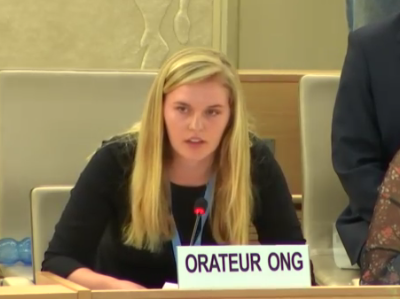
Mar 18, 2019 | Advocacy, Non-legal submissions
The ICJ today called for prompt release of a database of businesses involved in certain activities in the Occupied Palestinian Territory, that has been prepared by the UN Office of the High Commissioner for Human Rights (OHCHR).The statement, delivered in a general debate, read as follows:
“Regarding the Database of business enterprises involved in listed activities in the settlements on the Occupied Palestinian Territory, the ICJ recognizes the important work that has been done, but is deeply concerned at OHCHR’s failure to publicly release it.
All States, including the home States of the companies involved, have a responsibility to prevent companies from operating in breach of international law. Businesses themselves should see the database as an opportunity to more proactively incorporate respect for human rights within their policies and operations.
The prompt publication of the database should contribute to global efforts to hold all business enterprises accountable for their role in violations of human rights and humanitarian law and to give them an incentive to cease in such behaviour. The ICJ urges all States, including those that have supported the creation of this database, to redouble efforts to prevent business complicity in serious human rights abuses and to hold businesses legally accountable when abuses occur in their own territories as well as in the global operations of businesses for which they are the home State.”