Oct 14, 2019 | Comunicados de prensa, Multimedia, Noticias
La condena impuesta hoy a los líderes independentistas catalanes por una amplia definición del delito de sedición restringe excesivamente e ilegalmente los derechos de libertad de expresión, asamblea y asociación, dijo hoy la CIJ.
“Estas condenas representan una grave interferencia con el ejercicio de la libertad de expresión, asociación y asamblea de los líderes catalanes. El recurso a la ley de sedición para restringir el ejercicio de estos derechos es innecesaria, desproporcionada e injustificable” dijo Massimo Frigo, asesor legal senior para la CIJ en Europa y Asia Central.
La CIJ también puntualizó que la excesivamente amplia definición del delito de sedición aplicada en este caso crea un alto riesgo de arbitrariedad.
“Nos preocupa que el Tribunal Supremo no haya tenido totalmente en cuenta las obligaciones de España bajo el derecho internacional de los derechos humanos en su consideración de los cargos contra estos acusados lo cual mina seriamente sus condenas” añadió.
Nueve de los doce líderes politicos procesados – incluyendo altos cargos del gobierno catalán – han sido condenados por sedición en conexión con su contribución a la administración el 1 de octubre de 2017 de un referéndum sobre la independencia de Cataluña. El referéndum se llevó acabo pese haber sido declarado ilegal por el Tribunal Constitucional.
El proceso de voto durante el referéndum fue reprimido por la fuerza en muchas localidades por la policía, con informes creíbles de uso innecesario y desproporcionado de la fuerza en violación de las obligaciones de España en derecho internacional.
“La intereferencia con la expresión y protesta política pacífica es inacceptable, salvo en limitadas circunstancias en las que sea estrictamente necesario y proporcionado por razones convincentes como la seguridad nacional.” dijo Frigo.
Contacto
Massimo Frigo, asesor legal senior, Programa Europeo de la CIJ, t: +41 22 979 38 05 ; e:massimo.frigo(a)icj.org
Antecedentes
Las doce personas que han sido condenadas en conexión con el referéndum de Octubre de 2017 incluyen a Oriol Junqueras, ex-vicepresidente de la Generalitat catalana; Carme Forcadell, ex-presidenta del Parlament catalán; ocho ex-consejeros del Gobierno catalán – Jordi Turull, Raül Romeva, Joaquim Forn, Santi Vila, Meritxel Borràs, Dolors Bassa, Josep Rull, Carles Mundó -; Jordi Sànchez, ex-líder de la Asamblea Nacional Catalana (ANC), y Jordi Cuixart, ex-líder de la organización independentista Òmnium Cultural.
España tiene obligación de proteger la libertad de expresión, incluyendo la expresión política, bajo el artículo 10 de la Convención Europea de Derechos Humanos (ECHR, por sus siglas en inglés) y el artículo 19 del Pacto Internacional de Derechos Civiles y Políticos (ICCPR, por sus siglas en inglés), y la libertad de asamblea y asociación pacíficas bajo el artículo 11 de ECHR y los artículos 21 y 22 de ICCPR.
El Comentario General sobre libertad de expresión del Comité de Derechos Humanos afirma que Los Estados partes deben procurar con el mayor cuidado que las leyes sobre traición y las disposiciones similares que se refieren a la seguridad nacional, tanto si se califican de leyes sobre secretos de Estado o sobre sedición, o de otra manera, estén redactadas y se apliquen de conformidad con las condiciones estrictas del párrafo 3 del artículo 19 del ICCPR, lo cual requiere que las restricciones en la libertad de expresión estén legisladas y que sean necesarias en base a propósito legítimo, como la seguridad nacional o el orden público. El derecho a participar en la vida pública está protegido bajo el artículo 25 de ICCPR.
Oct 14, 2019 | Events, News
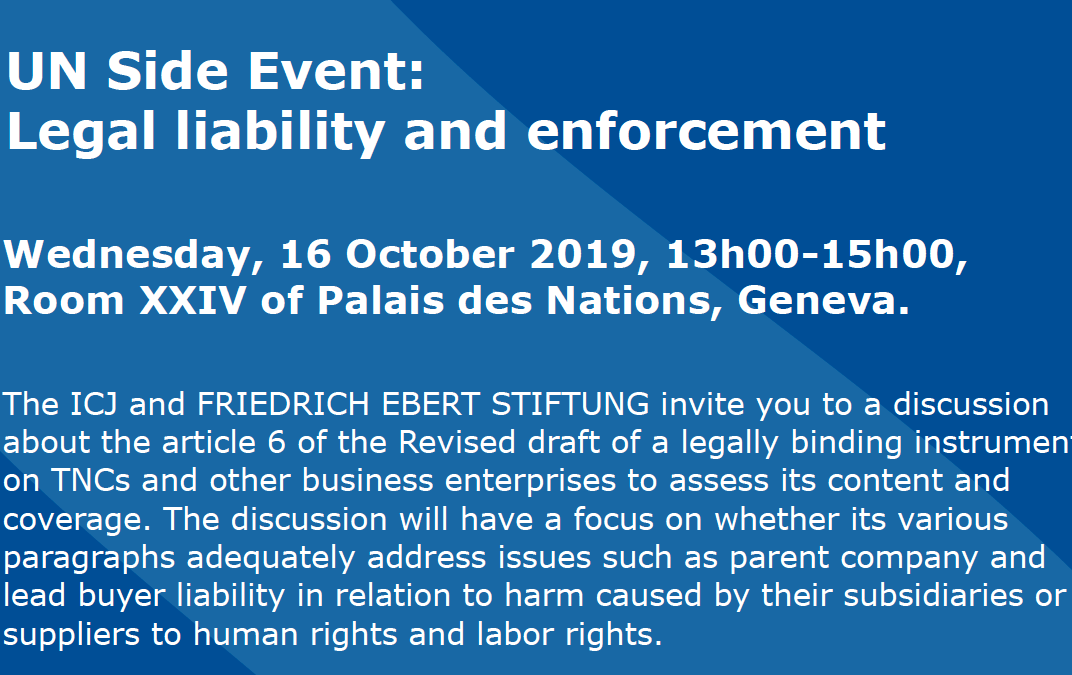
This side event will take place on Wednesday, 16 October 2019 at 13h00-15h00 in room XXIV of Palais des Nations, Geneva.
The ICJ and FRIEDRICH EBERT STIFTUNG invite you to a discussion about the article 6 of the Revised draft of a legally binding instrument on TNCs and other business enterprises to assess its content and coverage. The discussion will have a focus on whether its various paragraphs adequately address issues such as parent company and lead buyer liability in relation to harm caused by their subsidiaries or suppliers to human rights and labor rights.
The panel will feature:
- Doug Cassel (by video), University of Notre Dame
- Makbule Sahan, International Trade Union Confederation
- Markus Krajewski, Friedrich-Alexander-Universität Erlangen-Nürnberg
- Olivier de schutter, University of Louvain
Moderator
- Ian Seiderman, ICJ Legal and Policy Director
Side event Legal liability (flyer of the event, in PDF)
Oct 12, 2019 | Agendas, Events
Today begins in Izmir (Turkey) a one-day workshop for lawyers and CSO practitioners on the use and strategies of UN mechanisms and of their decisions in domestic courts.
This event is organized by ICJ, in cooperation with its partners Kapasite Geliştirme Derneği and Human Rights Joint Platform, as part a/the EU co-financed project Rebuilding and Ensuring Access to justice with civil society in Turkey.
30 lawyers and civil society practitioners are taking part in the workshop on 12 October in Izmir.
The workshop aims at discussing the functioning of the UN human rights mechiansms (treaty bodies and charter-based bodies) as well as their follow up procedures and the implementation of their decisions in the domestic legal framework in Turkey.
The workshop will provide presentations on the functioning of UN mechanisms by international expert, including from OHCHR, on the value of UN decisions under Turkish law, as well as discussions and brainstorming on how to use UN decisions in Turkey.
The project is funded by the European Instrument for Democracy and Human Rights (EIDHR) of the European Union.
Turkey-Workshop-Agenda-UNmechanisms-Izmir-2019-eng (download the agenda in English)
Turkey-Workshop-Agenda-UNmechanisms-Izmir-2019-tur (download the agenda in Turkish)
Oct 11, 2019 | News
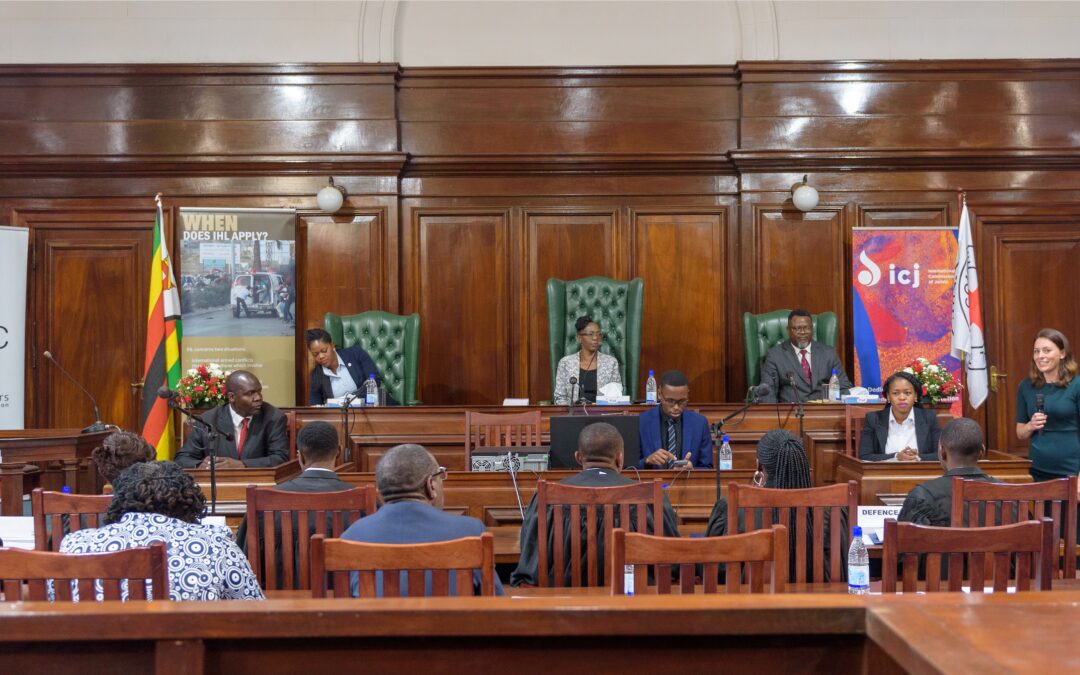
The ICJ in partnership with the International Committee of the Red Cross (ICRC) convened the 2019 International Humanitarian Law (IHL) moot court competition.
The IHL moot court competition brought together 12 law students from Great Zimbabwe University, Midlands State University, University of Zimbabwe and Zimbabwe Ezekiel Guti University; to engage with IHL issues.
The Great Zimbabwe University students won the competition and will participate in the All Africa Moot Court Competitions to be held in Arusha, Tanzania representing Zimbabwe.
Moot Court competitions are a part of the philosophy of developing a conscientious lawyer and contributing to law graduates who have an affinity for defending human rights and the rule of law. IHL incorporates human rights principles in times of war. As a result, understanding IHL allows students to have an understanding of the application and limitations of human rights during times of war. The moot court competitions additionally equip the students with an invaluable opportunity to develop key advocacy skills.
“The moot competition gives law students the opportunity to have experiential learning and can be one among an array of interventions that could be done to supplement the university education of lawyers in Zimbabwe that has not been very strong on human rights and humanitarian law,” said Arnold Tsunga, Director of ICJ’s Africa Regional Programme.
The competition was held from 8 October to 11 October 2019. On 8 October the law students underwent an advocacy boot camp which was a full training day on advocacy skills. The four law faculties participated in a preliminary round on 9 October. The top two, Great Zimbabwe University and Midlands State University qualified for the final round. The winning team, Great Zimbabwe University will participate in the All Africa Moot Court Competitions which brings together IHL national champions from all over Africa.
The competition was supported by the European Union.
Contact
Arnold Tsunga, t: +26377728 3248; e: arnold.tsunga(a)icj.org
Rumbidzai Muyendesi, t: +263771666579; e: rumbidzai.muyendesi(a)icj.org
Oct 9, 2019 | News
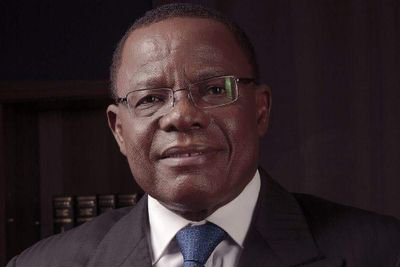
The ICJ today welcomed the release from detention and the dropping of charges against, of Maurice Kamto and other opposition figures.
The ICJ has called on Cameroonian authorities to ensure that they and others are able to exercise their human rights and fundamental freedoms without harassment or fear of arrest and prosecution.
The ICJ also called for the authorities to embark on wider legal and institutional reforms to facilitate respect for human rights and the rule of law in order to build genuine constitutional democracy in that country.
‘’Neither the arrest, nor detention nor prosecution of people for exercising their fundamental freedoms, including political dissent and peaceful opposition nor the trial of civilians before a military court was in compliance with Cameroon’s international legal obligations,” said Arnold Tsunga, ICJ’s Africa Regional Director in reaction to news of the release.
Maurice Kamto, a leading international jurist, former ICJ Commissioner, and presidential candidate of the Cameroon Renaissance Movement (MRC), was arrested on 28 January 2019 along with dozens of other opposition figures for protesting and challenging the results of the last Presidential elections held in October 2018.
They were facing trials before military courts, in contravention of their rights to a fair trial trial, on charges of ‘’insurrection, hostility to the motherland and rebellion’’ – charges which potentially carry the death penalty.
The detainees were released last weekend after Cameroon’s President Paul Biya’s tweet on 4 October 2019, that he had ordered the discontinuance of proceedings against them. The bringing and dropping charges should be in the remit of independent prosecutorial authorities, not the President.
Nonetheless, the ICJ stressed that the release of Maurice Kamto and the other leaders provides a welcome window of opportunity for Cameroonian authorities to begin an inclusive process of revamping the legal and constitutional framework to meet international standards.
The ICJ called on the Cameroonian authorities to desist further from applying the law and legal process to persecute or otherwise harass any person for the exercise of fundamental freedoms and from administering justice through military courts, which should be reserved for prosecution military personnel for military offences only.
The ICJ stressed that the release of Maurice Kamto and other opposition figures presents a unique opportunity for Cameroonian authorities to restore public confidence in the country’s democratic institutions by including all Cameroonians in the building of a society based on the rule of law.
Contact:
Arnold Tsunga, ICJ Africa Director, C: +27716405926, or +254 746 608 859 E: arnold.tsunga(a)icj.org
Solomon Ebobrah, Senior Legal Adviser, ICJ Africa, C: +234 8034927549; E: Solomon.ebobrah(a)icj.org