Apr 23, 2015 | News
The ICJ is concerned at the recent arrest of Swaziland High Court Judges Jacobus Annandale and Mpendulo Simelane, the High Court Registrar Fikile Nhlabatsi and the Minister of Justice Sibusiso Shongwe.
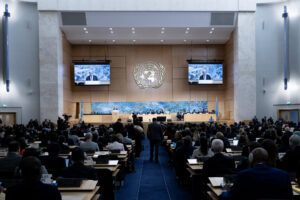
The four detainees appeared today before High Court Justice Qinisile Mabuza (photo).
Justice Minister Sibusiso Shongwe was denied bail and remains detained, while the other two High Court Judges and the registrar were released on bail.
The judges, registrar and Minister of Justice are all facing various charges related to corruption and obstructing the course of justice.
The ICJ is also aware that police are presently seeking to arrest Chief Justice Michael Ramodibedi, and that they have surrounded his place of residence.
The ICJ has received information alleging that the police have cut off the electricity and water and have actively prevented people from bringing food supplies to him and his family.
The ICJ urges the authorities in Swaziland to immediately investigate the situation of the Chief Justice and, if the allegations are substantiated, to immediately restore supply of essential services to the Chief Justices family, denied in violation of rights guaranteed under the Swaziland’s Constitution and its international legal obligations.
“The arrest and attempted arrest of several judges, and a High Court Registrar as in this case, invariably raises questions of separation of powers and the independence of the judiciary,” said Wilder Tayler Secretary General of the ICJ.
“The ICJ therefore calls on the authorities in Swaziland to conduct themselves with rigorous adherence to rule of law principles, the separation of powers between the executive and the judiciary. They must also do so with strict respect for international human rights law,” he added.
The ICJ emphasizes that the Chief Justice and the other judges are entitled as everyone else in Swaziland to freedom from arbitrary detention and the right to a fair trial guaranteed under international law.
These protections include the right to be informed the reasons for their arrest and the nature of any criminal charges, the right to representation by a lawyer of their choice and the right to be considered for bail if appropriate.
If no crime is alleged, but serious professional misconduct is suspected, then arrest and detention is inappropriate.
Additional information:
The ICJ has had longstanding concerns with the state of the independence of the judiciary and legal profession and the fair administration of the justice in Swaziland.
The ICJ has recently intervened in a case involving the conviction of prominent lawyer Thulani Maseko in an unfair trial.
For an ICJ analysis of the independence of the judiciary and legal profession in Swaziland, go here.
Contact:
Arnold Tsunga, Regional Director, ICJ’s Africa Programme, t: +27 731318411, e: arnold.tsunga(a)icj.org
Apr 22, 2015 | Multimedia items, News, Video clips
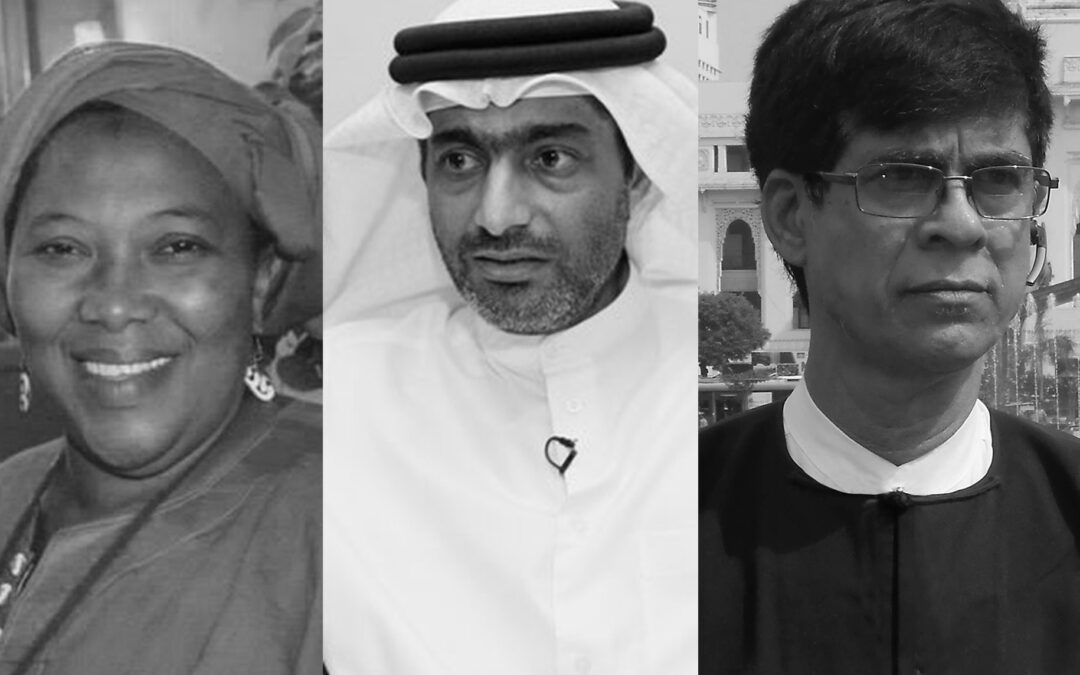
The three final human rights defenders who will compete for the award are Ahmed Mansoor (United Arab Emirates), Robert Sann Aung (Myanmar) and Asmaou Diallo (Guinea). The ICJ is member of the MEA Jury.
The Martin Ennals Award for Human Rights Defenders (MEA) is the main award of the human rights movement and as such can be labelled as the Nobel Price for human rights.
It is a unique collaboration among ten of the world’s leading human rights organizations to give protection to human rights defenders worldwide.
This award is selected by the International Human Rights Community (members of the jury are ICJ, Amnesty International, Human Rights Watch, Human Rights First, International Federation for Human Rights, World Organisation Against Torture, Front Line Defenders, EWDE Germany, International Service for Human Rights and HURIDOCS).
It is given to Human Rights Defenders who have shown deep commitment and face great personal risk. The aim of the award is to highlight their work and protect them through increased visibility.
The 2015 Award will be presented on Oct. 6th at a ceremony hosted by the City of Geneva.
Since 2006, Ahmed Mansoor (United Arab Emirates) has focussed on initiatives concerning freedom of expression, civil and political rights.
He successfully campaigned in 2006-2007 to support two people jailed for critical social comments. They were released and the charges dropped.
Shortly after, the Prime Minister of UAE issued an order not to jail journalists in relation to their work.
He is one of the few voices within the United Arab Emirates who provides a credible independent assessment of human rights developments.
He regularly raises concerns on arbitrary detention, torture, international standards for fair trials, non-independence of the judiciary, and domestic laws that violate international law.
He was jailed in 2011 and since then has been denied a passport and banned from travelling.
“I’m very pleased to be nominated for the Martin Ennals award,” he said. “This recognition indicates that we are not left alone in this part of the world and I hope it will shed further light on the human rights issues in the UAE. It is not just full of skyscrapers, big malls and an area attractive to businesses, but there are other struggles of different sorts beneath all of that.”
Since his first year of University in 1974, Robert Sann Aung (Myanmar) has courageously fought against human rights abuses.
He has been repeatedly imprisoned in harsh conditions, physically attacked as well as regularly threatened.
His education was interrupted numerous times and he was disbarred from 1993 – 2012.
In 2012, he managed to regain his license to practice law. Since then he has represented jailed child soldiers, those protesting at a contested copper mine, peaceful political protesters, those whose land has been confiscated by the military, as well as student activists.
Throughout his career he has provided legal services, or just advice, often pro bono, to those whose rights have been affected.
“I feel humble and extremely honored to be nominated for this prestigious award. This nomination conveys the message to activists, human rights defenders and promoters who fight for equality, justice and democracy in Myanmar that their efforts are not forgotten by the world,” he said.
Asmaou Diallo (Guinea)’s human rights work started following the events of 28 September 2009 when the Guinean military attacked peaceful demonstrators.
Over 150 were killed, including her son, and over 100 women raped. Hundreds more were injured.
She and l’Association des Parents et Amis des Victimes du 28 septembre 2009 (APIVA), which she founded, work to obtain justice for these crimes and to provide medical and vocational support to victims of sexual assault, many of whom cannot return to their homes.
She has worked to encourage witnesses to come forward and supported them as they provided information and testimony to court proceedings.
As a result, eleven people have been charged, including senior army officers.
“Being among the nominees for the Martin Ennals Foundation encourages me to continue my fight for the protection and promotion of human rights in Guinea. I trust that this award will have a positive effect on the legal cases concerning the events of the September 28, 2009, and will be a lever for all defenders of human rights in Guinea,” she said.
Contact:
Olivier van Bogaert, Director Media & Communications, ICJ representative in the MEA Jury, t: +41 22 979 38 08 ; e: olivier.vanbogaert(a)icj.org
Michael Khambatta, Director, Martin Ennals Foundation, t: +41 79 474 8208 ; e: khambatta(a)martinennalsaward.org
Universal-MEA Final Nominees 2015-News-Press Release-2015-ENG (Official press release in English)
Universal-MEA Final Nominees 2015-News-Press Release-2015-FRE (Official press release in French)
Universal-MEA Final Nominees 2015-News-Press Release-2015-ARA (Official press release in Arabic)
Universal-MEA Final Nominees 2015-News-Press Release-2015-BUR (Official press release in Burmese)
UAE-MEA 2015 Bio Ahmed Mansoor-2015-ENG (full bio in PDF)
Myanmar-MEA 2015 Bio Robert Sann Aung-2015-ENG (full bio in PDF)
Guinea-MEA 2015 Bio Asmaou Diallo-2015-ENG (full bio in PDF)
Apr 22, 2015 | Communiqués de presse, Multimédia, Nouvelles
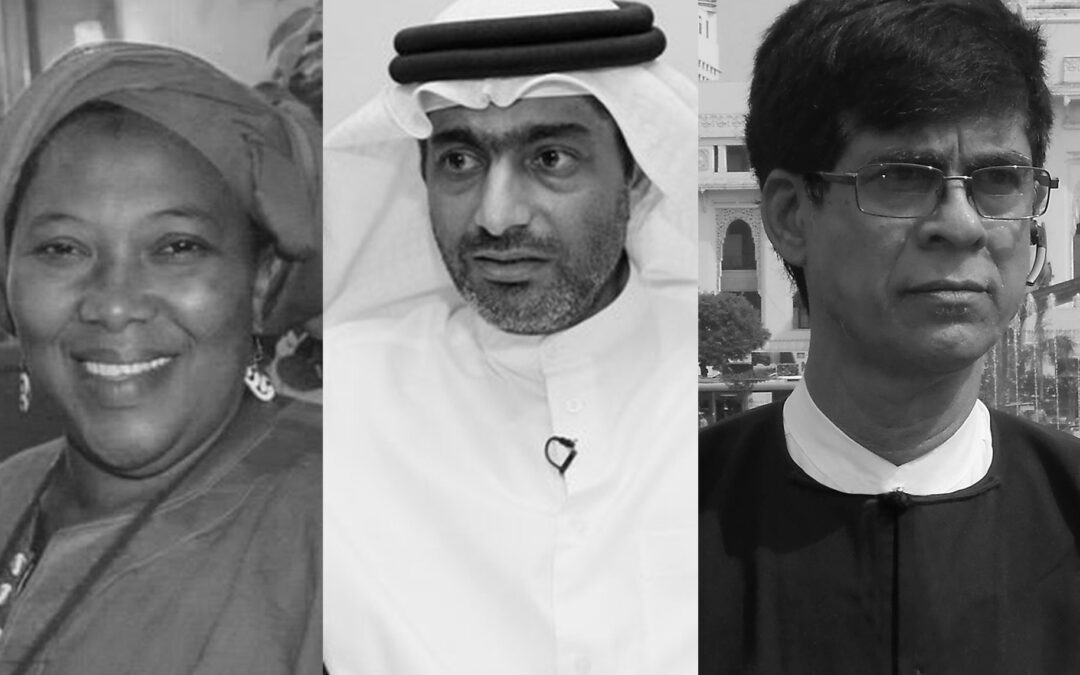
Les trois finalistes défenseurs des droits de l’Homme en lice pour le prix sont Ahmed Mansoo (Emirats Arabes Unis), Robert Sann Aung (Myanmar) et Asmaou Diallo (Guinée).
La CIJ est membre du jury du Martin Ennals Award (MEA).
La sélection des nominé-e-s au Prix est effectuée par la communauté internationale des droits humains. Le Prix est attribué à des défenseur-e-s des droits humains qui ont montré un engagement important et font face à un risque personnel sérieux. L’objectif du Prix est de mettre en lumière leur travail et de les protéger à travers une visibilité accrue.
Universal-MEA Final Nominees 2015-News-Press Release-2015-FRE (Communiqué de presse officiel en PDF)
Apr 20, 2015 | Incidencia
En febrero de 2014, el Representante para Suramérica de la CIJ rindió un dictamen pericial en audiencia pública ante la Corte Interamericana de Derechos Humanos, en el Caso Cruz Sánchez y otros Vs. Perú.
Este caso está referido a la ejecución extrajudicial de tres miembros del grupo armado “Movimiento Revolucionario Túpac Amaru – MRTA”, luego de ser puestos fuera de combate, por las fuerzas de seguridad peruanas en el marco de la llamada “Operación Chavín de Huántar”, de retoma de la Embajada del Japón en Lima (Diciembre 1996 –abril 1997).
El dictamen pericial rendido por la CIJ abordó cuestiones relativas a: i) la naturaleza jurídica de graves infracciones al derecho internacional humanitario; ii) la intervención de la justicia militar en la investigación y juzgamiento de delitos que no son de función y que pueden constituir violaciones a los derechos humanos; y iii) los estándares internacionales relativos a la debida diligencia en la investigación, juzgamiento y sanción de los responsables de violaciones de derechos humanos.
El pasado 17 de abril de 2015, la Corte Interamericana profirió Sentencia en el caso.
Peru-PeritajeFAGChavinHuantar-Advocacy-legal submission-2015-SPA (texto íntegro en PDF)

Apr 20, 2015 | News
The ICJ is concerned at reports that a police official has purported to terminate a lawyer’s representation of a client against the client’s wishes, in violation of the right to fair trial and international standards on the independence and role of the legal profession.
A.J. Uchkempirov, the investigator of the City Department of Internal Affairs (the city police department) of Karakol City, reportedly issued a ruling removing lawyer Nurkyz Asanova from representation of her client, Mr Ishen Abdyrashev.
The ICJ is particularly concerned given that the removal of lawyer Asanova comes while she is representing Mr Abdyrashev in a case alleging that he was subjected to torture by police officers in detention, and subsequently detained at a police officer’s home and forced to carry out unpaid work for one and a half months.
On 29 December 2014, Ishen Abdyrashev, assisted by lawyer Asanova, complained about these events and a criminal investigation was initiated.
The investigation has now been completed and a criminal trial is underway.
On 3 April 2015, Abdrashev himself was charged with robbery, which he denies.
Lawyer Asanova also represents him in the robbery case.
On 14 April, investigator Uchkempirov issued a ruling purporting to remove her, despite Mr Abdyrashev’s opposition.
The purported basis for the ruling was that Lawyer Asanova was in some way interfering with the investigation of the case.
The investigator had no authority under Kyrgyz law to issue such a decision.
Under international standards, such a decision could in any event only be taken by an appropriately independent authority following a regular and fair procedure, which was clearly not the case here.
According to the UN Basic Principles on the Role of Lawyers, for instance, “[n]o court or administrative authority before whom the right to counsel is recognized shall refuse to recognize the right of a lawyer to appear before it for his or her client unless that lawyer has been disqualified in accordance with national law and practice and in conformity with these principles” (Article 19).
This is an important guarantee for the right under international law of every person to be represented by a lawyer of their own choice, as protected by the International Covenant on Civil and Political Rights and recognized by the Basic Principles.
The Principles also recognize, further to the right to fair trial under the Covenant, that it is the obligation of the government to guarantee that lawyers are able to pereform their functions without “intimidation, hindrance, harassment or improper interference” and that they are able to consult with their clients both within their own country and abroad.
The investigator’s decision should be declared void and lawyer Nurkyz Asanova’s right to represent, to communicate with and to visit her client, should be fully recognized and respected.
Furthermore, the authorities must take steps to ensure that there is no further unlawful interference with Ishen Abdyrashev’s right to the lawyer of his choice.
Kyrgysztan-Lawyer Asanova_statement-News-web story-2015-RUS (full text in PDF)