
Apr 23, 2015 | News
The ICJ is concerned at the recent arrest of Swaziland High Court Judges Jacobus Annandale and Mpendulo Simelane, the High Court Registrar Fikile Nhlabatsi and the Minister of Justice Sibusiso Shongwe.
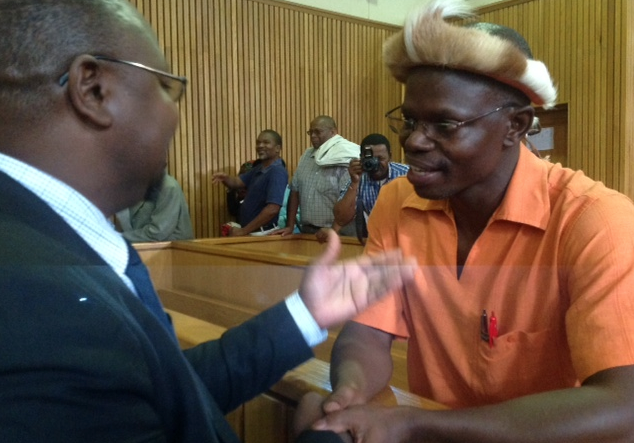
The four detainees appeared today before High Court Justice Qinisile Mabuza (photo).
Justice Minister Sibusiso Shongwe was denied bail and remains detained, while the other two High Court Judges and the registrar were released on bail.
The judges, registrar and Minister of Justice are all facing various charges related to corruption and obstructing the course of justice.
The ICJ is also aware that police are presently seeking to arrest Chief Justice Michael Ramodibedi, and that they have surrounded his place of residence.
The ICJ has received information alleging that the police have cut off the electricity and water and have actively prevented people from bringing food supplies to him and his family.
The ICJ urges the authorities in Swaziland to immediately investigate the situation of the Chief Justice and, if the allegations are substantiated, to immediately restore supply of essential services to the Chief Justices family, denied in violation of rights guaranteed under the Swaziland’s Constitution and its international legal obligations.
“The arrest and attempted arrest of several judges, and a High Court Registrar as in this case, invariably raises questions of separation of powers and the independence of the judiciary,” said Wilder Tayler Secretary General of the ICJ.
“The ICJ therefore calls on the authorities in Swaziland to conduct themselves with rigorous adherence to rule of law principles, the separation of powers between the executive and the judiciary. They must also do so with strict respect for international human rights law,” he added.
The ICJ emphasizes that the Chief Justice and the other judges are entitled as everyone else in Swaziland to freedom from arbitrary detention and the right to a fair trial guaranteed under international law.
These protections include the right to be informed the reasons for their arrest and the nature of any criminal charges, the right to representation by a lawyer of their choice and the right to be considered for bail if appropriate.
If no crime is alleged, but serious professional misconduct is suspected, then arrest and detention is inappropriate.
Additional information:
The ICJ has had longstanding concerns with the state of the independence of the judiciary and legal profession and the fair administration of the justice in Swaziland.
The ICJ has recently intervened in a case involving the conviction of prominent lawyer Thulani Maseko in an unfair trial.
For an ICJ analysis of the independence of the judiciary and legal profession in Swaziland, go here.
Contact:
Arnold Tsunga, Regional Director, ICJ’s Africa Programme, t: +27 731318411, e: arnold.tsunga(a)icj.org
Apr 20, 2015 | News
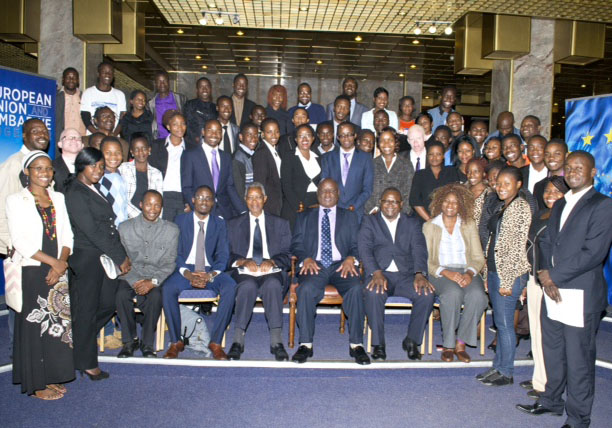
The ICJ and the Zimbabwe Law Students Association (ZILSA) held a symposium on economic, social and cultural rights (ESC rights) on 17 April 2015 at Rainbow Towers Hotel, Harare.
A total of 84 people attended the symposium, 77 being students from the University of Zimbabwe.
The presenters at the symposium were Deputy Chief Justice L. Malaba, Dr V. Guni, Mr. D. Chimbga, Ms R. Rufu and Mr. J Mavedzenge.
Economic, social and cultural rights are a new phenomenon in Zimbabwe’s human rights discourse as they have been introduced into Zimbabwe’s Declaration of rights by the new Constitution of Zimbabwe (Constitution of Zimbabwe Amendment (No.20) Act 2013).
Zimbabwean jurisprudence on ESC rights is therefore still developing.
As a consequence, the notion of the justiciability of ESC rights is one that still requires nurturing if greater protection of these rights is to be achieved.
It was this background that motivated the ICJ and ZILSA to hold this symposium on ESC rights.
The symposium forms part of a broader initiative by the ICJ to ensure ESC rights awareness, education and litigation in Zimbabwe.
Through this symposium, the ICJ and ZILSA sought to provide a platform for law students to engage in an academic discussion on the scope, meaning and enforcement of the ESC rights.
The symposium discussions were meant to increase the students’ knowledge and understanding of ESC rights.
The topics presented at the symposium focused on the historical development and significance of ESC rights, litigation and justiciability of ESC rights under the new constitution and international best practices in the implementation of ESC rights.
The key note address was made by Deputy Chief Justice Malaba, under the topic, “Defining the Role of the Judiciary in the Enforcement of ESC Rights in Zimbabwe”.
The focus of his presentation was how the Zimbabwean judiciary has developed jurisprudence around ESC rights and in particular the approach of the Constitutional Court to the issue of “progressive realization” of ESC rights.
Commenting, after the symposium, Herbert Muromba a 4th year law student and President of ZILSA said: “The Deputy Chief Justice has transformed my understanding of ESC rights. The whole concept is no longer abstract but real, alive and relevant in my everyday life.”
Contact:
Arnold Tsunga, ICJ Regional Director for Africa, t: +27 73 131 8411, e: arnold.tsunga(a)icj.org
Mar 5, 2015 | News
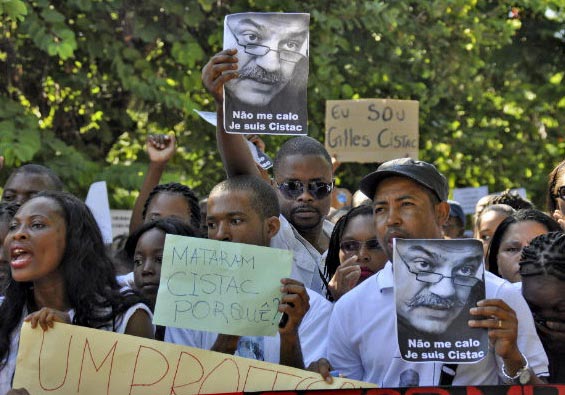
The ICJ calls for the prompt and thorough investigation into the killing of Gilles Cistac, a prominent academic and human rights defender.
Gilles Cistac served as a Professor of Law at the Faculty of Law, Universidade Eduardo Mondlane in Mozambique.
His death, at the hands as of yet un-indentified gunmen in Maputo, Mozambique, on Tuesday 3 March 2015, follows his involvement in the debates on the sensitive issues of decentralization of power and establishment of autonomous provinces in Mozambique.
It is also reported that he was the subject of recent attacks on social media by a person who used a pseudonym and called Gilles Cistac a spy and a traitor, and accused him, along with others, of subverting the country.
“Demonstrating its commitment to the rule of law and respect for human rights, which were central to Gilles Cistac’s work, the government must fulfill its obligation to investigate the killing of Professor Cistac, promptly and effectively, and to ensure that those responsible are brought to justice in fair proceedings,” said Arnold Tsunga the Africa Director of the ICJ.
These obligations arise as part of the government’s duty to protect the right to life including under the African Charter on Human and Peoples’ Rights and the International Covenant on Civil and Political Rights, international human rights treaties to which Mozambique is a party.
The government must also take steps to ensure protection of those, including human rights defenders, who exercise their right to freedom of expression.
Arnold Tsunga also called on the authorities in Mozambique to heed the message of the UN High Commissioner for Human Rights, Zeid Ra’ad Al Hussein, UN High Commissioner for Human Rights: “Human rights defenders are not violent seditionists, criminals, nor bloody revolutionaries, as so many governments like to portray them. They are the best of us, all of us. And they have a message. (…) Understand the message, talk to them about it, be persuaded or persuade, without violence, instead of silencing them, punishing them, their families, and their communities.”
The ICJ will continue to monitor is the investigation of this deadly attack as part work to promote enhanced respect for human rights and in defence of human rights defenders.
Contact:
Arnold Tsunga, t +27 716 405 926 ; e arnold.tsunga(a)icj.org
Feb 17, 2015 | News
Alleging a range of human rights violations by Swaziland in the cases of Thulani Maseko and Bheki Makhubu, leading legal advocates today filed a petition with the UN Working Group on Arbitrary Detention (UNWGAD) in Geneva.
The American Bar Association’s Center for Human Rights, the global law firm Hogan Lovells and the ICJ jointly produced a petition calling for the UNWGAD to issue an opinion regarding the lawfulness of the continued incarceration of Thulani Maseko, an internationally recognized human rights lawyer and feature writer for The Nation magazine.
“The consequences of this arbitrary action against Thulani Maseko have not only violated his rights and exacted a heavy personal toll, but have also highlighted the rule of law deficit in Swaziland,” said Wilder Tayler, ICJ’s Secretary General. “Thulani Maseko has been denied his right to express an opinion on public affairs and the administration of justice, guaranteed under international law and affirmed in the UN Basic principles on the Role of lawyers.”
Thulani Maseko and journalist Bheki Makhubu were charged with two counts of contempt of court emanating from articles published in February and March 2014, in which they questioned circumstances surrounding the arrest of a government vehicle inspector.
They were sentenced to two years of imprisonment, without the alternative option of a fine at the end of a trial largely condemned by leading international rights groups as unfair and not complying with international standards on the right to a fair trial.
Some of the fair trial guarantees that have been breached, according to the legal petition filed with the UNGWAD, include the right to be tried by an independent and impartial tribunal; right to a public hearing; right to a legal counsel; right to the presumption of innocence; right to bail; and right to protection of the law.
“The use of contempt of court proceedings to suppress the right to freedom of expression is a violation of international human rights law,” said Marc Gottridge, partner at Hogan Lovells. “The right to freedom of expression is guaranteed in the Swazi constitution and international law, including treaties to which Swaziland is a party.”
“The general failings of the Swazi judiciary with respect to independence and impartiality makes it reasonable to conclude that there cannot be an effective domestic remedy for Thulani Maseko,” he added.
Contact:
Arnold Tsunga, Director, ICJ Africa Regional Programme, t +27 716 405 926 or +41 762 399 032, e arnold.tsunga(a)icj.org,
Matt Pollard, Senior Legal Adviser, ICJ, Centre for Independence of Judges and lawyers, t +41 22 979 38 12, e matt.pollard(a)icj.org
Marc Gottridge, Partner Hogan Lovells, t +1 212 918 3000, e marc.gottridge(a)hoganlovells.com
Ginna Anderson, Senior Counsel, Center for Human Rights, American Bar Association, t +1 202 442 3438, e ginna.anderson(a)americanbar.org
Background:
Thulani Maseko was arrested on 17th March 2014 following a warrant of arrest that was issued by the Chief Justice Michael Ramodibedi on his own motion.
This was after he had written an article titled “Where the Law Has No Place” criticising the courts for the way that a fellow Swazi citizen Mr Gwebu Bhantshana had been arrested and detained and the wider implications of that case on the rule of law in Swaziland.
Save for 3 days in April 2014 when he was released following Judge Mumcy Dlamini’s judgment declaring his arrest and detention wrongful and illegal, Thulani has been in custody since his initial arrest. Mr. Maseko was initially held at Sidwashini Correctional facility before he was taken to Big Bend Correctional facility, where he is currently lodged.
Further background material can be found here:
http://www.americanbar.org/news/abanews/aba-news-archives/2014/04/statement_of_jamesr.html
https://www.icj.org/swaziland-icj-condemns-the-harsh-prison-term-imposed-on-thulani-maseko-and-bheki-makhubu/
https://www.icj.org/swaziland-icj-condemns-the-conviction-of-celebrated-human-rights-lawyer-and-prominent-journalist-on-charges-of-contempt-of-court/
https://www.icj.org/swaziland-icj-concerned-at-detention-of-human-rights-lawyer-and-journalist/
Download the petition:
Swaziland-Maseko WGAD Petition-Advocacy-2015-Eng (full text in PDF)
The lawyers at Hogan Lovells US LLP who worked on this petition are Marc Gottridge, Dianne Milner, Allison Holt and Hans H. Hertell.
Dec 5, 2014 | Multimedia items, News, Video clips
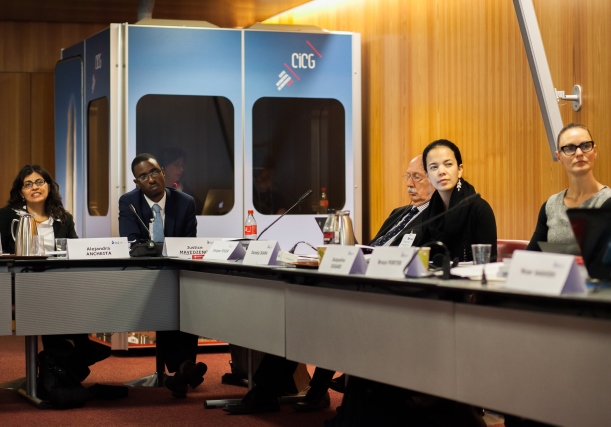
Jacqueline Dugard, Hina Jilani, Rodrigo Uprimny Yepes, Gilles Badet, Alejandra Ancheita and Harsh Mander talk about their experience and the situation of economic, social and cultural rights in their respective countries.
These prominent participants in ICJ’s Geneva Forum 2014 give their views on judicial protection of economic, social and cultural rights (ESCR) as well as on what needs to be changed to address obstacles to guarantee an effective remedy for victims of violations of their socio-economic rights.
They also tell about the main opportunities and key challenges for the realization of ESCR in their respective countries.
The 2014 Geneva Forum of Judges and Lawyers is a joint initiative of the ICJ Center for the Independence of Judges and Lawyers (CIJL) and the ICJ Programme on Economic, Social and Cultural Rights.
It has been made possible with the support of the République et Canton de Genève, the Permanent Mission of Germany to the United Nations in Geneva, and the Taipei Bar Association.