Aug 22, 2020 | News
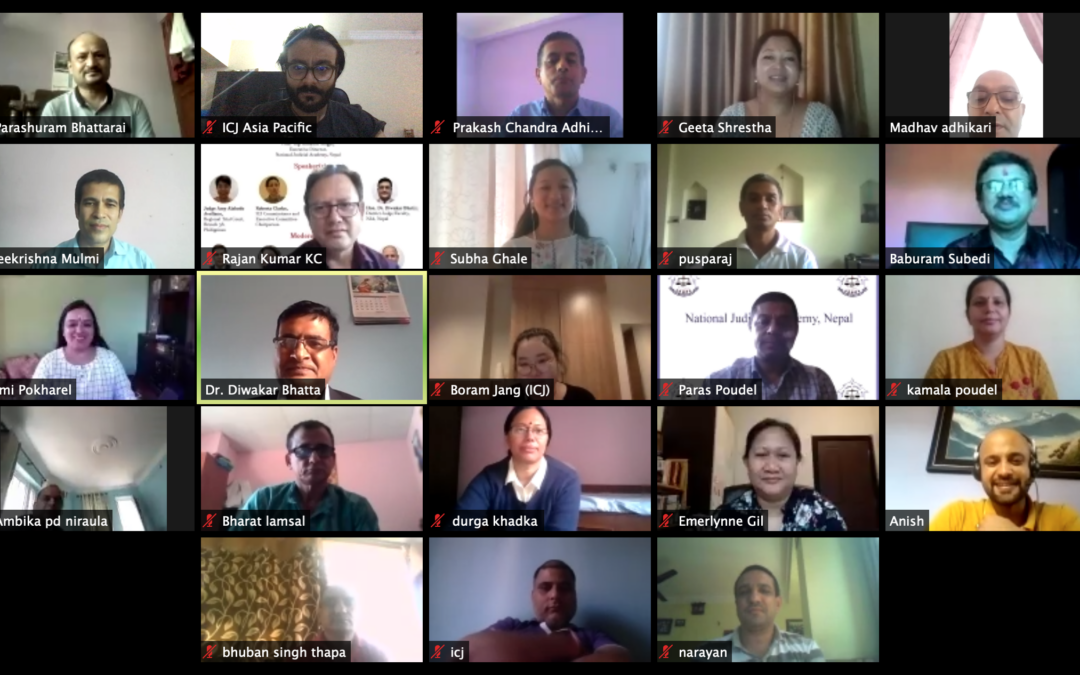
On 15 and 22 August 2020, the ICJ, in collaboration with the National Judicial Academy (NJA) of Nepal, organized the National Judicial Dialogue on the Elimination of Discrimination against Women and Enhancing Women’s Access to Justice.
Due to the exigencies caused by the COVID-19 pandemic, the judicial dialogue was conducted through virtual means.
Fifteen trial court judges from Kathmandu Valley participated in this judicial dialogue with judicial experts from other countries.
Judge Amy Alabado Avellano, a Regional Trial Court judge from the Philippines, engaged with the judges on the application of the Convention on the Elimination of All Forms of Discrimination Against Women (CEDAW) in their judicial decisions. Roberta Clarke, ICJ’s Executive Committee Chairperson and UN Women’s OIC for UN Women’s East and Southern Africa Regional Office, spoke on the right to access to justice under international human rights law.
The second day featured a discussion on specific barriers that women in Nepal face when they access justice. The judges discussed their own role and measures available to the judiciary as an institution to enhance access to justice for women in Nepal. Hon. Justice Sapana Pradhan Malla from the Supreme Court of Nepal and Dr. Diwakar Bhatta from the National Judicial Academy of Nepal led these discussions.
At the Dialogue Emerlynne Gil, ICJ Senior International Legal Adviser, remarked that “judges have a responsibility to uphold the fairness and integrity of the justice system by ensuring that proceedings are conducted in a fashion that does not subordinate the fact-finding process to myth and stereotype.” Honorable Top Bahadur Magar, the Executive Director of the National Judicial Academy, stressed that, “Trial court judges play a pivotal role in debunking myths and gender stereotypes.”
Highlighting the importance of continuing the work towards eliminating gender discriminatory practices among frontline justice actors, even during the COVID-19 pandemic, Emerlynne Gil said. “The COVID-19 pandemic is aggravating existing gender inequalities and women are experiencing more violations of their human rights.”
Contact
Laxmi Pokharel, National Legal Advisor, International Commission of Jurists, t: 977 9851047588, e: laxmi.pokharel(a)icj.org
Aug 21, 2020 | News
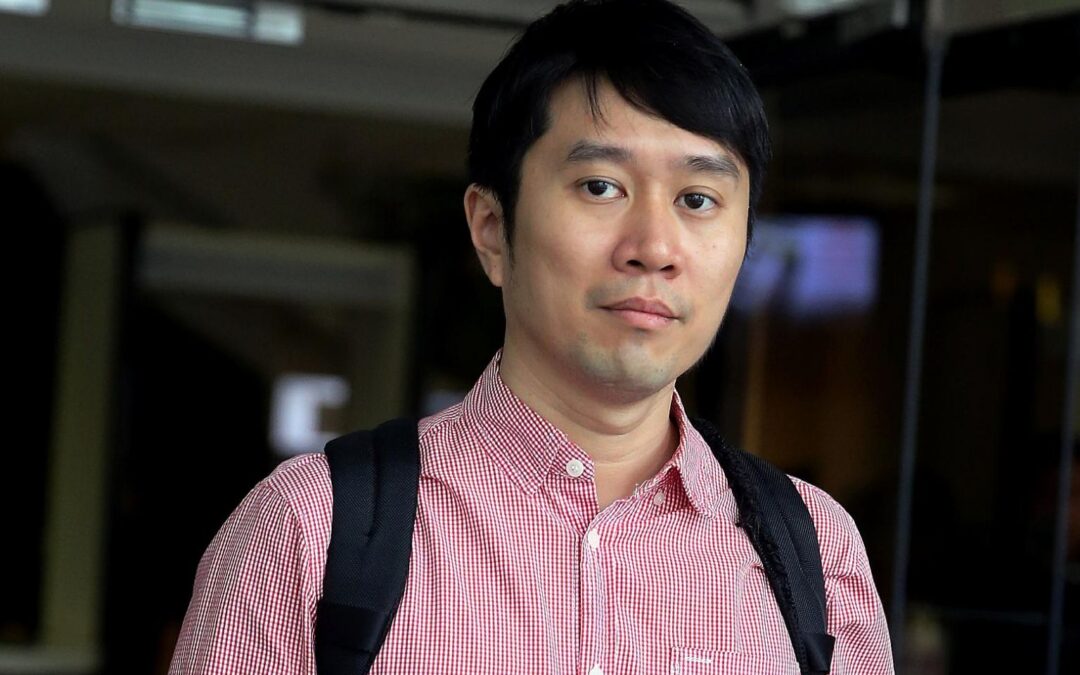
The ICJ today condemned the conviction and imprisonment of human rights defender Jolovan Wham following the dismissal of his appeal by Singapore’s highest court in connection with a conference he had organized in 2016.
The ICJ urged the Singapore’s authorities to take action to quash the conviction and immediately release Wham from prison.
The ICJ further called on the authorities to refrain from targeting human rights defenders for harassment through unwarranted legal proceedings and to amend the country’s Public Order Act which formed the basis for the charges against Wham.
“Wham will now be in jail for organizing an indoor private discussion, in violation of his rights to free expression and freedom of association and peaceful assembly,” said Ian Seiderman, the ICJ’s Legal and Policy Director.
In November 2016, Wham organized a discussion entitled “Civil Disobedience and Social Movements” for approximately 50 participants in an indoor event venue, which included Hong Kong activist Joshua Wong as a speaker who called in via a video call. Prior to the event, Wham had not applied for a police permit to conduct the discussion, which was required under the Public Order Act (POA) as Wong is not a citizen of Singapore.
In 2019, Wham was convicted of violating section 16(1) of the POA and sentenced to a fine of S$2,000 (approx. USD 1,463) or ten days’ imprisonment in default by the District Court, following which his appeal was dismissed by the High Court. Yesterday, his appeal against the High Court decision was dismissed by Singapore’s apex Court of Appeal. Today, Wham began his prison term of ten days.
“The highly flawed Public Order Act was initially adopted to regulate public assemblies and processions, but has now perversely expanded in its scope of application to cover even private discussions,” said Seiderman.
In January 2019, the UN Special Rapporteurs on the right to freedom of opinion and expression, the situation of human rights defenders and the rights to freedom of peaceful assembly and association issued a joint statement expressing concern that the conviction was “clearly neither a necessary nor a proportional response to the actions of Jolovan Wham.” The Special Rapporteurs noted that the action had wrongly targeted the “legitimate exercise of the right to freedom of expression and freedom of peaceful assembly in Singapore.”
“The conviction and imprisonment of Wham marks a continued trend of abuse of poorly conceived laws to limit free expression, association and peaceful assembly in Singapore and harass individuals who seek to bring human rights violations to light in the country,” said Seiderman.
The ICJ calls on Singapore’s legislators also to act to amend other non-human rights compliant laws, including the Protection from Online Falsehoods and Manipulation Act (POFMA), Administration of Justice (Protection) Act (AJPA), and criminal defamation provisions under its Penal Code.
Wham was previously convicted in 2018 under the AJPA for alleged contempt of court following a comment on Facebook that “Malaysian judges are more independent than Singapore’s in cases with political implications”. He currently has active charges under the POA relating to the organizing of a vigil for a death row inmate and the holding of a silent protest on an MRT train and is being investigated under the POA for holding signs silently in solidarity with other activists.
See also
In a 2019 regional report, the ICJ found that in Singapore, non-human rights compliant provisions in POFMA, AJPA and other contempt of court provisions, civil and criminal defamation laws have been used to curtail freedom of expression and information online.
ICJ, Dictating the Internet: Curtailing Free Expression, Opinion and Information Online in Southeast Asia, December 2019
Similarly, the ICJ and other human rights organizations have called on Singapore authorities to drop investigations of human rights lawyer M Ravi and others under the contempt of court law and cease their harassment of human rights defenders. On 13 August, in relation to a death penalty case M Ravi is defending, the Court of Appeal opined that a statement made by the Attorney-General’s Chambers against the lawyer could have been “reasonably construed as intimidating”, offering a recent glimpse into the trend of legal harassment faced by human rights defenders in the country.
ICJ, ICJ and other groups call on authorities to drop investigations under abusive contempt of court law, March 2020
Aug 13, 2020 | Advocacy, News
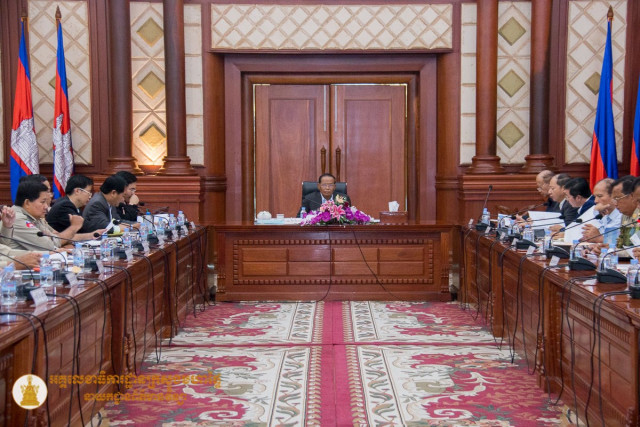
Today, the ICJ and 64 civil society organizations jointly called on the Royal Government of Cambodia (“RGC”) to discard the draft Law on Public Order (“draft law”) which, if adopted, would breach Cambodia’s international legal obligations.
The draft law aims to regulate public spaces and public behavior within those spaces, covering aesthetics, sanitation, cleanliness, noise, and social values, all under the broad aim of maintaining “public order”. It sets out a number of specific activities that are prohibited, lists a range of penalties that may be imposed for violations, and grants unfettered enforcement powers to authorities across all levels of government, with the proclaimed objective of creating “a more civilized society”.
The organizations expressed concern that the draft law contains multiple overbroad and arbitrary provisions which violate numerous human rights protections enshrined in the Constitution of the Kingdom of Cambodia and human rights treaties to which Cambodia is party, including the International Covenant on Civil and Political Rights and the International Covenant on Economic, Social and Cultural Rights.
Amidst an ongoing crackdown on fundamental freedoms in Cambodia, a number of existing laws already grant overbroad and unfettered powers to the RGC and are regularly deployed abusively to undermine human rights. Adoption of this draft Law on Public Order would serve to facilitate a further deterioration of the human rights situation in Cambodia.
The joint statement is available in English here.
The joint statement is available in Khmer here.
Contact
Kingsley Abbott, Senior Legal Adviser, ICJ Global Accountability Initiative e: kingsley.abbott(a)icj.org
See also
ICJ, ‘ICJ and 31 organizations jointly urge Governments to call for respect of human rights in Cambodia’, 22 July 2020
ICJ, ‘Cambodia: State of Emergency bill violates the rule of law’, 8 April 2020
ICJ, ‘Misuse of law will do long-term damage to Cambodia’, 26 July 2018
ICJ report, ‘Achieving Justice for Gross Human Rights Violations in Cambodia: Baseline Study’, October 2017
Aug 6, 2020
In a report published today, the ICJ called on the Government of Nepal to undertake substantial reforms in order to ensure that the wide-ranging constitutional and political restructuring of recent years will allow the country to deliver on human rights accountability and access to justice for all Nepalis.
The Report on Human Rights and the Rule of Law in a Federal Nepal incorporates the findings of a High-Level Mission undertaken by the ICJ in December 2019.
The Report offers more than 50 recommendations, including that the Nepali authorities act to remove obstacles to access to justice for those seeking a remedy and reparation for human rights violations and abuses, both from the conflict era and contemporary times. The ICJ also called upon the authorities to end political interference in the enforcement of the law and administration of justice, including in respect to directives from the courts and the National Human Rights Commission.
“In the face of the challenges of federal decentralization, it is vital that all Nepalis are able to trust in their fair and equal treatment under the law,” said ICJ Commissioner and former Nepal Supreme Court Justice Kalyan Shrestha. “This report is a guide to how that public trust can be strengthened in Nepal.”
The ICJ Mission found that despite strides in the development of human rights law, policy and jurisprudence, many long-standing obstacles to accountability and access to justice persisted and remained largely unaddressed.
“Nepal remains caught in a cycle of impunity that threatens to undermine the rule of law, as evidenced by a stalled transitional justice process, compromised justice sector institutions, a fragmented civil society, and the persistence of systemic discrimination,” said ICJ Commissioner Dame Silvia Cartwright. “Despite notable efforts by provincial policymakers, a robust judiciary and the relentless advocacy of civil society, authorities representing the ‘new’ Nepal are in danger of repeating the mistakes of the past in failing to truly listen and respond to the demands of Nepalis for justice.”
The Report considers the human rights impacts of recent changes in the political and legal context, such as the implementation of provisions of the 2015 Constitution that operationalize elements of a new federal system of governance, long-awaited amendments to the Penal Code and other laws affecting the criminal justice system, and a lack of progress in the transitional justice process, as well as the de-stabilizing effects of recent political developments and COVID19.
The Mission was undertaken by ICJ Commissioners Justice Sanji Monageng (Botswana), Dame Silvia Cartwright (New Zealand) and Justice Kalyan Shrestha (Nepal), as well as ICJ Legal and Policy Director Ian Seiderman and ICJ Asia-Pacific Director Frederick Rawski.
The Report, building on a 2017 ICJ baseline study, offers findings in three main areas:
- Non-Implementation. Nepal has made notable strides in the progressive development of law and jurisprudence that incorporates significant elements of the international human rights law framework, such as the fundamental rights provisions of the 2015 Constitution. However, constitutional mandates, legislation and judicial decisions have in many cases gone unimplemented or been actively undermined at the expense of public trust in government, and access to justice for victims.
- Independent and Impartial Institutions. Nepal has made progress in establishing and building the capacity of justice institutions including police, prosecutors, the judiciary, transitional justice mechanisms and national human rights bodies. However, these institutions suffer from weaknesses in capacity and independence, and are vulnerable to political influence and manipulation.
- Accountability and Access to Justice. Despite improvements in the law and progress in institution-building, Nepalis still face the same barriers to accessing the justice system. Frontline institutions, particularly the police and prosecutors, lack the political will and capacity to effectively interface with communities. Individual Nepalis, especially those from ethnic minority communities or without proof of citizenship, typically face overwhelming obstacles when pursing a remedy in the courts.
Safeguarding the independence of the judiciary was a central theme of the Mission. The Mission found that the Supreme Court continues to effectively carry out its responsibilities under Nepal’s constitution and international law to protect human rights. However, it also concluded that persistent non-implementation of judicial decisions constituted a serious abdication of responsibility on the part of the executive authorities.
“The Mission was impressed by the role that the judiciary, and particularly the Supreme Court, has played in protecting human rights,” said ICJ Commissioner Justice Sanji Monageng. “However, we repeatedly heard concerns that officials routinely ignore judicial decisions – to such a degree that non-implementation threatens to diminish the credibility of the judiciary in the eyes of the public.”
The Mission found that the failure to respect judicial decisions was exacerbated by political interference in the appointment processes of key institutions, such as the Supreme Court, Nepal Police, National Human Rights Commission and transitional justice bodies. Among its recommendations, the report calls for the adoption of more fair and transparent appointment processes, and other measures to prevent political interference in the application of the law.
“Political interference in the appointments of high public officials erodes public trust, degrades the effectiveness of governance, and creates conditions for corruption,” added Justice Shrestha. “This includes the current system of judicial appointments, which is vulnerable to political influence, and must be reformed.”
Drawing on these findings and observations, the report offers extensive recommendations directed to the Office of the Prime Minister, federal and provincial legislatures, the Nepal Police, the Office of the Attorney General, the judiciary including the Supreme Court and National Judicial Academy, the National Human Rights Commission, civil society and the diplomatic community.
Download
Human Rights and the Rule of Law in a Federal Nepal: Recommendations from an ICJ High-Level Mission in English and Nepali.
Executive Summary and Recommendations in Nepali.
Story in English and Nepali
Contact
Frederick Rawski, ICJ Asia-Pacific Director, e: frederick.rawski(a)icj.org
Ian Seiderman: ICJ Legal and Policy Director, e: ian.seiderman(a)icj.org
Mandira Sharma: ICJ Senior Legal Adviser, e: mandira.sharma(a)icj.org
Aug 3, 2020
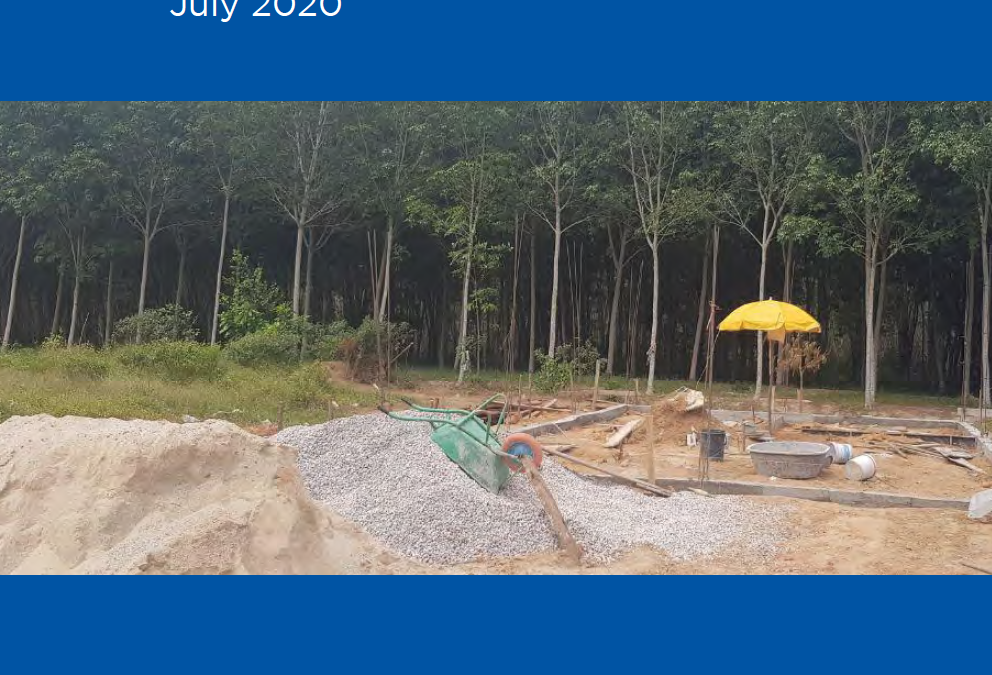
In a report published today, the ICJ called on the Thai government, legislature and regulatory agencies to take steps to address deficiencies in the legal and regulatory framework governing economic development in Special Economic Zones and the Eastern Economic Corridor to improve transparency, protect communities and labourers’ human rights, and implement safeguards to mitigate the adverse impact of such development on the environment and human rights.
The report, titled ‘The Human Rights Consequences of the Eastern Economic Corridor and Special Economic Zones in Thailand’ identifies gaps and weaknesses in the current law and policy governing investment in areas that have been designated for economic development in order to attract foreign investment. The report documents reported human rights violations and abuses of affected communities, as well as the adverse impact on the environment and working conditions for migrant labourers.
Drawing on international law and good practices, and the ICJ’s previous work in Myanmar, the report offers a detailed set of recommendations for how to improve the existing legal framework in order to prevent future human rights violations and abuses and provide reparation to victims of human rights violations perpetrated in and associated with SEZs.
“There is no reason for Thailand to repeat the mistakes made by governments elsewhere in the world that have rushed to dilute human rights and environmental legal protections in a misguided attempt to attract foreign investment,” said Frederick Rawski, ICJ Asia-Pacific Director.
“Safeguarding the well-being of local communities and the environment, ensuring decent conditions for migrant workers, and establishing transparent and inclusive decision-making processes are essential elements of a sustainable development that respects human rights,” he added.
As discussed in the report, the current laws and regulations governing SEZs do not contain adequate procedural safeguards and human rights protections, including for the rights to food, health, water, work and adequate housing.
While the law governing development of the EEC does contain a number of provisions that protect communities and the human rights of affected individuals, the report outlines concerns about the regulatory body governing the EEC’s broad discretionary powers and inadequate transparency in its work, as well as a lack of adequate preventive and remedial frameworks to ensure respect of human rights and environmental protections in areas designated for development under the law.
“The ICJ is encouraged by the fact that Thailand has adopted a stand-alone National Action Plan (NAP) on Business and Human Rights – the first country in Asia to do so. As part of the NAP, it has committed to reviewing and amending laws and regulations to ensure that they comply with human rights law and standards”, said Rawski.
“This report offers a set of concrete recommendations for law and policymakers to help them to fulfill this commitment as it pertains to the environmental and human rights consequences of SEZs, and the development of the EEC in particular,” he added.
The report was based on extensive legal research, as well as interviews with over 90 people, including individuals from affected communities in Chonburi, Chachong Sao, Rayong, Songkhla and Tak provinces, as well as human rights lawyers, academics and government officials at the provincial and central levels.
Key recommendations to the Government of Thailand
- Protect human rights by amending SEZ legal frameworks, EEC laws, laws governing land acquisition and environmental and labour protections, following meaningful public consultation in accordance with international standards, to ensure that:
- the government bodies responsible for developing and administering SEZs and the EEC be independent, and operate in a transparent and inclusive manner including by providing public participation in planning and decision-making processes;
- all persons have a minimum degree of security of tenure sufficient to protect them from forced eviction, harassment and other threats;
- standards be in place to protect the environment, and to mitigate the impact of environmental degradation on communities; and
- all workers enjoy equal rights protections based on the principles of non-discrimination and equality.
- Adopt an amended SEZ Act that contains provisions that are in compliance with Thailand’s international human rights obligations.
- Ensure that effective, prompt and accessible judicial and non-judicial remedies be provided to those affected by the implementation of SEZ and EEC policies; and
- Ensure that companies operating in SEZs and the EEC carry out business activities in line with the UN Guiding Principles on Business and Human Rights.
Download
The Human Rights Consequences of the Eastern Economic Corridor and Special Economic Zones in Thailand in English and Thai. (Updated in February 2021)
Story with additional background information in English and Thai.
Contact
Frederick Rawski, ICJ Asia Pacific Regional Director, e: frederick.rawski(a)icj.org
Further reading
Myanmar: amend Special Economic Zones Law to protect human rights – new ICJ report