Jul 16, 2020 | Advocacy, Non-legal submissions
The ICJ and its Dutch national section today highlighted findings and recommendations of the UN Special Rapporteur on racism, racial discrimination and xenophobia, on her visit to the Netherlands.
The statement was prepared for the ICJ by its Dutch national section, Nederlands Juristen Comité voor de Mensenrechten (NJCM), for today’s interactive dialogue with the Special Rapporteur at the UN Human Rights Council, but could not be read out during the meeting due to limited time allowed for civil society statements:
“Madam Special Rapporteur,
The ICJ highly appreciates your dedicated work in the fight against racism, and welcomes your report following your country visit to the Netherlands last October. During this visit you met our colleagues from the Dutch section of the ICJ, who have prepared and join in this statement.
The ICJ shares your concern that the highest levels of political office in the Netherlands do not reflect the racial, ethnic and cultural diversity of its society. The extent in which under-representation still plays a role in the Netherlands is worrisome. This is reflected in the lack of inclusive and non-discriminatory policies.
The ICJ agrees that a full account of the history of slavery and colonialism is fundamental in Dutch education. The essence of this education must highlight how the exploitation of colonized peoples and territories normalized racial and cultural hierarchies. Racial relations in the Netherlands will not be understood in context without a fair and accurate account of history.
The ICJ commends you for addressing the systemic and institutional nature of racism within the Netherlands on an intersectional level and we call upon the government to fulfill its human rights obligations in this regard.
Madam Rapporteur could you share good practices in which governments collect data on ethnic minorities to help protect human rights while protecting against misuse of the data?
Thank you.”
Jul 10, 2020 | Events, News
Today, the ICJ and the Human Rights Joint Platform (IHOP) are hosting an online conference to take stock of the current situation of access to justice and the rule of law in Turkey and discuss compliance with international standards and the Turkish Constitution.
The online conference features international and European experts and will address the shortcomings in accessing justice in the country both in terms of the capacity of the justice system to ensure the respect and protection of human rights and of the independence and effectiveness of the justice system itself.
The conference will take stock of the state of access to justice in Turkey after four years of extraordinary and worrisome events for the Rule of Law and human rights in the country. During this period, Turkey has experienced a severe deterioration in the rule of law. The state of emergency, in force between 2016 and 2018, has led to the cleansing of the judiciary and restricted the capacity of lawyers and civil society to act, and increasingly dramatically the arrests and trials of some of their members under spurious charges of terrorism, offences against the State, insult to the nation or its President, and hate speech crimes.
Many of the measures undertaken under the state of emergency included mass dismissal of public servants, judges and prosecutors without ensuring due process guarantees and the degradation of the justice system, depriving the judiciary of essential guarantees to ensure its independence from the political authorities.
The conference will address how these developments impacted the capacity of people in Turkey, and in particular those belonging to marginalised groups, to access justice for their human rights, and what should be done to ensure that such access exists and is effective.
As a result of the conference, a draft statement on the state of access to justice in Turkey will be issued to provide Turkish authorities with recommendations on how to ensure effective and independent access to justice for human rights protection.
Jul 9, 2020 | Agendas, Events, News
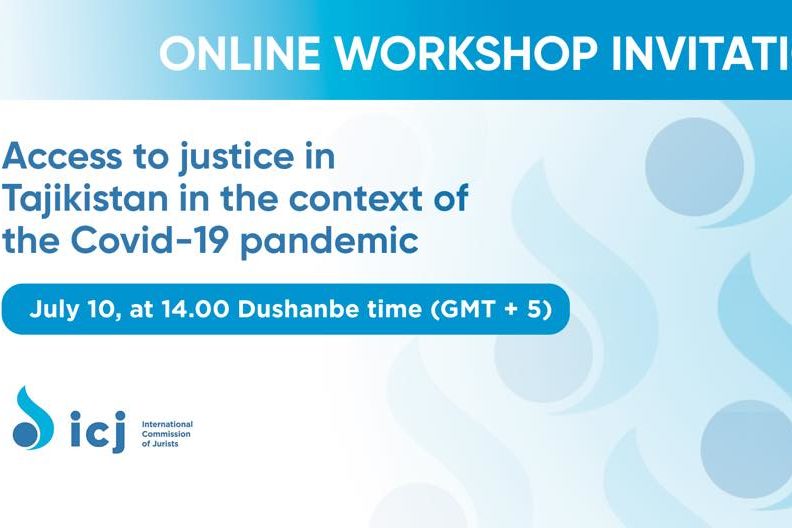
The ICJ is holding an online discussion for lawyers and other representatives of civil society in Tajikistan on access to justice in the context of the Covid-19 pandemic. The discussion is held on 10 July 2020 from 14.00 to 17.00 Dushanbe Time (GMT + 5) on the GoToMeeting platform
The discussion aims to raise some of the main issues that lawyers face in providing legal representation both in and outside of courts.
The event will present an opportunity for practicing lawyers, NGOs and IGOs to discuss the recent challenges that the legal profession faced in Tajikistan as well as seek some of the solutions based on international law and best practices of other countries.
During the discussion, relevant international law and standards as well as comparative examples from the Central Asian countries and Azerbaijan will be discussed.
To participate in the discussions registration is required on the following link : https://forms.gle/QRywqBFPSxfR5eyk7
Working languages of the event are Russian and Tajik.
Contact:
Dilshod Juraev, t: +992 77 700 18 34 ; e: Dilshod.jurayev(a)icj.org
Jul 8, 2020 | News
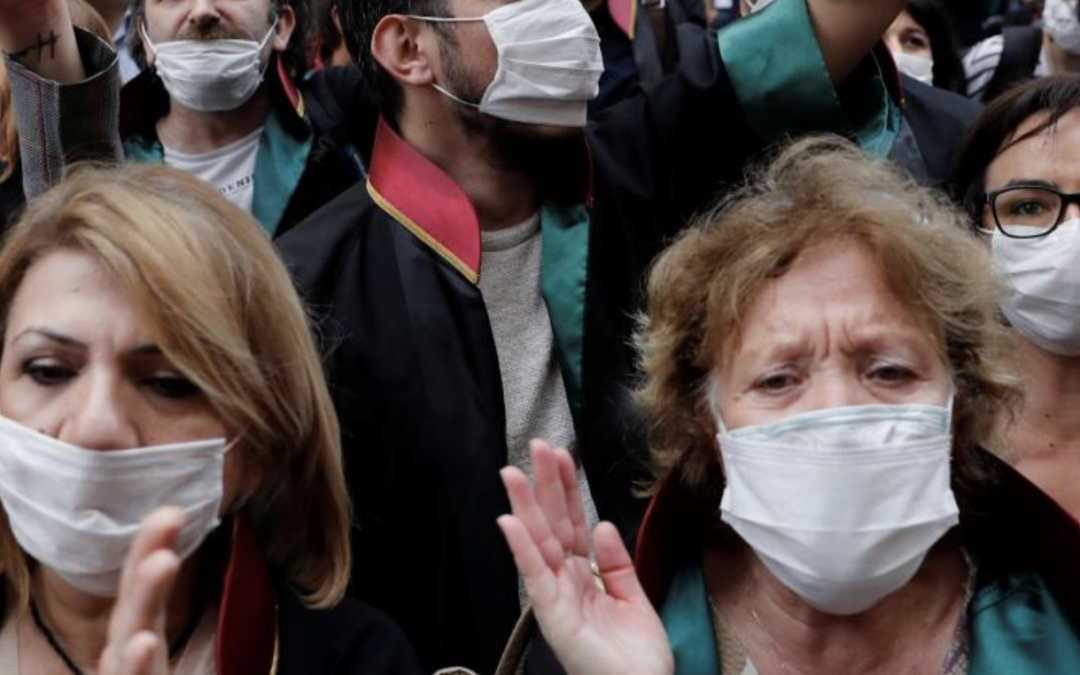
Draft law reduces leading bar associations’ authority, leads to creation of rival groups, the ICJ and Human Rights Watch said today. The Turkish government’s plan to allow for multiple bar associations appears calculated to divide the legal profession along political lines and diminish the biggest bar associations’ role as human rights watchdogs, they added.
The current bar associations have not been consulted, and 78 bars out of 80 signed a statement opposing the plan.
The ICJ and Human Rights Watch have published a question and answer document explaining the draft law, scheduled for a vote in parliament in the coming days. The document outlines the government-led effort to reduce the influence of leading bar associations, reflecting the executive’s growing dissatisfaction with the bar associations’ public reporting on Turkey’s crisis for human rights and the rule of law.
“Turkey’s prominent bar associations play a key role in defending fair trial rights and scrutinizing human rights at a time when flagrant violation of rights is the norm in Turkey,” said Hugh Williamson, Europe and Central Asia director at Human Rights Watch.
“The government move to create multiple bars and dramatically cut leading bars’ representation at the national level is a clear divide-and-rule tactic to diminish the bar associations’ authority and watchdog role,” he added.
The proposed amendments provide that in provinces with over 5,000 lawyers, a group of at least 2,000 lawyers can establish alternative bar associations.
In big cities such as Istanbul, Ankara, and Izmir, several bar associations could be established. The amendments would also greatly reduce the representation of the largest bar associations at the national level within the Union of Turkish Bars, the Ankara-based umbrella body with significant financial resources it controls and distributes to provincial bars.
The fact that the vast majority of elected legal profession representatives oppose the move and that the likely impact will be to greatly diminish the authority of leading provincial bars that have been critical of certain government initiatives demonstrates that the aim of the proposed change is to shield the government from justified criticism, the ICJ and Human Rights Watch said.
Drastically cutting the number of delegates from large bar associations representing thousands of lawyers to the national Union of Turkish Bar Associations would reduce the influence of the large bar associations in electing the national group’s president and participating meaningfully in other decision-making functions.
A provincial bar association with fewer than 100 lawyers, such as Ardahan in northeastern Turkey, for example, would be represented by 4 delegates, compared with 3 at present.
But a bar association such as Izmir in western Turkey, with over 9,500 lawyers, which sends 35 delegates, would be entitled to only 5. Istanbul, Ankara, and Izmir Bar, which represent 55 percent of the lawyers in Turkey, would be entitled to only 7 percent of all delegates within the national union.
The atmosphere of conflict in which the draft law has been introduced, its timing, and the lack of consultation with the bar associations themselves provides credible grounds for great concern and skepticism over the government’s motives, the groups said.
Over the past year, Turkey’s presidency and government have made public statements strongly criticizing leading bar associations in response to the bars’ legitimate expression of concerns about Turkey’s rule of law crisis and executive interference in the justice system.
The government has reacted strongly against the bars’ scrutiny of its failure to uphold human rights obligations through bar association publication of reports on torture, enforced disappearances, and other rights abuses ignored by the authorities.
For these reasons, the government’s proposed amendments are clearly designed to achieve a political purpose unrelated to an effort to advance or strengthen standards in the legal profession, the ICJ and Human Rights Watch said.
The government’s move is politically divisive and will contribute to undermining the appearance of independence and impartiality in the justice system.
“The government should immediately withdraw the current proposed amendment and embark on a process of full consultation with bar associations,” said Róisín Pillay, Director of ICJ’s Europe and Central Asia Programme.
“The government’s plan as it stands will only deepen mistrust in Turkey’s justice system as lacking independence by dividing the legal profession along political lines. This could have disastrous long-term consequences for upholding the role and function of lawyers and for fair trial rights.”
Contact:
Róisín Pillay, Director of ICJ’s Europe and Central Asia Programme, t: +32-2-734-84-46 ; e: roisin.pillay(a)icj.org
Massimo Frigo, Senior Legal Adviser, ICJ’s Europe and Central Asia Programme, t: +41-79-749-99-49 ; e: massimo.frigo(a)icj.org ; Twitter: @maxfrigo
Download
Turkey-Q and A on the bar associations-Advocacy-2020-ENG (Q & A, in PDF)
Turkey-Q and A on the bar associations-News-Press releases-2020-TUR (Story in Turkish, PDF)
Turkey-Q and A on the bar associations-Advocacy-2020-TUR (Q & A in Turkish, PDF)
Jul 3, 2020 | News
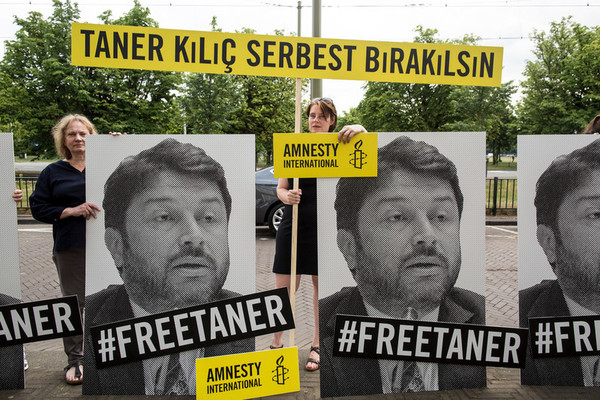
The ICJ deplores today’s conviction of former Amnesty International Turkey President Taner Kılıç, and former Chair of Human Rights Agenda Association Günal Kurşun, former Director of Amnesty International Turkey İdil Eser and human rights defender Özlem Dalkıran by the Istanbul 35th Heavy Penal Court, on clearly unfounded terrorism charges.
“These convictions, which were clearly revealed to be baseless during the trial, are an alarming setback to efforts to restore the rule of law in Turkey,” said Massimo Frigo, Senior Legal Adviser for the ICJ Europe and Central Asia Programme.
“This prosecution and conviction constitute harassment of human rights defenders, in violation of a number of Turkey’s international legal obligations. The Turkish authorities should be protecting human rights and supporting the important work of human rights defenders, but instead we have witnessed a continuing pattern of arrests on human rights defenders in the country,” he added.
Taner Kılıç has been sentenced to six years and three months of imprisonment for “membership of a terrorist organization. Günal Kuşun, İdil Eser and Özlem Dalkıran were sentenced to one year and 13 months of imprisonment for “assisting a terrorist organisation”. This decision was taken by majority, with one dissenting opinion that called for their acquittal.
The Court acquitted the other defendants in the case: Nalan Erkem, İlknur Üstün, Ali Gharavi, Peter Steudtner, Veli Acu, Nejat Taştan et Şeyhmus Özbekli.
On 6 June 2017, Taner Kiliç, then President of Amnesty International Turkey was arrested on spurious terrorism charges. The other human rights defenders were arrested while attending a training in Istanbul on digital security and information management; also reported arrested were two trainers (reportedly a German and a Swedish national) and the owner of the training venue.
In Turkey, anti-terrorism offences are oftentimes abused and are applied in over-extensive terms to charge and prosecute human rights defenders and political dissenters, as it occurred in this case. The ICJ has highlighted this problem in several reports, including in its submission to the UN Human Rights Council on the universal periodic review of Turkey.