Oct 11, 2018 | Nouvelles
La CIJ a condamné aujourd’hui la nomination par le président Andrzej Duda de 27 juges à la Cour suprême en remplacement de ceux qui ont été mis «à la retraite forcée» en juillet dernier.
«Ces nominations sont manifestement illégitimes et portent gravement atteinte à l’état de droit en Pologne», a déclaré Róisín Pillay, directrice de programme de la CIJ pour l’Europe et l’Asie centrale.
Les nouvelles nominations visent à remplacer les juges de la Cour suprême, y compris la présidente de la Cour suprême, Małgorzata Gersdorf, dont la «retraite forcée» constitue une violation flagrante des normes internationales relatives à la sécurité du mandat et à l’indépendance des juges.
La décision du président est d’autant plus préoccupante qu’elle enfreint une décision de la Cour suprême suspendant la loi en vertu de laquelle ces nominations ont été faites, dans l’attente d’une décision de la Cour de justice de l’Union européenne.
L’un des principes fondamentaux de l’état de droit et des principes relatifs à l’indépendance du pouvoir judiciaire est que l’exécutif respecte les décisions dûment prises par le pouvoir judiciaire.
«En annonçant ces nominations maintenant, alors que des cas relatifs à la retraite forcée de juges de la Cour suprême sont toujours pendants à la Cour européenne, le président Duda a ignoré les procédures de l’instance judiciaire suprême de l’Union européenne», a ajouté Róisín Pillay.
La CIJ considère que la légalité de la nomination des nouveaux juges est d’avantage compromise par le rôle joué par le Conseil national de la magistrature, désormais politisé, dont l’indépendance et l’impartialité ont été gravement compromises par les récentes modifications législatives.
La CIJ exhorte les autorités polonaises à cesser toute ingérence envers la Cour suprême dans l’exercice de ses fonctions légitimes, et à inverser les mesures prises de contraindre les membres de la Cour suprême à prendre leur retraite.
Contexte
Cette offensive contre les agissements de la Cour suprême a lieu dans le cadre d’un travail de sape systématique de l’indépendance du pouvoir judiciaire en Pologne par les autorités exécutives et législatives polonaises, dans le but d’accroître leur influence politique sur le pouvoir judiciaire, ce que la CIJ a maintes fois condamné.
Plus tôt cette année, la Pologne a adopté une nouvelle loi sur la Cour suprême qui tente de contraindre un tiers des juges à la Cour suprême « à prendre leur retraite », y compris son Premier président, en abaissant l’âge de la retraite obligatoire de ses juges de 70 à 65 ans. Cette mesure contrevient clairement au droit et aux standards internationaux relatifs aux droits de l’Homme.
La Commission européenne a lancé une procédure d’infraction pour non-conformité de cette loi avec le droit européen.
En l’absence de réformes satisfaisantes de la part de la Pologne, la Commission a saisi la Cour de justice de l’Union européenne (CJUE) le 24 septembre et a demandé des mesures provisoires pour rétablir la Cour suprême de ce pays dans sa situation antérieure au 3 avril 2018.
Au même moment, la Cour suprême de Pologne a adressé à la CJUE une demande de décision préliminaire visant à obtenir son interprétation sur la conformité de sa législation sur l’âge de la retraite des juges au regard du droit européen, en particulier en ce qui concerne l’interdiction de la discrimination basée sur l’âge, et ce en vertu de la Directive 2008/78. .
Conformément à la jurisprudence de la CJUE, la Cour suprême a suspendu l’application du droit national sur la retraite forcée des juges.
Une lettre de la CIJ du 11 juillet 2018 (uniquement disponible en anglais), signée par 22 hauts magistrats de toutes les régions du monde, a exhorté le gouvernement polonais à agir immédiatement pour réintégrer les juges mis de force à la retraite.
Oct 5, 2018 | News
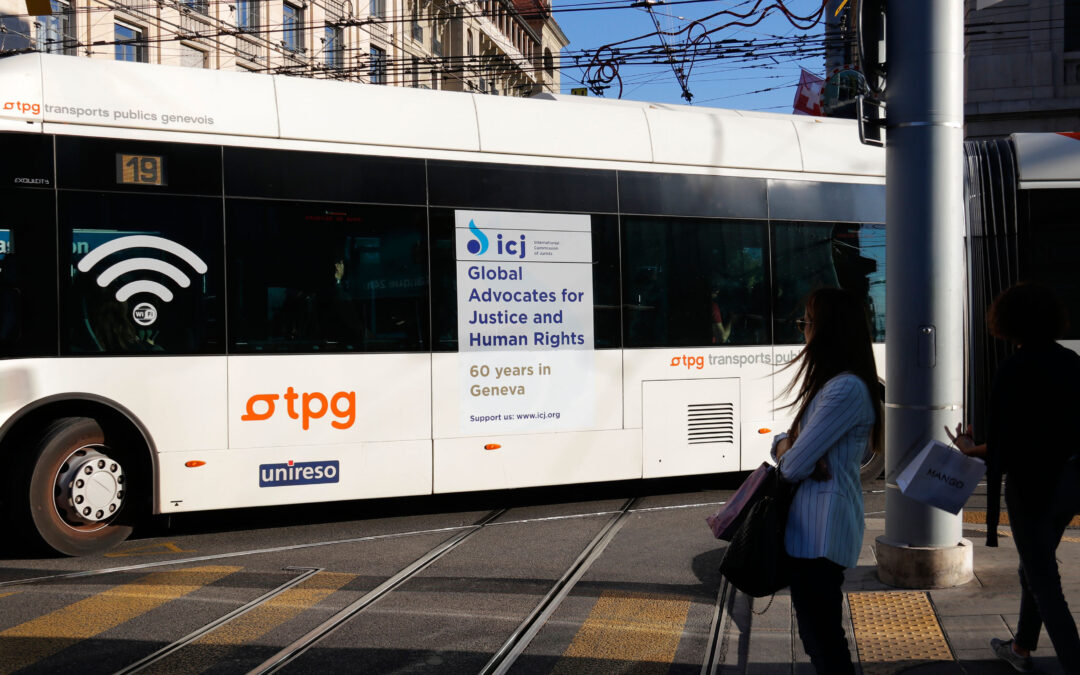
2018 marks the 60th anniversary of the ICJ’s move to Geneva thanks to the great Swiss jurist Jean-Flavien Lalive, who was ICJ’s Secretary General in 1958.
This makes the ICJ one of the earliest international organizations to establish its headquarters in Geneva.
At the 1959 ICJ Congress in New Delhi, Dr. Lalive helped breathe new life into the rule of law and human rights.
The Delhi Declaration is, to date, a fundamental instrument interpreting the rule of law as a living concept, and underscoring the primary role of lawyers in its safeguard and in the advancement of human rights.
The ICJ plays a unique and preeminent role as a non-governmental organization seeking to defend human rights and the rule of law worldwide.
The ICJ will mark this event with two major initiatives:
- A visibility campaign from 26th September to 9th October: the TV screens on the Geneva public transport network and five vehicles will carry the slogan “Global Advocates for Justice and Human Rights – 60 years in Geneva”
- The launch of the “60th Anniversary Appeal” to all lawyers in the Republic and canton of Geneva to support the ICJ and, in turn, their less privileged colleagues, victims of persecution on five continents.
“Geneva can be proud of its image as the world human rights capital. It is a beacon for justice advocates around the world. We must continue to make it shine,” said Sam Zarifi, Secretary General of the ICJ.
“Through its 60-year history, the ICJ has contributed significantly to Geneva’s human rights record: the campaigns that led to the creation of the post of UN High Commissioner for Human Rights in 1993 and the UN Human Rights Council in 2006, as well as the adoption of the United Nations Convention against Torture in 1984 are some emblematic examples,” said Olivier Coutau, Head of La Genève Internationale.
“In the face of repeated attacks on human rights, the world needs, more than ever the ICJ’s competent, rigorous and effective defense of the rule of law,” Sam Zarifi added.
The Republic and canton of Geneva support the ICJ 60th Anniversary Appeal.
Additional information
The international reputation of the ICJ rests on these pillars:
- 60 Commissioners – eminent judges and lawyers – from all regions of the world and all legal systems – with unparalleled knowledge of the law and human rights;
- Cooperating with governments committed to improving their human rights performance;
- Effective balance of diplomacy, constructive criticism, capacity building, and if necessary, ‘naming and shaming’;
- Unmatched direct access to national judiciaries, implementing international standards and improved legislation impacting millions;
- Guiding, training and protecting judges and lawyers worldwide to uphold and implement international standards;
- Working for access to justice for victims, survivors and human rights defenders, in particular from marginalized communities;
- Following a strict result based management in project delivery.
In recognition of this effective approach, the ICJ has been awarded, during its long history, some of the most prestigious international awards: the Council of Europe Human Rights Prize, the United Nations Award for Human Rights, Erasmus Prize, Carnegie Foundation Wateler Peace Prize.
In 2018, the ICJ provided local trainings on five continents to assist 4,300 judges, lawyers and prosecutors strengthen their ability to protect and promote fundamental rights.
The ICJ has consultative status with the United Nations Economic and Social Council, UNESCO, the Council of Europe and the African Union.
Contact :
Michaël W. Sombart, Director Philanthropy & Strategic Partnerships, t: +41 22 979 38 31 ; m: +41 77 965 98 45 ; e: michael.sombart(a)icj.org
Oct 3, 2018 | News
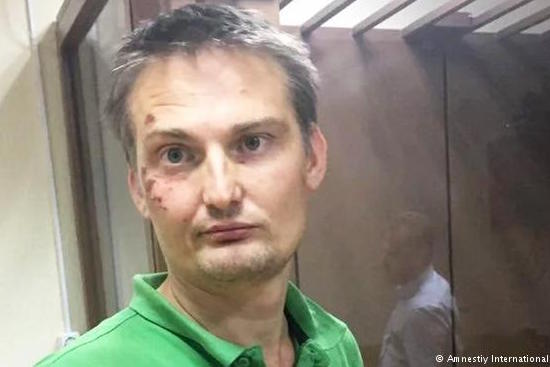
Today, the ICJ expressed concern at ongoing criminal proceedings against Mikhail Benyash, a lawyer practicing in Russia, who is charged with use of force against the police and impeding justice.
The lawyer has been detained until 23 November. The ICJ called on the responsible authorities to drop any criminal charge relating to his conduct of professional duties in the courtroom, and to ensure that the lawyer’s rights are protected and that allegations of his ill-treatment are fully investigated.
Benyash alleges that following his apprehension by the police on 9 September, the police beat him up in the car. According to the police report he inflicted the injuries on himself, contrary to demands of the police that he stop doing so.
He was charged with disobedience to the police, which according to the police report was due to “the fact that the police asked Benyash not to injure himself, but he continued self-beating”. Benyash was convicted and sentenced to 14 days of imprisonment and 40 hours of correctional works.
On 23 September, the day of his release, Benyash was arrested again. He was charged with two further offences: violence against a representative of authority (Criminal Code Article 318(1)) based on an allegation, seemingly not raised at the time of his earlier charge and conviction in relation to the same incident, that in the course of his arrest on 9 September he allegedly bit a police officer and hit another.
On 23 September he was also charged with obstruction of justice (Criminal Code Article 294(1)), reportedly on the basis of an allegation that in a court hearing on 6 May 2018, Benyash had “repeatedly interrupted, gave instructions and objections to the decisions of the judge” and after he had been removed from the courtroom “continued unlawful behaviour”.
According to the lawyer, he was taken out of the courtroom by force due to his motions to allow certain members of the public to be present at the open hearing.
The ICJ is concerned that the criminal obstruction charge against Mikhail Benyash appears to relate at least in part to statements he made in court in the course of carrying out his professional duties of representation of his clients.
The fact that this charge was only laid following his recent arrest, some five months after the alleged incident occurred, also raises questions as to the motivation for bringing the charge forward now.
“Benyash is currently charged on account of his alleged attack on a police officer and obstruction of justice. While the first charge requires an impartial and independent inquiry, the second charge should be of concern to the entire lawyers’ community”, said Karinna Moskalenko, ICJ honorary member. “We fear that this may lead to lawyers in Russia being charged with obstruction of justice simply for actively expressing their position and objections in accordance with the procedure prescribed by law”, she added.
Furthermore, the ICJ emphasises that under international human rights law, states have obligations to investigate allegations of treatment that may amount to torture or inhuman or degrading in violation of Article 3 of the European Convention on Human Rights, as well as other international law norms binding on the Russian Federation.
The investigative authorities have duty to investigate allegations of ill-treatment of the lawyer by police following his arrest on 9 September promptly, effectively and impartially and any persons responsible should be brought to justice.
Read the ICJ’s full statement here: Russia-Statement on Benyash-News-Web Story-2018-ENG

Oct 3, 2018
European leaders should act quickly to help the Aquarius, the last nongovernmental search and rescue ship operating in the Mediterranean, register after its flag was withdrawn by Panamanian authorities, five international rights organizations said today in an open letter.
The letter was sent to European leaders on the fifth anniversary of the Lampedusa shipwreck, in which at least 368 people died, urging them to offer the Aquarius a flag.
“The Aquarius has saved tens of thousands of lives at sea, filling a gap left by states,” said Judith Sunderland, acting Europe and Central Asia deputy director at Human Rights Watch, on behalf of the organizations. “What better homage to those who died off Lampedusa five years ago than to ensure that the Aquarius—a symbol of solidarity and respect for human life and dignity—can continue its life-saving work.”
The letter was signed by Amnesty International, Human Rights Watch, European Council on Refugees and Exiles (ECRE), International Commission of Jurists (ICJ), and the International Federation for Human Rights (FIDH).
SOS MEDITERRANEE and MSF initiated a petition here.
For more information and to arrange an interview, please contact:
Róisín Pillay, ICJ Europe Programme Director: + 32 2 734 84 46; or roisin.pillay(a)icj.org
The full letter is available here: Europe-Aquarius Letter-Advocacy-Open Letter-2018-ENG

Oct 3, 2018 | Communiqués de presse, Nouvelles, Plaidoyer
Les dirigeants européens doivent agir rapidement pour aider l’Aquarius, dernier navire de recherche et de sauvetage non-gouvernemental opérant en Méditerranée, à s’immatriculer après le retrait de son pavillon par les autorités panaméennes, ont annoncé aujourd’hui cinq organisations internationales des droits de l’Homme dans une lettre ouverte (uniquement disponible en anglais).
La lettre a été envoyée aux dirigeants européens à l’occasion du cinquième anniversaire du naufrage de Lampedusa, qui a fait au moins 368 morts, les exhortant à offrir un pavillon à l’Aquarius.
«l’Aquarius a sauvé des dizaines de milliers de vies en mer, comblant ainsi le vide laissé par les États», a déclaré Judith Sunderland, directrice adjointe par intérim de Human Rights Watch pour l’Europe et l’Asie centrale, au nom des organisations. «Quel meilleur hommage à ceux qui sont morts au large de Lampedusa il y a cinq ans que de veiller à ce que l’Aquarius, symbole de solidarité et de respect de la vie et de la dignité humaines, puisse continuer à sauver des vies».
La lettre a été signée par Amnesty International, Human Rights Watch, le Conseil européen sur les réfugiés et les exilés (ECRE), la Commission internationale de juristes (CIJ) et la Fédération internationale des droits de l’Homme (FIDH).
SOS MEDITERRANEE et MSF ont lancé une pétition ici (uniquement disponible en anglais).
Pour plus d’informations et pour organiser une interview, veuillez contacter:
Róisín Pillay, Directeur de programme auprès de la CIJ Europe: + 32 2 734 84 46; ou roisin.pillay@icj.org
La lettre complète est disponible ici: Europe-Aquarius Letter-Advocacy-Open Letter-2018-EN (uniquement disponible en anglais)