Sep 21, 2018 | Nouvelles, Plaidoyer
La CIJ a écrit aujourd’hui à la Commissaire aux droits de l’Homme du Conseil de l’Europe, Dunja Mijatović, pour demander d’intervenir contre la décision des autorités turques d’interdire l’accès à la place Galatasaray d’Istanbul (Turquie) à un collectif de mères de personnes disparues appelées « les Mères du samedi ».
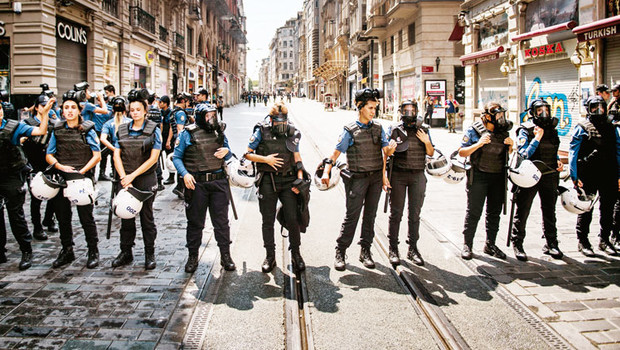
Le 25 août 2018, le sous-gouvernorat du district de Beyoğlu à Istanbul a prononcé une interdiction de se rassembler pour tout type de manifestation sur la place Galatasaray à Istanbul, la place où ont pris l’habitude de se réunir chaque samedi « les Mères du samedi » d’abord de 1995 à 1998, et ensuite de 2009 jusqu’à 2018.
À la 700ème semaine de leurs manifestations pacifiques, les Mères du samedi et leurs partisans se sont réunis en milieu de journée sur la place Galatasaray pour sensibiliser une fois de plus sur la nécessité pour les responsables des exécutions extrajudiciaires et des disparitions forcées les années 1990 de rendre des comptes.
La police a utilisé des gaz lacrymogènes pour mettre fin à la manifestation et a arrêté 47 personnes. Toutes ont été libérées samedi soir.
Des officiers supérieurs des autorités turques ont même publié des déclarations accusant les Mères du samedi d’avoir été abusées par des organisations terroristes ou d’être en collusion avec elles.
La CIJ a écrit au Commissaire européen aux droits de l’Homme qu’elle « considère que cette situation est contraire aux obligations de la Turquie en vertu du droit international humanitaire, en particulier du droit de réunion pacifique en vertu de l’article 11 de la Convention européenne des droits de l’Homme et 21 du Pacte international relatif aux droits civils et politiques ».
La CIJ a ajouté que « compte tenu de la constance et de la présence des Mères du samedi sur la place Galatasaray au fil des ans, il est difficile de voir comment la restriction de leur droit de réunion pacifique pourrait être nécessaire et proportionnée à un objectif légitime.
Il est clair qu’aucun avertissement préalable pour le rassemblement n’était nécessaire pour des raisons de sécurité compte tenu de son occurrence régulière au moins depuis sa reprise en 2009, c’est-à-dire il y a neuf ans. En outre, la manifestation a eu lieu dans une zone piétonne où les voitures ne sont pas autorisées ».
ICJ-Letter-SaturdayMothers-CoEComm-Turkey-2018-ENG (télécharger la lettre, uniquement disponible en anglais)
Sep 20, 2018 | Advocacy, Non-legal submissions
The ICJ today put the spotlight the lack of independence of the legal profession in Azerbaijan speaking at the UN Human Rights Council in Geneva.
The statement, made during the consideration of the Universal Periodic Review (UPR) of Azerbaijan, read as follows:
The International Commission of Jurists (ICJ) welcomes the acceptance by Azerbaijan of the recommendations by France (140.70), by Greece (141.12), Austria (141.13), Estonia (141.68), Slovenia (141.71), and Mexico (141.77), to respect the rights of lawyers.
The ICJ regrets, however, that Azerbaijan only noted and did not explicitly support the recommendations by Sweden (141.33), USA (141.39), Czechia (141.67) and Germany (141.76) and rejected the recommendation by the United Kingdom (141.60) to “End all interference in the work of lawyers through disbarment or other disciplinary measures on improper grounds such as expressing critical views.”
These recommendations call for the amendment of the Law on Advocates and Advocates’ Activities to ensure the effective independence of the Bar Association of Azerbaijan. They also call for the setting up of independent and transparent mechanisms for lawyers’ admission to practice, and disciplinary proceedings against lawyers, in conformity with the UN Basic Principles on the Role of Lawyers.
The ICJ notes that Azerbaijan’s support of most recommendations is predicated on the assumption that the situation of the independence of the legal profession in Azerbaijan is in line with international law.
This, however, is not the situation in the country.
The ICJ expresses concern at the persistent lack of independence of the Bar Association of Azerbaijan; indeed, it has actually played a role in undermining the work of lawyers defending human rights. The situation is exacerbated by recent hasty reforms that prohibit lawyers from appearing in any court hearing unless they are members of this non-independent Bar association, furthermore without a sufficient and meaningful transition period. This seriously curtails access to justice for human rights violations in the country.
Sep 18, 2018 | Plaidoyer
La CIJ a mis en lumière les graves menaces qui pèsent sur l’état de droit en Hongrie, en Pologne et en Turquie, lors de sa prise de parole au Conseil des droits de l’Homme à Genève.
La déclaration, faite pendant le débat général sur les situations nécessitant l’attention du Conseil, est la suivante:
«La Commission internationale de juristes (CIJ) voudrait attirer l’attention du Conseil sur les graves menaces qui pèsent sur l’état de droit en Hongrie, en Pologne et en Turquie.
En Pologne, le gouvernement a adopté une mesure législative pour imposer de manière arbitraire un «départ à la retraite» involontaire d’un tiers de ses juges à la Cour suprême, portant ainsi un coup fatal à l’indépendance du pouvoir judiciaire, déjà mis à mal par les réformes passées.
En Hongrie, de multiples réformes législatives ont affaibli l’indépendance des juges et puni les activités de certaines ONG de défense des droits de l’homme et restreint leur financement.
Enfin, en Turquie, la consolidation de mesures d’urgence en droit commun, des réformes constitutionnelles régressives, et le licenciements massif de juges et de procureurs a supprimé une protection essentielle pour le fonctionnement d’un pouvoir judiciaire indépendant.
La CIJ est en outre préoccupée par l’interdiction des manifestations des mères du samedi qui prévoit d’organiser des manifestations hebdomadaires à la mémoire des membres de leur famille disparus, en violation de leur droit à la liberté de réunion.
La CIJ est profondément préoccupée par l’escalade de telles menaces aux principes fondamentaux de l’état de droit en Europe, sans que des mesures spécifiques soient prises par le Conseil pour y remédier.
La CIJ exhorte le Conseil à prêter attention à ces développements, qui s’inscrivent dans le cadre d’une attaque mondiale plus vaste contre la primauté du droit [1] et à observer la situation des droits de l’homme dans ces pays.
[1] Voir la CIJ, «L’état de droit sous la menace mondiale» (déclaration lors du débat général sur le compte rendu oral du Haut Commissaire), 11 septembre 2018: https://www.icj.org/hrc39-gd2-hc/
Sep 18, 2018 | Advocacy, Non-legal submissions
The ICJ today put the spotlight on serious threats to the rule of law in Hungary, Poland and Turkey, speaking at the UN Human Rights Council in Geneva.The statement, made during general debate on situations that require the Council’s attention, read as follows:
“The International Commission of Jurists (ICJ) would like to bring to the Council’s attention the serious threats to the rule of law in Hungary, Poland and Turkey.
In Poland, the Government has adopted legislation to arbitrarily force into involuntary “retirement” one third of its Supreme Court Justices, delivering a fatal blow to the independence of the judiciary, already strained by past reforms.
In Hungary, multiple legal reforms have weakened judicial independence and effectively criminalized the activities of certain human rights NGOs and curtailed their financing.
Finally, in Turkey, consolidation of emergency measures in ordinary law, regressive constitutional reforms, and the mass dismissal of judges and prosecutors have removed essential protection for the independent functioning of the judiciary.
The ICJ is further concerned by the protest ban against the Saturday Mothers to hold weekly protests in memory of their disappeared family members, in breach of their right to freedom of assembly.
The ICJ is alarmed at the escalation of such threats to the very basic tenets of the rule of law in Europe, without specific action being taken by this Council to address them.
The ICJ urges the Council to give attention to these developments, which indeed form part of a broader global attack on the rule of law,[1] and to keep under observation the human rights situation in these countries.”
[1] See ICJ, “The Rule of Law under Global Threat” (statement in general debate on the oral update of the High Commissioner), 11 September 2018: https://www.icj.org/hrc39-gd2-hc/
Sep 14, 2018 | News
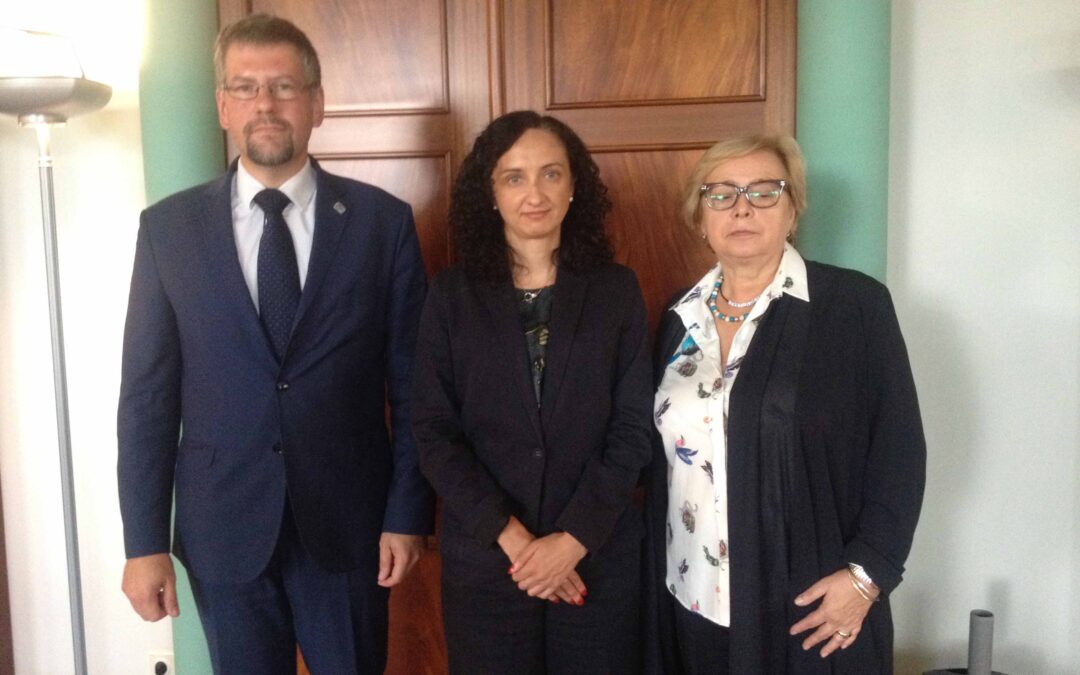
The ICJ met this week in Warsaw with the First President of the Polish Supreme Court, Małgorzata Gersdorf.
Róisín Pillay, Director of the ICJ Europe and Central Asia Programme, met with President Gersdorf to convey the support of the ICJ for the Court’s defence of the rule of law and the independence of the judiciary in Poland, in the face of government attacks.
The ICJ emphasized that a new law on the Supreme Court that attempts to force the “retirement” of 27 of the 72 Supreme Court judges, including the First President, by lowering the mandatory retirement age for its judges from 70 to 65 years, contravenes international human rights law and standards, including the right to a fair hearing.
The measure is contrary to the principle of the security of tenure of judges and therefore to the independence of the judiciary, as expressed in the UN Basic Principles on the Independence of the Judiciary.
In August, the Supreme Court submitted a preliminary ruling request to the Court of Justice of the EU (CJEU) seeking its interpretation on the compliance of the measure with EU law. The Supreme Court has suspended implementation of the law pending the proceedings before the CJEU.
The European Commission has recognized the current situation as undermining “the principle of judicial independence, including the irremovability of judges” and has triggered a procedure under Article 7 of the Treaty of the European Union that could ultimately lead to suspension of Poland’s EU voting rights.
The Commission has also launched infringement proceedings against Poland in respect of the law on the Supreme Court.
An ICJ letter of 11 July 2018, signed by 22 senior judges from all regions of the world, urged the Polish government to act immediately to reinstate the forcibly retired judges in office.