

Engaging with civil society after Facebook revelations
On 8 December 2021, ICJ alongside 20 other civil society organisations sent a letter to Frances Haugen, the former Facebook employee who spoke out about the tech giant’s business model and the problems it raises for human rights, inviting her to speak and exchange ideas with us. We believe that engaging with civil society is crucial in order to find solutions that work for businesses and individuals alike.

States must implement an immediate moratorium on the sale, transfer and use of surveillance technology
ICJ along with 155 civil society organizations and 26 independent experts worldwide call on states to implement an immediate moratorium on the sale, transfer and use of surveillance technology.

Our Annual Report highlights the ICJ’s successes amidst a global pandemic
Our latest Annual Report provides a summary of the work we did to protect human rights and uphold the rule of law in 2020, amid the Covid-19 pandemic and resultant challenges. Successes achieved throughout the year have been highlighted in this report.
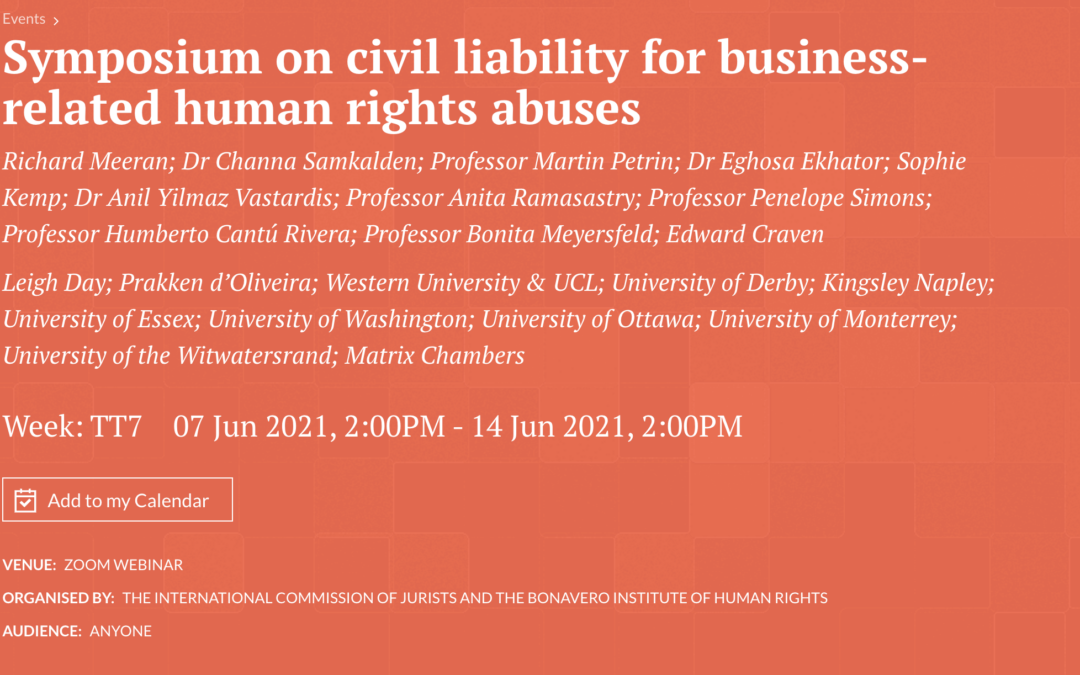
Symposium on civil liability for business-related human rights abuses
As part of its work to raise awareness and deepen the understanding about the importance of civil liability for the objective of improved accountability of business-related human rights abuses and access to justice and reparations, the ICJ is partnering with the Bonavero Institute of Human Rights to organize an online symposium.
The symposium is open to practitioners, policymakers, civil society, academics, and students working on these subjects. It will feature two panel discussions on Zoom on 7 June 2021 and 14 June 2021.
Past decades saw an emerging trend towards reliance on civil liability claims to address business-related human rights abuses (e.g., Lungowe v Vedanta and Okpabi v Shell in the UK; Choc v Hudbay Minerals and Araya v Nevsun in Canada; Akpan v Shell in the Netherlands; Jabir and others v KiK Textilien in Germany).
The ICJ and the Bonavero Institute of Human Rights’ symposium will discuss the wider implications of recent jurisprudence and identify the remaining gaps in the law.
The discussions will focus on a range of issues, including 1) the contours of rules on the duty of care; 2) prospects for supply chain liability under the law of civil remedies; 3) parent company liability and complicity under civil law; 4) prospects of access to justice.
Please follow the links below to register separately for each panel. The symposium will also involve a series of blogs by experts in the field to be published by Opinio Juris starting 21 June 2021.
Panel 1 ‘Duty of care and parent company liability’
Day and time: 7 June 2021 at 14.00 – 16.00 BST
- Richard Meeran (Leigh Day)
- Dr Channa Samkalden (Prakken d’Oliveira)
- Professor Martin Petrin (UCL)
- Dr Eghosa Ekhator (University of Derby)
- Julianne Hughes-Jennett (Quinn Emanuel)
- Dr Anil Yilmaz Vastardis (University of Essex)
To register for Panel 1, please click here
Panel 2 ‘Access to justice and civil claims for business-related human rights abuses: Challenges and opportunities’
Day and time: 14 June 2021 at 14.00 – 16.00 BST
- Professor Anita Ramasastry (University of Washington)
- Professor Penelope Simons (University of Ottawa)
- Professor Humberto Cantú Rivera (University of Monterrey)
- Professor Bonita Meyersfeld (University of the Witwatersrand)
- Edward Craven, (Matrix Chambers)
- Further speakers will be announced shortly
To register for Panel 2, please click here
This symposium is co-convened by Dr Carlos Lopez and Dr Ekaterina Aristova. Please get in touch with the organisers if you have any questions. The symposium is part of the project on civil liability for human rights violations led by the Bonavero Institute and funded by the Oak Foundation.
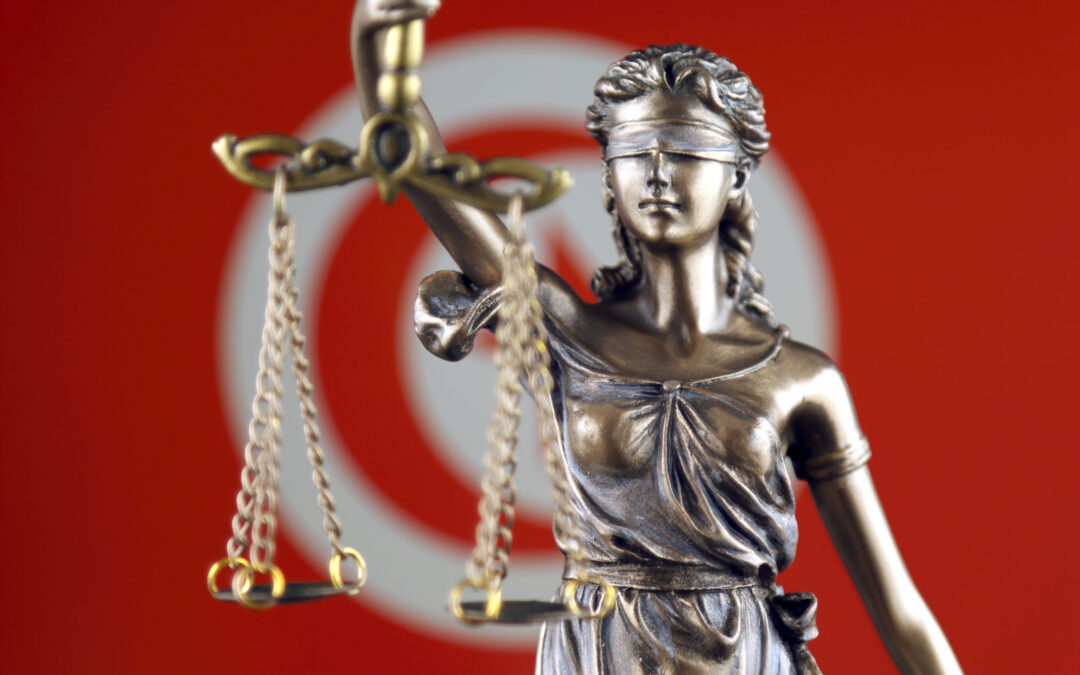
Tunisia: reforms needed to provide justice for victims of gross human rights violations
As the third anniversary of the opening of trials before Tunisia’s Specialized Criminal Chambers (SCC) is approaching, the ICJ denounces the Tunisian authorities’ failure to adopt reforms necessary to advance accountability and justice for victims of gross human rights violations.
هذا البيان الصحفي متوفر باللغة العربية أيضاً
Trials before the SCC started on 29 May 2018. Since that first hearing, evident gaps and shortcomings in the Tunisian Criminal Code, the Code of Criminal Procedure and the Transitional Justice law have undermined efforts to hold perpetrators to account, bring justice to victims and prevent recurrence of gross human rights violations in the future.
“The Tunisian authorities have abdicated their responsibility to ensure the effective functioning of the SCC, depriving judges of basic tools to ensure that trials are conducted without undue delay and consistent with international fair trial standards,” said Said Benarbia, the ICJ’s MENA Programme Director.
Many offences referred by the Truth and Dignity Commission to the SCC are not adequately defined in the Tunisian law. Judicial rotation occurs mid-way through SCC trials, impacting the continuity of trials. Prosecutors are not effectively engaged in the conduct of trials. Accused are absent in most of the SCC trials, and the transitional justice framework does not provide for appeal chambers.
“By failing to address these obstacles, the Tunisian authorities are undermining the right of victims to truth and to effective remedies, and betraying the very promise of the transitional justice process to end impunity,” added Benarbia.” It’s high time for them to reverse course and live up to that promise.”
Background information
The ICJ has recommended reform to ensure the compliance of SCC proceedings with international law and standards, including through:
- Ensuring the adequate criminalization of gross human rights violations amounting to crimes under international law;
- Fully ensuring the rights of the accused to a fair trial;
- Ensuring the rights of victims, including their families, to an effective remedy and reparation;
- Ensuring the protection of victims and witnesses;
- Ensuring that the collection, admissibility and assessment of evidence guarantee the right of the accused to a fair trial and the victims’ right to an effective remedy.
In addition to the above reforms, the Tunisian authorities should remove all obstacles preventing the SCC and other judicial authorities from exercising their function in a manner that complies with international standards. To this end, the authorities should:
- Ensure that the Office of the Public Prosecutor and other investigative authorities carry out their mandate in an independent and impartial manner, as defined under the Code of Criminal Procedure;
- Ensure that the annual judicial rotation, as regulated by Organic Law No. 34 on the High Judicial Council, be consistent with the right of the accused to a fair trial
- Ensure that newly appointed SCC judges and prosecutors receive timely and adequate training in transitional justice as provided for by Organic Law No. 53 on Establishing and Organizing Transitional Justice;
- Ensure that, if the annual judicial rotation occurs mid-way through trials, safeguards be implemented with the view to ensuring that newly appointed judges hearing the case have the appropriate understanding of the evidence and arguments.
These recommendations are informed by the ICJ Practical Guide Series on Accountability Through the Specialized Criminal Chambers and findings on the role of international law and standards in proceedings before the SCC (Practical Guide 1), the investigation and prosecution of gross human rights violations under Tunisian and international law (Practical Guide 2), and the application of principles and best practices on evidence in the administration of justice before the SCC (Practical Guide 3).
The SCC were established in 2014 to adjudicate cases involving alleged “gross human rights violations” perpetrated between 1955 and 2013 and referred by the Truth and Dignity Commission (Instance Verité et Dignité, IVD) to the SCC.
At the end of its mandate in December 2018, the IVD’s referred to the SCC 200 cases of arbitrary deprivations of life, arbitrary deprivations of liberty, torture and other ill-treatment, enforced disappearance, rape and sexual assault and crimes against humanity committed by the former government.
In a briefing paper published in October 2020, the ICJ called on the Tunisian authorities to undertake substantial legal and policy reforms with a view to strengthening accountability and removing all obstacles preventing the SCC from functioning effectively.
Download this press release in PDF form here.
Contact:
Said Benarbia, Director, ICJ Middle East and North Africa Programme, t: +41-22-979-3817; e: said.benarbia(a)icj.org
Valentina Cadelo, Legal Adviser, ICJ Middle East and North Africa Programme, e: valentina.cadelo(a)icj.org
Asser Khattab, Research and Communications’ Officer, ICJ Middle East and North Africa Programme, e: asser.khattab(a)icj.org
Recent News
 Thailand: Judges have a critical role to play in combating and ensuring accountability for torture and enforced disappearance16 Oct 2026
 Joint Letter: Urgent diplomatic action to halt further executions in eastern Libya13 Oct 2026
 Czech Republic: UN Committee on the Rights of the Child finds that immigration detention of children violated the prohibition of arbitrary detention and ill-treatment13 Oct 2026
 UN Human Rights Council once again navigates troubled waters to protect human rights in crisis situations, despite global setbacks.12 Oct 2026