Apr 2, 2020 | News
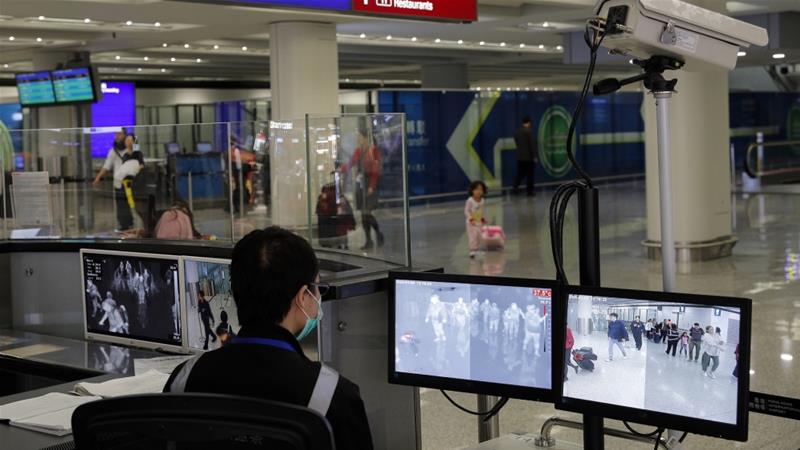
Today, the ICJ joined more than 100 other organizations to urge States to ensure that any use of digital technologies to track and monitor individuals and populations as part of measures to tackle the COVID-19 pandemic is fully human rights compliant.
The organizations warned that efforts to contain the virus must not be used as a cover to impose greatly expanded systems of invasive digital surveillance that are likely to be abused, unless adequate safeguards are put in place to protect freedom of expression, the right to privacy and other rights.
Technology can and should play an important role in the midst of the current crisis to protect the rights to health, life and security.
Deploying non-consensual State digital surveillance powers however can risk violations of the rights to privacy, freedom of expression, information and association. If implemented in an arbitrary or discriminatory way, and without adequate oversight, these measures risk damaging public trust in state authorities and undermining the effectiveness of any public health response. Non-consensual digital surveillance measures may also disproportionately exacerbate discrimination against already marginalized communities.
The organizations called on all governments to ensure that increased digital surveillance measures meet the following conditions:
- Surveillance measures adopted to address the pandemic must be lawful, necessary and proportionate. Governments must be transparent about the measures they are taking so that they can be scrutinized and, if appropriate, later modified, retracted, or overturned.
- Expansion of monitoring or surveillance measures must be time-bound, and only continue for as long as necessary to address the current pandemic.
- States must ensure that increased collection, retention, and aggregation of personal data, including health data, is only used for the purposes of responding to the COVID-19 pandemic. Data collected, retained, and aggregated to respond to the pandemic must be limited in scope, time-bound in relation to the pandemic and must not be used for commercial or any other purposes.
- Governments must take every effort to protect people’s data, including ensuring sufficient security of any personal data collected and of any devices, applications, networks, or services involved in collection, transmission, processing, and storage. Any claims that data is anonymous must be based on evidence and supported with sufficient information regarding how it has been anonymized.
- Any use of digital surveillance technologies in responding to COVID-19, including big data and artificial intelligence systems, must address the risk that these tools will facilitate discrimination and other rights abuses against racial minorities, people living in poverty, and other marginalized populations, whose needs and lived realities may be obscured or misrepresented in large datasets.
- If governments enter into data sharing agreements with other public or private sector entities, they must be based on law, and the existence of these agreements and information necessary to assess their impact on privacy and human rights must be publicly disclosed – in writing, with sunset clauses, public oversight and other safeguards by default. Businesses involved in efforts by governments to tackle COVID-19 must undertake due diligence to ensure they respect human rights, and ensure any intervention is firewalled from other business and commercial interests.
- Any response must incorporate accountability protections and safeguards against abuse. Increased surveillance efforts related to COVID-19 should not fall under the domain of security or intelligence agencies and must be subject to effective oversight by appropriate independent bodies. Individuals must be given the opportunity to know about and challenge any COVID-19 related measures to collect, aggregate, and retain, and use data.
- COVID-19 related responses that include data collection efforts should include means for free, active, and meaningful participation of relevant stakeholders, in particular experts in the public health sector and marginalized population groups.
Link to joint statement here.
See also
ICJ, ‘Southeast Asia: States must respect and protect rights in combating misinformation online relating to COVID-19’, 1 April 2020
Mar 8, 2020 | News
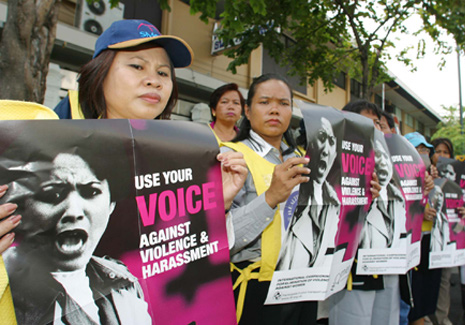
The ICJ commemorates International Women’s Day by calling on States all over the world to take decisive steps to abolish or amend laws, policies and practices that discriminate against women and girls, including those belonging to Sexual Orientation, Gender Identity and Expression and Sex Characteristics (SOGIESC) minorities.
“All over the world, we are facing increasing attacks on the rule of law, which intensify existing inequalities resulting in compounded and intersecting forms of discrimination against women and girls, especially women from SOGIESC minorities,” said Emerlynne Gil, ICJ’s global focal point on gender.
The ICJ also calls on frontline justice actors, such as judges, lawyers and law enforcement officers, to take proactive steps in eliminating gender discriminatory practices in their work to further enhance access to justice for women.
Such action includes an open and inclusive discourse on regressive interpretations of religious and customary laws that discriminate against women.
The ICJ also urges States to acknowledge the diverse voices of women in this discourse, including those of women who belong to SOGIESC minorities.
“Women and girls, including those from SOGIESC minorities, are at a heightened risk of human rights abuses, most especially because a greater number among them is now living in poverty and is unable to access information about their rights, as well as justice for the violations they suffer,” added Emerlynne Gil.
.International Women’s Day is a symbolic acknowledgement of women’s struggle for gender equality in all spheres of life.
While celebrating the recognition of women’s legal rights and entitlements, the ICJ also notes with deep concern the growing trend around the world to push back on these advances in a manner that fundamentally violates the rights of women.
In 2019, the ICJ adopted the Tunis Declaration on Reinforcing the Rule of Law and Human Rights (Tunis Declaration), wherein it highlighted how “culture, tradition, or religion are being used to justify laws, policies, and practices that discriminate against women and girls”.
The proliferation of these discriminatory laws, policies and practices “come at a time when there is growing inequality, accelerating climate change, conflict, and large-scale displacement of people.”
Upholding cultural practices is often invoked as a convenient excuse to justify the continued existence of laws, policies, and practices that discriminate against women and girls, including those belonging to SOGIESC minorities.
While the ICJ affirms the importance of respecting cultural rights, these must be exercised in a manner consistent with core rule of law principles of non-discrimination, equality and equal protection of the law.
The ICJ notes that claims of cultural preservation are often based upon harmful gender stereotypes and deeply problematic patriarchal norms and attitudes that undergird the sanctification of discriminatory cultural, religious, traditional, and customary norms.
In the Tunis Declaration, the ICJ recognized “the persistent, deep entrenchment of patriarchal culture that perpetuates gender stereotypes in many national and international institutions, including those of the legal profession and judiciary.”
Harmful gender stereotypes, in turn, severely hamper women from enjoying their human rights and from equal access to justice, including for crimes of sexual and gender-based violence perpetrated against them.
Contact
Emerlynne Gil, ICJ Senior International Legal Adviser, email: emerlynne.gil(a)icj.org
Mar 5, 2020 | Advocacy, Non-legal submissions
The ICJ today expressed concern at violations of human rights perpetrated in the name of countering violent extremism, and at attempts by some States at the Human Rights Council to dilute its focus on human rights while countering terrorism and the human rights of victims of terrorism.
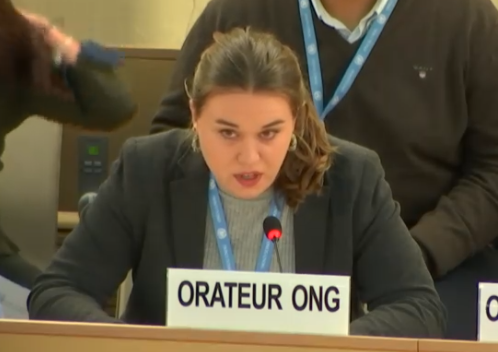
The statement, delivered during an interactive dialogue with the UN Special Rapporteur on the promotion and protection of human rights and fundamental freedoms while countering terrorism, read as follows:
“The International Commission of Jurists (ICJ) welcomes your report on “Human rights impact of policies and practices aimed at preventing and countering violent extremism” (A/HRC/43/46).
The ICJ shares concern at the growing range of measures that restrict human rights, adopted in the name of the opaque and contested concepts of countering or preventing violent extremism. At the Council, certain States push for agreed language on suppression of terrorism to be cut-and-pasted to apply to “violent extremism”, and then eventually to all “extremism” whether violent or not, without definitions. As your report documents, at the national level this translates into overbroad, unjustified, arbitrary, and discriminatory measures, with particular impacts on civil society, especially human rights defenders, and from a gender perspective.
We also share the view expressed at para 51 of your report, that the current draft report of the Human Rights Council Advisory Committee on “the negative effects of terrorism on the enjoyment of human rights”, remains fundamentally flawed. Any discussion of “effects of terrorism” at the Council should exclusively focus on a human-rights based approach to victims of terrorism, consolidating work already undertaken by successive Special Rapporteurs and other UN and regional entities, as collected in a compilation published recently by the ICJ.[1] The Council must not allow its attention and limited resources to be diverted away from the human rights of victims of terrorism and protecting human rights while countering terrorism, to more diffuse questions of a macro-economic or budgetary character or duplicating work of other bodies.”
[1] See https://www.icj.org/victimsofterrorism2019/ and https://www.icj.org/icj-highlights-rights-of-victims-of-terrorism-to-un-delegations/
Feb 25, 2020 | Advocacy, Non-legal submissions
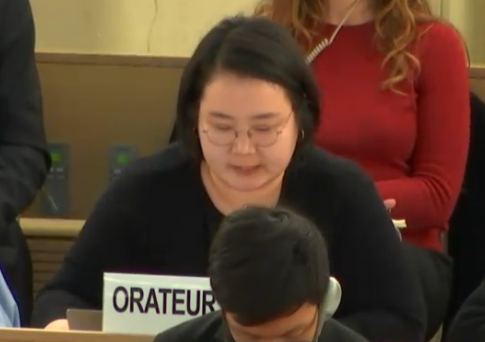
The ICJ today spoke at the UN Human Rights Council in Geneva, highlighting issues of access to justice for women in the context of religious and customary law.
The statement, delivered during a High Level Panel discussion commemorating the twenty-fifth anniversary of the Beijing Declaration and Platform for Action adopted at the Fourth World Conference on Women, read as follows:
“The International Commission of Jurists (ICJ) welcomes this opportunity to celebrate the progress made in the implementation of the Beijing Declaration and Platform for Action 25 years after its adoption and to address the remaining challenges to gender equality and women’s empowerment.
We have indeed seen an expansion in many countries of women’s legal entitlements and protection of their rights. However, there is also a growing trend to push these advances back and violate women’s human rights, invoking as justification religion, tradition, culture, and custom. This came out clearly when ICJ, UN Women and the OHCHR hosted a consultation for the UN Special Rapporteur on freedom of religion or belief last year, where women human rights defenders from all over Asia raised concerns about the resurgence of intersecting forms of discrimination by religion and culture based on patriarchal attitudes. They specifically narrated how women and girls were denied their sexual and reproductive rights.
Recalling the vision of the Beijing Declaration and Platform for Action, we reiterate the obligation of States not to invoke, “any custom, tradition or religious consideration”, to avoid their obligations to combat gender-based violence and discrimination against women. The Human Rights Committee also provides that “State parties should ensure that traditional, historical, religious or cultural attitudes are not used to justify violations of women’s right to equality before the law and to equal enjoyment of [ICCPR] rights[1].”
We therefore urge the Council to foster an open and inclusive discourse with Member States on the regressive interpretations of religious and customary laws that discriminate against women, and to acknowledge the voices and the diversity of women in that process. We urge States to ensure the full implementation of the human rights of women as an inalienable part of all fundamental freedoms.”
[1] Para 5, CCPR/C/21/Rev.1/Add.10
Feb 17, 2020 | Advocacy, Non-legal submissions
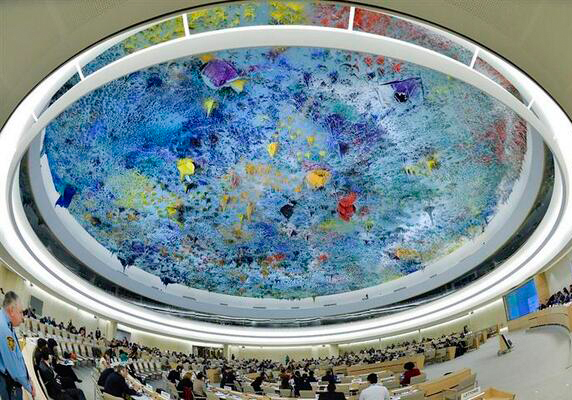
The ICJ has urged expert members of the UN Human Rights Council Advisory Committee to focus on the most direct and acute human rights issues, including a human-rights based approach to victims of terrorism, as the Committee prepares a report on “effects of terrorism on all human rights”.
In an oral statement to the Advisory Committee’s ongoing 24th session in Geneva, the ICJ expressed grave concern about the content of the latest draft of the report, and the potential negative consequences for human rights protection of the report in its current form, and urged the Advisory Committee:
- To substantially revise and refocus the report to include a clear recommendation to the Council that the exclusive focus of the Council’s work should remain on the most acute issues from a human rights perspective: violations in countering terrorism and a human-rights based approach to victims of terrorism, along the lines already established by successive holders of the Special Rapporteur mandate.
- To recommend against the Council entering into more diffuse macroeconomic issues such as diverting foreign direct investment, reducing capital inflows, destroying infrastructure, limiting foreign trade, disturbing financial markets, and negatively affecting certain economic sectors and impeding economic growth.
- To avoid making recommendations that simply repeat already-existing obligations or commitments to counter terrorism under various UN or other instruments.
- To affirm that the existing and longstanding normative and institutional framework on counter-terrorism and human rights is already sufficient to address relevant impacts of terrorism from a human rights perspective.
Prior to the session, the ICJ together with other NGOs had filed a written statement alerting the Advisory Committee to the highly sensitive context into which its report would be delivered at the Council, and urging the Committee to guard against its work being instrumentalized by Egypt and other States who seek to distort, distract and divert the limited resources and attention of the Council and its Special Rapporteur, away from the longstanding focus, achieved by years of Mexican leadership with consensus support of the Council, on human rights in countering terrorism, and the human rights of victims of terrorism.
The Advisory Committee’s report was requested by a 2017 resolution led by Egypt, which was not a matter of consensus, and is being drafted by a former Ambassador of Egypt who is now a member of the Committee.
Earlier at the session, several States including the EU, Switzerland, and Mexico had expressed concern or otherwise questioned particular aspects of the current draft of the report, and urged the Committee to substantially review and revise the draft. Egypt, China, Russia and several other States expressed satisfaction with the draft and urged the Committee to quickly finalize the report and send it to the Council.
The Advisory Committee report is due to be presented to and considered at the September 2020 session of the Human Rights Council, although some Committee members expressed the wish to finalize the report at the current Committee session.