Sep 13, 2017 | Incidencia
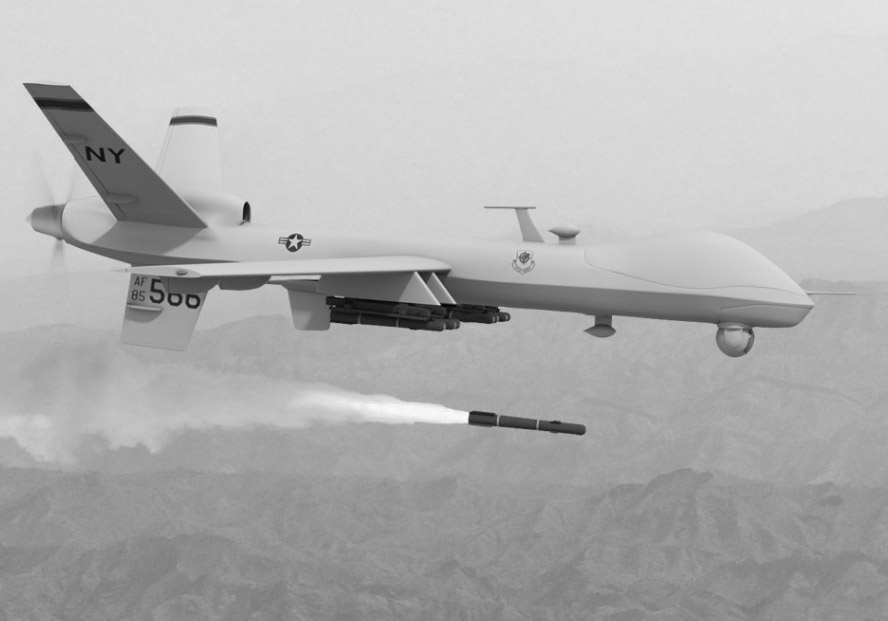
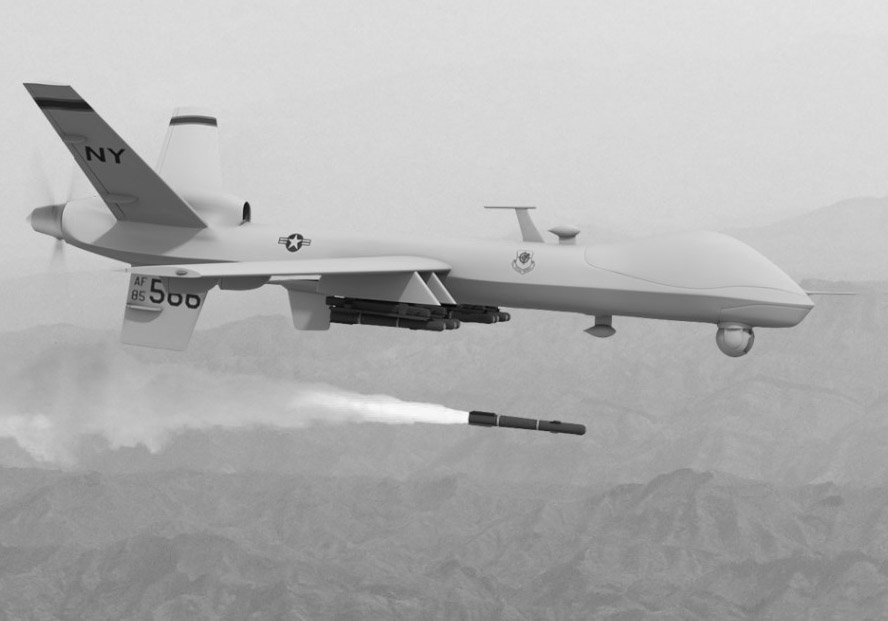
Drones han causado daño a comunidades, incluidas víctimas significativas; generado serias preocupaciones legales y éticas; y amenazado el orden internacional y el estado de derecho al reducir las restricciones políticas, prácticas y tecnológicas sobre el uso de la fuerza.
Los Estados deben de estar conscientes de que las características específicas de estas tecnologías facilitan la expansión global del uso de la fuerza letal.
Por consiguiente, los Estados no deben ignorar las reglas históricas del derecho internacional que rigen el uso de la fuerza.
Por lo tanto, el uso, la implementación, y la proliferación creciente de drones son retos fundamentales que necesitan atención.
Universal-Dronestandards-Advocacy-2017-SPA (Texto completo en PDF)
Sep 13, 2017 | Advocacy
The ICJ joined 17 other organizations in calling for robust and human rights compliant international standards to regulate the use of “Unmanned Aerial Vehicles” , developed through fully inclusive and consultative processes.
Universal-DroneStandards-Advocacy-2017-ENG (full PDF)
Sep 5, 2017 | Eventos, Noticias
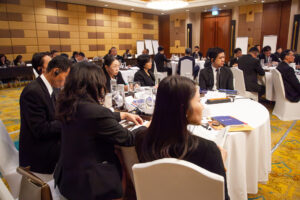
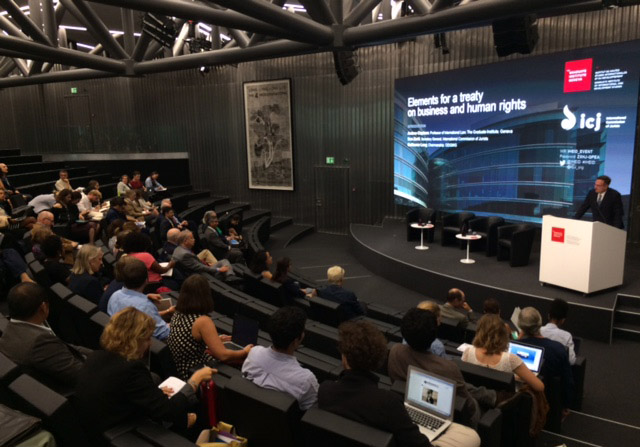
Hoy la CIJ y el Institut de Hautes Etudes Internationales et du Développement co-organizaron una conferencia pública sobre los Elementos de un tratado sobre las empresas y los derechos humanos.
En junio de 2014, el Consejo de Derechos Humanos de las Naciones Unidas estableció un grupo de trabajo intergubernamental encargado de “elaborar un instrumento internacional jurídicamente vinculante para regular, en el derecho internacional de los derechos humanos, las actividades de las empresas transnacionales y otras empresas comerciales”.
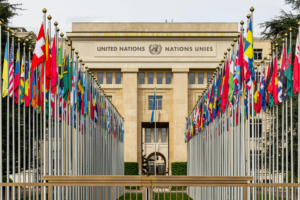
La tercera reunión del Grupo de trabajo tendrá lugar del 23 al 27 de octubre de 2017 en el Palacio de las Naciones.
El evento tuvo lugar en un momento crítico para informar el proceso de elaboración del tratado en el Grupo de trabajo, y se orientó a fomentar el intercambio de opiniones entre los actores internacionales con el objetivo de crear las base para el consenso sobre los posibles contenidos de un instrumento jurídicamente vinculante en el ámbito de las empresas y los derechos humanos.
Se espera que el futuro tratado contribuya a subsanar algunas deficiencias en el marco normativo internacional en materia de rendición de cuentas, en relación con las operaciones de las empresas en materia de derechos humanos. El tratado también debería fortalecer la acción de los Estados para garantizar recursos efectivos y reparaciones para las víctimas de abusos.
Este tratado será el primero en el marco internacional del derecho de los derechos humanos para abordar directamente las actividades de las sociedades comerciales.
El tema de los impactos de los derechos humanos por parte de las empresas comerciales figura a la cabeza de la agenda internacional sobre el que se han desarrollado varios instrumentos no vinculantes, entre los que destacan los Principios Rectores sobre las Empresas y los Derechos Humanos.
Se prevé que el proceso hacia un tratado en este ámbito se basará en los logros alcanzados hasta la fecha, cubriendo las lagunas restantes y mejorando las normas y la acción de los Estados y las empresas por igual.
Sep 5, 2017 | Events, News
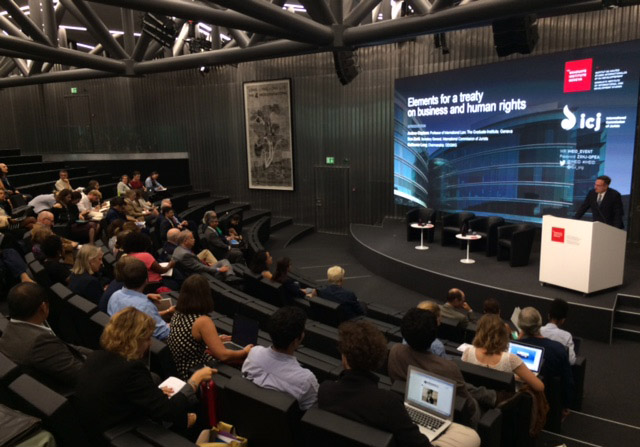
Today the ICJ and the Graduate Institute of International and Development Studies co-organized a public conference: Elements of a treaty on Business and Human Rights.
In June 2014, the United Nations Human Rights Council established an inter-governmental working group to “elaborate an international legally binding instrument to regulate, in international human rights law, the activities of transnational corporations and other business enterprises”.
The third session of the working group will take place from 23-27 October 2017 at the Palais des Nations.
Today’s event took place at a critical moment to inform the process of elaboration by the working group.
It fosters the exchange of views among international actors, with the aim of creating the basis for consensus on possible contents of a legally binding instrument in the field of business and human rights.
The prospective treaty is expected to contribute to fill some accountability gaps in the international normative framework, in relation to the operations of business enterprises in terms of human rights.
The treaty should also enhance States’ action to ensure effective remedies and reparations for the victims of abuses.
This treaty will be the first in the international human rights law framework to address directly activities of business corporations.
The issue of human rights impacts by business enterprises has reached the top of the international agenda, and several non-treaty instruments have been developed, foremost among them the Guiding Principles on Business and Human Rights.
The process towards a treaty in this field is expected to build on the achievements so far, filling remaining gaps and enhancing rules for and action by states and businesses alike.
For additional information & registration click here
See also the photo of the week on Genève Internationale
Jul 20, 2017 | Artículos, Noticias
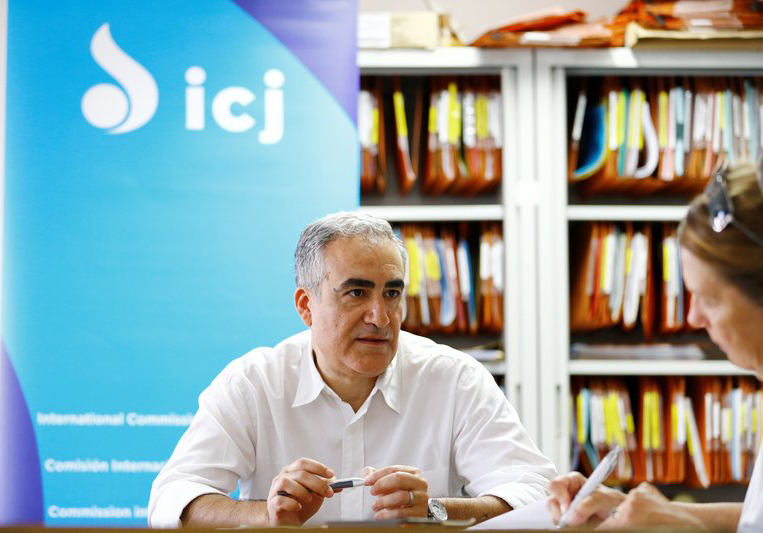
Una entrevista del Secretario General de la CIJ Sam Zarifi con la periodista de Reuters Stephanie Nebehay.
El presidente estadounidense Donald Trump es parte de una nueva estirpe de líderes en el mundo que, como el venezolano Nicolás Maduro, quieren utilizar su mandato democrático para socavar el estado de derecho, dijo el miércoles el jefe de una ONG de derechos humanos y asuntos jurídicos.
Saman Zia-Zarifi, secretario general de la Comisión Internacional de Juristas (ICJ por sus siglas en inglés), que tiene su sede en Ginebra, llama a Trump un “populista autoritario” y lo compara a los líderes de países como Venezuela, Turquía, Filipinas o Hungría.
Zarifi, que nació en Irán y se mudó a Estados Unidos cuando era adolescente, citó como ejemplo la restricción a los viajes impuesta por el gobierno de Trump a los ciudadanos de seis países de mayoría musulmana.
“Lo que es diferente ahora es que se usa un cierto tipo de populismo para contrarrestar la noción del estado de derecho”, dijo Zarifi en una entrevista en la sede de la ICJ, que está conformada por 60 jueces y abogados destacados del mundo que buscan proteger los derechos humanos y el imperio de la ley.
“El nuevo populismo tiene un cierto descaro que es nuevo. No es que están negando que están violando derechos, lo que dicen es que pueden violar derechos porque de alguna manera están empoderados por el pueblo”, señaló.
Zarifi, que encabeza la ICJ desde abril, dijo que esta nueva generación de populistas incluye a Nicolás Maduro de Venezuela, Tayyip Erdogan de Turquía y Rodrigo Duterte de Filipinas; al primer ministro Viktor Orban de Hungría y al líder del partido oficialista de Polonia, Jaroslaw Kaczynski.
“Yo diría que en Estados Unidos Trump es un populista autoritario. Tiene tendencias autoritarias pero aún hay mecanismos de control y equilibrio”, estimó Zarifi. “Así es que no es una figura totalmente autoritaria”.
La Corte Suprema revisó partes del decreto del gobierno de Trump que establecía restricciones al ingreso de viajeros de Irán, Libia, Somalia, Sudán, Siria y Yemen, una normativa que según Trump busca combatir el terrorismo.
La decisión del tribunal, de acuerdo a Zarifi, pondría a prueba “la salud del sistema de equilibrios” de los poderes en Estados Unidos.
En Venezuela, Maduro busca establecer una Asamblea Constituyente con autoridad para reformar a Constitución y cerrar el Congreso dominado por la oposición, con una votación prevista para el 30 de julio.
Foto: Reuters / Pierre Albouy