Jul 20, 2017 | News
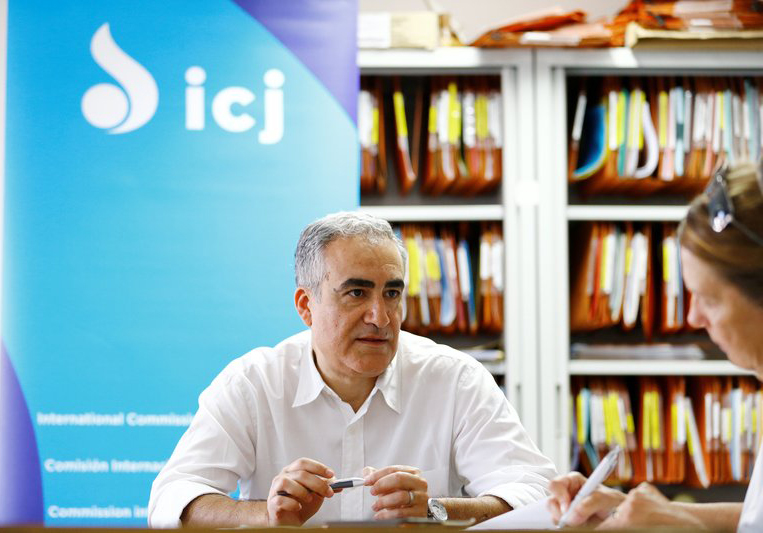
An interview of ICJ Secretary General Sam Zarifi with Reuters journalist Stephanie Nebehay.
GENEVA (Reuters) – Donald Trump is one of a new breed of leaders around the world who seek to use their democratic mandate to undermine the rule of law, the head of a legal and human rights watchdog said on Wednesday.
Branding the U.S. president an “authoritarian populist”, Saman Zia-Zarifi, secretary-general of the Geneva-based International Commission of Jurists (ICJ), compared him to the leaders of Turkey, the Philippines, Hungary and Venezuela.
Zarifi cited as an example Trump’s travel ban on nationals from six Muslim-majority countries, a policy that he called “highly problematic” under the U.S. constitution and international law.
“What is different now is that a certain kind of populism is being used to actually counter the notion of the rule of law,” Zarifi said in an interview at the headquarters of the ICJ, which is composed of 60 eminent judges and lawyers from all regions who seek to protect human rights and the rule of law.
“The new populism has a certain shamelessness about it that is new. It’s not that people are denying that they are violating rights, what they are saying is they can violate rights because somehow they are empowered by the people,” he said.
Zarifi, who took over at the ICJ in April, said the new breed of populists included Turkey’s President Tayyip Erdogan, Venezuela’s Nicolas Maduro, the Philippines’ Rodrigo Duterte, Hungary’s Prime Minister Viktor Orban and Jaroslaw Kaczynski, head of Poland’s ruling party.
“I would say that in the U.S., Trump is an authoritarian populist. He has authoritarian tendencies but he still is facing checks and balances,” Zarifi said. “So he is not a full-blown authoritarian figure.”
The U.S. Supreme Court revised parts of Trump’s executive order banning travellers from Iran, Libya, Somalia, Sudan, Syria and Yemen, a policy Trump says is aimed at tackling terrorism.
“Looking at it again from the point of view of U.S. law – I’m an American lawyer – it seems highly problematic,” said the Iranian-born Zarifi, who moved to the United States as a teenager and holds a law degree from Cornell University.
Supreme Court rulings would be, he said, “a test for the health of the system of checks and balances in the U.S.”
Turkish Judiciary “Politically Compromised”
A crackdown by Erdogan’s government has led to the arrest of 50,000 people and the suspension of 150,000 in the year since a failed military coup in Turkey where the judiciary is “now politically compromised”, Zarifi said.
The Turkish government has said the action is justified by the gravity of the threat to the state from the coup attempt.
On Monday, the state prosecutor asked a court to remand the local Amnesty International director and nine other activists in custody pending trial for membership of a terrorist organisation.
Erdogan was quoted by Turkish media this month as saying they were detained on the basis of intelligence and that the judiciary would make its own decision.
But Zarifi said the judiciary should have thrown the case out.
“The handling of the case highlights the very serious concerns – and alarm in fact at this point – that we have raised about the independence of the judiciary and the legal system in Turkey over the last few years.”
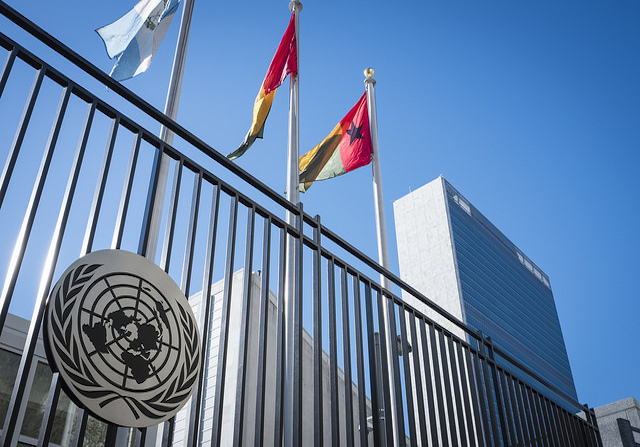
Photo Credit: Reuters / Pierre Albouy
Jul 19, 2017
ICJ has joined other leading NGOs in calling on the UN to ensure its NGO Committee fulfils its duties of constructive dialogue with NGOs, after the Committee has failed to convene regular meetings with NGOs as required by its mandate.
Civil society has long held concern that certain political dynamics and working methods of the NGO Committee, including lack of transparency and dialogue, are serving more to obstruct rather than facilitate civil society engagement with the UN, particularly on human rights issues.
The letter therefore begins by welcoming the recent decision of the NGO Committee’s superior body, the ECOSOC, requiring the Committee to webcast its sessions.
As a next step towards improving the situation, the letter notes that the resolution that provides the mandate for the NGO Committee (ECOSOC resolution 1996/31), provides that the NGO Committee is ‘responsible for regular monitoring of the evolving relationship between NGOs and the UN’. The resolution specifically requires that the Committee ‘shall hold’ meetings with accredited NGOs before each of its sessions and at other times as necessary, to discuss ‘questions of interest to the Committee or to the organizations related to the relationship between NGOs and the United Nations.’ The resolution specifies that a report on such consultations is to be transmitted to ECOSOC for appropriate action.
As far as is known to the NGOs, no such meetings have been held, in recent years.
The letter affirms that regular meetings between the Committee and accredited NGOs are essential to build a more constructive relationship between the Committee (as well as the ECOSOC) and NGOs. They could help to address the wide range of challenges faced by NGOs in engaging with the UN.
The letter emphasises that, in the absence of formal opportunities to engage with the Committee, including during the meetings envisaged in resolution 1996/31, on issues of general concern, NGOs have sought to address the NGO Committee briefly at the start of Committee sessions. However, on the two most recent occasions these attempts have been rejected. The letter underlines that the Committee’s refusal to engage with NGOs on general topics of concern is in contradiction to its responsibilities outlined in resolution 1996/31.
Affirming ECOSOC’s duty to ensure that the Committee fulfils its responsibilities fully and effectively, the NGOs therefore request that the ECOSOC remind the NGO Committee of its responsibility to convene at least one meeting with NGOs before each session, beginning with its next session in January 2018.
The full letter may be downloaded in PDF format here: UN-OpenLetter-ECOSOC-NGOCommittee-2017
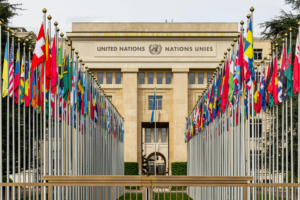
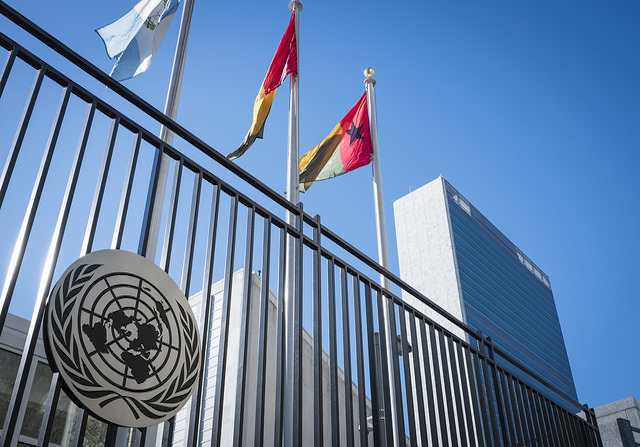
(photo credit: UN Photo/Manuel Elias, 20 April 2016, creative commons licence, https://www.flickr.com/photos/un_photo/26772166976)
Jun 30, 2017 | Advocacy
A Joint NGO Statement was issued on the occasion of the Twenty-ninth meeting of UN treaty body chairs 27-30 June 2017, New York
This statement includes some reflections and recommendations, by the undersigned organisations (see list on p.6-7), in relation to the programme of work for the 2017 annual meeting.
Some of the comments and recommendations stem from a two-day consultation involving representatives of NGOs, States, treaty body members, OHCHR and academics, which took place in Geneva on 23-24 May 20171.
The consultation focused on developing a strategy for the Treaty Body strengthening process.
A report will shortly be made public.
The comments and recommendations below are structured around the substantive treaty body chairs meeting agenda items.
Universal-MeetingTreatyBodies-Advocacy-2017-ENG (full text in PDF)
Jun 28, 2017
NGOs, including the ICJ, have sent an open letter to the OHCHR Petitions Unit and Treaty Bodies chairs on threats and assaults against Treaty Body petitioners.
The purpose of this letter is to encourage Treaty Bodies to proactively request that State parties adopt protection measures in cases of reprisals against Treaty Body petitioners, and seek follow-up to those measures by OHCHR field presences.
Universal-ReprisalsTreatyBodies-Advocacy-OpenLetter-2017-ENG (full text in PDF)
Jun 28, 2017 | Advocacy, Non-legal submissions
The ICJ has joined other leading human rights NGOs in setting out a range of specific measures to increase the effectiveness of UN Special Procedures – independent experts appointed by the Human Rights Council to address particular themes or countries.
The written submission was made in the context of the Annual Meeting of the Special Procedures, in Geneva.
Coordinated by the International Service for Human Rights (ISHR), the document assesses current practices against a range of recommendations made in an earlier joint civil society submission in 2016.
The 2017 submission welcomes progress on a number of the recommendations, but also highlights issues where little or no progress has been made. It also offers several new recommendations.
Among the positive developments are the enhanced role of the Coordination Committee, action taken to combat reprisals, the creation of a database where details of individual communications (i.e. complaints) can be accessed, and engagement of Special Procedures with international and regional forums.
The full 2017 submission, entitled “The Special Procedures: Developments in Institutional Strengthening and Working Methods”, can be downloaded in PDF format here: UN-Submission-AnnualMeetingSpecialProcedures-2017