Nov 25, 2013 | Agendas, Events
This is the title of a book to be launched on Monday 2 December at the UN in Geneva, in partnership with the Permanent Mission of Ecuador, and the ICJ.
Do the ‘Respect, Protect, and Remedy Framework and the Guiding Principles on Business and Human Rights adequately address the challenges concerning the human rights obligations of business?
This book engages critically with these important developments. The chapters in the book revolve around four key issues: the process and methodology adopted; the source and justification of corporate human rights obligations; the nature and extent of such obligations; and the implementation and enforcement thereof.
In addition to highlighting several shortcomings of the Framework and the Guiding Principles, the contributing authors also outline a vision for the twenty first century in which companies have obligations to society that go beyond the responsibility to respect human rights.
Ian Seiderman, ICJ’s Legal and Policy Director, will be one of the discussants.
Invitation UNOG Business-event-2013 (full text in pdf)

Nov 11, 2013
The ICJ today submitted to the UN its recommendations for a draft set of “Basic Principles and Guidelines” on the right of anyone deprived of liberty to challenge the lawfulness of his or her detention, and the right of victims of arbitrary or unlawful detention to an effective remedy.
The United Nations Working Group on Arbitrary Detention, which will meet in Geneva 13 to 22 November 2013, was requested last year by the Human Rights Council to prepare the draft “Principles and Guidelines” before the end of 2015. The ICJ submission responds to a call by the Working Group for input to the drafting process.
Among the key aspects highlighted by the ICJ submissions are:
- the elements of an effective remedy for unlawful or arbitrary deprivation of liberty;
- the requirement that anyone deprived of liberty for any reason have access to a proper court to seek release;
- the broad grounds such courts must consider in determining whether the detention is lawful;
- the requirement that the proceedings lead to a prompt decision that is actually implemented by the detaining authorities;
- the right of the detainee to have confidential access to a lawyer of his or her choosing, promptly after arrest or detention;
- the right of the detainee to be present for the proceedings;
- necessary guarantees for the fairness of such proceedings, including that the person and his or her lawyer have access to the evidence and allegations on which the detention is based;
- the right to challenge the lawfulness of detention continues to apply in situations of emergency.
UN-ICJ-WGAD68-SubmissionHabeas-advocacy-non-legal submission-2013 (full text in pdf)

Nov 7, 2013 | Events, News
The ICJ addressed the 15th Meeting of the European Network of Contact Points for investigation and prosecution of genocide, crimes against humanity and war crimes.
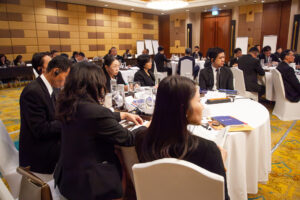
The meeting, which took place in the Hague, had a focus on criminal responsibility of corporations and business persons for serious international crimes and congregated a number of European public prosecutors and investigators.
In its presentation, Carlos Lopez, Senior Legal Adviser at ICJ, addressed ways to overcome difficulties in prosecuting business corporations.
He focused on three cases that are among the ones most advanced in the investigation and prosecution stage of business corporations for crimes under international law: the Riwal/Lima Holding, the Amesys and the Lundin Petroleum cases.
They illustrate the acute dilemmas that public prosecutors are likely to face in these kind of cases and how difficult to solve them it may be.
The full ICJ presentation and the agenda of the meeting can be downloaded in pdf format below.
The Hague Meeting-Prosecuting corporations-Presentation-analysis brief-2013
The Hague Meeting-Prosecuting corporations-Agenda-2013

Nov 5, 2013 | Advocacy, Non-legal submissions
The ICJ has called on States that are candidates for membership to the UN Human Rights Council to do more to respect human rights at home and at the international level.
On 12 November, the United Nations General Assembly will elect 14 new members to the Human Rights Council.
The ICJ added its name to a joint letter, delivered by International Service for Human Rights on behalf of 40 NGOs from all regions of the world, emphasising the need for candidate states to uphold the highest standards of respect for human rights, the fullest cooperation with the Human Rights Council, and to refrain from impeding the access of individuals and civil society to international human rights mechanisms.
HRC-GAElections-JointNGOLetter-NonLegalSubmission-2013 (download joint open letter in PDF)

Oct 29, 2013 | News
The ICJ welcomes the report of the UN Special Rapporteur on the independence of judges and lawyers presented to the UN General Assembly today.
The report calls for the adoption by the Human Rights Council of the draft principles governing the administration of justice through military tribunals, known as the ‘Decaux Principles’.
“This is a major step forward towards the establishment of universally applicable minimum standards to regulate the use and operation of military courts and tribunals”, said Alex Conte, Director of the ICJ’s International Law and Protection Programmes.
“The investigation and prosecution of alleged offences involving serious human rights violations is in many countries undertaken by military courts for the purpose of avoiding the accountability of perpetrators of such acts. It is therefore significant that the UN Special Rapporteur has reaffirmed that the jurisdiction of ordinary courts should prevail in such cases,” he added.
“It is also important that the Special Rapporteur has reiterated the recommendation of many human rights experts that the trial of civilians in military courts should in principle not occur and should be limited to strictly exceptional cases,” Conte further said.
The ICJ closely followed and contributed to the development of the Decaux Principles and has repeatedly called for their adoption and implementation by all States.
These principles were elaborated in 2006 in consultation with human rights experts, jurists and military personnel from throughout the world, and include specific provisions relating to the establishment and functioning of military tribunals.
They are based on the principle that military justice should be an integral part of the normal judicial system and should operate in a way that guarantees full compliance with human rights, including the need to ensure accountability for perpetrators of human rights violations.
Contact:
Alex Conte, ICJ International Law and Protection Programmes Director (Geneva), t: +41 79 957 2733; email: alex.conte(a)icj.org