May 25, 2021 | News
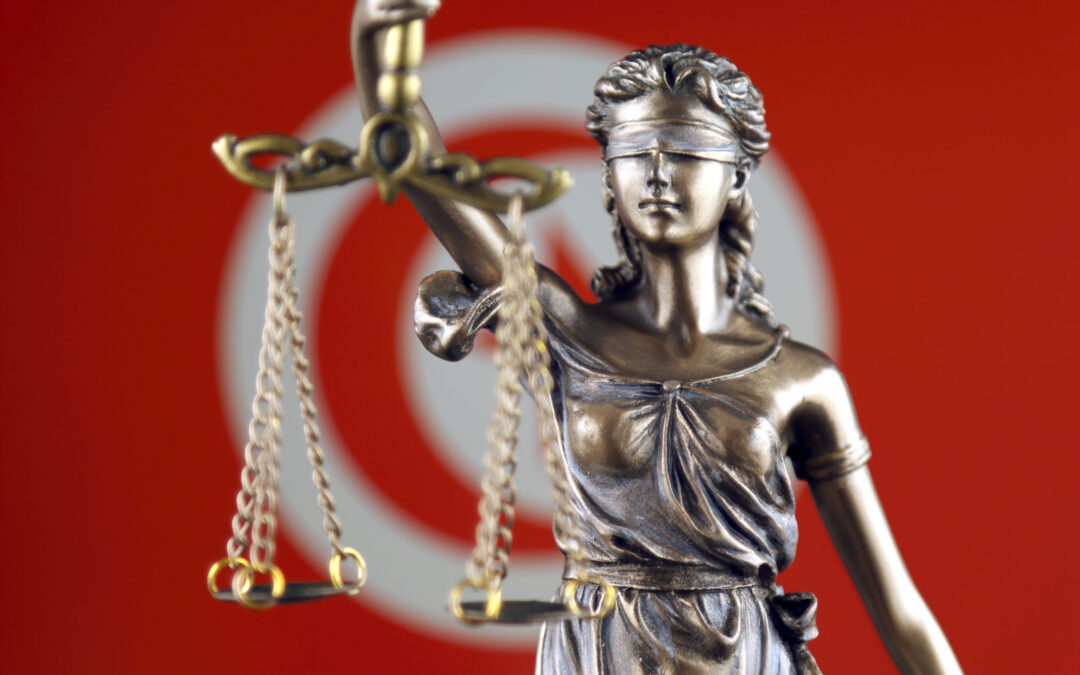
As the third anniversary of the opening of trials before Tunisia’s Specialized Criminal Chambers (SCC) is approaching, the ICJ denounces the Tunisian authorities’ failure to adopt reforms necessary to advance accountability and justice for victims of gross human rights violations.
هذا البيان الصحفي متوفر باللغة العربية أيضاً
Trials before the SCC started on 29 May 2018. Since that first hearing, evident gaps and shortcomings in the Tunisian Criminal Code, the Code of Criminal Procedure and the Transitional Justice law have undermined efforts to hold perpetrators to account, bring justice to victims and prevent recurrence of gross human rights violations in the future.
“The Tunisian authorities have abdicated their responsibility to ensure the effective functioning of the SCC, depriving judges of basic tools to ensure that trials are conducted without undue delay and consistent with international fair trial standards,” said Said Benarbia, the ICJ’s MENA Programme Director.
Many offences referred by the Truth and Dignity Commission to the SCC are not adequately defined in the Tunisian law. Judicial rotation occurs mid-way through SCC trials, impacting the continuity of trials. Prosecutors are not effectively engaged in the conduct of trials. Accused are absent in most of the SCC trials, and the transitional justice framework does not provide for appeal chambers.
“By failing to address these obstacles, the Tunisian authorities are undermining the right of victims to truth and to effective remedies, and betraying the very promise of the transitional justice process to end impunity,” added Benarbia.” It’s high time for them to reverse course and live up to that promise.”
Background information
The ICJ has recommended reform to ensure the compliance of SCC proceedings with international law and standards, including through:
- Ensuring the adequate criminalization of gross human rights violations amounting to crimes under international law;
- Fully ensuring the rights of the accused to a fair trial;
- Ensuring the rights of victims, including their families, to an effective remedy and reparation;
- Ensuring the protection of victims and witnesses;
- Ensuring that the collection, admissibility and assessment of evidence guarantee the right of the accused to a fair trial and the victims’ right to an effective remedy.
In addition to the above reforms, the Tunisian authorities should remove all obstacles preventing the SCC and other judicial authorities from exercising their function in a manner that complies with international standards. To this end, the authorities should:
- Ensure that the Office of the Public Prosecutor and other investigative authorities carry out their mandate in an independent and impartial manner, as defined under the Code of Criminal Procedure;
- Ensure that the annual judicial rotation, as regulated by Organic Law No. 34 on the High Judicial Council, be consistent with the right of the accused to a fair trial
- Ensure that newly appointed SCC judges and prosecutors receive timely and adequate training in transitional justice as provided for by Organic Law No. 53 on Establishing and Organizing Transitional Justice;
- Ensure that, if the annual judicial rotation occurs mid-way through trials, safeguards be implemented with the view to ensuring that newly appointed judges hearing the case have the appropriate understanding of the evidence and arguments.
These recommendations are informed by the ICJ Practical Guide Series on Accountability Through the Specialized Criminal Chambers and findings on the role of international law and standards in proceedings before the SCC (Practical Guide 1), the investigation and prosecution of gross human rights violations under Tunisian and international law (Practical Guide 2), and the application of principles and best practices on evidence in the administration of justice before the SCC (Practical Guide 3).
The SCC were established in 2014 to adjudicate cases involving alleged “gross human rights violations” perpetrated between 1955 and 2013 and referred by the Truth and Dignity Commission (Instance Verité et Dignité, IVD) to the SCC.
At the end of its mandate in December 2018, the IVD’s referred to the SCC 200 cases of arbitrary deprivations of life, arbitrary deprivations of liberty, torture and other ill-treatment, enforced disappearance, rape and sexual assault and crimes against humanity committed by the former government.
In a briefing paper published in October 2020, the ICJ called on the Tunisian authorities to undertake substantial legal and policy reforms with a view to strengthening accountability and removing all obstacles preventing the SCC from functioning effectively.
Download this press release in PDF form here.
Contact:
Said Benarbia, Director, ICJ Middle East and North Africa Programme, t: +41-22-979-3817; e: said.benarbia(a)icj.org
Valentina Cadelo, Legal Adviser, ICJ Middle East and North Africa Programme, e: valentina.cadelo(a)icj.org
Asser Khattab, Research and Communications’ Officer, ICJ Middle East and North Africa Programme, e: asser.khattab(a)icj.org
May 11, 2021 | News
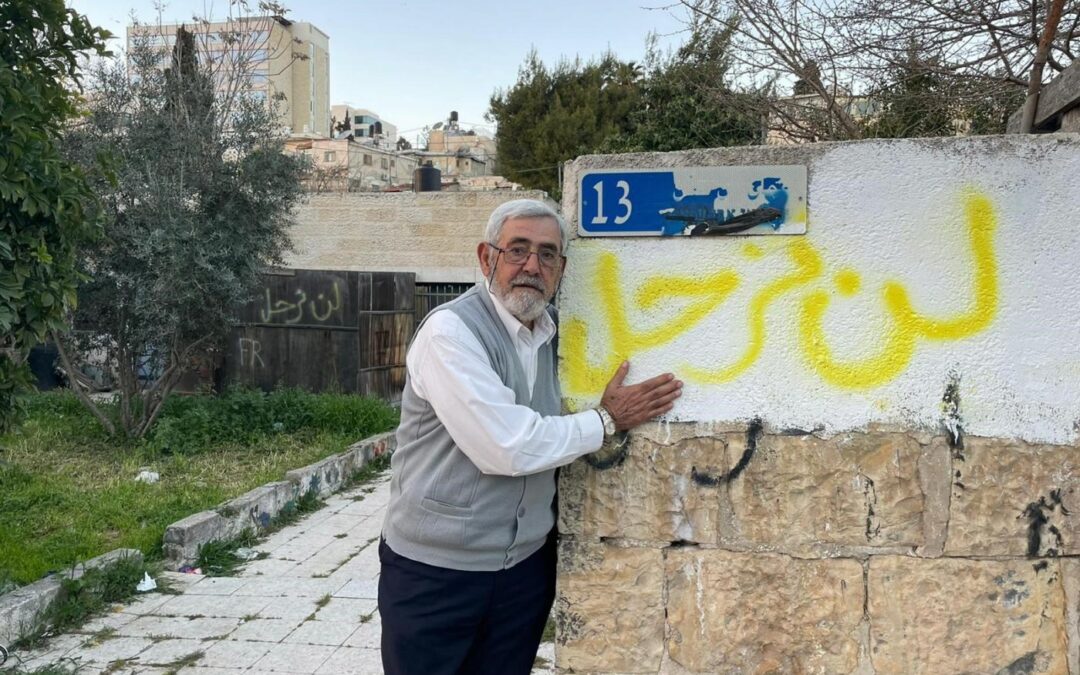
The International Criminal Court (ICC) must immediately investigate the forced eviction of Palestinian families and residents in Sheikh Jarrah and other neighbourhoods in East Jerusalem, as well as any indiscriminate and disproportionate attacks against civilians in the Gaza Strip, the ICJ said today.
The investigation must establish whether any serious violation of international humanitarian law, such as indiscriminate or disproportionate attacks against civilians, the forced deportation of Palestinians and the transfer of Israeli settlers into occupied East Jerusalem, as well as the extensive destruction and appropriation of property, have taken place in Sheikh Jarrah and in Gaza. Following the opening of an investigation by the ICC Office of the Prosecutor, if warranted, Israeli officials should be prosecuted for such crimes to ensure accountability. As confirmed by the ICC Pre-Trial Chamber I, the Court’s territorial jurisdiction “extends to the territories occupied by Israel since 1967, namely Gaza and the West Bank, including East Jerusalem.”
Evictions against Palestinians in Sheikh Jarrah were ordered by the Jerusalem District Court following legal proceedings initiated by Israeli settlers organizations under Israeli law. The Supreme Court was due to rule on 10 May 2021 on challenges against evictions brought by Palestinian families, yet, it decided to postpone the hearing at the request of Israel’s Attorney-General.
“Evictions in Sheikh Jarrah are part of a cynical campaign by the Israeli authorities to purge occupied East Jerusalem from its Palestinian civilian population,” said Said Benarbia, the ICJ MENA Director.
The ICC must also ensure accountability for unlawful attacks targeting civilians and civilian objects in connection to the hostilities between Israel and Palestinian armed groups in Gaza. Since 2007, Israel has imposed a full closure on Gaza, which has resulted in a major humanitarian crisis, and has led to significant escalation of hostilities in 2008-09, 2012 and 2014, where thousands of Palestinians have been killed and injured. On 10 May 2021, Hamas started firing rockets against Israel following a crackdown on Palestinian worshippers in the al Aqsa compound in Jerusalem. In response, Israel has carried out multiple airstrikes in Gaza, which have reportedly caused the death of at least 24 people, including nine children. All parties to the conflict are prohibited from conducting indiscriminate and disproportionate attacks, which may amount to war crimes under the Rome Statute.
“The ICC must ensure that all those responsible for ordering and carrying out these attacks be held criminally accountable,” Benarbia added.
Since April 2021, Palestinians peacefully demonstrating against the evictions in Sheikh Jarrah, a decades-long legal battle, have been subjected to violence by Israeli settlers and Israeli security forces. Earlier this year, the Jerusalem District Court ordered that several Palestinian families be evicted from the neighborhood. According the UN Office of the High Commissioner for Human Rights, “at least 218 Palestinian households in East Jerusalem, including the families in Sheikh Jarrah, have eviction cases filed against them”, and overall “970 people, including 424 children, [are] at risk of displacement.”
As part of the Israeli crackdown on Palestinians, Israeli security forces have also been firing tear gas and employing other less-lethal weapons against people praying at the Al Aqsa mosque in Jerusalem purportedly in crowd-control operations. According to the Palestinian Red Crescent, more than 200 demonstrators have been injured as a result of the use of such less-lethal weapons.
Israeli forces have also been preventing gatherings of Palestinians at Damascus Gate in East Jerusalem during the night hours of the month of Ramadan when many Muslims gather for prayer and breaking of the fast at sunset, and have responded with excessive force to the ensuing demonstrations.
Israel has a duty to respect the right to peaceful assembly and freedom of religion of Palestinians in East Jerusalem. Israel’s use of excessive force against Palestinian demonstrators and the crackdown on Palestinian worshippers violate its obligations under international human rights law
“Israeli authorities must respect and ensure the right of Palestinians to protest and challenge decades of prolonged unlawful occupation and related abusive practices, and immediately end the use of disproportionate and unlawful force to disperse protesters”, Benarbia said.
Contact
Said Benarbia, Director, ICJ Middle East and North Africa Programme, t: +41-22-979-3817; e: said.benarbia(a)icj.org
Asser Khattab, Research and Communications Officer, ICJ Middle East and North Africa Programme, e: asser.khattab(a)icj.org
You can read this press release in Arabic here or download a PDF version of it in English here.

Mar 22, 2021 | Advocacy, Non-legal submissions
The ICJ joined today seven other organisation in a statement before the UN Human Rights Council expressing concern at the systematic human rights violation and the persistent impunity in the Philippines and calling for more accountability.
The joint statement delivered by FORUM ASIA reads as follows:
“Madam President,
Nearly six months since its adoption, Human Rights Council resolution 45/33 offering technical assistance to the Philippines has proven to be utterly insufficient to address the systematic human rights violations and persistent impunity documented in the High Commissioner’s report. The Philippine Government’s policies and actions since the Resolution’s adoption have been completely at odds with the commitments outlined in it.
Extrajudicial killings in the so-called ‘war on drugs’ have continued. To date, the Government has made no tangible progress towards accountability against those most responsible for such killings. In December 2020, the Office of the Prosecutor of the ICC found that there is “reasonable basis to believe that the crimes against humanity” of murder, torture, the infliction of serious physical injury and mental harm, and other inhumane acts were committed between at least 1 July 2016 and 16 March 2019.
Human rights defenders pursuing legitimate work, especially those who advocate for international accountability, including lawyers, continue to be attacked and accused of belonging to terrorist groups. Rights defenders continue to be arrested and jailed. The draconian Anti-terrorism Act, passed last year, exacerbates risks to defenders. The killing of nine human rights defenders and activists on 7 March, two days after President Duterte ordered the police and military to “finish off” and “kill” those purported to be “communist rebels”, illustrates clearly the persistent killings and attacks faced by activists and defenders. It is very clear that no amount of technical assistance or capacity building will end the killings as the President and top government officials continue to incite murder and violence as official policy.
In this context, it is imperative that the Council set up an international accountability mechanism to end the cycle of violence and impunity in the Philippines.
Thank you.”
The statement was endorsed by:
- Amnesty International
- Asian Forum for Human Rights and Development (FORUM-ASIA)
- CIVICUS: World Alliance for Citizen Participation
- Human Rigths Watch
- International Commission of Jurists (ICJ)
- International Federation for Human Rights (FIDH)
- Philippines Alliance of Human Rights Advocates (PAHRA)
- World Organisation Against Torture (OMCT)
Contact:
Massimo Frigo, ICJ UN Representative, e: massimo.frigo(a)icj.org, t: +41797499949
Mar 19, 2021 | Advocacy, News
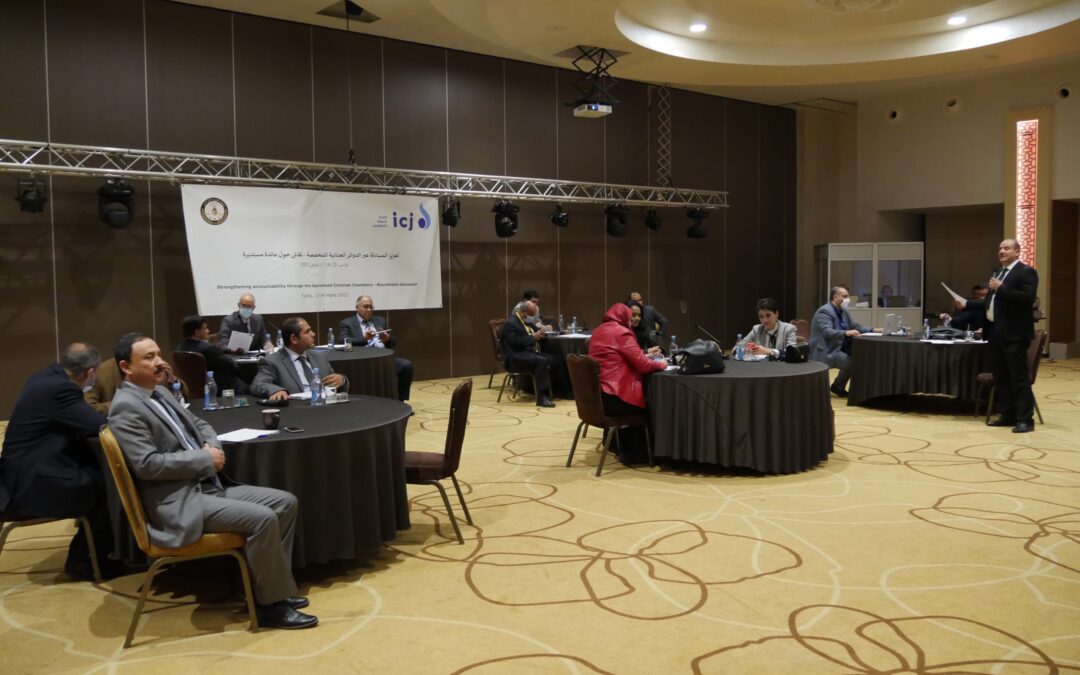
On 13 and 14 March 2021, the ICJ and the Association of Tunisian Magistrates (AMT) organized a roundtable discussion in Tunis to assist Specialized Criminal Chambers (SCC) judges and prosecutors to advance accountability and justice in line with international law and standards.
Participants discussed in-depth the ongoing challenges to the fair and effective prosecution and adjudication of gross human rights violations before the SCC. They also examined joint approaches to address these challenges with a view to enhancing the fairness and effectiveness of the SCC proceedings and achieving accountability in turn.
At the roundtable, Said Benarbia, ICJ’s MENA ProgrammeDirector, underlined that SCC trials should enable victims to obtain redress and reparation, while ensuring the defendants’ right to a fair trial in compliance with Tunisia’s obligations under international law. Anas Hmedi, the President of the AMT, highlighted the key role that the SCC play in relation to the discovery of the truth, accountability and guarantees of non-recurrence of gross human rights violations in Tunisia.
Martine Comte, ICJ France Commissioner,stressed the importance of finding joint approaches and reinforcing coordination among the SCC to address the various challenges that that they are currently facing. Kalthoum Kennou, ICJ Tunisia Commissioner, called for the development ofjoint approaches to ensure victims’ participation at SCC trials and enhance support for the transitional justice process.
In light of the roundtable discussion, participants identified joint solutions and agreed to develop a set of recommendations targeting the High Judicial Council and its role in supporting the SCC and resolving the practical obstacles that might impede their work.
The roundtable is part of the ICJ’s efforts to enhance the SCC’s capacity to adjudicate the cases referred to them by the Truth and Dignity Commission (IVD) in a manner consistent with international law and standards.
Contact
Valentina Cadelo, Legal Adviser, ICJ Middle East and North Africa Programme, e: valentina.cadelo(a)icj.org
Asser Khattab, Research and Communications’ Officer, ICJ Middle East and North Africa Programme, e: asser.khattab(a)icj.org
Mar 16, 2021 | Advocacy, Non-legal submissions
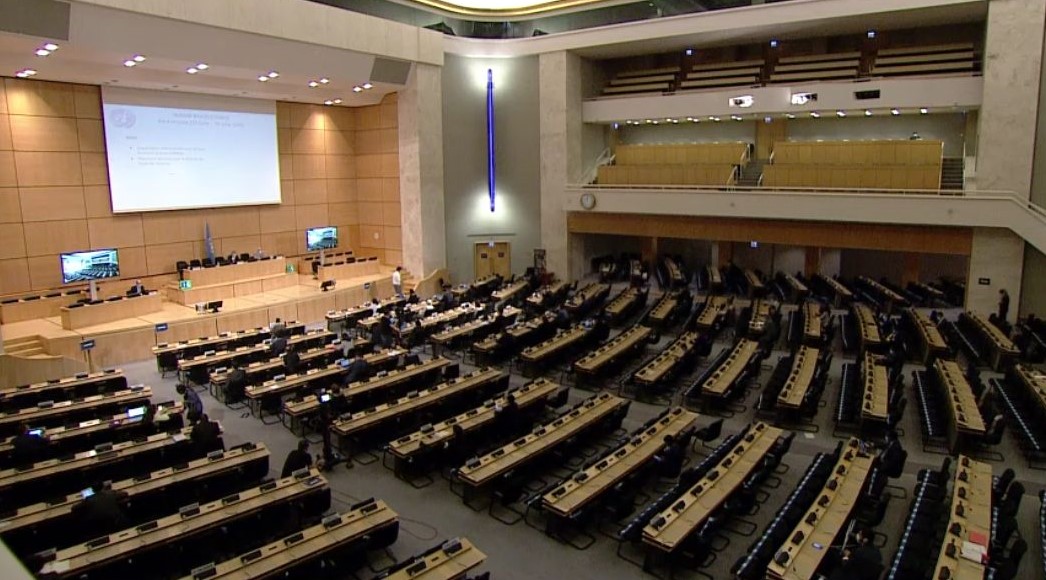
Today, during a debate on the outcome of the Universal Periodic Review of Libya, the ICJ called on Lybian authorities to bring the country’s criminal legislation in line with international law, in particular by defining clearly crimes under international law.
The statement reads as follows:
“Madame President,
The International Commission of Jurists (ICJ) welcomes Libya’s acceptance of the recommendation to cooperate fully with the Independent Fact-Finding Mission on Libya and ensure that it has unfettered access throughout the country’s territory (148.7-8, 148.11-17).
The ICJ regrets that Libya has only taken note of – as opposed to accepting ‒ Estonia’s recommendation (148.80) to bring the Penal Code in line with international standards, and Libya’s rejection of Zambia’s recommendation (148.70) to define crimes under international law in Libya’s domestic legal system clearly.
Libyan domestic law fails to criminalize: arbitrary deprivation of life; torture and other ill-treatment; enforced disappearance; rape and other forms of sexual and gender-based violence; slavery; war crimes; and crimes against humanity, in line with international law and standards.
The ICJ further welcomes Libya’s acceptance of the recommendations (148.144-146, 148-149, 151-161, 165-166) to investigate effectively crimes under international law and bring perpetrators to justice.
The ICJ expresses concern, however, at the prevailing impunity in the country. Crimes under international law are not being effectively investigated and prosecuted, largely because of the absence of political will, inadequate resources, and the frequent threats against justice actors, particularly by armed groups.
The ICJ also regrets that Libya failed to accept the recommendations of: Ukraine (148.25); Costa Rica (148.31); Cyprus (148.32); France (148.33); the Holy See (148.34); Liechtenstein (148.35); Namibia (148.36); Portugal (148.37); Rwanda, Croatia and Slovakia (148.37); Argentina (148.38); Australia (148.39); Honduras (148.40); Iceland (148.41); Italy (148.42); and Latvia (148.43). These recommendations call on Libya to establish a moratorium on executions, and to accede to the Second Optional Protocol to the International Covenant on Civil and Political Rights with a view to abolishing the death penalty. The death penalty constitutes a violation of the right to life and of the absolute prohibition of torture and other cruel, inhuman or degrading treatment or punishment.
I thank you.”
Contact:
Massimo Frigo, ICJ UN Representative, e: massimo.frigo(a)icj.org, t: +41797499949
Vito Todeschini, Legal Adviser, ICJ MENA Programme, e: vito.todeschini(a)icj.org